

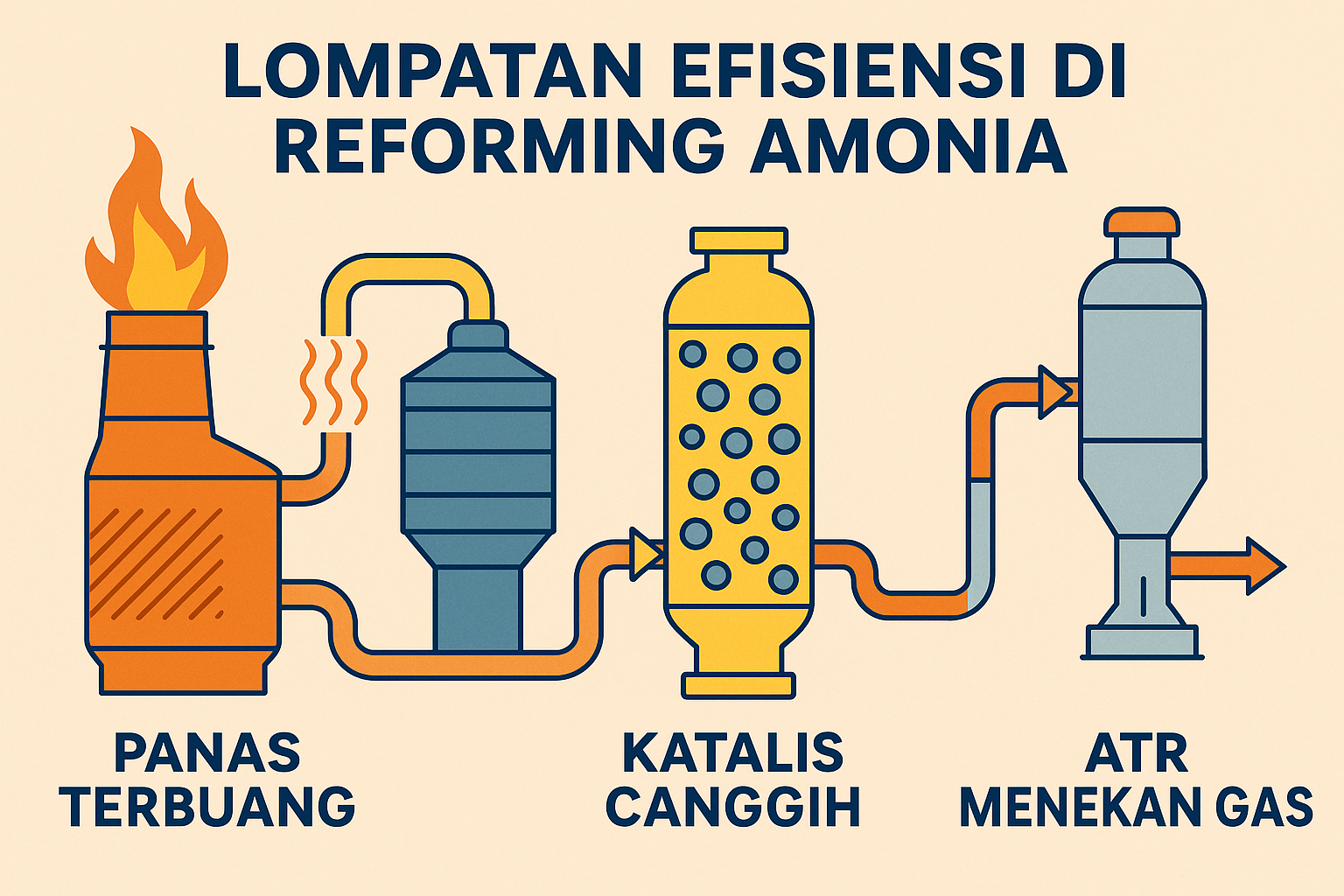
From high‑emissivity coatings to autothermal reformers, ammonia plants are squeezing more heat into chemistry and less out the stack. The payoff: lower fuel use, lower NOx, and regulatory tailwinds.
Industry: Fertilizer_(Ammonia_&_Urea) | Process: Natural_Gas_Reforming
Industrial ammonia—and the urea that often follows it—still runs on fossil methane. The two‑step heart of the process is a fired primary steam methane reformer (SMR, an endothermic reactor that converts CH₄ with steam) and an air‑fired secondary reformer (ATR/POX, an exothermic stage that finishes conversion and sets H₂/N₂). These units dominate site energy. Average natural‑gas‑based plants consume ≈36–37 GJ per tonne of ammonia (t‑NH₃, net), while best performers use ~28–33 GJ/t; best available techniques aim ~28 GJ/t (≈25% below average) (all per iipinetwork.org).
The route to that 25% gap is a mix of smarter heat transfer, catalysts that tolerate lower temperature or lower steam‑to‑carbon ratio (S/C), and unrelenting flue‑gas heat recovery. Each move adds up—often to millions of dollars a year at scale.
Primary reformer furnace efficiency
Modern SMRs deliver only 45–60% of the fuel’s heat via radiant transfer to catalyst tubes; the rest rides out with flue gas, of which ~35–50% is typically recaptured in the convection section to preheat feeds and generate steam (integratedglobal.com).
One low‑disruption upgrade: high‑emissivity ceramic refractory coatings. Applied to the radiant box, these coatings lower stack temperature and save fuel—real‑world results show ≈1–5% fuel savings or capacity gains, including a documented ~2% fuel reduction with ~9% NOx reduction (integratedglobal.com; integratedglobal.com). Lower flue temperature also cuts thermal NOx by ≈20–30%, and payback often lands around one year (integratedglobal.com).
Burner tuning and insulation matter too. Lower O₂ excess, proper staging, tight door seals, and uniform tube loading push radiant efficiency toward ~60% (integratedglobal.com; integratedglobal.com).
Convection sections foul. Online cleaning—abrasives or sootblowers—can immediately restore ~1–3% efficiency and recover 0.5–2% extra steam output without shutdown (integratedglobal.com; integratedglobal.com). On the water/steam side, ancillary equipment such as a demineralizer is commonly paired with high‑pressure circuits to protect heat‑recovery surfaces.
Catalyst swaps add another lever. Nickel‑based SMR catalysts with improved geometry and promoters keep CH₄ slip low at lower duty. Clariant’s ReforMax LDP Plus, with an eight‑hole shape, reduces pressure drop by ~20%, allowing ~11% higher gas throughput without a temperature rise—or lower recycle compression for energy savings—while maintaining activity (and cooler tube walls that help tube life) (digitalrefining.com; digitalrefining.com). These catalysts still run around ~800–900°C; truly low‑temperature SMR catalysts remain largely experimental (pubs.acs.org).
Stack the measures and the gains add up. A 2–5% thermal improvement (for instance, lifting radiant efficiency from 60% to ~63%) is realistic: case studies show ~2% fuel cuts from coatings, with 1–5% throughput uplifts from combined heat‑transfer and catalyst upgrades—worth roughly 0.5–1.5 GJ/t‑NH₃ in practice (integratedglobal.com; integratedglobal.com).
Secondary reforming and autothermal options
Conventional SMR+secondary reformer trains run high S/C (≈2.5–3) to drive conversion and avoid coke (ammoniaenergy.org). New autothermal reformers (ATR, which combine combustion and reforming in one vessel) target much lower S/C. Topsoe’s SynCOR ATR runs around S/C≈0.6 (vs ~3.0 for SMR+ATR), slashing steam volume and boiler load by ~80%—but with an air separation unit (ASU) and higher capex that pencil out at large scales (≥1 Mtpa NH₃) (ammoniaenergy.org; ammoniaenergy.org).
Autothermal designs typically run at 30–40 bar—similar to SMRs—which saves footprint and eases CO₂ capture, while slightly lowering equilibrium conversion (ammoniaenergy.org). Compared with older two‑step reforming, ATR/POX can cut fuel use by ~5–10% for the same H₂ output, depending on CO₂ capture targets (ammoniaenergy.org).
Case in point: CF Industries’ 4,000 t/d plant will deploy Topsoe SynCOR ATR at S/C≈0.6 to minimize gas use; at >6,000 t/d, Air Liquide/KBR favor an ATR‑based high‑pressure design (ammoniaenergy.org; ammoniaenergy.org).
Even without a full ATR, catalytic partial oxidation (CPOX) in the secondary stage can run at ~800–900°C instead of >1200°C. Suppliers from Air Products to Air Liquide, Casale, and Shell have ATR/POX references; Casale’s HyPOX uses a water‑cooled coal‑burner with ~30 bar output (ammoniaenergy.org; ammoniaenergy.org). High‑temperature ATR/POX also yields very low CH₄ slip; Linde/Air Liquide report near‑zero methane slip, reducing purge losses (ammoniaenergy.org). Some designs add cryogenic or N₂ wash to strip inerts without losing NH₃.
Reliability counts: modern burners—Johnson Matthey’s long‑neck nozzle or Casale’s water‑cooled lance—are engineered for long life; Johnson Matthey reports >27 years in air‑fired secondary reformers (ammoniaenergy.org).
Advanced catalysts targeting lower duty
Lab‑scale catalysts hint at bigger leaps. Ni–CeO₂–Al₂O₃ nanocluster catalysts begin converting CH₄ at ~400°C and show high turnover at 500°C; the best achieved near‑100% CH₄ conversion with H₂ yield ≈3× CH₄ at 500°C, stable over 8 hours (pubs.acs.org). If scaled, that could shave 5–10% of furnace fuel duty; for now, commercial SMRs still run ~800–900°C, making these a longer‑term prospect.
Oxygen‑storage supports (e.g., CeO₂, ZrO₂) enable hybrid steam+CO₂ reforming (“bi‑reforming”) and lower S/C. Hierarchical Ni–ZrO₂/Al₂O₃ nanosheet catalysts have reported full conversion at “ultralow” temperatures down to ~520°C under low steam, with trends showing tailored Ni plus alkaline/rare‑earth promoters resist coking at S/C≈1 (pubs.acs.org). Other routes—methane pyrolysis (solid carbon + H₂) or ammonia decomposition—sidestep steam but would overhaul plant flows and remain at R&D or pilot scales.
Bottom line: a catalyst that delivers full reforming 300–400°C lower could cut the endothermic heat by ~15–20%. Even modest gains—better Ni dispersion, alkali promotion—permit safely lower steam ratios, trimming boiler load. Suppliers such as Clariant and Johnson Matthey embed these ideas in new formulations, but real‑world performance data remain limited. Keeping close watch could time retrofits to step‑change results.
Flue‑gas heat recovery and steam integration
Both reformers vent very hot gases—often 500–700°C after the convection bank in the SMR. Without recovery, ≈40–50% of furnace energy goes up the stack. Modern trains stack exchangers and waste‑heat boilers (WHBs) to grab it. In SMRs, 35–50% of fuel heat is reclaimed in the convection section to preheat natural gas and combustion air, generate high‑pressure steam, and superheat feed steam; good designs cool flue gas to ~200–300°C before the stack (integratedglobal.com). Fouled tubes get offline cleaning to restore steam output (integratedglobal.com).
On the secondary side, the ATR/POX section feeds a WHB; in fact, fertilizer “gas‑making” furnace flue can be burned in a boiler to make all reforming steam—achieving steam self‑sufficiency (zbgboiler.com). Air Products’ POX designs place a WHB to maximize steam; “quench” configurations avoid a WHB by injecting high‑pressure water into hot gas but then demand extra upstream steam (ammoniaenergy.org).
Integrated steam systems often run multiple pressure levels—e.g., 100–140 bar, ~480°C HP steam for turbines or reformer service, plus lower pressures—and can capture 75–90% of reformer fuel energy as useful steam or preheat, with remaining stack losses ≈10–20% (integratedglobal.com). Every tonne of steam made from flue gas saves ≈3–4 GJ of fuel otherwise burned in a boiler; cooler final gas also lowers CO and NOx emissions. WHB retrofits commonly pay back in 1–2 years.
Steam‑side housekeeping supports this backbone. Examples include a condensate polisher to protect high‑pressure circuits, a dosing pump for precise chemical feed, and boiler chemistries such as oxygen scavengers or scale inhibitors for reliability. These ancillaries complement the heat‑recovery gains.
Policy context and investment signals
Indonesia’s fertilizer industry is moving toward “green” production. In 2023, the Ministry of Industry issued Permenperin No. 11/2023 to set Green Industry Standards for ammonia and urea plants (peraturan.bpk.go.id). National leadership underscored green/blue ammonia in 2024, citing Pupuk Kaltim and ammonia’s role in the energy transition (ekon.go.id; ekon.go.id). These signals tilt investment cases toward efficiency upgrades that cut fuel per t‑NH₃.
What the savings look like
A 2% SMR fuel saving is about 0.6 GJ/t‑NH₃ (≈0.17 MWh/t) and trims CO₂ by ~2%. Dropping S/C from 3.0 to 0.6 in a 3,000 t/d plant can save tens of MW in steam production. Catalyst and heat‑recovery upgrades in the 5–10% range translate to multi‑million‑dollar annual gains in large plants. The consensus across engineering sources (iipinetwork.org; digitalrefining.com; integratedglobal.com; ammoniaenergy.org; peraturan.bpk.go.id) is clear: targeted reforms in reformers pay off—through lower NG purchase, easier compliance (e.g., CO₂ and NOx), and more ammonia per unit energy.