

Industry: Semiconductor | Process: Specialty_Gas_Delivery
In a modern fab, some of the scariest hazards are invisible. Toxic hydrides, corrosives, and flammables often give workers no visible or odor warning before an accident, so plans have to assume any leak can immediately threaten life and property (Control Global). Arsine (AsH₃) has an ACGIH TLV (threshold limit value, a health‑based airborne limit) of only 5 ppb (parts per billion) (Control Global), while silane (SiH₄) ignites spontaneously on contact with air (Taiwan English News).
Even inert gases like nitrogen or helium can silently displace oxygen and kill without cues—nitrogen, helium, krypton, xenon, all without warning properties (Control Global). That’s why industry guidance emphasizes extensive gas monitoring and automated controls (GasDetection.com) (Fire Engineering).
Hazard detection and automatic shutdown
Leak‑detection sensors—electrochemical, infrared (IR), and other technologies—are placed at likely leak points such as cylinders, valves, tool exhausts, and workspaces; triggered alarms should cut power or shut valves immediately (GasDetection.com) (Fire Engineering). Many fabs use “upstream” fail‑safe logic that closes a gas feed as soon as a detector alarms (Fire Engineering) (Control Global).
Ventilation or deluge systems then purge the area; one study found that properly optimized exhaust flow can prevent a hydrogen gas leak from exploding (MDPI). Responders use appropriate PPE (personal protective equipment), including SCBA (self‑contained breathing apparatus) for toxic gases, and apply inerting agents for reactive leaks, while emergency shutdown procedures stop the source and contain the gas.
Evacuation procedures and accountability (OSHA 1910.38)
Upon any leak alarm, a full site evacuation via pre‑planned routes is initiated. OSHA mandates that emergency plans specify evacuation procedures and exit assignments (OSHA 1910.38). Routes and muster points (upwind of the leak) must be clearly signed and practiced, with designated “sweepers” to check for remaining personnel and “head‑counters” to confirm everyone is at the assembly area.
The plan includes accounting for all employees, visitors, and contractors after an evacuation (OSHA 1910.38). In a 2015 SK Hynix construction incident, roof workers suffocated on leaked nitrogen because they were not evacuated in time—a tragedy robust drills could have prevented (Global Times). OSHA also requires training employees to “assist in a safe and orderly evacuation” (OSHA 1910.38). No re‑entry occurs until gas levels are verified safe and the EHS (environment, health, and safety) team clears the incident.
Authority notification and lines of communication
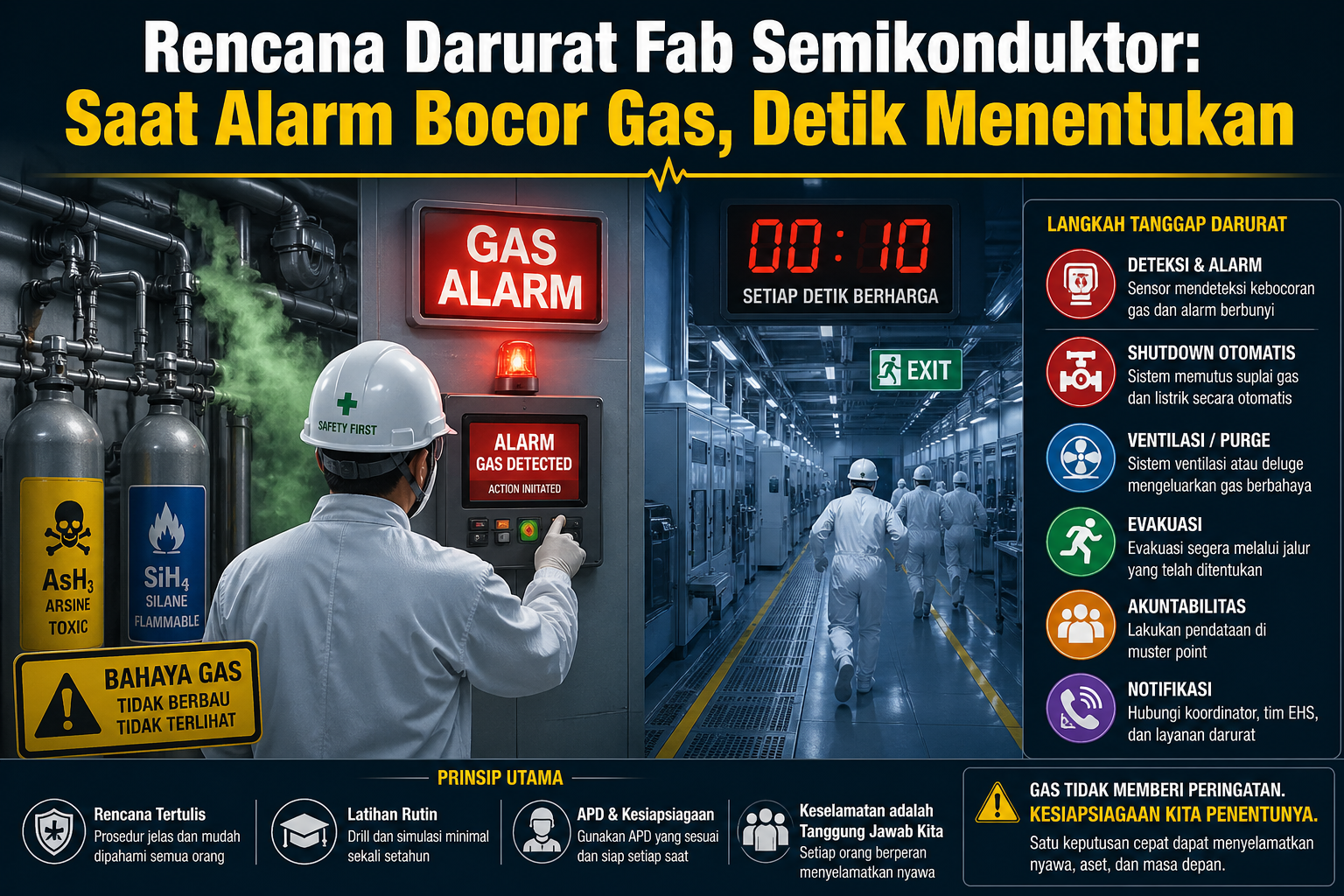
The plan defines who to call and when. Internally, anyone discovering a release immediately notifies the on‑site emergency coordinator; OSHA stresses that all employees who may encounter a release must understand to whom they report it (OSHA guidance). Externally, the coordinator or designated EHS manager contacts local emergency services (fire department/HazMat team, police) and regulatory agencies.
In Indonesia, for example, major chemical leaks are reported to local disaster management (BPBD), environmental authorities (KLHK/BAPEDAL), and the labor inspectorate under B3 regulations (hazardous and toxic substances) as part of a written plan listing exact phone numbers and triggers. Per U.S. PSM (Process Safety Management) standards, the written plan follows 29 CFR 1910.38 and includes procedures for handling even small releases—implying timely notification of fire/rescue and public authorities whenever hazardous gas is uncontained (OSHA 1910.119/1910.120). In practice, this means dialing emergency services immediately for any uncontrolled leak and submitting required incident reports afterward (OSHA guidance).
Training, drills, and measurable readiness
Regular training and exercises cover everyone involved in gas delivery or fabrication. Indonesian B3 regulations explicitly require periodic emergency response training and simulations for anyone involved in hazardous waste management (KLHK B3 emergency training), and annual full‑scale drills at least once per year for any hazardous process (KLHK drill frequency).
Drills simulate realistic gas‑leak scenarios (toy mixtures, drills in cleaned rooms) and test every element: detection, shutdown, evacuation, and notification. The European Agency for Safety and Health notes that because emergencies cannot be ruled out, repeated drills are needed so each person knows exactly what to do and no one forgets the processes (EU-OSHA). Fab teams track measurable outcomes, such as time from alarm to full evacuation, time to isolate the leak, and accuracy of headcounts; these metrics should improve with practice.
The business impact is tangible: well‑drilled teams minimize production downtime and avoid costly fines. Industry analysis warns that gas leaks lead to significant production delays during incident investigation (Swagelok Northern California). Conversely, a failure to train can be disastrous; in one U.S. case a facility’s safety violations in handling diborane gas led to a crippling explosion that injured multiple workers and resulted in about $200,000 in OSHA fines (U.S. DOL case details) (U.S. DOL penalties, $201,573 proposed).
Documentation, alarms, and continuous improvement
A written emergency plan details all steps (as required by OSHA 1910.38), and the workplace alarm system must cover leaks (OSHA 1910.38). Plans are reviewed frequently—after drills or any incident—to correct deficiencies. Implementing a data‑driven plan with sensors meeting TLV limits, drill metrics, and clear roles greatly reduces risk. All procedures above are supported by industry best practices and regulations: SEMI and SEMI‑member sources on TGMS design (Control Global) (GasDetection.com); OSHA/HAZWOPER (Hazardous Waste Operations and Emergency Response) requirements (OSHA 1910.38) (OSHA 1910.119/1910.120) (OSHA guidance); Indonesian law on B3 emergency readiness (KLHK training) (KLHK drills); and industry reports and accident analyses (Global Times) (U.S. DOL case) (Swagelok Northern California).