

Industry: Automotive | Process: Stamping
In automotive stamping, the wet‑sanding and finishing line is a water hog — manufacturers “use thousands of litres of water each day” (infrastructurenews.co.za). The rinse stream is a slurry of coarse steel chips, sub‑10 μm (micrometre) particulate oxides, and traces of press‑room lubricants. The fix, increasingly, is a closed loop: remove solids and oils up front, settle and floc the fines, filter the polish, then treat the recycle to prevent corrosion and microbial growth.
Ahead of any settling, free oil goes first. Plants commonly deploy a belt or wheel skimmer with a honeycomb coalescer; the coalescer alone can remove up to 97% of free oil on the first pass (partsfinished.wordpress.com), keeping downstream units clear. Where free‑oil separation is formalized, packaged units such as an oil removal system are standard.
Clarification tank sizing and internals
Once gross oils are out, the effluent goes to a settling tank (clarifier — a gravity separator sized so solids drop out while clarified water overflows). Industry practice is to size this for on the order of 4 hours hydraulic retention (HRT, or the time water remains in the tank) (nepis.epa.gov) (NBA) to let dilute slurries go quiescent.
Most clarifiers use sloped or conical bottoms to concentrate sludge (finishingandcoating.com), and sludge may accumulate for days or weeks (nepis.epa.gov). Designs for metal‑bearing waste often add inclined‑plate packs at 45–60° to boost the settling of small flocs (finishingandcoating.com). In operation, clarified water overflows forward while sludge is periodically withdrawn for dewatering and disposal. For packaged plant duty, an industrial clarifier or a compact plate unit such as a lamella settler is typical.
Coagulation–flocculation to capture fines
Fine colloidal particles (<10 μm) and oxides do not settle on their own. A two‑step chemical train resolves this: rapid mixing to dose a coagulant (charge‑neutralizing inorganic salts such as ferric chloride, alum, or polyaluminum chloride), followed by slow mixing to add a flocculant (bridging polymer) so particles join into large, settleable flocs (mdpi.com; nepis.epa.gov). Doses are typically in the tens to hundreds of mg/L for coagulants and ~1–5 mg/L for cationic polyacrylamide flocculants (mg/L means milligrams per litre).
Jar tests (bench trials to optimize dose) set the recipe, and the flocculation zone runs with “slow agitation to permit flocculent particles to contact each other” (nepis.epa.gov). Flocs either settle in the clarifier or are skimmed if buoyant, and clear overflow is drawn off (mdpi.com). Plants commonly meter chemicals with an accurate dosing pump, sourcing the agents from coagulant and flocculant programs; when polyaluminum chloride is preferred, operators often specify a PAC grade aligned to industrial duty such as PAC for wastewater treatment.
Polishing filtration for low turbidity
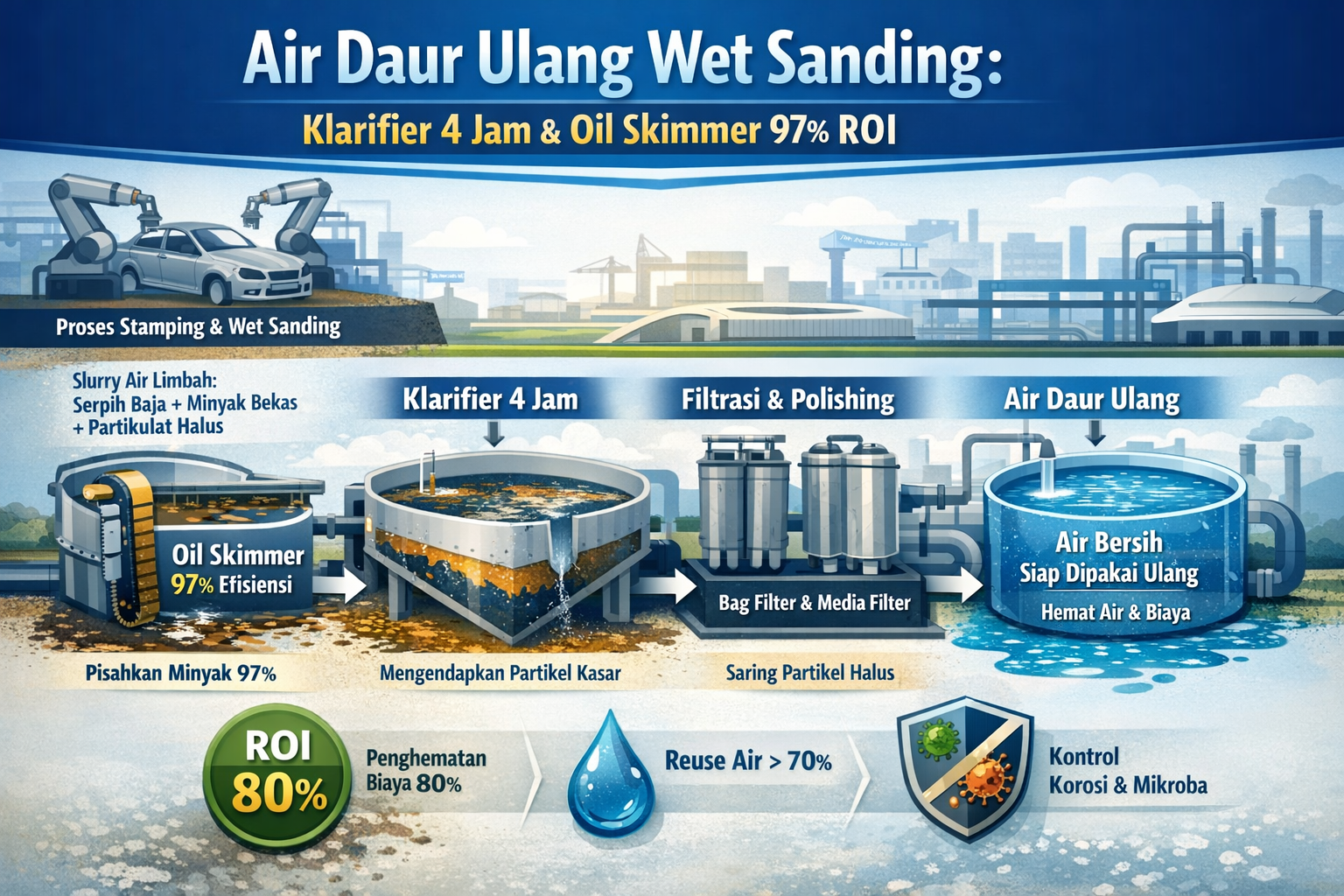
After clarification, polishing filtration removes residual suspended solids. Plants typically choose bag filters (5–50 μm rating) or multimedia beds using sand and anthracite. Industrial multimedia filters in packaged form handle flows of 2–175 m³/h (pureaqua.com). EPA guidance notes polishing filters are suited to waters with <1000 mg/L TSS (total suspended solids) after settling (nepis.epa.gov).
A typical setup runs one or more parallel bag trains (easy bag changes) to catch the “last 1–5%” of fines and prevent carryover. Proper maintenance — periodic bag replacement or bed backwashing — keeps turbidity low. A well‑designed combination of a clarifier plus 5–10 μm bags or fine sand filters can routinely reduce suspended solids to a few mg/L, often meeting reuse targets and any local discharge limits. For media beds, common choices include sand media paired with anthracite, and bag duty often uses industrial housings such as a steel filter housing or dedicated cartridge filters for fine capture.
Corrosion control in recycled loops
Recycled water recirculates across steel, so corrosion control is critical. Plants raise and stabilize pH to about 7.5–8.5 and add corrosion inhibitors — inorganics such as sodium nitrite, sodium silicate, sodium molybdate, or orthophosphate that block anodic sites by forming thin passive films on steel (suezwaterhandbook.com). SUEZ notes nitrites, silicates, molybdates, and phosphates are standard “anodic inhibitors” (suezwaterhandbook.com).
Dosing ranges vary by program and risk: products might run to hundreds of mg/L of nitrite or molybdate — anodic inhibitors often operate in grams‑per‑litre — though modest tens of mg/L are typical in smaller closed loops. Organic filming amines (e.g., polyamines) are another option for protective coatings. Hardness and alkalinity are managed to avoid scale/corrosion; partial softening or targeting a Ryznar index balance (a water stability index) helps prevent slightly hard water from precipitating or attacking metal. Chemistry is monitored continuously — pH, conductivity, and metal levels — to keep inhibitor residuals above critical thresholds. For programs and blends, industrial corrosion inhibitor packages are standard, and partial softening can be achieved with a water softener.
Microbial control in closed loops
Even closed loops can foul if water stands or carries organics. Operating practice keeps the loop moving to prevent dead legs and applies periodic disinfection. One source notes that “passing the clean water through Ultra‑Violet purifiers … effectively removes colonies” (partsfinished.wordpress.com); in practice, a UV unit (e.g., 20–30 mJ/cm² dose) or a chemical biocide — chlorine/bromine at ~1–5 mg/L or a non‑oxidizing agent such as glutaraldehyde — is used intermittently. These treatments inactivate bacteria and algae, preventing slime and microbially induced corrosion or filter fouling.
Any biocide must be neutralized or allowed to decay before final discharge if there is an outfall; inside an internal recycle loop it simply keeps water “sterile” at all times (partsfinished.wordpress.com). Plants typically deploy an ultraviolet disinfection unit for physical treatment or select targeted biocides when chemical control is preferred.
Performance outcomes and reuse targets
When the loop is built out end‑to‑end, water cuts are substantial. One automotive plant’s integrated recycle system recovered ~80% of its water via RO (reverse osmosis) stages, saving about 2900 m³/day of fresh water — a ≥ 80% cut in intake — while enabling zero‑liquid‑discharge compliance and lowering costs (ionexchangeglobal.com; ionexchangeglobal.com). Modern facilities often target reuse rates >70–80%, cutting water costs and discharge fees, in line with the sector’s push for “closed‑loop water systems” as manufacturers “use thousands of litres of water each day” (ionexchangeglobal.com; ionexchangeglobal.com; infrastructurenews.co.za).
The technical backbone is straightforward: clarifiers, filters, and dosing typically achieve >90% solids removal; conditioning the recycle loop against corrosion and microbes maintains quality, letting plants reduce municipal draws by tens of millions of liters per year. The payoff shows up in lower water bills, reduced wastewater discharge (and associated fees), and more consistent process water quality (infrastructurenews.co.za; ionexchangeglobal.com). Where membrane polishing is added, packaged systems such as RO, NF, or UF membrane systems are widely deployed in industrial reuse.
Sources: The design criteria and practices above draw on U.S. EPA guides and industry references for clarifier sizing and coagulant use (nepis.epa.gov; nepis.epa.gov), published reviews and case studies for procedures and outcomes (mdpi.com; ionexchangeglobal.com), and industrial notes from the motor sector illustrating reuse rates and costs (infrastructurenews.co.za; ionexchangeglobal.com). All numerical values and design suggestions reflect those sources.