
A waste plan for HPAL-era refineries hinges on chemistry, polishing trains, and dry-stack solids—and it’s turning liabilities into products while meeting Indonesian discharge rules.
Nickel refineries running lateritic or sulfide feedstocks don’t just make metal; they make complex waste. High‑pressure acid leach (HPAL, a high‑temperature, high‑pressure sulfuric acid process) facilities alone can generate approximately 250–400 m³ of wastewater per tonne of nickel, with typical compositions around Ni ~2.0 ppm, Co ~6.0 ppm, Mn ~40 ppm, Fe ~10 ppm, Cr ~3.45 g/L (3450 ppm), Mg ~18 g/L, and SO₄ ~75 g/L (patents.justia.com). Most Ni and Co have already been recovered by that point, but residual metals and suspended solids remain.
On the solid side, neutralized tailings slurries (iron/aluminum hydroxides from acid neutralization), treatment precipitates, and thickener underflow tailings cakes concentrate metals and gypsum. Add smelter slags and dusts from RKEF (rotary kiln–electric furnace) or EAF (electric arc furnace) streams—ferronickel slag often runs ~0.5–1% Ni (www.mdpi.com)—plus baghouse dust carrying tar and chlorides, and the profile matches a regulated hazardous waste (B3) that must be managed under Indonesian rules.
Waste stream inventory and sources
Liquid process effluent arises from ore leaching, cementation (selective metal precipitation onto another metal), solvent extraction, and electrowinning circuits; cooling water and scrubber blowdown can contain trace metals or chlorides. Solid wastes include precipitates/sludges (Ni/Co/Fe hydroxides or sulfides), gypsum, thickener underflow, smelter slags and dusts, and collected baghouse dust. Typical ferronickel slag chemistry includes Fe, Si, MgO, and residual Ni/Co (~0.5–1% Ni) (www.mdpi.com).
Regulatory targets and discharge controls
Treatment aims to remove heavy metals and polish effluent to meet Permen LH No. 09/2006 limits for nickel processing: pH 6–9, TSS (total suspended solids) ≤100 mg/L, Ni ≤0.5 mg/L, Fe ≤5 mg/L, Co ≤0.4 mg/L, and Cr⁶⁺ ≤0.1 mg/L (nikel.co.id). For coastal plants in tropical climates such as Indonesia, final wastewater frequently goes to ocean outfall under strict limits; before discharge, “regulated metals (Cr, Mn, Ni, Co) should be removed to acceptable levels” (nickelinstitute.org).
Neutralization and precipitation chemistry
Refineries neutralize spent acids with lime or limestone to raise pH and precipitate metals. Iron and aluminum precipitate around pH ~4–5; nickel and cobalt rise at pH 8–9; magnesium and manganese form hydroxides under alkaline conditions. For HPAL effluent with ~18 g/L Mg, more than 90% of magnesium can be precipitated as Mg(OH)₂ (patents.justia.com). Sulfide precipitation (e.g., with H₂S gas) can further remove residual Cu, Zn, and trace Ni/Co as insoluble sulfides, yielding a mixed‑metal sulfide sludge (patents.justia.com; nepis.epa.gov).
Hydroxide precipitation is effective at pushing Ni, Co, Fe, Mn and others to sub‑mg/L levels; reported residual Ni after hydroxide settling can be below 1 mg/L, and technical tables show hydroxide precipitation routinely achieves low mg/L effluent concentrations for Ni and Co (nepis.epa.gov; nepis.epa.gov). Accurate addition of lime or limestone is typically handled via metered chemical addition, where dosing pumps provide the pH control needed to hit the right precipitation windows.
Clarification, thickening, and solids handling
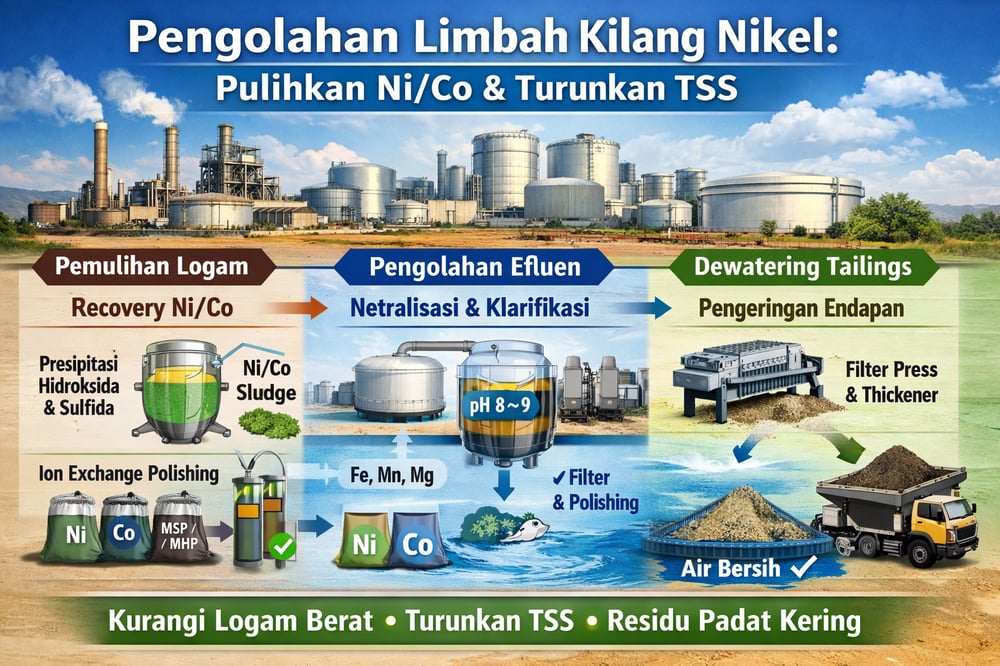
Precipitates (metal hydroxides, gypsum) are thickened in clarifiers or modified cementation circuits; clarified water overflows to further treatment while underflow sludge is dewatered. Plants commonly target effluent TSS well below the 100 mg/L limit—often 10–30 mg/L—with coagulant aid. In practice this step is anchored by equipment like clarifiers, often assisted by chemistry such as coagulants and flocculants.
Ion exchange and membrane polishing
Where metals remain at mg/L levels, ion exchange polishing is widely used. Mixed‑bed resins can remove Cu, Zn, Ni, and Co to below 0.4 mg/L (nepis.epa.gov), comfortably meeting 0.1–0.5 mg/L targets for Ni. Facilities deploy ion exchange systems for this polishing duty, and some target Ni/Co specifically with chelation columns; mixed‑bed trains are common (mixed‑bed resins are a typical configuration). Alternatively, ultrafiltration (UF, a pressure‑driven membrane that screens out fine colloids) or reverse osmosis (RO, a desalination process that rejects dissolved ions) can achieve near‑complete ion removal; integrated ultrafiltration modules are often paired with brackish‑water RO in polishing service, delivered as part of modular membrane systems.
Final pH, TDS control, and outfall
After metal removal, plants adjust pH to 6–9 (typically ~7.5–8.0) and monitor sulfate/TDS (total dissolved solids) (patents.justia.com). In semi‑closed loops, sulfate builds up; operators control conductivity via partial bleed with make‑up dilution or RO. Treated effluent is verified against the Indonesian standard (Ni ≤0.5 mg/L; Fe ≤5 mg/L; Co ≤0.4 mg/L; Cr⁶⁺ ≤0.1 mg/L; TSS ≤100 mg/L; pH 6–9) before discharge (nikel.co.id).
Example: HPAL effluent polishing and recovery
A Vale HPAL case illustrates the mass balance: starting “raw” effluent Ni is ~2.0 ppm; achieving Ni ≤0.5 ppm requires at least 75% removal. Combining hydroxide/sulfide precipitation and polishing drives Ni below 0.5 mg/L. Likewise, Co (6 ppm to <0.4 ppm) and Fe (10 ppm to <5 ppm) are precipitated; the large Mg (18,000 ppm) is precipitated as Mg(OH)₂ or via specialized recovery (patents.justia.com). Overall, more than 90% of Ni/Co is captured for recovery, and final effluent meets discharge standards (patents.justia.com; nikel.co.id).
Capturing value: MSP/MHP, slags, and regenerants
Integrated operations maximize recovery from wastes. Mixed metal precipitates from extraction circuits are often intentional products: HPAL lines produce MSP (mixed sulfide precipitate, ~50–55% Ni+Co content) or MHP (mixed hydroxide precipitate, ~40% Ni+Co) for sale (nickelinstitute.org). Co and Ni recoveries in HPAL can exceed 90–95% (patents.justia.com).
Spent electrowinning electrolyte can yield “Ni‑sulfate sludge” rich in Ni (and Fe, Zn); it “can be filtered out, and then part of the acid can be returned to the system, or it may be sold” (nepis.epa.gov). Ferronickel slag (~0.6% Ni, 0.2% Co) is a secondary resource; studies report ~80% recovery of Ni and Co from furnace slag via leaching with citric/ascorbic acids (www.mdpi.com; www.mdpi.com). Adopting such ‘technospheric mining’ could reclaim hundreds of ppm of Ni/Co in slag (e.g., 0.6% Ni becomes ~0.48% recovered). Higher‑grade Ni matte smelting slags also undergo re‑melting or leaching; if uneconomic, slag can be valorized as construction aggregate rather than landfilled (www.antaranews.com) .
Even the polishing step can pay back: spent IX (ion exchange) regenerant concentrates Ni salts that can be recovered (e.g., via evaporation to nickel crystals) before chemicals are recycled—turning a residual from ion exchange resin service into a recoverable product.
Dewatering, dry stacking, and disposal
Solid residues are dewatered for volume reduction and stability. Slurries from decanters or clarifiers are routed to high‑rate thickeners; HPAL tailings are commonly thickened to 40–60% solids, with water recovered and recycled. Counter‑current decantation (CCD, a multi‑stage wash circuit) produces a dark residue that is typically thickened to ~50% solids before disposal; overflow is returned to process or treatment (nickelinstitute.org).
For drier cakes, membrane filter presses or vacuum belt filters push moisture down to ~22–25% (one case achieved ≤22–24%), enabling “dry stack” storage and cutting impoundment footprint (dewaterfilterpress.com; dewaterfilterpress.com). Thickener underflow at ~50% solids versus filter cake at ~75–78% solids is a substantial volume reduction. Consultants note that dewatering “increases tailings strength and reduces the volume of stored water” and enables reuse such as dry‑stack storage or paste backfill (www.barr.com).
Some tailings are mixed with cement or mine waste and pumped underground as paste backfill, eliminating surface disposal for those fractions. Filtered metal hydroxide sludge (Ni/Co/Fe hydroxides, gypsum) is often cemented into monolithic blocks or consigned to B3 landfills; dewatered sludges (typically >50% solids after filtration) are not discharged, but sent to lined disposal. Dewatering to <30% moisture reduces leachability and volume; in some cases, Ni‑bearing sludge is recycled to high‑pressure leach or smelter feed.
Ferronickel slag and dust, if non‑toxic, can be reused. Indonesia’s Vale is studying tailings as construction aggregate (www.antaranews.com); similarly, ferronickel slag has been used as cementitious aggregate . By contrast, any high‑Leachate sludge or ash is classified B3 and sent to double‑lined hazardous waste landfills under Indonesian law.
Performance targets and operations
The solids program emphasizes volume reduction and stabilization. Dewatering interrupt containers waste by partial volume of water. Achievable outcomes include tailings dried from ~40% solids to ~75% solids (a ~60% mass reduction) (dewaterfilterpress.com), with sludges converted to thick cakes for safe capping. The goal is zero free liquid in storage. Engineering controls—impermeable liners, leachate collection, and closed piping—ensure even residual filtrate is captured and returned to treatment.
With more than 90% Ni/Co recovery, effluents typically carry only trace metals. After treatment, final discharge can achieve Ni ≤0.5 mg/L and TSS ≪100 mg/L (nikel.co.id); ion exchange polishing routinely drives Ni to <0.4 mg/L (nepis.epa.gov). Thickened tailings and filter cakes—with moisture <25% (dewaterfilterpress.com)—are suitable for dry stacking. Industry data indicate a shift to closed‑loop water (recycling >90% of process water) and filtered tailings to minimize impoundments (nickelinstitute.org; www.barr.com). The upshot: potential liabilities (Ni, Co, Mg, and more in waste) become recoverable products and stable materials rather than pollutants.
Methodology and sources
A survey of industry guidelines and case studies underpins the waste characteristics and treatment outcomes. Regulatory values are from Indonesia’s Permen LH No. 09/2006 (nikel.co.id). Process details and typical compositions are drawn from trade literature and patents (e.g., Vale’s HPAL data: patents.justia.com), Nickel Institute analysis (nickelinstitute.org; nickelinstitute.org). Treatment performance (precipitation/IX removal) is documented in technical reports (nepis.epa.gov; nepis.epa.gov) and vendor case studies (dewaterfilterpress.com). All values and recommendations are supported by these sources.
