

Chemical dust control can slash airborne particulates by roughly 90%, but poor choices and sloppy application push toxins and salts into streams. A responsible program starts with low‑toxicity, biodegradable suppressants, measured spray rates, and drainage that ends in sediment ponds—not creeks.
Industry: Coal_Mining | Process: Dust_Suppression_Systems
In coal mining, dust palliatives work—chloro‑salts or polymers can cut dust generation by ∼90% (www.ironbirdcc.com). But regulators and scientists also have a long memory: the US EPA’s “Avoiding Another Times Beach” research recounts how unvetted oils tainted with dioxin poisoned a town (nepis.epa.gov) (nepis.epa.gov).
The modern playbook is blunt: use low‑toxicity, biodegradable binders; meter out application rates to avoid ponding and runoff; and route every drop of stormwater from treated roads into ditches, traps, or ponds built for sediment—not into waterways. Indonesian guidelines go so far as to require sediment ponds be in place before dirt is ever moved (www.scribd.com).
For operators comparing options like a coal dust suppressant at the crusher or a hauling road dust suppressant for haul roads, the environmental bar is rising fast—and so is scrutiny.
Low‑toxicity, biodegradable suppressants
Dust suppressants fall into three broad classes: hygroscopic salts (water‑attracting salts like calcium or magnesium chloride), organic polymers (synthetic chain‑molecule binders), and biological materials (natural organics such as sugars, lignosulfonates, or plant oils). Natural products—molasses, soy/vegetable oils, lignin derivatives—are generally more biodegradable. EPA experts note food‑based suppressants “are likely to contain less toxic compounds…and likely biodegrade” so “toxic effects are expected to be minimal” (nepis.epa.gov).
Evidence backs this up: lignosulfonate (a wood‑pulping byproduct used as an adhesive) readily breaks down over months (pmc.ncbi.nlm.nih.gov), whereas synthetic polymers—with unreacted vinyl/acrylate monomers—can persist in soils. Yet “biodegradable” is not a free pass: field tests have shown lignosulfonate solutions can “reduce biological activity and retard fish growth” (nepis.epa.gov), and petroleum emulsions have been toxic to bird embryos (nepis.epa.gov).
The red line is clear: never use waste oils or untested industrial byproducts—EPA research warns these may carry heavy metals or dioxin‑contaminated oils that caused the Times Beach disaster (nepis.epa.gov) (nepis.epa.gov).
Selection criteria are tightening: insist on low aquatic toxicity (high LC50—median lethal concentration—in fish/Daphnia tests) and proven biodegradability (OECD 301 ready‑biodegradability benchmarks). Prefer suppressants certified or documented to be biodegradable post‑application. Recent field studies favor plant‑straw or molasses‑based formulas: one “eco‑friendly” straw composite decomposed in months with virtually no effect on seed germination, outperforming commercial polymer suppressants (pmc.ncbi.nlm.nih.gov) (pmc.ncbi.nlm.nih.gov). Similarly, a molasses/sugarcane formulation—supplemented with glycerol and a small amount of CaCl₂—controlled open‑pit haul‑road dust for days in trials (pmc.ncbi.nlm.nih.gov) (pmc.ncbi.nlm.nih.gov).
On the ground, check the Safety Data Sheet for absence of heavy metals and persistent chemicals. Avoid chlorides or salts near sensitive vegetation—many trees and plants (including larch, maple, ornamentals, and pine) have low salt tolerance (www.borregaard.com). If salts must be used, test downstream water for chloride levels—chlorides do not biodegrade and even moderate runoff can raise stream salinity (nepis.epa.gov) (www.borregaard.com). The cleaner the formulation, the easier compliance is—less regulatory risk and less long‑term liability.
Calibrated application rates and penetration
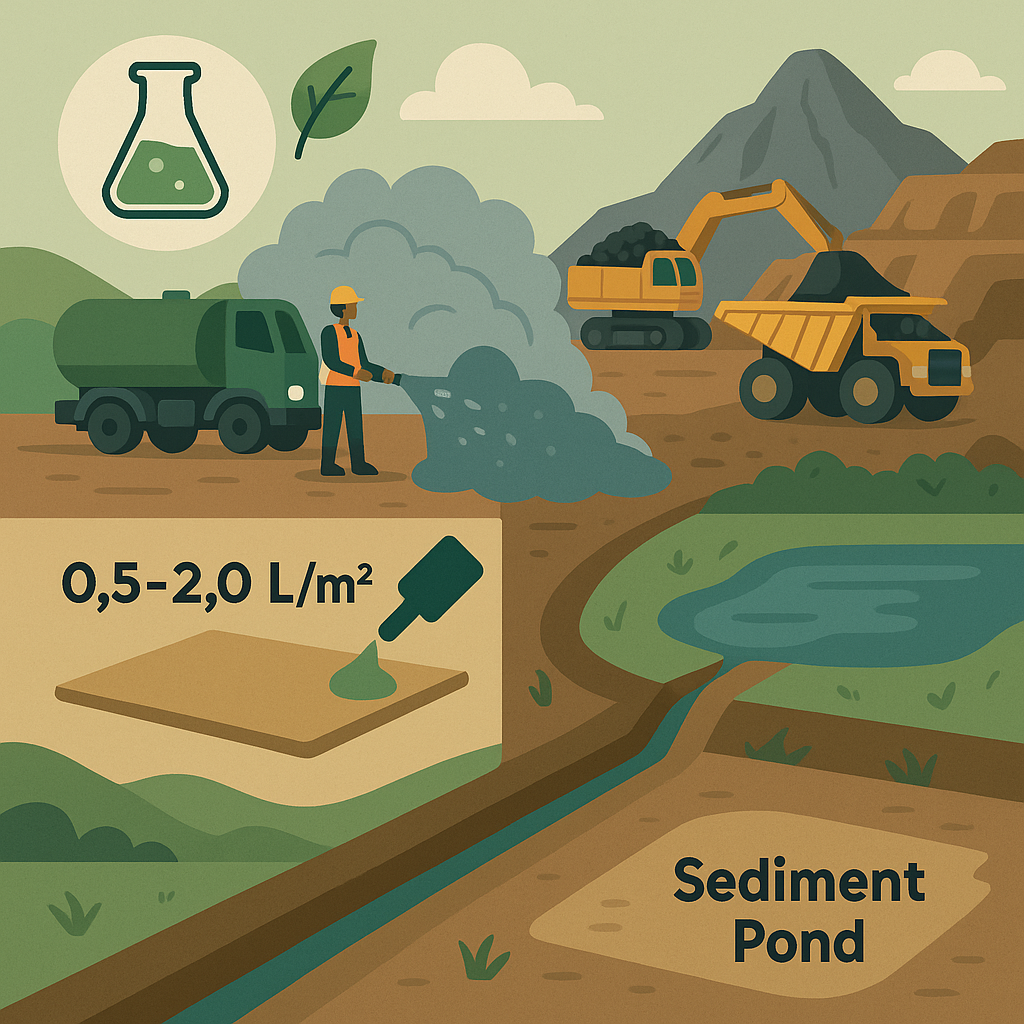
Apply suppressants as sparingly as effective. The EPA warns that excess chemical “could potentially cause both surface and groundwater contamination” (nepis.epa.gov). That starts with calibration: measure road area and use test strips so application rates are known, and use accurate chemical dosing (see dosing pumps) to hit the target.
In many manuals, a reasonable starting dose is on the order of 0.5–2.0 L/m² of liquid binder (www.ironbirdcc.com), with one technical guide noting 0.5–1.5 L/m² as a “typical concentration per unit” for many suppressants (www.ironbirdcc.com). Apply uniformly and at low pressure so the liquid soaks in—USDA experts recommend achieving about 10–20 mm penetration into the road surface (millimeter‑scale depth helps anchor fines) (www.fs.usda.gov).
If surfaces are very dry, lightly pre‑wetting or timing a spray to follow a rain can improve penetration (www.fs.usda.gov). Never spray to ponding—if liquid pools or runs off, reduce the rate or reapply in stages. Follow any compaction or curing instructions (some polymer binders require rolling or time to harden), and adhere to manufacturer guidance on minimum rates and curing time (www.fs.usda.gov).
Beyond the needed level, dose increases deliver diminishing dust control but sharply higher runoff risk. Real‑world operations see frequency benefits: one mine switching from water‑only (requiring about 48 treatments/year) to magnesium chloride ran effectively with only about 8–12 applications/year (www.ironbirdcc.com). In general, biodegradable or hygroscopic suppressants allow longer intervals than plain water, cutting frequency by 70–80% in cold climates (www.ironbirdcc.com).
On product choice, make the environmental criteria above the first screen—whether the application is a hauling road dust suppressant run or a coal dust suppressant near the plant.
Runoff and sediment control structures
Even with careful application, some runoff is inevitable. Any residual binder or mobilized fines must be contained on‑site. Design drainage to intercept and treat all road runoff: perimeter ditches or berms should channel flow from treated roads into sediment traps or ponds, not directly into streams or soil. Indonesian mining guidelines explicitly require this: “Sedimen dari lokasi kegiatan harus ditangkap dengan kolam sedimen. Kolam dan perangkap sedimen harus disiapkan sebelum kegiatan konstruksi dimulai” (sediment from the site must be captured in sedimentation ponds, built before any disturbance) (www.scribd.com).
Steeper or longer slopes should have terraces or check‑dams (“Lereng berteras, saluran dan penahanan sedimen”) to slow flow and drop out particulates (www.scribd.com). Treat roads as a source area: divert clean upslope water around it, and collect stormwater and any inevitable runoff in settling basins. Even small earth‑bermed ponds (“mud ponds” or safety ponds) will greatly reduce pollutant loads.
Size ponds for adequate volume—treat a design storm runoff from the full road length plus a safety factor—and provide forebays or stilling basins (small calm zones that let sediments settle before the main pond). Check and clean out these traps regularly so they do not overflow with accumulated fines. Completed roads should be immediately stabilized with vegetation or mulch to prevent erosion. Indonesian practice emphasizes rapid revegetation: “stabilisasi seperti penanaman tumbuhan penambatan, mulsa, kolam sedimen, anyaman pengendali erosi” on disturbed areas (www.scribd.com).
In dry seasons or between rains, portable filters or silt fences along ditches can also catch suspended dust before it enters ponds. In short, waterborne chemical runoff must be captured. Appropriately sized ditches and sediment basins downstream of treated haul roads not only protect waterways but also recover binder for reuse. Designing for the worst rains expected locally (for example, tropical downpours in Indonesia) keeps pollutants contained even if washout occurs.
Regulatory anchors and source material
Authorities stress both dust control and environmental safety. US EPA’s dust control fact sheet underlines the runoff risk from over‑application (nepis.epa.gov), and its “Avoiding Another Times Beach” report documents the movement of salts with water (raising chloride in streams) and risks from lignosulfonates or oils to biota (nepis.epa.gov) (nepis.epa.gov). Indonesia’s mining rules require dust mitigation (spray systems, covers, monitoring) under MEMR Decree 1827/2018 and KLHK air standards (greenchem.co.id) (greenchem.co.id), while industry best practice converges on the same three pillars: use benign materials, apply minimally, and treat all runoff with erosion controls (nepis.epa.gov) (www.scribd.com).
Technical guidance used above includes the USDA Forest Service’s Dust Palliative Selection and Application Guide (www.fs.usda.gov) (www.fs.usda.gov), EPA’s Potential Environmental Impacts of Dust Suppressants (nepis.epa.gov) (nepis.epa.gov), IronBird Civil’s application‑rate guide and field economics (www.ironbirdcc.com) (www.ironbirdcc.com), Borregaard’s vegetation‑sensitivity note (www.borregaard.com), and two 2025 Scientific Reports studies on plant‑straw and molasses‑based suppressants (pmc.ncbi.nlm.nih.gov) (pmc.ncbi.nlm.nih.gov) (pmc.ncbi.nlm.nih.gov) (pmc.ncbi.nlm.nih.gov).