

Industry: Coal_Mining | Process: Mine_Dewatering
In abrasive service, mine dewatering pumps are effectively operating inside a sandblaster. Slurry particles — with d85 sizes (the diameter at which 85% of particles are smaller) from 100 µm up to several mm — hammer impellers, volutes (the pump casing chamber), and liners, driving gouging, scouring, and even cavitation damage (dro.deakin.edu.au) (www.sgb-slurrypump.com). In severe 24/7 duty, wetted parts can wear out in only 2–3 months (www.sgb-slurrypump.com). Scale matters: more than 240,000 pumps were deployed globally for mine dewatering in 2023, and over 145 processing plants upgraded to abrasion‑resistant pumps that year (www.marketgrowthreports.com) (www.marketgrowthreports.com).
Material selection for abrasive duty
High‑chromium iron (typically 25–30% Cr “white iron”) is a standard wear material for slurry pump wet ends. These alloys form very hard carbides (600+ HB, a Brinell hardness scale), offering strong resistance to hard‑particle erosion (www.topslurrypump.com). Field comparisons show white‑chrome side‑liners deliver “significantly lower wear rates” than grey cast iron under identical particle loads (dro.deakin.edu.au). The mechanism is well known: brittle carbides resist cutting while the iron matrix absorbs impact energy through slight deformation (www.topslurrypump.com).
Rubber (elastomer) linings are the other main approach. Rubber turns particle impact into elastic deformation, so particles tend to bounce or briefly embed rather than chip the surface — an “elastic shield” effect that can dramatically extend liner life (www.topslurrypump.com). Industry experience highlights that rubber‑lined pumps resist coarse‑particle abrasion effectively; Weir Minerals reports conversions of large mill pumps to rubber‑lined wet ends that “improved wear life significantly,” with added advantages of lighter weight, corrosion resistance, and fast swap‑outs (www.miningweekly.com) (www.miningweekly.com) (www.miningweekly.com).
Application guidance is pragmatic: for coarse or sharp particles (e.g., rock fragments), choose high‑chrome alloys, as rubber is “not appropriate” for large sharp rock (atlanticpumps.co.uk). For fine sand/silt slurries of small, smoother particles, rubber often outperforms metal (atlanticpumps.co.uk) (atlanticpumps.co.uk). Rubber has limits: above ~80–100 °C or at very high impeller tip speeds, opt for metal liners to avoid softening or deformation (atlanticpumps.co.uk) (atlanticpumps.co.uk). Hybrid builds — for instance, a metal impeller for high head with rubber wear plates in the volute — are common in modern interchangeable liner designs (atlanticpumps.co.uk).
The payoff is measurable. In one Indonesian mine study, post‑optimization (using higher‑capacity rubber pumps) increased efficiency from 21% to 56% and cut pumping time by nearly half — a clear performance gain in that mining context (www.researchgate.net) (www.researchgate.net).
Pump geometry and configuration
Design choices shape wear. Open or semi‑open impellers (the rotating vaned component that imparts energy to fluid) improve solids handling, while sacrificial wear rings, backup liners, and replaceable casing liners protect the shroud, volute tongue, and cutwater (www.sgb-slurrypump.com). Vertical‑turbine or submersible sump pumps suit deep pits; horizontal centrifugal slurry pumps move larger flows. Thick‑walled casings, large clearances, and impellers that keep particles suspended are hallmarks of solids‑duty builds. Split casings with bolted liners enable faster on‑site service.
Specification matters. Many slurry pumps run far from their design point, accelerating wear. Aligning a pump’s Best Efficiency Point (BEP — the flow at which hydraulic efficiency is maximized) with the duty flow and head is a core design goal (www.sgb-slurrypump.com) (www.sgb-slurrypump.com). Refiguring layouts to let higher‑capacity pumps run closer to BEP can reduce pump count and more than double efficiency, as shown in the Indonesian case (21% to 56%) (www.researchgate.net).
Operating near best efficiency point
At BEP, internal recirculation is minimal and flow symmetry reduces localized velocity gradients — the conditions for maximum efficiency and least wear. Off‑design operation invites cavitation (vapor bubbles collapsing and pitting surfaces), recirculation, and uneven loads that erode impellers and load bearings (www.sgb-slurrypump.com) (www.sgb-slurrypump.com).
Above BEP, increased recirculation raises pipe friction, vibration, and NPSH (net positive suction head, the suction pressure margin to avoid cavitation) requirements — all of which intensify wear and power draw (www.sgb-slurrypump.com). Below BEP, lower velocities can cause “sanding” and internal backflow that scour volute walls and increase radial loads (www.sgb-slurrypump.com). Industry guidance is blunt: “Ideally, slurry pumps would be operated at 100% of BEP flow, resulting in maximum efficiency and minimum wear,” with operators keeping routine duty within 90–105% of BEP where possible and watching real‑time flow and vibration for drift; even a 10% flow deviation can shave a few points of efficiency, compounding erosion and energy costs over 24/7 runs (www.sgb-slurrypump.com).
The stakes are big. One review notes that a poorly matched, off‑BEP pump can see a robust 50% increase in operating hours (i.e., time on the clock to move the same water) — and that ensuring operation “as close to BEP as possible” maximizes efficiency and component life (www.sgb-slurrypump.com) (www.sgb-slurrypump.com).
Maintenance and monitoring discipline
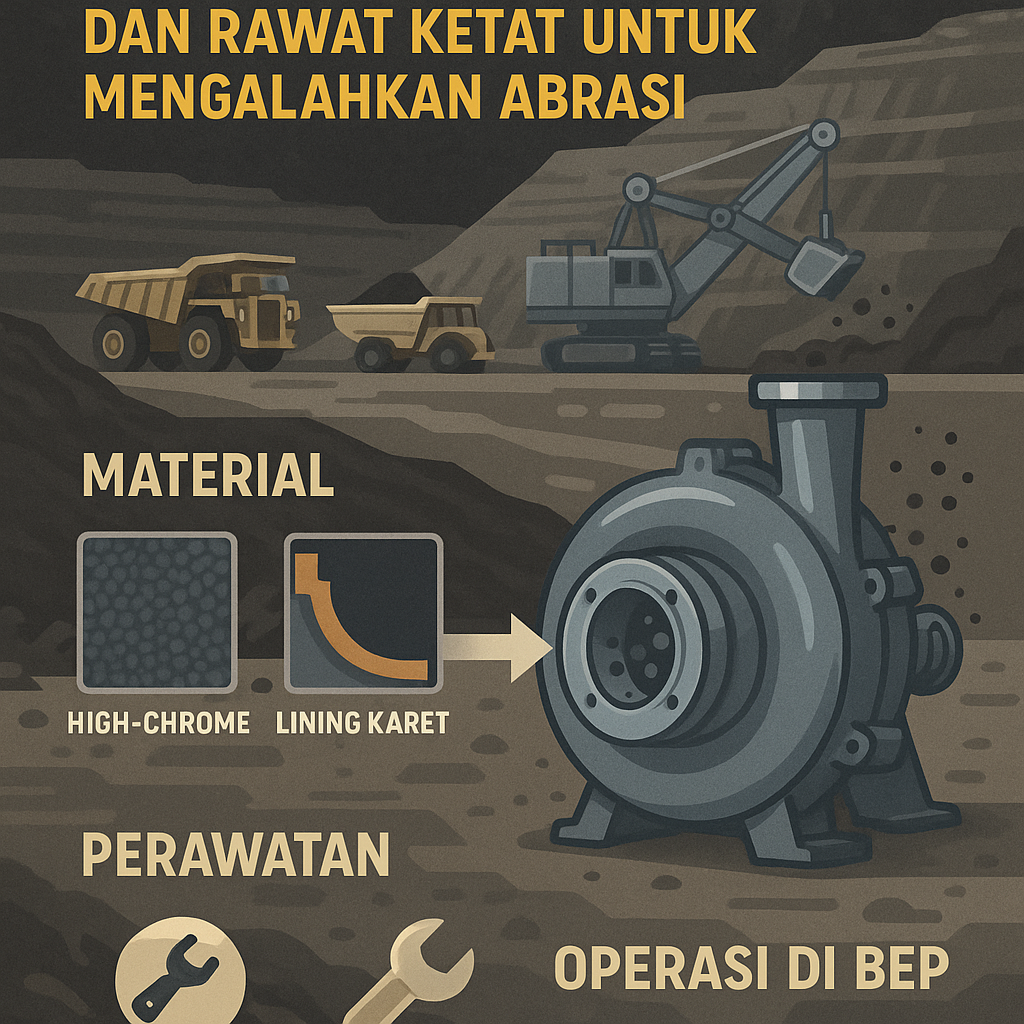
Even with optimal selection and operation, abrasive wear accumulates. Crews track liner and impeller thickness with calipers or ultrasonic gauges, and some high‑end systems (e.g., Weir’s Synertrex) alert when liners drop below safe thickness. In the harshest duties, inspections every 500–1000 hours are routine, and wear parts are replaced long before complete wear‑through — for example, scrapping liners around 50% of original thickness to avoid run‑out failures. Modular pumps with split casings and bolted liners minimize downtime during planned swaps (www.miningweekly.com).
Condition monitoring — vibration, bearing temperature, and power draw — flags hydraulic imbalance from uneven erosion or seal issues before they turn catastrophic. Rebuild vs. replace decisions lean toward renewing wear internals to preserve costly casings and castings; hot spares for liners, impellers, and seals are standard because unplanned slurry pump outages “can bring a mining project grinding to a halt” (www.pumpindustry.com.au) (www.sgb-slurrypump.com). Reliable, abrasion‑resistant pumps also support safety and environmental compliance; for example, Indonesian Permen LHK wastewater rules require proactive pit water management, and a flooded bench risks both violations and worker safety.
Performance outcomes and market trends
The Indonesian case quantified the gains: an original 42 m³/h pump at 7.32 m head was replaced in a redesigned duty with an 80 m³/h unit at 10.34 m head, halving pumping time and lifting efficiency from 21% to 56% (www.researchgate.net). Globally, more than 145 processing sites upgraded to hardened pumps last year, part of a broader shift toward abrasion‑resistant designs (www.marketgrowthreports.com). Trade press note “a definite shift…towards rubber linings on pumps, as mines recognise their value in these applications,” and cite abrasion‑life and even greenhouse‑gas gains from lighter rubber units; surveys have found many operators saving tens of percent in part‑replacement costs after converting to rubber liners on large pumps (www.miningweekly.com) (www.miningweekly.com).
Energy is the other lever. A 100 kW slurry pump running 8,760 hours per year saves roughly 22,500 kWh with a 5% efficiency boost — and wears less in the process. Conversely, inefficient, worn pumps “experience gouging and wear that reduces the lifespan of its components, subsequently reducing efficiency and increasing its lifetime ownership costs” (www.sgb-slurrypump.com).
Best‑practice checklist
- Duty profiling: characterize slurry (specific gravity, particle size distribution, concentration) and conditions (flow, head, temperature). Select solids‑capable geometries accordingly (open/closed impeller, multi‑stage, vertical/horizontal).
- Material match: for coal‑/ore‑related abrasion, default to high‑chrome/manganese alloys for metal parts; use rubber or polyurethane linings when abrasives are fine and flows are large (dro.deakin.edu.au) (atlanticpumps.co.uk).
- Operate at BEP: design and control for near‑BEP flow; use staging or speed control rather than running far off design (www.sgb-slurrypump.com).
- Monitor wear: scheduled inspections; use ultrasonic/optical measures or embedded sensors; replace before failure.
- Maintain backups: keep hot spares for liners, impellers, seals; short wear lives (sometimes months) justify inventory versus long cast‑part lead times.
- Energy efficiency: even abrasive‑duty pumps pay back on hydraulic efficiency; footprint and brand choices should account for energy over life.
By combining robust construction (white iron and/or rubber components), precise sizing, and vigilant maintenance, operators extend pump life by factors — months‑long wear lives versus weeks if improperly used (www.sgb-slurrypump.com). In Indonesia’s coal mines and internationally, that data‑driven discipline is increasingly a business imperative, paying back in energy savings, lower parts consumption, and uninterrupted production (www.researchgate.net) (www.sgb-slurrypump.com).
Sources: Authoritative industry and research sources including pump manufacturers and mining journals provide guidance and case data. Prominent references include empirical slurry‑pump studies (dro.deakin.edu.au), mining operation reviews (www.sgb-slurrypump.com) (www.sgb-slurrypump.com), and regional case studies (www.researchgate.net). Statistics and trends are drawn from recent market analyses (www.marketgrowthreports.com) and mining industry reports (www.miningweekly.com) (www.sgb-slurrypump.com).