

Industry: Landfill | Process: Stormwater_Management
In tropical settings, stormwater at landfills arrives like a freight train. Indonesian design storms — for example, 10‑year, 24‑hour events — can exceed several hundred millimeters of rain. Engineers size systems with site‑specific IDF data (intensity–duration–frequency curves), then run the numbers on peak runoff using the Rational Method, Q = C·I·A (C = runoff coefficient, I = rainfall intensity, A = drainage area), as codified in Indonesian landfill design guidelines (Permen PU) with Manning and Rational equations explicit: “Kapasitas saluran dihitung dengan persamaan Manning … Q = (1/n)·A·R^(2/3)·S^(1/2)… Debit dihitung dengan: D = 0,278·C·I·A (m³/s)” (id.scribd.com) (id.scribd.com).
On compacted caps with low infiltration (typical runoff coefficients 0.7–0.9), the math gets big fast. A practical example — C≈0.8 and a 1‑hour intensity of 100 mm/hr (not uncommon in tropical downpours, www.iieta.org) over 1 ha — yields Q≈22 m³/s (via D = 0.278·C·I·A). That’s why even “minor” channels and culverts at engineered landfills are often sized for 5‑ to 25‑year storms, with safety factors for extreme events.
Hydrologic design basis and peak conveyance
Design starts with IDF data to capture local storm behavior and the Rational Method (Q = C·I·A) to estimate peak flows. Manning’s equation (Q = (1/n)·A·R^(2/3)·S^(1/2); A = flow area, R = hydraulic radius, S = slope, n = roughness) is then used to size channels per Permen PU (“Kapasitas saluran dihitung …” and “Debit dihitung … D = 0,278·C·I·A (m³/s)”) (id.scribd.com) (id.scribd.com).
Typical C values for paved or compacted landfill caps are 0.7–0.9. Using C≈0.8 and 100 mm/hr over 1 ha gives roughly 22 m³/s — confirming that channels must move very large flows. Indonesian storm patterns are becoming more variable; guidance responds by leaning on higher‑frequency IDF data (www.iieta.org).
Benched slope channels and Manning sizing
Landfill covers (caps) and exposed phases are graded to sheet‑flow into channels. Slopes are “benched” — broad, low‑gradient terraces cut into the slope — to break up long runs and collect flow. Industry practice and field observations typically space benches about 12–15 m (40–50 ft) apart horizontally (www.wastetodaymagazine.com). Each benched channel drains to the next lower bench, slowing flow and reducing erosion.
Bench channels or swales are often grass‑lined or rock‑lined. Channel grades are kept gentle — usually 1–2% minimum — to limit velocity; Indonesian guidance implies ≥2% grade for channels, and roads are sloped 2–3% toward drains (id.scribd.com). Side slopes between benches are armored (erosion blankets, mulch, permanent vegetation) to resist rilling. In particularly erosive soils or intense rainfall areas, benches may be closer together or lined with filter cloth and riprap.
Each bench channel is sized with Manning’s equation using appropriate n values — concrete trapezoidal channels often use n≈0.013; grass channels n≈0.03–0.05. Permen PU notes n=0.05–0.06 for unlined channels when calculating capacity with Manning and flows with the Rational formula (id.scribd.com) (id.scribd.com). Engineers ensure capacity exceeds design flow with freeboard. Runoff intercepted on each bench is conveyed down the slope via open channels (terraces, level spreaders) or enclosed drains.
Maintenance is explicit: “atau saluran drainase dipelihara… Lakukan pemeriksaan rutin setiap minggu khususnya pada musim hujan, untuk menjaga kerusakan saluran” (maintain channels weekly, especially in rainy season) (id.scribd.com).
Culverts, headwalls, and outlet protection
Where channels cross roads or fills, culverts or reinforced concrete conduits carry the flow. They are sized so the design storm (often 10–25‑year) passes with minimal headwater rise, using Manning‑based hydraulics and accounting for inlet loss and tailwater. Access roads at Indonesian landfills must be ≥8 m wide and graded 2–3% toward culverts/drains (id.scribd.com).
Culvert inverts are set below road grade, with concrete headwalls and cutoff walls to intercept seepage. Typical diameters range from 300 mm for small drains up to 1000 mm or more for major channels. Freeboard — top of outlet to ground — is maintained (e.g., ≥0.3 m) to account for debris or blockage. Outlet protection (riprap or energy dissipators) prevents scour at the toe. In short, culvert flow capacity ≥ peak inflow, with hydraulic verification using the Rational Method and Manning.
Sedimentation basins: forebay, detention, slopes
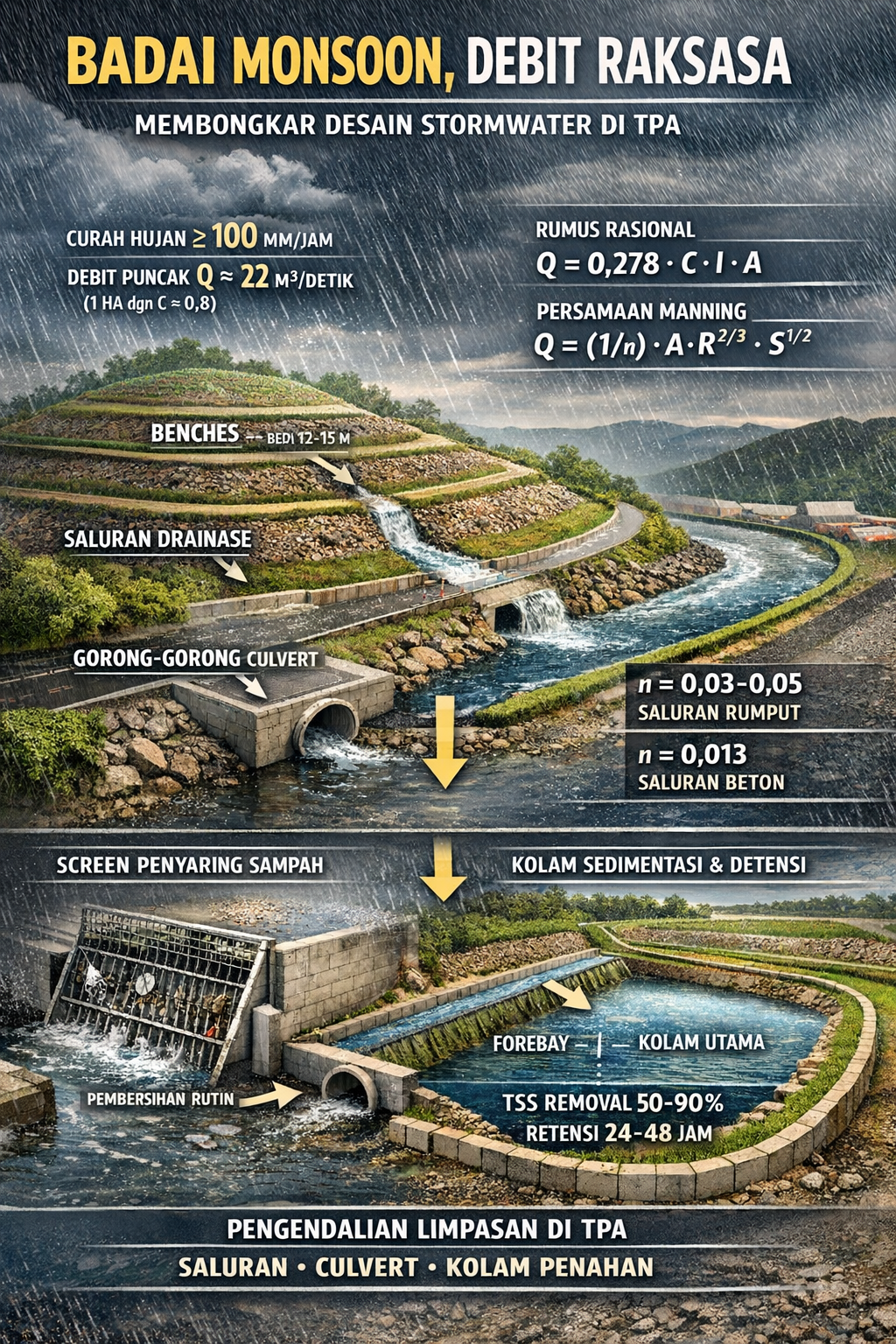
All collected runoff is routed to sedimentation basins (ponds) at the perimeter or toe to slow flows and remove sediments. Design typically includes two stages: a water quality volume (first‑flush capture) and extended detention (peak attenuation and further settling). A common EPA rule‑of‑thumb is a separate forebay — about 5–10% of total pond volume — to trap coarse sediment (nepis.epa.gov) (nepis.epa.gov).
Pond bed and side slopes are set flat enough — typically 3:1 to 5:1 horizontal:vertical — to remain stable and allow maintenance (nepis.epa.gov). For safety and ease of mowing, side slopes ≤3:1 are preferable (nepis.epa.gov). Low‑flow outlets (“micropool”) admit only high stormwater volumes and keep a permanent pool for biological uptake.
Ponds are sized so the design storm (often 2‑year or 5‑year) is detained and released slowly (e.g., via an orifice). Design manuals suggest about 24–48 hours detention of the water quality volume before discharge. These detention times allow roughly 80–90% of incoming Total Suspended Solids (TSS) to settle out (nepis.epa.gov). Empirical data show well‑designed wet detention ponds remove the majority of sediments, with studies reporting TSS removals on the order of 50–90% (nepis.epa.gov) (nepis.epa.gov). BOD/COD (biochemical and chemical oxygen demand) and nutrient removals are more modest, typically 20–50%, unless engineered wetlands or extended treatment are used (nepis.epa.gov).
All collected runoff — after passing through these basins — can either be discharged off‑site (if allowed) or re‑used on‑site. In tropical climates, evaporation is high, so ponds are usually designed as dry (no permanent pool) with vegetated grass basins, unless continual wetting is required for polishing. Basins and outlets must be maintained: sediment should be dredged when accumulation reduces storage volume (some guidelines advocate emptying when one‑third full), and EPA and international practice emphasize that sediment traps and ponds must be cleaned out periodically to remain effective. Accumulated sediment — largely inert landfill cover soil — can often be repurposed as cover material (nepis.epa.gov).
Performance outcomes and maintenance regimes
Properly designed and maintained, a detention pond sized for a 1–2‑year storm can roughly halve peak discharge versus uncontrolled runoff. EPA estimates for wet ponds are ~80–90% TSS removal (nepis.epa.gov), cutting turbidity and particulate‑bound contaminants in discharge. In practice, an engineered landfill stormwater system (channels + culverts + ponds) can reduce offsite runoff rates by >80% and trap most sediments, compared to an uncontrolled dump.
Regulatory design anchors and climate variability
National regulations (Permen PU) codify critical criteria — road grades (2–3% to drains), channel design by Manning, and Rational‑method peak flows — and call for weekly inspection of drains during rainy season (id.scribd.com) (id.scribd.com) (id.scribd.com). These rules help “harden” systems against Indonesian monsoon intensities.
Globally, stormwater management trends favor Low‑Impact Development (LID) techniques — vegetated swales, permeable surfaces — to reduce runoff, though landfill priorities are different: space is reserved for processing, and infiltration is minimized to protect liners. Indonesian storm patterns are becoming more variable, a shift reflected by using higher‑frequency IDF data (www.iieta.org).