

Industry: Aquaculture | Process: Wastewater_Treatment
Aquaculture load swings and risk
In aquaculture, only about 30% of feed nutrients are retained by fish; the rest—≈70%—becomes waste in the form of sludge, nitrogen (N), and phosphorus (P) (mdpi.com). Typical discharges cited for Norwegian farms land near 27 kg/ha·year of N and 9 kg/ha·year of P (mdpi.com), and intensive operations can exceed 80 kg N/ha年 (mdpi.com).
Then come the hydraulics. Seasonal rainfall and routine pond flushing can spike flow by an order of magnitude over base conditions (wex-global.com). In practice, small specialized WWTPs (≪0.1 MGD) often see 10×–flight‑to‑zero variations in flow (wex-global.com), starving nitrifiers at low flow and overwhelming clarifiers and filters at peaks. Operators without buffering and automation tend to “ineffectively ‘chase’…limits by overdosing process streams,” wasting chemicals and money (wex-global.com) (wex-global.com).
Equalization basin design and operation
An equalization (EQ) basin—an aerated, mixed tank used to buffer flow and pollutant load—is the front-end shock absorber. A common rule-of-thumb is 4–12 hours of average flow (longer for extreme diurnal swings) (nepis.epa.gov). One EPA evaluation reported a side‑stream EQ basin “is highly effective in leveling influent flow variations and providing a uniform flow rate to the process units” (nepis.epa.gov).
The same study noted equalization does not erase diurnal concentration patterns—raw and EQ’d wastewater strengths still rise together—but it does level out mass loading by smoothing flow (nepis.epa.gov). The payoff can be stark: granular filters processing equalized flow achieved 82% TSS removal versus 33% under un-buffered diurnal conditions, and total filter effluent TSS loading dropped roughly from 93 kg to 51 kg per week simply by running at constant flow (nepis.epa.gov). For these granular filters, specifying media such as sand can align with dual media filtration designs.
Key design notes from the evaluation: keep the EQ basin aerated and mixed to prevent septicity and solids settling—“Equalization tanks should be aerated to help maintain aerobic conditions and to aid in conditioning the sewage for downstream processes” (nepis.epa.gov). Automated airflow control is preferable; manual valves destabilize oxygen transfer as tank levels change (nepis.epa.gov). In a Michigan case study, added basin pumping raised total pump-energy cost by less than 2%, and real operation showed virtually no net power increase (nepis.epa.gov). Steady flows can also allow smaller downstream clarifiers or filters, offsetting EQ capital outlays (nepis.epa.gov).
Volume design: typically 0.5–1 day of average flow, based on historical peaks. Aeration/mixing: essential to keep mixed liquor aerobic; diffusers on variable‑frequency drive (VFD) blowers with auto‑valves. Operation: level‑controlled inlets/outlets to maintain near-constant effluent and avoid surcharge or starvation of tank (nepis.epa.gov) (nepis.epa.gov).
Continuous sensors and analytics
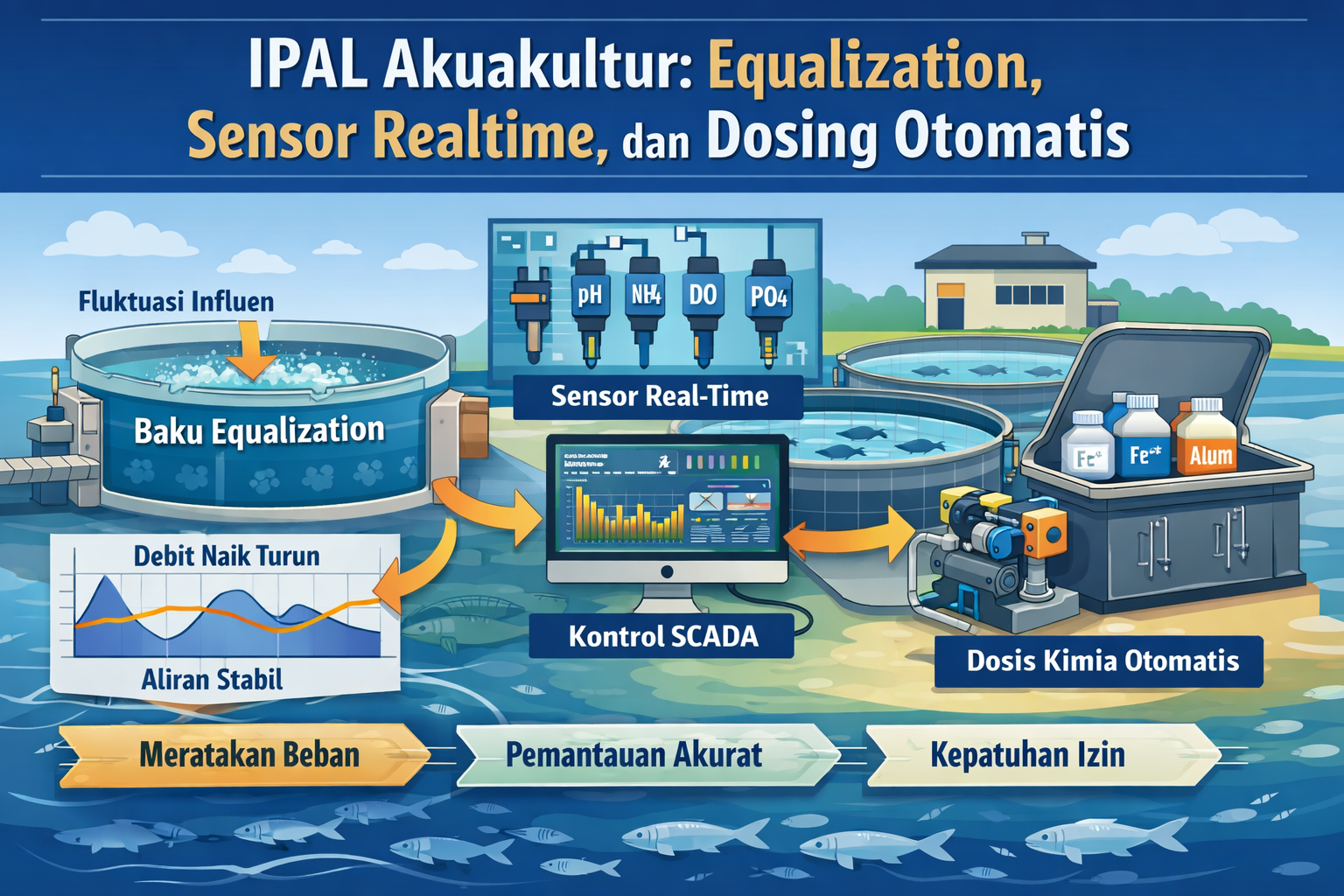
Modern control starts with continuous sensing. Online probes at the EQ basin and treatment units should measure flow, pH, temperature, turbidity/total suspended solids (TSS), dissolved oxygen (DO), ammonia (NH₄⁺), nitrate (NOx), and orthophosphate, with data streaming into SCADA/PLC (supervisory control and data acquisition/programmable logic controller) or cloud analytics for trend detection and feed‑forward control. Optical UV fluorescence sensors can estimate conventional lab BOD/COD (biochemical/chemical oxygen demand), enabling proactive aeration control (h2oglobalnews.com).
Since aeration consumes about 50–75% of a WWTP’s energy (h2oglobalnews.com), real-time BOD/COD lets blowers be throttled to actual load; a study using a fluorescence‑based BOD sensor (Proteus) showed that optimizing blower speeds to observed BOD could cut energy costs by a large percentage (estimated data in [33]) and utilize permit capacity more fully (h2oglobalnews.com). Continuous ammonia and phosphorus analyzers at the inlet or EQ enable immediate corrective actions, rather than reacting to weekly lab samples. One trial reported that an online orthophosphate analyzer controlling dosing cut ferric chloride usage by ~25% versus a time‑based schedule, with an additional 8% optimization by adjusting the P:Fe ratio (worldpumps.com).
Advanced analytics can sharpen the picture: a LightGBM (gradient boosting) model trained on influent pH, conductivity, turbidity, and flow predicted optimal coagulant dose and outperformed traditional PID loops (researchgate.net). Even simple feedback helps: a flow‑proportional mixing valve or pump for coagulant automatically scales with EQ flow (nepis.epa.gov), and pH probes can trigger lime or acid dosing in real time. Supporting panels and instrumentation fall under wastewater ancillaries for integration.
Automated dosing architecture
The hardware link is automated chemical dosing: metering units, flow controllers, and interlocks for coagulants (alum or ferric salts), polymers, and pH adjusters. Feed‑forward control (anticipating required dose from influent sensors) is often superior for lag‑dominated systems; in phosphorus removal, a feed‑forward scheme using inlet PO₄ plus flow computed coagulant rates and “demonstrate[d]…considerable savings”—~25% less ferrous than a static schedule (worldpumps.com). For precise delivery, facilities standardize on accurate chemical dosing equipment and tie control to sensor signals.
Ammonia spikes can trigger temporary aeration boosts or operational changes to protect nitrification, while pH correction (caustic/acid) keeps the sweet spot for nitrifiers and phosphate precipitation (~7.5–8). Polymer feeds for settleable solids can be governed by turbidity meters, with coagulants and flocculants specified from a plant’s chemical suite such as coagulants and flocculants. In essence, chemical dosing should be automated and proportional. EPA guidance stresses designing chemical feed with flow‑proportional control to automatically compensate for adjustments to the equalized flow rate (nepis.epa.gov), and modern systems add flowmeters, pressure sensors, and auto‑shutdowns for clogs or low tank levels to reduce error; these are typically bundled with supporting equipment.
-
Coagulant dosing (for solids/P removal): bled to EQ’s flow and turbidity.
-
Biocide/detergent (if needed for pathogen control): based on pathogen sensor or fixed weekly doses.
-
Nutrient precipitant (e.g., alum, ferrous): fed by sensor or demand.
-
pH control: upstream lime or acid to maintain 7–8 pH (for nitrification efficiency).
-
Key monitored parameters and controls: Flow rate (to scale processes and detect surges); pH (for nitrification and precipitation; acid/base dosing); DO (aeration control for nitrification and organic removal); Turbidity/TSS (trigger polymer dosing or filter backwash); Ammonia/NOx (modulate aeration and biofilter recycle); Orthophosphate (trigger metal salt dosing).
Measured results and compliance
When real‑time monitoring and dosing meet equalized hydraulics, permit stability follows. One plant used a phosphorus controller to match real‑time P spikes and cut ferric feed from an average 12.5 to 5.6 gal/hr—a 56% reduction—saving about $125,000/year in ferric with less sludge (wex-global.com). The same approach achieved compliance with a 1.0 mg/L total‑P permit using far lower chemical doses (wex-global.com), and feed‑forward PO₄ control elsewhere cut iron use ~25% with an additional 8% optimization by tuning the P:Fe ratio (worldpumps.com).
Steady flows lift treatment performance: as noted, filters operating on equalized flow captured 82% TSS versus 33% without equalization, halving weekly effluent TSS load from ~93 kg to ~51 kg (nepis.epa.gov). Energy follows suit. Though EQ adds some pumping (<2% in the Michigan case study, and real operation showed virtually no net increase) (nepis.epa.gov), real‑time DO/BOD control allows lower blower baseload and multi‑thousand‑dollar annual savings by aligning oxygen supply to actual demand (h2oglobalnews.com).
The operational dividend is predictability. Variability drives emergency fixes; automated control and buffering reduce upsets and alarms, delivering what one provider frames as “peace of mind”—reliable compliance with less manual intervention (wex-global.com). Mathematically, one can summarize outcomes: for example, a target P removal of 90% might be achieved with only X lbs of coagulant if dosing is minimized by sensor‑based timing, versus 1.5X by fixed dosing. Filters and clarifiers achieve design removal factors only under steady flow.
Bottom line: plants typically see two‑ to three‑fold reductions in permit exceedance incidents and tens of percent savings in chemicals (confirmable from metered usage), with one facility’s 56% ferric cut paying back sensors in under a year (wex-global.com). Regulatory momentum is also aligning: Indonesian rules now explicitly mandate continuous effluent monitoring (enviliance.com).
Integrated strategy for variable loads
The strategy is hybrid by design: hydraulic buffering via equalization, vigilant sensing via real‑time monitors, and smart dosing via automation/algorithms. Together, they convert a reactive aquaculture WWTP into a predictive one—transforming permit compliance from “arguably met” into consistently met—while trimming treatment costs and environmental load. Source evidence from engineering assessments and case studies underpins these outcomes (nepis.epa.gov) (nepis.epa.gov) (worldpumps.com) (wex-global.com) (wex-global.com) (researchgate.net), with the regulatory nudge reinforcing the case (enviliance.com).