

Turbid canals, ponds and tailwater can carry enough sand, silt, algae and precipitates to choke irrigation systems. The fix is a multi-stage filtration and chemical pretreatment strategy that trades capital, backwash water and maintenance for uniformity and yield.
Industry: Agriculture | Process: Irrigation_Water_Pumping_&_Filtration
Microirrigation’s promise—saving 50–60% of water versus surface flood—evaporates fast when emitters clog. Effective filtration is therefore required for successful operation. The physics are unforgiving: emitters typically have openings of 0.5–1.0 mm (500–1000 µm), so particles far smaller than the opening—especially below ~100 µm—must be removed.
Extension guidance classifies suspended solids (SS) by plugging risk: slight hazard below 50 mg/L, moderate at 50–100 mg/L, and severe above 100 mg/L. The culprits span three categories—physical (sand, silt), biological/organic (algae, bacterial slime), and chemical (mineral precipitates)—and often arrive as a mix.
When chemistry helps, the gains can be large: field trials showed 0.5–1 mg/L of polyacrylamide (PAM) cut suspended solids ~86–92% and slashed sediment loss across six irrigations from ~70 lbs/acre to under 3 lbs/acre (an 89–96% reduction). As one industry summary puts it, avoiding filter clogs is essential to reap maximum benefit from irrigation.
CLOGGING RISK AND PARTICLE TARGETS
“Fine” in irrigation means finer than the emitter. In practice, 120 mesh (~130 µm) filtration is standard for drip to remove fine sand. A 200-mesh screen limits passage largely to very fine sand, producing effluent with particles ≲75–100 µm.
SCREEN FILTERS (SURFACE FILTRATION)
Screen filters are meshes in pressurized housings that trap solids on the surface. They excel on inorganic debris (sand, grit), with very low head loss, compact footprint and low capital cost per flow. Limits appear fast with organics or clays because only one layer of solids is captured.
Use cases: as a primary filter on well water or as a secondary polish after media for surface supplies. Maintenance can be daily under heavy load. Automatic back-flush is common; an automatic screen filter reduces manual labor, while smaller systems may rely on a manual screen. Standard 120 mesh (~130 µm) applies widely; 200 mesh targets ≲75–100 µm effluent.
DISC FILTERS (STACKED GROOVED MEDIA)
Disc filters use stacked, grooved disks to create a three-dimensional pathway, combining fine retention with high dirt-holding capacity. They back-flush automatically, typically when differential pressure (ΔP) reaches ~0.5 bar (~7 psi) or on a timer. Groove fineness is color-coded (e.g., red ≈130 µm, black ≈100 µm).
They handle moderate loads of sand and organics with very small backwash volumes, though complexity and eventual manual cleaning are trade-offs. If a unit continually flushes, discs need manual cleaning. Annual cleaning commonly uses 3–10% hydrogen peroxide for organics and 3–10% hydrochloric acid for carbonates or iron, followed by thorough rinsing.
MEDIA FILTERS (SAND/GRAVEL DEEP BEDS)
Media filters are pressure vessels filled with graded sharp sand or crushed rock, often 0.6–1.5 mm, forming a three-dimensional depth filter suited to silt and algae. They are the workhorse for dirty water, catching large quantities of fine material without blinding as quickly as a surface screen.
Performance is flow-dependent: a No. 11 sand bed with mean size 0.78 mm at 25 gpm/ft² (~870 L/min·m²) can remove to ~75 µm; at 35 gpm/ft², cut-off degrades to ~100 µm. Backwash is mandatory; one tank typically flushes while others irrigate. Undersized backwash causes tunnelling and poor capture. Many systems specify silica sand media to meet the 5–10 micron-to-coarse capture envelope of multi-layer beds.
PRE-PUMP SAND SEPARATION (HYDROCYCLONE/SAND SEPARATOR)
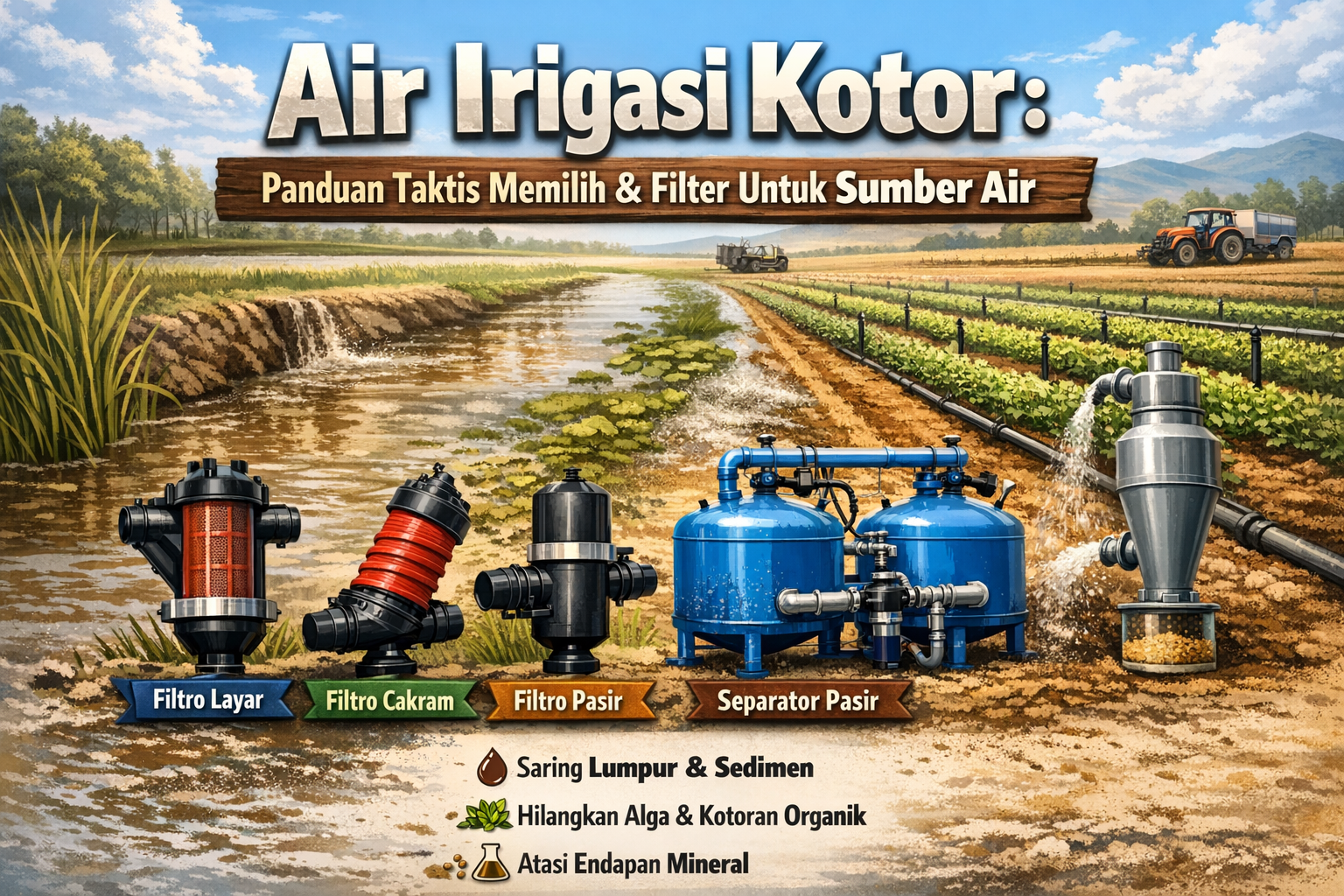
Hydrocyclones spin the flow to fling high-density particles outward, dropping them into a collection chamber. They have no moving parts, handle very large flows, and protect downstream filters from abrasion. Typical design loss is ~35–70 kPa (~5–10 psi). Lab tests on 20 cm units showed ~30–50% solids capture, favoring coarser and heavier grains; clay largely passes.
There is no backwash water; solids are drained when the collection chamber exceeds about one-third full. Common combinations pair a cyclone with a 120-mesh screen on well water.
MULTI-STAGE FILTRATION TRAINS
Dirty surface water benefits from series filtration: intake screen or cyclone → primary filter (media or disc) → polishing screen/disc at 120–200 mesh. Sizing rules of thumb emphasize increasing stringency stage-by-stage to balance cost and removal. Pairing a polishing screen with an automatic back-flush mechanism is common to maintain flow during irrigation.
PERFORMANCE AND COST BENCHMARKS
Finer filtration generally means higher pressure drop and more backwash water. Disc filters keep backwash volumes to seconds per cycle with moderate ΔP; media filters can reach ≲50 µm with fine sand but require lower fluxes—around ~900 L/min·m² yields ~75 µm capture on No. 11 sand, while higher rates let larger particles pass. Correct filter area is critical; undersizing forces constant cleaning, oversizing wastes capital.
Economics from greenhouse studies illustrate the spread. Screen systems ran about $0.02–0.12 per 1,000 gal with minimal consumables. Synthetic fiber paper filters incurred about $0.78 per 1,000 gal of media consumed, with overall costs up to $2.97 per 1,000 gal. Sand or glass media showed low operating cost for large volumes, especially pond water. Overall, screen and rigid filters delivered 3–5× lower cost per volume than fine-fabric media in that study; over-sizing drove cost per 1,000 gal as much as 3× higher.
CHEMICAL PRETREATMENT STRATEGIES (COAGULATION/FLOCCULATION)
Filters alone struggle with colloidal clays and dissolved organics. Coagulation neutralizes charges and flocculation binds fines into settleable flocs. Alum and ferric salts commonly remove 80–95% turbidity at roughly 20–100 mg/L in jar tests, with alum often showing best potential around pH 6–7. Rapid mix is brief, around 30–60 seconds, followed by 10–20 minutes flocculation. Sludge generation and flush water on the order of ~0.5–2% of volume are typical considerations.
Polymers such as polyacrylamides are potent flocculants. Doses as low as 0.5–5 mg/L cationic PAM achieved >85–90% suspended solids reduction in field irrigation, with 0.5–1 mg/L cutting turbidity by ~92% and sediment loss by ~90%. Seasonal dosing costs were estimated at $26–34 per acre for four applications in one study. Biopolymers such as chitosan, tannin, and plant-based coagulants like Moringa oleifera seed extract have shown ~90% turbidity and color removal in agricultural wastewater contexts.
Implementation typically doses coagulant into a line or surge tank, then provides flocculation and settling in a basin or lamella clarifier before filtration. Optimization by jar test—especially pH and dose—matters. Overdosing yields fragile flocs, while underdosing leaves colloids. In very high-solids water, coagulation ahead of sand filtration has cut turbidity to under 10 NTU and extended filter run times in pilots. In irrigation service, chemical injection is commonly handled by a chemical dosing pump, with filters downstream. Coagulant and polymer selections often align with coagulants and flocculants used in water treatment. Where conventional clarification is preferred, a gravity clarifier or compact plate unit can precede media filters.
TROUBLESHOOTING AND MAINTENANCE CHECKS
Rising ΔP is the first alarm. If back-flushes trigger rapidly or ΔP stays high afterward, the element may be impacted. On disc and screen systems, constant automatic flushing without ΔP relief points to lodged debris requiring manual cleaning or element replacement. On sand media, sharp ΔP spikes can signal media too fine or tunnelling; adjust backwash rate, backwash time, or renew media as needed. Gauges and differential switches provide early warnings.
Poor outlet quality suggests the mesh or groove is too coarse or damaged. Verify the specified rating, check for tears, and confirm back-flush cycles are occurring. Persistent cloudiness from fine colloids points to upstream coagulation optimization or a finer polishing stage.
Organics and biofilm present as slime and odors, with rising cleaning frequency. Disinfection such as 1–2 mg/L free chlorine for a few hours or hydrogen peroxide soaks on discs can restore flow. Scale shows up as white crust from lime or black and rusty deposits from iron and manganese. Acid flushes at ~3–5% HCl dissolve carbonate and oxide fouling. Oxidizing high iron and manganese well water upstream, through aeration or low-dose chlorine, moves the precipitate to the filterable phase, while in-line acidification near pH ~5 can keep calcium soluble during filtration.
Equipment checks matter: O-rings and seals, valve actuators, and waste outlets for backwash discharge need periodic inspection. Insufficient pump head can starve a backwash, while overpressure can damage seals. Hydrocyclones require periodic inspection and flushing of the solids chamber, such as when more than one-third full. For systems exposed to aggressive cleaning, operators sometimes specify corrosion-resistant housings. Where pressurized housings are used, an industrial option is a steel filter housing rated for higher pressures.
OPERATIONAL IMPACTS AND MONITORING
Well-designed filtration can keep emitter blockages to under 1% across a season, whereas poor filtration can see 50% or more emitters clog. Conservative designs—more filter area and an extra backwash tank—may be 2–3× higher up front but can avoid much larger yield and labor losses. Conversely, overspending relative to volume treated has pushed cost per 1,000 gal as much as 3× higher in greenhouse cases.
The recurring pattern in difficult water is multi-pronged: cyclone for sand, media or disc for silt and organics, polishing screen, automated back-flush, modest coagulant dose when turbidity runs in the hundreds of NTU, and vigilant ΔP and flow tracking. When pretreatment is required, farmers often align chemical selection with standard coagulants and flocculants and rely on compact settlers such as a lamella settler between dosing and filtration. Extension bulletins and manufacturer guides converge on the same message: filtration trains with staged mesh and proactive cleaning are the reliable way to keep irrigation water clean enough for microemitters.