

Industry: Desalination | Process: Pre
Desalination pretreatment filters generate a surprising volume of dirty watee assessments peg backwash effluent at 2–8% of plant throughput (www.mdpi.com) (nepis.epa.gov). For a 100,000 m³/d facility, that’s roughly 2,000–8,000 m³/d of wash water—0.5–5% of feed—needing treatment before reuse or discharge (nepis.epa.gov).
Backwash comes off media like dual‑media sand beds (a common multimedia stage; see sand/silica filtration) and membranes such as UF (ultrafiltration) used as pretreatment ahead of RO (reverse osmosis) (ultrafiltration). It is a dilute slurry—about 0.05–0.1% TSS (total suspended solids), or ≈500–1,000 mg/L solids (nepis.epa.gov)—with turbidity reported at about 25× the intake by Wolska et al. (www.mdpi.com). Organic‑coagulant residues and microbes (from pre‑chlorination) can be present. In short, backwash water is high‑volume but relatively low‑solids, requiring treatment to remove >90% of particulates before reuse.
Equalization and flocculation sequence
The basic flow is straightforward: collect backwash in an equalization tank, then pump to a clarification basin (often combined with a thickener). A rapid‑mix chamber meters coagulant or polymeric flocculant—common practice is polyacrylamide at a few mg/L—to aggregate particles (www.mdpi.com), with chemical feed handled by a dosing pump and polymer make‑down via flocculants. Flocculated solids settle by gravity in a clarifier, where 30–60 minutes detention typically achieves >90–95% TSS removal; conventional sedimentation after coagulation routinely meets <20 mg/L turbidity outflow (nepis.epa.gov). Overflow (the clear supernatant) is then routed onward.
Design sizing is anchored to peak backwash flow. As an example, 5,000 m³/d of washwater (≈3.5 L/s) might use a 140 m³ clarifier assuming a 12‑minute process time. Polymer dose is set by jar tests; typical consumption runs ~0.5–1 kg per 1,000 m³ of backwash. Under such design, bench/field data show >90% turbidity removal, yielding treated water <20 mg/L TSS (nepis.epa.gov).
Sludge thickening and optional polishing
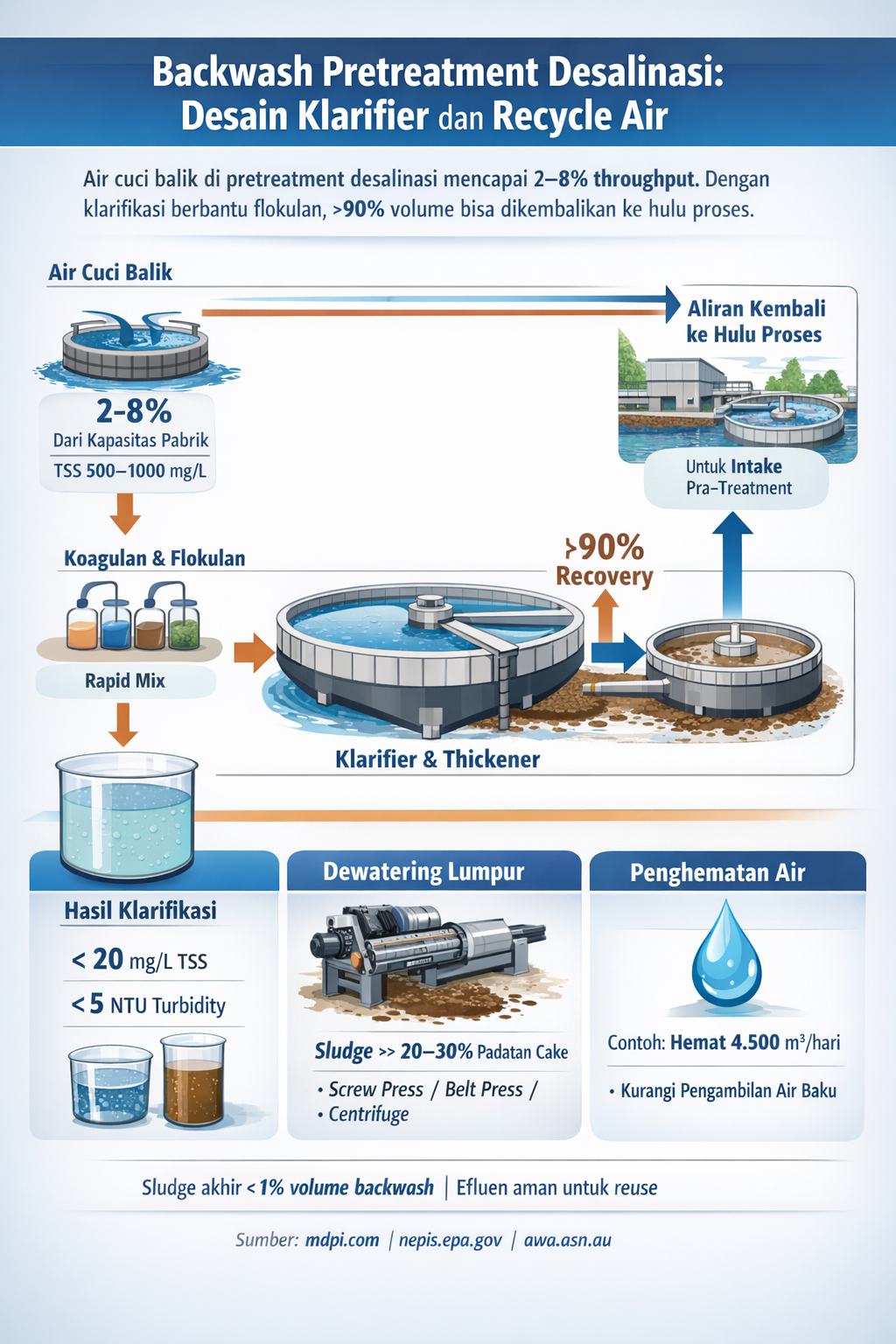
Settled sludge is gravity‑thickened in the same basin or in a separate hopper/tank (nepis.epa.gov), with polymer aid raising sludge solids to ~3–5% by gravity. Many plants use a two‑stage setup (primary clarifier, secondary thickener). One case (Orica groundwater WTP) buffered filter backwash, then used a polymer‑thickened clarifier; underflow went to sewer while overflow was initially intended for reuse (www.awa.asn.au). Thickener effluent solids are typically ~5–10× lower than influent (e.g., 800 mg/L in → ≈80 mg/L out). Where higher clarity is required, a secondary step such as dissolved‑air flotation or membrane polishing (e.g., UF to <1 NTU [nephelometric turbidity units]) is added (www.awa.asn.au).
Water recovery to headworks
The clarified supernatant—typically >90% of influent volume—can be pumped back to the head of pretreatment (raw intake or rapid‑mix), effectively recycling washwater and reducing new seawater intake (nepis.epa.gov) (www.mdpi.com). One study cited up to 100,000 m³/month of backwash (≈3,300 m³/d) safely returned to a ~100,000 m³/d plant, subject to quality criteria (www.mdpi.com). In practice, many facilities recycle 5–10% of raw flow. For a 100,000 m³/d plant with 5% backwash and 90% recycle, that’s ~4,500 m³/d (4.5%) saved. Wolska et al. report ~71,000 m³/year conserved (≈0.78% of a 25,000 m³/d plant’s output) (www.mdpi.com).
Because the recycled stream re‑enters the pretreatment train before RO, it passes through standard barriers again; modest backwash recycling can even improve organics removal compared with baseline (www.mdpi.com). In seawater applications, plants route the recovered water ahead of SWRO trains while applying a low‑level disinfectant—chlorine or UV—to manage pathogens. WHO guidance for restricted reuse is ≤10⁴ CFU (colony‑forming units) E. coli/100 mL (www.mdpi.com), and Indonesian industrial discharge standards (Permen‑LH No.5/2014) set TSS ≤200 mg/L and pH 6–9 (studylibid.com). Well‑run clarifiers typically produce <50 mg/L TSS in overflow, comfortably within those limits.
The economics follow: recycling backwash trims raw‑water demand and brine/disposal volumes, with reported environmental fee savings of €150–250k/year for medium plants (www.mdpi.com) and reduced municipal discharge costs at another site (≈$600k/year) (www.awa.asn.au).
Dewatering and solids handling
Clarifier/thickener underflow (≈0.5–3% solids) is periodically dewatered. Screw presses, belt filter presses, or centrifuges—with polymer conditioning—typically deliver 20–30% solids cake (nepis.epa.gov). If the feed sludge already contains polymer, dewatering performance is often favorable. For scale, treating 1,000 m³ of 0.08% sludge (~800 kg solids) at 20% cake yields ~4 m³ of cake. Even for a large plant (≈5,000 m³/d backwash ⇒ ~4 t solids/d), daily cake volumes land around 20–30 m³/d.
Dewatered cake is managed as solid waste. With non‑toxic coagulants (e.g., polyaluminum without heavy metals), it typically goes to nonhazardous landfill or incineration; agencies note sludge may require dewatering or lime conditioning before landfill (nepis.epa.gov). Some streams find beneficial reuse (e.g., bricks), but most are hauled off‑site. Even at 30% cake, annual volumes from a 100,000 m³/d plant are ~7,000–10,000 m³; dewatering energy and haulage costs are modest compared with water‑savings benefits. Filtrate from dewatering drains back to the head of the plant.
Measured outcomes and compliance
- Water recovery: 80–99% of backwash volume can be recaptured (www.mdpi.com); Wolska et al. conserved ~71,000 m³/year (≈0.8%) at a 25,000 m³/d facility (www.mdpi.com).
- Quality: Clarifier effluent typically <20 mg/L TSS and <5 NTU, within Indonesian limits (TSS ≤200 mg/L; pH 6–9) (studylibid.com).
- Cost: Reduced water purchases and discharge fees (hundreds of thousands $/€ per year in case studies) (www.mdpi.com) (www.awa.asn.au).
- Sludge: Final dewatered cake is <1% of backwash volume by volume after dewatering (e.g., 4 L cake per 1,000 L backwash).
Overall, a data‑driven package—sized clarifier, matched polymer program, and mechanical dewatering—returns clear supernatant to the front end (closing the water loop) and minimizes sludge. This directly reduces a plant’s water footprint, aligns with current or upcoming reuse regulations (including Indonesian PP 22/2021 and Permen‑LH standards) and typically pays back through operational savings and compliance benefits (www.mdpi.com) (studylibid.com).
References and guidance
Technical design data and outcomes are described in recent industry and academic studies (www.mdpi.com) (www.mdpi.com) (www.awa.asn.au), U.S. EPA guidance (nepis.epa.gov) (nepis.epa.gov) (nepis.epa.gov), and Indonesian regulations (www.mdpi.com) (studylibid.com).