
Real‑time control of pH, dissolved oxygen, and temperature is moving from nice‑to‑have to non‑negotiable in larval rearing — and the ROI math is adding up fast. Automated probes, alerts, and dosing are helping farms raise more stock with less labor and energy.
Global aquaculture has doubled since 2000 and is still expanding at roughly 7.5% per year, according to peer‑reviewed analyses (mdpi.com). For hatcheries and larval rearing, those gains are fragile: small swings in pH (acidity level), dissolved oxygen (DO), or temperature can trigger mass mortality. Indonesian guidance likewise stresses tight control of temperature, pH, DO, ammonia and more using multi‑parameter meters (saka.co.id).
One industry expert puts the risk plainly: poor DO monitoring can “mean the total loss of a harvest…in less than an hour” (in-situ.com). That urgency is driving real‑time sensor adoption. Reviews conclude in‑situ sensor networks make “real-time and cost-effective aquaculture management” feasible (mdpi.com), and automation directly addresses the industry’s challenge of “producing more product without increasing operational costs” (in-situ.com).
Integrated sensor networks and PLC control
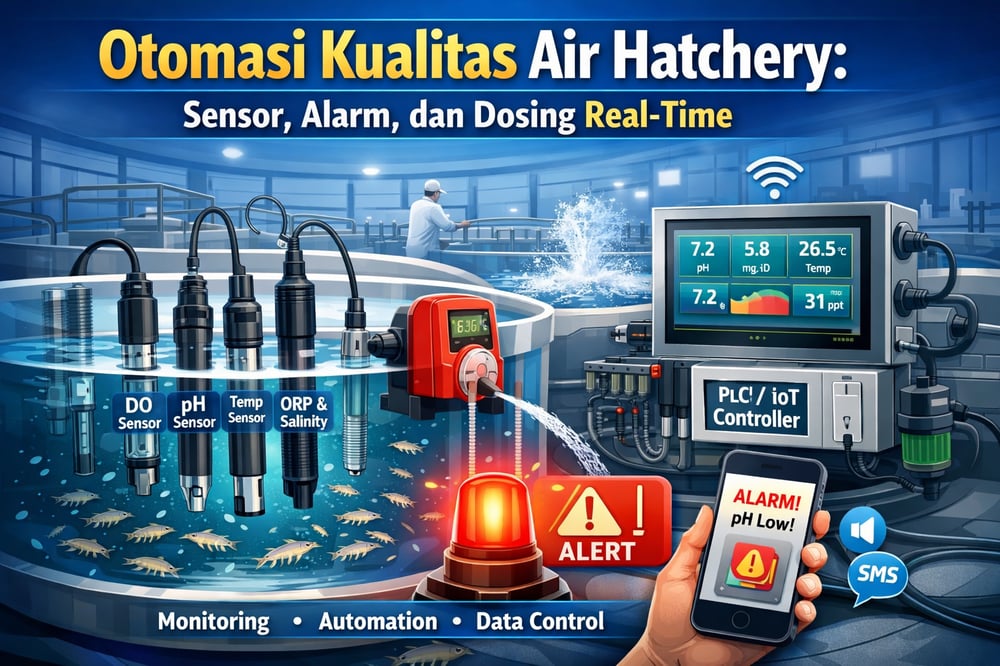
Modern setups blend probes for DO, pH, and temperature with salinity or conductivity and ORP (oxidation‑reduction potential), feeding a central PLC (programmable logic controller) or IoT gateway. Optical DO sensors are frequently chosen for durability and lower drift than galvanic alternatives (in-situ.com). Continuous data log to on‑site servers or cloud dashboards like ThingSpeak (mdpi.com), and automated actions kick in when readings drift.
In practice, a pH probe can trigger buffer dosing, DO probes can power aerators, and temperature sensors can drive chillers or heaters. Wireless IoT designs (e.g., ESP32 Wi‑Fi) push data to mobile apps and can send Telegram/SMS alerts on threshold breaches (researchgate.net; researchgate.net), while platforms deliver “real-time monitoring, automatic data collection and storing” (onlinelibrary.wiley.com) and help fine‑tune aeration, filtration, or feeding schedules remotely (flypix.ai).
Reviews note that modern IoT toolkits readily cover DO, pH, temperature, turbidity, and salinity in real time (onlinelibrary.wiley.com). Multi‑sensor controllers such as the YSI Model 5200A can log and alarm on DO, pH, conductivity, ORP, salinity, and more (onlinelibrary.wiley.com). Expanded I/O modules then drive actuators for dosing and environmental control — including tying alarms directly to dosing pumps for buffering.
Real‑time data, alarms, and dosing control
Automated networks replace spot checks with continuous control loops: precision sensing plus “smart” dosing and ventilation. Data streams can be pushed to ThingSpeak or viewed via ThingView dashboards, depending on the implementation (mdpi.com). Operators commonly use YSI‑class controllers or industrial models such as Walchem 900 or YSI 5500 to support alarms and pump outputs; these controllers slot into existing PLC/IoT stacks.
Placement matters. Probes are typically set at tank inlets/outlets or a well‑mixed sump to capture representative water. Many multi‑tank racks pair mechanical filtration at the sump with disinfection — that’s the architecture referenced in a research hatchery’s automated system, which included “the UV light [and] sump mechanical” equipment as part of a roughly $32,000 install (pmc.ncbi.nlm.nih.gov). Where mechanical polishing is required, managers often specify cartridge filters; when ultraviolet disinfection is needed, purpose‑built ultraviolet units slot easily into the same rack footprint.
Measured productivity and cost impacts
The gains are tangible. Continuous DO control alone lets farms raise stocking density and yields while avoiding mortalities, making operations more productive (in-situ.com). Reliable DO monitoring and responsive aeration “makes ponds productive,” whereas a single prolonged hypoxic event can kill stock (in-situ.com; globalseafood.org). Automated pH buffering keeps larvae in optimal ranges, improving metabolic efficiency.
In Indonesia, an IoT shrimp system study reported that continuous monitoring “can optimize shrimp growth, health, and survival rates” while “lowering labor costs” (researchgate.net). Managers can also tune feeding times and quantities off sensor data to improve feed conversion (flypix.ai).
The labor and energy side improves as well. Studies find integrated IoT suites offer “much simpler set‑up and maintenance” and a “substantially cost‑effective improvement in labor cost” versus manual sampling (mdpi.com). A multi‑tank automated lab system around $32K installed was justified against years of manual checks (pmc.ncbi.nlm.nih.gov). Smart aeration cuts electricity by running blowers only when DO dips (in-situ.com), and automated heaters/chillers maintain tight temperature bands without constant manual adjustment. Alerts to phones shrink response times and avoid needless site visits (flypix.ai).
As one practitioner notes, sensors act like “eyes below the water,” enabling proactive fixes — turn on a pump, dose chemicals — before fish experience stress (in-situ.com; flypix.ai). Numerous case studies note that real‑time data platforms prevent disease outbreaks and mass die‑offs, boosting survival and the consistency of harvests.
Compliance and market documentation
Automated data logs support regulatory monitoring and traceability as standards tighten. Larger producers increasingly demand certified suppliers; smart monitoring can document that water quality targets were met, enabling access to premium markets. Consistent DO and pH control can reduce antibiotic need and deliver more uniform product — a value point for export markets (globalseafood.org).
ROI model for hatchery managers
Capital and OPEX: a multi‑sensor bundle (pH, DO, temperature probes plus controller and communications) typically runs from a few thousand to the tens of thousands of dollars, depending on scale. One research hatchery reported an entire automated rack (sensors, pumps, chiller, controller) at about $32,000 (pmc.ncbi.nlm.nih.gov). Commercial multi‑parameter monitors plus dosing pumps often land in the $5–15K range. Ancillary costs include installation, calibration, and maintenance (electrode replacements, desiccant, power), though many components are reusable and maintenance is minimized by durable optical sensors (in-situ.com).
Payback via increased revenue: consider a hatchery producing 1 million juveniles annually. Even a 1–2% bump in survival or growth under more stable water can mean tens of thousands more fish to sell. At even a few cents per fry, that converts to thousands of dollars — often recouping the system in a year or two. As a concrete example, a 10% survival increase on 1 million larvae (from 80% to 90%) yields 100,000 additional fingerlings; at $0.03–0.05 each, that’s $3,000–5,000 more revenue per batch. Over multiple batches, payoff is rapid. Preventing a single catastrophic DO crash — which can kill 100% of stock — would dwarf annual system cost (in-situ.com).
Cost reductions: labor and utilities stack up. If a technician costs $10–15/hour and spends 4 hours/day on manual testing and adjustments, automation saves roughly $1,200–1,800 per month in labor alone. Targeted aeration or ozone dosing trims energy and chemicals by running only when needed. Studies highlight “substantially” lower labor needs with integrated IoT monitoring (mdpi.com), and the Indonesian prototype noted “lowering labor costs” while optimizing growth (researchgate.net).
Productivity and quality premiums: in recirculating systems, oxygen‑rich, stable ponds can trim harvest cycles by weeks; 5–10% faster growth at early stages effectively boosts throughput and cash flow. There’s a market advantage as well: high‑tech, tightly controlled production supports consistency and sustainability narratives.
Market adoption and scaling strategies
The global aquaculture water‑quality monitoring market was valued at about $3.5 billion in 2022 and is rising ~7–10% annually, per market trackers (linkedin.com). Manufacturers report growing demand for turnkey solutions with IoT analytics (linkedin.com; globalseafood.org). Adoption is highest in intensive commercial farms, where payback is clear on large volumes. Smaller or traditional farmers — common in Indonesia — may prefer subscription or shared models because cost barriers remain (globalseafood.org). Many managers validate business cases with a pilot tank or critical brood unit before scaling.
Implementation checklist and thresholds
System design: cover the critical parameters. For shrimp and larvae, spikes in ammonia or pH can be fatal — so ORP/ammonia sensing is recommended if possible. Use high‑quality multi‑parameter probes and robust controllers (e.g., Walchem 900 or YSI 5500) that support alarms and pump outputs. Opt for well‑protected sensors, such as optical DO and gel‑filled pH, to reduce drift and fouling (in-situ.com; mdpi.com). Position sensors for representative sampling at tank inlets/outlets or in a well‑mixed sump.
Calibration and maintenance: even “smart” probes need periodic calibration (pH in buffers; DO checks) and regular cleaning. Anti‑fouling coatings or mechanical wipers help. A noted drawback of fixed probes is algae fouling, underscoring the need for preventive upkeep (globalseafood.org). Choosing equipment with easily replaceable parts — a feature flagged in one IoT design (“platform” and “ThingView”) — simplifies long‑term care (mdpi.com).
Alerts and controls: initial thresholds are typically conservative. Many managers alarm if DO falls below 5–6 mg/L or if pH drifts ±0.2 units from target. Hysteresis in control logic avoids rapid on/off cycling. Notifications (SMS/Telegram/email) ensure intervention if automated control cannot correct the deviation.
Data use and economics: log data continuously and analyze patterns — daily pH swings or weekly water use — to correlate with growth and survival. Simple before/after metrics (e.g., “monthly mortality dropped from X% to Y%”) help document ROI. While some vendors offer AI‑style prediction, even basic trend alerts add value (flypix.ai; onlinelibrary.wiley.com). On costs, one analysis concluded that even complex automated systems “may seem high” but are “not exorbitant” relative to ongoing labor (pmc.ncbi.nlm.nih.gov). Documented cases show that expanding density while cutting aeration time directly reduces production cost per kilogram (in-situ.com).
On the hardware side, routine items such as controllers, probes, and plumbing are typically paired with supporting water‑treatment ancillaries to integrate dosing, filtration, and alarms cleanly into hatchery racks.
Bottom line
Across studies and field reports, advanced sensor‑driven monitoring is reshaping hatchery management. Real‑time pH, DO, temperature, and more — plus automated dosing and alerts — are associated with higher survival and growth, more efficient feed and aeration use, and sharply reduced labor (in-situ.com; researchgate.net; mdpi.com). Those benefits translate directly into financial returns. Market forecasts of a ~$3–$4 billion segment with ~9–10% CAGR echo that logic (linkedin.com).
A phased approach is common: many teams begin with DO automation, measure mortality and energy reductions, then expand. In Indonesia — where smaller producers dominate — cloud‑based subscription services or joint investments have been used to lower entry costs (globalseafood.org). Avoiding even one stock crash (in-situ.com) or lifting survival by a few percent can more than cover the investment. As one expert summarized, making aquaculture a “data‑driven industry” produces more while “wasting less” (globalseafood.org; globalseafood.org).
