

Industry: Aquaculture | Process: Recirculating_Aquaculture_Systems_(RAS)
In RAS, fish and microbes respire oxygen and produce CO₂, which must be stripped to avoid blood pH shifts that can halve hemoglobin–oxygen (Hb–O₂) affinity and trigger pathologies such as nephrocalcinosis (learn.farmhub.ag). Unlike aeration with ambient air, systems that inject pure O₂—such as low‑head oxygenators (LHOs)—lose most gas‑exchange area and do not purge CO₂; without a dedicated stripper, CO₂ accumulates to toxic levels (researchgate.net) (learn.farmhub.ag). Industry practice is to pair high‑oxygen systems with a comparable CO₂‑removal unit (studylib.net).
Packed‑column stripping towers (counter‑current)
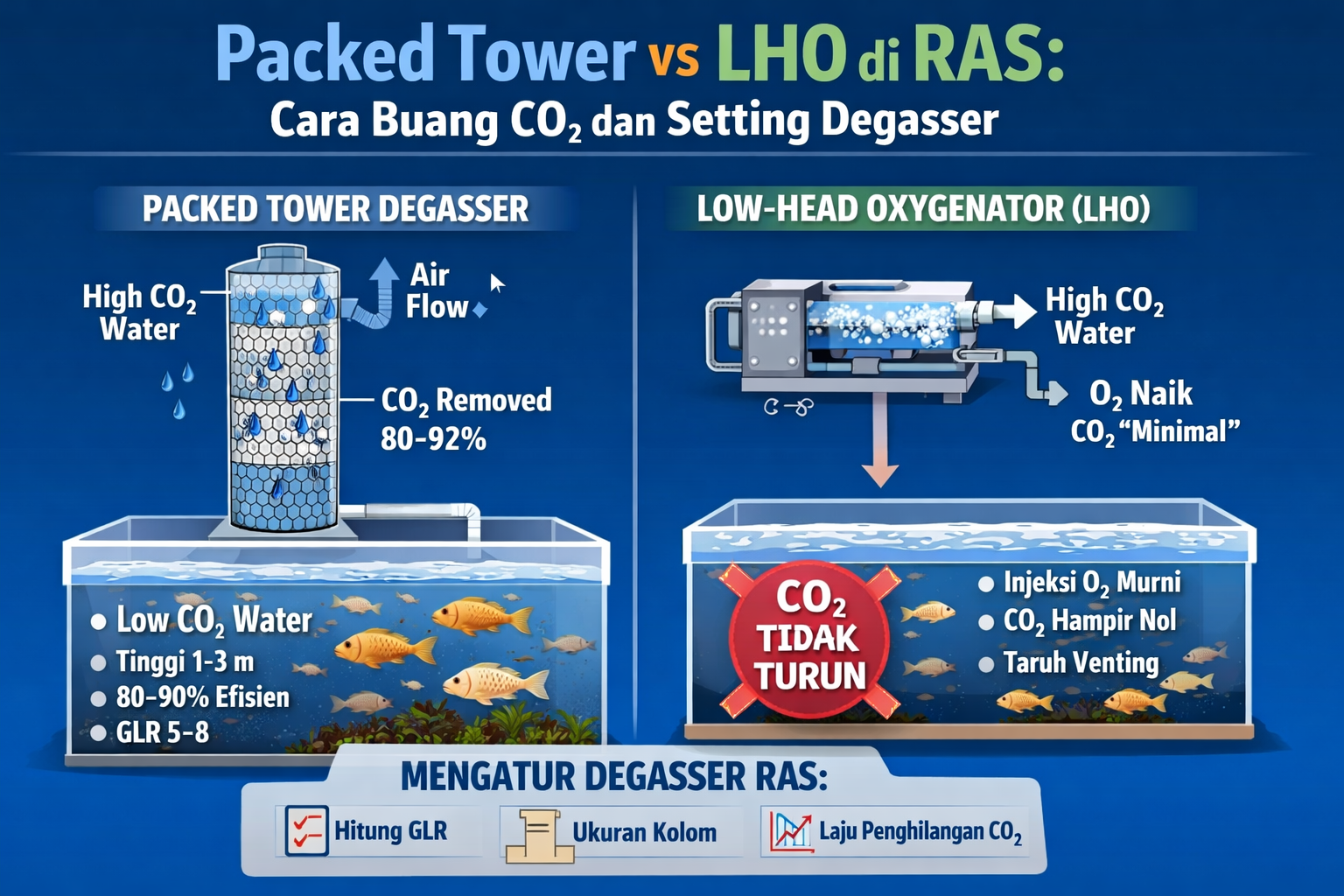
These vertical towers are filled with plastic media; water trickles down while air is forced up in counter‑current flow. The design increases surface area and contact time, driving degassing (researchgate.net) (learn.farmhub.ag).
In lab tests by Hu et al. (2011), single‑pass CO₂ removal reached 80–92% when the air‑to‑water volumetric ratio (gas‑to‑liquid ratio, GLR) was ~5–8; removal asymptoted at about 6.4 mg CO₂/L (≈6.4 g/m³) at high GLR (researchgate.net) (c.coek.info) (c.coek.info). The data fit an exponential model: “CO₂_removed (mg/L) ≈ 6.44 – 5.82·(0.648^GLR)” (r²=0.91), so GLR≈5 reached ≈6.0 mg/L removal (≈85% of the ~7.0 mg/L inlet) and GLR≈8 gave ≈6.4 mg/L (≈90–92% removal) (c.coek.info) (c.coek.info), with minimal gains beyond GLR≈8 (researchgate.net). At typical design conditions (20 °C, fresh water), Henry’s law (H≈1.1) predicts GLR≈5–10 for 80–95% removal, aligning with these results (researchgate.net) (lenntech.com).
c.coek.info researchgate.net Figure: CO₂ removal by packed‑column degasser vs. air:water (G/L) ratio (from Karimi et al., 2020). High GLR yields diminishing improvement.
Field results and tower dimensions
Full‑scale systems rarely match lab ideals. In a salmon farm, two 1‑m towers packed with 4–5 cm plastic achieved only ~36% single‑pass removal at GLR ~9.7, and ~33% at GLR ~5.3 (researchgate.net). Field factors—shorter contact time, biofouling, uneven flow—cut efficiency; 40–70% removal per pass is often cited in practice (researchgate.net).
Towers are typically tall (1–3 m) with open media. Colt & Bouck (1984) recommend ~1–3 m to achieve a ΔP ~20 mmHg CO₂ driving force and ≥90% O₂ saturation; packing size trades height versus air pressure drop. In oxygen‑saturated water (high dissolved oxygen), a vacuum column can shorten the needed height (researchgate.net).
The overall transfer rate (K_La, an overall mass‑transfer coefficient times area) for CO₂ in towers can be on the order of 1–2 h⁻¹ in practice. Eshchar et al. measured K_La ≈1.5 h⁻¹ for a paddlewheel (air‑driven) and 0.76 h⁻¹ for a diffused‑air aerator, yielding 1.2 and 0.9 kg CO₂/kWh, respectively—implying ~0.8–1.2 kW per kg/h of CO₂ removed. Packed‑tower energy use is similar (researchgate.net) (researchgate.net).
Cascade and spray towers (ventilated)
Open‑aeration devices—waterfalls over baffles or stacked blocks—operate like packed towers but with simpler media. In Summerfelt’s 2003 study (0.9–1 m tall “forced‑ventilated cascade” towers), single‑pass removal was ~22% at GLR ~2.5, ~33% at GLR≈5.3, and ~36% at GLR≈9.7. Each 1 m pass removed only ~0.5–6 mg/L depending on GLR, so multiple stages or very high airflow are needed for >80% removal (researchgate.net). Cascade units often plug with solids less than fine‑packed columns. Plugging and bed fouling are recurring concerns; separate solids removal units—such as a manual screen (removes debris >1 mm)—are outside the scope of the cited tests.
Oxygenators: O₂ in, CO₂ stuck
LHOs (stacked plate or spiral contactors) are built to inject pure O₂, with high oxygen‑transfer efficiency (reported up to ~2 kg O₂/kWh and, with head, up to 80 kg O₂/kWh), but have very limited CO₂‑stripping capability. With only an LHO and a closed headspace, CO₂ accumulates because no external low‑CO₂ air is contacted with the water (researchgate.net) (researchgate.net) (learn.farmhub.ag). They are always used alongside a venting step; for example, Glaciersprings Trout Farm (Canada) ran cascade columns ahead of an LHO to strip CO₂ before final O₂ saturation (researchgate.net). The prudent assumption is ~0–10% CO₂ removal per pass from the LHO itself—essentially zero without venting (learn.farmhub.ag) (studylib.net).
Other aerators—venturi injectors, paddlewheels, diffusers—strip CO₂ by creating surface area but are less controllable than towers. A paddlewheel (blown air) reached K_La≈1.55 h⁻¹ with ~1.2 kg CO₂/kWh; a diffused‑air aerator delivered K_La≈0.76 h⁻¹ and ~0.9 kg/kWh (researchgate.net) (researchgate.net). Only dedicated degassing towers ensure controlled CO₂ removal (learn.farmhub.ag) (studylib.net).
Comparative effectiveness and energy
Packed tower (1–3 m tall): >80% removal achievable in lab at GLR≈5–8 (80–92%); field columns often see 30–60% per pass. K_La on the order of 1–2 h⁻¹ (CO₂) depending on height and media; energy roughly ~1 kg CO₂ removed per kWh (researchgate.net) (c.coek.info) (studylib.net).
Cascade (0.5–1 m per stage): ~20–40% removal per stage at GLR=3–6; K_La typically ≤1 h⁻¹ (researchgate.net).
Low‑Head Oxygenator: ~0–10% CO₂ removal per pass (essentially none without venting). High O₂ transfer (2–80 kg O₂/kWh with head), but CO₂ must be stripped separately (learn.farmhub.ag) (studylib.net) (researchgate.net).
Other aerators (paddle, diffusers): Limited by surface. Diffused‑air K_La≈0.76 h⁻¹ and ~0.9 kg CO₂/kWh; paddlewheel K_La≈1.55 h⁻¹ and ~1.2 kg/kWh (researchgate.net) (researchgate.net).
Design targets and CO₂ thresholds
Design targets follow fish tolerance. Blood‑acid organoleptic studies suggest keeping CO₂ below ~5–10 mg/L (CO₂ partial pressure <3 mmHg) in trout/salmon; some species tolerate more. RAS are often run at ≤10–15 mg/L CO₂ in tank effluent (learn.farmhub.ag).
Step‑by‑step sizing guide (by load and flow)
-
Estimate CO₂ load. Fish metabolic CO₂ ≈ 0.6–0.7 kg per kg feed consumed. If feeding at F (kg/day), CO₂ ≈ 0.66·F (kg/day). Example: 100 kg feed/day ⇒ ~66 kg CO₂/day (≈2.75 kg/h). Alternatively, base on O₂ demand: for salmonids assume ~20 g O₂/kg·h at ~15–20 °C; with respiratory quotient RQ≈0.9, CO₂ output ≈18 g/(kg·h). Thus 1,000 kg fish consume ≈20 kg O₂/h and produce ≈18 kg CO₂/h (researchgate.net).
-
Determine water flow through the degasser. Let the recirculating flow Q (m³/h) cycle the tank multiple times per hour. The needed per‑pass drop is ΔC (mg/L) = CO₂ production [mg/h] / Q [L/h]. Example: 2.75 kg/h production (2,750,000 mg/h) at Q=400 m³/h (400,000 L/h) needs ΔC≈6.9 mg/L; the stripper must reduce CO₂ by that amount (e.g., from ~8 mg/L to ~1 mg/L).
-
Choose GLR (air:water ratio). GLR≈5–8 achieves ~80–90% removal of that ΔC in one pass. Treating 400 m³/h implies air ≈ 2,000–3,200 m³/h (≈0.6–0.9 m³/s). Lower GLR can work with multi‑pass; higher GLR asymptotically approaches 90–95% removal but at higher energy cost. Diminishing returns set in beyond GLR≈8 (researchgate.net) (c.coek.info).
-
Column dimensions. Set superficial water velocity and packing height for the needed ΔC. For 80–90% removal, ≥2 m packed height is common. Cross‑section follows from Q and allowable velocity; e.g., 400 m³/h over 2 m² gives ~0.055 m/s. A 3 m height is a typical starting point. Colt & Bouck suggest 1–3 m for ΔP≈20 mmHg CO₂; media with large voids reduce clogging but require more height. In oxygen‑saturated water, a vacuum column can shorten height (researchgate.net).
-
Validate K_La / removal. Using C_out = C_in·exp(–K_La·t) with t = H/V (height/velocity): for H=3 m, Q=400 m³/h over A=4 m² ⇒ V≈0.028 m/s ⇒ t≈107 s. With K_La=1 h⁻¹ (=0.000278 s⁻¹), exp(–K_La·t) ≈ 0.97—far too small a reduction—indicating effective K_La must be much higher in packed media; vendor or empirical data are typically used to refine t and A.
-
Energy and air. A rule of thumb is ~1 kWh of blower per 1–1.2 kg CO₂ removed. In the example, removing 66 kg/day (2.75 kg/h) at ~1.2 kg/kWh implies ~2.3 kW blower (researchgate.net).
-
Field margins and fouling. Because actual efficiency is often lower (e.g., rapid loading, biosolids, temperature), design conservatively. Studies note ~40–50% per pass in practice; multiple towers or higher GLR may be needed. Bed fouling should be planned for accessible cleaning (researchgate.net). Separate filtration steps—such as a cartridge filter (removes 1–100 micron particles)—are distinct unit operations and not covered by the cited degassing tests.
Rule‑of‑thumb capacity matching
A practical rule is to match degasser capacity to oxygenation capacity: a system delivering O₂ at rate X should strip the CO₂ load corresponding to that oxygen delivery (studylib.net). Numerically: CO₂ to remove (g/h) = (fish biomass kg) × (gO₂/kg·h) × RQ ≈ (kg feed/day × 0.66 / 24) × 1000. Given water flow Q (m³/h), ΔC = (g/h CO₂)/(1000·Q). Choose GLR≈5–8 to achieve that ΔC, then set column area based on practical velocities (~0.02–0.1 m/s) and ~2–3 m height. Each RAS is unique, so empirical adjustment is typical; beyond GLR 8–10, additional CO₂ stripping is minimal (researchgate.net) (c.coek.info). Designers aim to hold tank CO₂ at safe levels (e.g., <10–15 mg/L) by matching degasser throughput to fish load (researchgate.net) (studylib.net).
Sources: Peer‑reviewed RAS engineering studies and reviews (researchgate.net) (researchgate.net) (researchgate.net) (studylib.net), plus technical analyses (learn.farmhub.ag) (researchgate.net). All performance figures and calculations above are drawn from these references.