

Industry: Aquaculture | Process: Solid_Waste_Removal_&_Sludge_Treatment
Fish‑pond and recirculating aquaculture system (RAS) sludge are nutrient‑rich wastes that, when treated, perform like slow‑release fertilizer and a soil conditioner. Mature “pond sediment” composts have clocked organic carbon near 30–35%, total nitrogen around 1.5–1.8%, phosphorus at ~0.8–1.1% on a P₂O₅ basis (a standard fertilizer expression for phosphorus pentoxide), and potassium near 1.5–1.6% (K₂O form of potash) (link) (link).
One analysis reported 321 g C/kg (32.1% organic carbon), 16.9 g N/kg (1.69% N), 0.83–1.14% P₂O₅, and 1.52–1.61% K₂O, with compost C:N ratios trending ~15–18—low enough to support nutrient availability (link) (link). Blending pangasius pond sludge with rice straw at 30% sludge + 70% straw delivered the highest organic matter and total N among mixes, and passed 15 out of 18 Vietnamese regulatory quality indicators for organic fertilizer (link) (link). Compositions compare well to manure‑based fertilizers and add organic matter that improves soil structure.
Physical separation and thickening train
Capturing solids efficiently upstream makes valorization easier. Farms can deploy primary treatment systems such as wastewater physical separation to concentrate sludge before composting or digestion.
For continuous debris removal above 1 mm, an automatic screen can stabilize loading to downstream units. Where gravity clarification fits, a clarifier provides 0.5–4 hour detention for suspended solids removal, while a compact lamela settler can reduce footprint by 80% compared to conventional clarifiers.
To boost settling, polymer aids like flocculants enhance particle aggregation and can improve clarifier efficiency by 30–50%. For finer solids and fats, a DAF unit can remove 95%+ suspended solids and oils within 1–3 hours of detention, creating a thicker sludge that is easier to handle.
Downstream, conditioning with sludge treatment chemistry can reduce sludge volume by 60% and improve dewatering characteristics prior to composting or digestion. Facilities can integrate these with ancillary wastewater equipment as needed.
Aerobic composting stabilization
To safely apply sludge on fields, aerobic composting (stabilization with oxygen and bulking agents) is recommended. Composting with straw or vegetation waste kills pathogens and yields a hygienic product that matures in ~6–8 weeks, with pH ≈7–8, water‑holding capacity >3 g water/g, and an odor described as “forest soil” (link) (link).
Aerobic composting destroys pathogens and transforms soluble nitrogen into more stable organic forms (link). Indonesian compost guidelines (Perm.70/2011) require organic fertilizers to meet strict C/N, heavy metal, and microbial standards; they specify minimum organic C (>15%), maximum C/N (<25), and caps on contaminants (Pb, Cd, Hg, As, typically in tens‑of‑mg/kg), plus absence or very low counts of pathogens like E. coli and Salmonella (link).
In composts tested to those criteria, no Salmonella or excess coliforms were detected and the germination index (GI, a phytotoxicity indicator) was >89% (link). Heavy metals were low—Cu ≈244 mg/kg, Zn ≈812 mg/kg, Pb ≈62 mg/kg—typically below regulatory maxima (link). Compost with sludge also improved soil organic‑C and structure over time (link).
Nutrient outputs and cropping trials
Trials confirm sludge‑based composts are effective fertilizers. Recycled fish sediment plus straw, combined with partial chemical NPK (nitrogen‑phosphorus‑potassium), produced high vegetable yields; using 30% pangasius sludge + 70% straw with reduced NPK sustained cucumber and water spinach yields while cutting chemical use by 25–75% (link).
Highest cucumber yields were observed with a 50%‑chemical/50%‑organic mix, and water spinach with 25%/75%; in both cases, 100% organic (no chemical) yielded markedly lower than mixed regimes (link). In one study, the optimum 50% inorganic + 50% sludge compost delivered ~28.7 t/ha cucumber in the wet season (link).
Application rates and replacement potential
Application rates vary—10–30 t/ha of compost is reported to match crop N needs. As a rule of thumb, every ton of dry organic material contributes ~10–15 kg N, with less P/K. With ~1.5% N, 20 t/ha of sludge‑based compost provides ~300 kg N/ha in slow‑release form, enough to replace 25–50% of usual nitrogen inputs in many systems.
Anaerobic digestion and biogas production
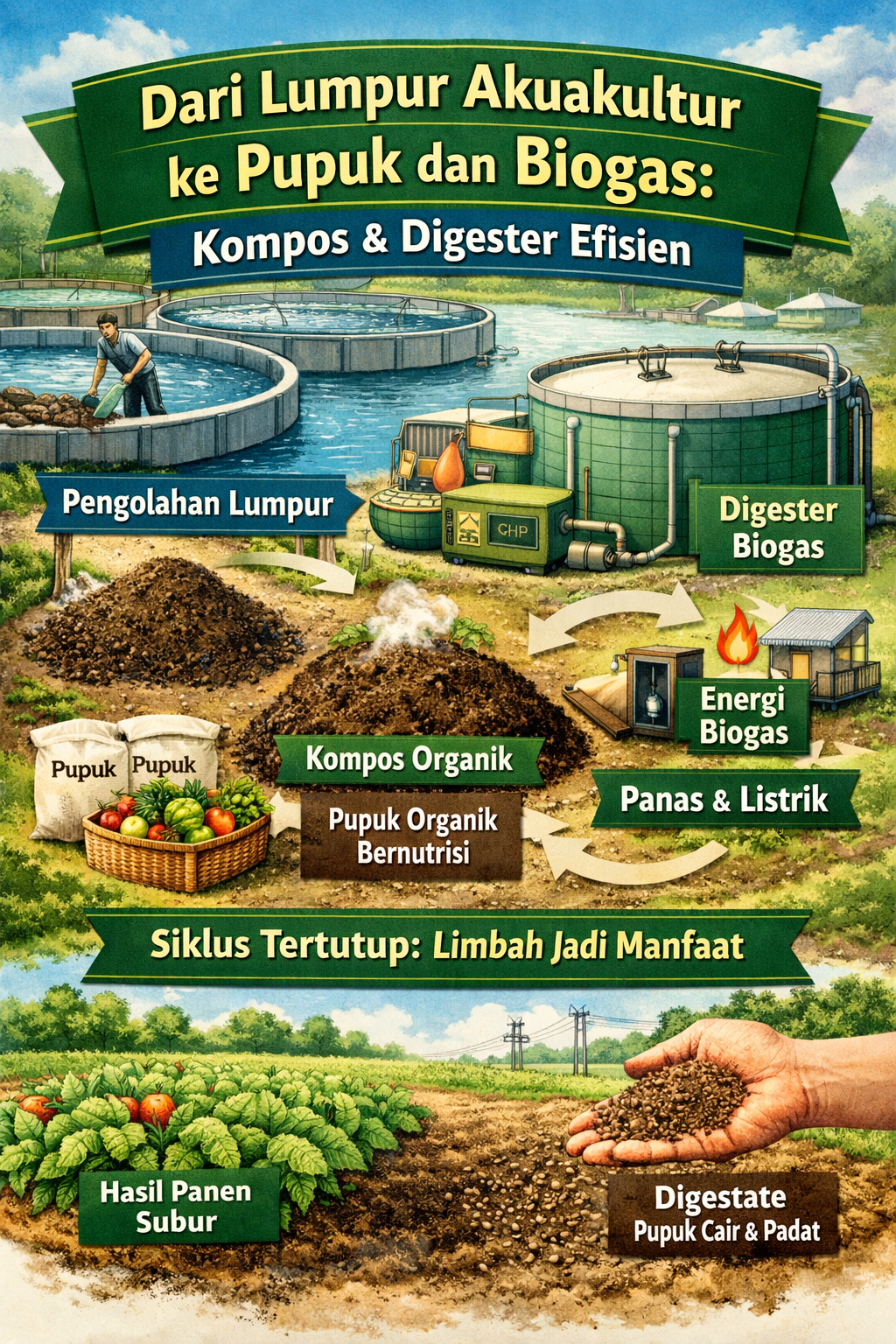
Anaerobic digestion (AD, microbial conversion of organics without oxygen) can turn sludge into biogas. Methane potential has been measured at ~229 L CH₄/kg VS (volatile solids, the combustible organic fraction) for African catfish RAS sludge in batch tests; a continuous stirred‑tank reactor (CSTR) on pure sludge yielded ~265 L/kg, while co‑digesting with 25% cucumber plant residue boosted output to ~381 L/kg. A UASB (upflow anaerobic sludge blanket) reactor reached ~329 L/kg (link) (link).
These figures line up with literature on marine and brackish aquaculture sludge: ~0.26–0.28 L CH₄/g VS (260–280 L/kg), and 0.27–0.33 L CH₄/g VS in other trials (link) (link). Sludge often contains ~50–70% VS; ponds run ~5–8% total solids (TS), whereas RAS sludge can be very dilute (~1% TS) (link). Low TS/dilution reduces per‑reactor yield and can increase H₂S; co‑digestion with manure, crop residues, glycerol, or similar substrates is often recommended to raise organics and balance C:N, and has been shown to increase CH₄ significantly (link).
The energy math is straightforward: 1 m³ of biogas (~60% CH₄ typical) equals ≈6.5 kWh of energy (link). The 229–381 L CH₄/kg VS above (0.229–0.381 m³) correspond to ~1.5–2.5 kWh per kg VS; digesting 1 tonne of sludge‑based VS could produce ~229–381 m³ CH₄, or ~1.5–2.5 MWh of heat/electricity (link) (link).
In practice, integrated farms leverage this synergy. In Germany, warm‑water RAS catfish farms have been co‑located with biogas CHP (combined heat and power) plants, using digester heat to warm fish tanks. The CHP can sell electricity or heat, while the attached aquaculture facility uses the waste heat and recycles nutrients in a closed‑loop setup (link).
For farms building out AD, packaged anaerobic digestion systems offer standardized train components for aerobic or anaerobic stages prior to energy recovery.
Digestate fertilizer use
Digestate (the solid/liquid residue after AD) is also a fertilizer. Most nitrogen is in ammonium form (plant‑available), and phosphorus and potassium are conserved. Studies indicate digestate can support plant growth comparably to raw manure or compost; while full data on aquaculture digestate is still limited, by analogy to manure digestates it would concentrate nutrients (link). Digestate can be applied as a slurry or after dewatering as a pelletized fertilizer—subject to pathogen and heavy‑metal testing before field use.
Regulatory criteria and safety
Indonesia’s Perm. 70/2011 sets quality criteria for organic fertilizers—organic C content, C/N ratio, macro‑nutrient content (N, P₂O₅, K₂O), and contaminant limits (heavy metals and pathogens). The Ministry specifies minimum C (>15%), maximum C/N (<25), and caps on Pb, Cd, Hg, As (usually in tens‑of‑mg/kg), along with absence or very low counts of E. coli and Salmonella (link). Properly composted or digested products typically meet these standards if raw sludges are uncontaminated; Karak et al. reported safe heavy metals (Zn ~812 mg/kg, Pb ~62 mg/kg) and GI tests at 89–96% (non‑phytotoxic) (link) (link).
If needed, additional treatments—pasteurization or lime stabilization—can further ensure safety. Before field use, farms should test the final material against regulations. Converting sludge to fertilizer not only recovers nutrients but also aids compliance: dumping untreated sludge into waterways causes pollution, whereas controlled compost/digestion recycles those nutrients legally, “closing the loop” (link). Where discharge polishing is still required, biological trains with nutrient removal can reduce N and P to <10 mg/L to prevent eutrophication.
Integrated benefits and key figures
Valorizing sludge yields multiple gains. In integrated systems combining fish and crops (or livestock), sludge feeds plants or digesters, biogas heat feeds the fish, and closed‑loop nutrient recycling enhances production. Case studies emphasize these synergies and income gains from reused nutrients and reduced energy costs (link) (link). Given aquaculture’s rapid growth—Indonesia’s production is millions of tonnes and rising—capturing value from sludge turns a disposal cost into farm inputs (fertilizer and energy) and potential new revenue (e.g., selling excess biogas or organic fertilizer).
Key figures: studies documented 25–75% cuts in chemical fertilizer without yield loss when using sludge compost blends (link). Biogas yields of ~229–381 L CH₄/kg VS translate to ~1.5–2.5 kWh/kg VS and ~1.5–2.5 MWh per tonne of sludge‑based VS (link) (link). Compost nutrient analyses (N ~1.6%, P₂O₅ ~0.9%, K₂O ~1.6%) confirm large‑scale application can supply substantial crop N‑P‑K (link) (link). Altogether, trials show that with composting or anaerobic digestion, aquaculture sludge is a proven resource for sustainable fertilization and renewable energy on farms (link) (link).
Sources and further reading
Authoritative studies and reports (peer‑reviewed journals, FAO‑style guidelines, and Indonesian government regulations) underpin these findings. Key sources include Dang et al. 2024 (VNU Journal), Chau et al. 2021 (Clean Tech & Environmental Policy), Klein et al. 2024 (Frontiers), Karak et al. 2013 (Clean – Soil, Air, Water), Nguyen et al. 2020 (MDPI Agronomy), and Indonesian regulation texts (link) (link) (link) (link), among others.