

Industry: Aquaculture | Process: Wastewater_Treatment
Global aquafarming hit a record 130.9 million tonnes in 2022, accounting for 51% of all fish and seafood, according to the UN’s food agency (Reuters). The FAO’s “Blue Transformation” vision aims for roughly +35% growth by 2030 (AP). Intensification, however, concentrates uneaten feed and excreta rich in nitrogen (N) and phosphorus (P) per farm — a 100‑tonne‑per‑year finfish site (feed conversion ratio ~1.8) can release on the order of 7–8 tonnes of N and 1.2 tonnes of P annually into surrounding waters (Frontiers in Marine Science).
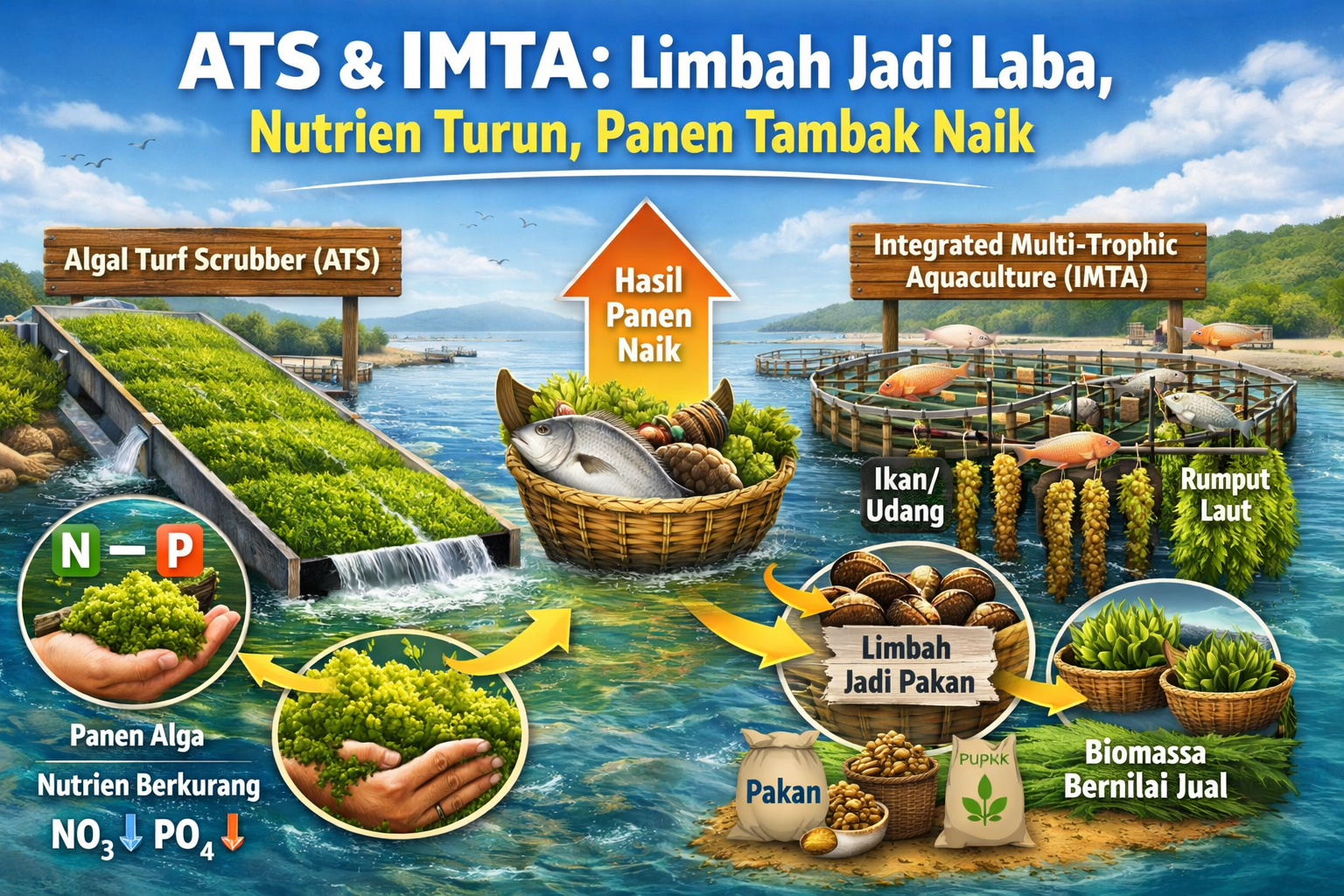
Untreated, those loads drive eutrophication in lakes, rivers and coastal areas — and pose rising compliance risks under national discharge limits on BOD (biochemical oxygen demand), N and P. For small‑to‑medium farms, two nature‑based tools are drawing attention for cost and co‑product value: algal turf scrubbers (ATS) and integrated multi‑trophic aquaculture (IMTA).
Pre‑screening and solids control
Before any bio‑based polishing, many farms start with simple primary treatment — for example, removing coarse debris using a manual screen or other front‑end solids control. Where footprint is tight, a compact inclined settling stage such as a lamella settler can cut suspended solids that would otherwise shade algae or smother filter feeders.
Algal turf scrubbers (ATS) overview and performance
ATS are shallow, sloped flow‑ways seeded with attached algae (periphyton) that strip dissolved nutrients as water pulses over the “turf.” In a bench‑scale, seeded ATS growing the green seaweed Ulva, researchers reported complete removal of phosphate (PO₄³⁻) in 24 hours and of ammonium (NH₄⁺) in 24 hours once the system was 18 days mature; Ulva coverage reached ~74% of the substrate and daily biomass growth was ~4.8% per day (Springer).
In a recirculating aquaculture system (RAS; closed‑loop systems that continuously treat and reuse tank water) with freshwater mussels, units fitted with ATS panels ran with “significantly lower levels of nitrate and phosphate” than identical systems without ATS (ammonia and nitrite were already low in both cases) (ResearchGate).
Key figures from ATS research include nutrient removal on the order of tens of mg/L per day, and algal biomass production at a few percent of standing biomass per day. Field and lab data suggest roughly 10–50 g N removal per square meter per day is achievable with healthy turf, with actual rates driven by light, flow and loading. By comparison, pig‑ or fish‑farm effluents often contain ammonia‑N in the tens to hundreds of mg/L, nitrate 0–150 mg/L and phosphate up to tens of mg/L (SciELO).
ATS biomass as revenue
Harvested ATS algae are nutrient‑ and carbon‑rich — often 20–40% protein, especially when grown in nitrate‑rich water (ResearchGate). One applied study converted ATS‑grown algae, via black soldier fly larvae, into tilapia feed with no loss of fish growth (Georgia Southern University). Macroalgal biomass (Ulva, Gracilaria, duckweed) can be sold directly as fish/shrimp feed or as a soil amendment, offsetting ATS cost. Capital outlays are largely channel construction and pumps, while operational costs are low (sunlight is the energy source). Case reports from the US and Europe indicate that even moderate ATS footprints (tens of m²) can supply feed‑grade algae while reliably polishing nutrient effluent.
IMTA nutrient capture and added yield
IMTA co‑cultures complementary species so one organism’s waste becomes another’s resource — for example, fish or shrimp alongside filter feeders (mussels, oysters) and photosynthetic feeders (seaweeds, kelp, duckweed). Seaweeds can assimilate large fractions of dissolved N and P; Ulva in land‑based RAS trials has removed ~27–92% of different N forms, and in one study Ulva lactuca removed ~27% of NH₄‑N, 46% of NO₂‑N and 10% of PO₄‑P from fish tank effluent (ResearchGate). A classic trial (Krom et al. 1995) found 24% of total inorganic N and 43% of total P were retained by Ulva grown on fish outflow.
Filter feeders help by consuming particulates and uneaten feed; oysters and mussels have high C:N:P ratios (~140–170:21–35:1 in tissue), sequestering nutrients while improving clarity and oxygen. One farmed mussel can clear more than 20 liters of water per hour. In a conceptual 100‑t/y finfish farm, adding 100‑t/y of mussels (and seaweeds) was estimated to remove ~19% of N and 22% of P from fish wastes (Frontiers in Marine Science). (Ten tonnes of oysters would add a few percent more N capture.)
IMTA raises total output per unit feed, too. In one experiment co‑culturing tilapia with mussels and Ulva, the integrated “All‑Mussel‑Fish” treatment produced ~1.86 times as much total biomass as the feed input weight — for each 1 kg of feed given to fish, the system generated ~1.86 kg of usable biomass (fish + mussels + seaweed) (ResearchGate). A simpler fish + algae IMTA treatment still exceeded a 1:1 output:input ratio in that study (ResearchGate). Guidance from NOAA highlights IMTA as a tool to reduce finfish‑farm impacts, noting shellfish or seaweeds can cut dissolved nutrient loads and improve water quality around cages (NOAA).
Field outcomes and water‑quality benchmarks
Empirical IMTA and aquatic‑plant systems often achieve tens of percent removal per cycle. An on‑farm constructed wetland treating pond effluent removed ~30–50% of total nitrogen and ~21–47% of total phosphorus over multiple years, and its discharge consistently met local Class I freshwater criteria for TN and TP (MDPI). Seaweed ponds have shown >90% nitrate‑N uptake in a few days under high loads with continuous culture (Springer), and modeling suggests that mussel longlines can intercept ~19% of N and 22% of P from a 100‑t/y finfish farm (Frontiers in Marine Science).
The biomass upside is non‑trivial. A 100‑t/y mussel unit can incorporate many tonnes of N into shellfish tissue annually (given mussel tissue C:N ~140:21), while seaweed harvests in IMTA have been reported at roughly 10–30 tonnes dry weight per hectare per year depending on species and conditions. In Ulva experiments on fish effluent, growth up to ~60–80 g dry weight per square meter per day has been noted under strong nutrient loading.
In controlled trials, ATS or IMTA filters have kept nitrate and phosphate near zero (ResearchGate; Springer), whereas untreated RAS or pond discharge typically carries ~5–20 mg/L nitrate‑N and 1–5 mg/L phosphate.
Implementation scale, costs and regulation
ATS and IMTA are modular and low‑tech, fitting small and mid‑sized farms. An ATS can be a simple trough or sloped channel with inexpensive matting; pumps or siphons circulate pond effluent. Operating costs are modest because sunlight drives algal growth. IMTA requires space and stock management, but polyculture is already common in countries like Indonesia (for example, seaweed with shrimp), and off‑bottom seaweed lines or floating mussel rafts can be added near cages at relatively small capital cost. NOAA guidance underscores the water‑quality benefit when adding shellfish or seaweeds near finfish cages (NOAA).
In Indonesia, pond farm discharges are governed by classed water quality standards (e.g., PP 22/2021, Permen LHK), commonly targeting BOD<40–100 mg/L and inorganic N and P below ~20 mg/L depending on receiving‑water class. By removing ~30–90% of nutrients, ATS/IMTA helps farms comply and reduces conflict with downstream users.
Engineering add‑ons and polishing steps
Where biological polishing is paired with conventional equipment, primary screening can be followed by compact settling or flotation; some operators use a physical separation train up front before algae or filter feeders do their work.
When biological oxygen demand is still a concern upstream of ATS or IMTA, aerobic biofilm systems like a moving bed bioreactor (MBBR) are commonly selected to stabilize loads before nutrient capture.
Settling performance can be aided chemically where allowed; in those cases, farms often standardize coagulant addition via a coagulant program in clarifiers to improve solids removal.
For final solids polishing after wetlands, ATS or IMTA, many opt for a gravity media stage such as a sand/silica filter to protect downstream channels or reuse loops from fine particles.
Where pathogen control is specified by buyers or regulators, low‑chemical disinfection via ultraviolet systems is often added downstream of nutrient polishing to stabilize microbial counts.
Revenue pathways and local markets
ATS and IMTA create saleable co‑products. Seaweed and shellfish from IMTA enter food markets or cottage industries; harvested algae can be dried for fertilizer or used as an animal‑feed ingredient. In some regions, policies support selling algal biomass as organic fertilizer, and treating aquaculture effluent with duckweed can yield biomass with ~33–39% protein (dry weight) suitable as feed (ResearchGate), effectively converting waste nutrients into value.
Bottom line and key figures
Both ATS and IMTA leverage biology to remove waste cheaply while producing biomass. Bench and pilot ATS units have dropped phosphate to near zero in 24 hours (<0.1 mg/L PO₄) and removed NH₄ ~100% in a day once mature (Springer). IMTA mussels have been estimated to sequester ~19% of farm N in a 100‑t/y finfish scenario (Frontiers in Marine Science). Constructed wetlands in aquaculture have removed roughly 40% of total N and total P on average across seasons, with multi‑year ranges of ~30–50% TN and ~21–47% TP (MDPI). Integrated ponds have yielded net outputs exceeding inputs (1.14–1.86× output vs. feed weight) in experiments (ResearchGate).
For small‑to‑medium farms — especially as national water rules tighten — these eco‑engineered systems offer a practical path to reduce aquaculture pollution while recovering value from waste. Sources for the figures above include peer‑reviewed studies and agency summaries: Springer; ResearchGate; ResearchGate; ResearchGate; Frontiers in Marine Science; MDPI; Reuters; AP; and NOAA.