
Commercial recirculating aquaculture systems are wiring in-line pH probes to dosing pumps to hold water chemistry steady within ±0.1–0.2 pH units. The payoff: optimized biofilters, safer ammonia levels, and smoother growth curves backed by stoichiometry and real-time control.
In intensive fish farming, pH isn’t a nice-to-have. It’s a growth lever. Operators of recirculating aquaculture systems (RAS) target a steady neutral-to-mildly basic pH—typically ~7.0–7.8—to keep biofilters humming and fish stress at bay (Yokogawa) (ResearchGate). Low pH spikes metal solubility; high pH increases the toxic un‑ionized fraction of ammonia (NH₃), both of which erode performance (Saka.co.id) (Yokogawa).
Young warmwater fish show stress outside ~6.5–9.0 pH (Yokogawa) (ResearchGate). Indonesian guidelines (PP No.82/2001) allow 6–9 pH (Saka.co.id), but most RAS operators aim for ~7.5–8.5 (ResearchGate), and they pair that with alkalinity (buffering capacity) around 50–150 mg/L as CaCO₃ to blunt swings (SRAC via Studylib) (Cornell/Slideplayer).
Why engineers obsess over decimals: at 25 °C, roughly 0.5% of total ammonia nitrogen (TAN, the sum of NH₃ and NH₄⁺) is NH₃ at pH 7.2, but >3% at pH 8.0 (Yokogawa). Keeping pH near ~7.2 helps hold NH₃ below the ~0.01 mg/L safe limit cited for salmonids (Yokogawa) (Wiley). In a well‑buffered RAS, pH can be held within ±0.1 units over a cycle.
In‑line sensing and closed‑loop dosing
Modern RAS favor continuous in-line pH electrodes (glass probes with automatic temperature compensation) over spot checks, feeding real‑time readings to a controller (Wiley). The controller—PLC or microcontroller—compares the signal to a setpoint (e.g., 7.5) and actuates a dosing pump using PID or on/off with hysteresis. If pH falls, the pump injects buffer; if it rises, dosing stops. Many systems log trends and alarm on sensor drift or pump failures (Wiley) (Wiley).
On hardware, farms deploy chemically compatible peristaltic or diaphragm units; a purpose‑built dosing pump provides accurate chemical dosing that ties neatly into the control logic.
Sodium bicarbonate as buffer
The dosing solution is typically sodium bicarbonate (NaHCO₃) because it dissolves readily, buffers gently (pKa≈6.3), adds carbonate alkalinity, and avoids sharp pH spikes that sodium hydroxide or lime can cause (SRAC via Studylib). Stock solutions of 20–30% w/v are held in a day tank; the pump draws from this reservoir and injects upstream of the biofilter or into a mixing loop to prevent local high‑pH pockets.
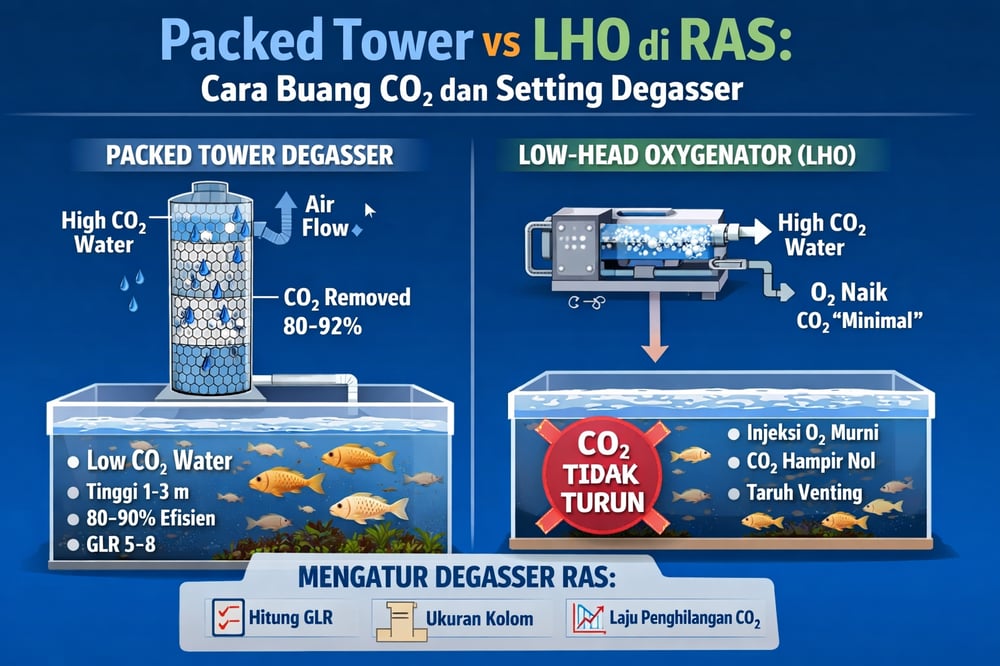
The flow rate is calibrated so a short dose offsets the expected acid load from nitrification. As a rule of thumb: 1 g NaHCO₃ in 1 L water provides ~0.6 mg/L CaCO₃ of alkalinity; larger volumes scale accordingly. Operators also integrate CO₂ degassing—cascade or aeration—because fish respiration lowers pH; keeping CO₂ below ~10–15 mg/L further stabilizes the system (Cornell/Slideplayer).
Alkalinity demand from feed load
Daily alkalinity requirements track the nitrogen chemistry. Each unit of feed yields roughly 2–3% of its weight as excreted ammonia‑N; SRAC cites ≈2.2 lb NH₃‑N per 100 lb feed (~0.022 kgN/kg feed) (SRAC via Studylib). Complete nitrification of 1 mg NH₄⁺‑N produces 2 H⁺ (NH₄⁺ + 2O₂ → NO₃⁻ + 2H⁺ + H₂O) (Aqua‑Partners DK).
Chemically, each mole of H⁺ (1 equivalent) consumes 50 mg CaCO₃ because CaCO₃ neutralizes two H⁺ per 100 mg (i.e., 50 mg CaCO₃ per equivalent). Therefore, each 1 mg of NH₄‑N requires about 7.14 mg CaCO₃ to neutralize. In metric terms, for feed input F (kg/day): ammonia‑N ≈ 0.022×F (kg/day) (SRAC via Studylib). CaCO₃ alkalinity consumed ≈ 7.14 × (ammonia‑N in mg/day) = 7.14 × (22 F×10^5) mg/day = (0.1578 × F) kg/day as CaCO₃. Delivering alkalinity as NaHCO₃ (molecular weight 84) requires multiplying by 84/50=1.68, because 84 mg NaHCO₃ provides one HCO₃⁻ equivalent to 50 mg CaCO₃.
Example: if F = 1000 kg feed/day, ammonia‑N ≈ 22 kg/day; CaCO₃ need ≈ 22×7.14 = 157 kg/day; NaHCO₃ ≈ 264 kg/day. For F = 50 kg/day, ammonia‑N ≈ 1.1 kg/day; CaCO₃ ≈ 7.85 kg/day; NaHCO₃ ≈ 13.2 kg/day. These represent maximum stoichiometric demands; actual dosing is tuned to measured alkalinity, typically maintaining ~50–100 mg/L as CaCO₃ (SRAC via Studylib). References suggest on the order of 0.17–0.25 kg NaHCO₃ per kg feed (SRAC via Studylib) (Cornell/Slideplayer), which aligns with the above (13.2 kg/50 kg = 0.264 ≈ 0.25). Continuous low‑rate dosing during feeding peaks is common. As a concentration check, 13.2 kg NaHCO₃ into a 50 m³ (50,000 L) farm raises alkalinity by ≈(13.2×1000×0.595)/50,000 ≈ 157 mg/L as CaCO₃, offsetting the daily acid load.
Maintenance, safety, and outcomes
Sensors foul in RAS. Probes require regular 2–3 point calibration with known buffers and periodic cleaning; redundancy (dual probes, backup control) is advisable, with interlocks for low NaHCO₃ levels or unresponsive pH. Integrating CO₂ removal keeps pH stable and boosts nitrifier performance (Wiley) (Cornell/Slideplayer).
With automated control, farms report holding pH within ±0.1–0.2 daily instead of swinging 0.5–1.0 units (Wiley) (Cornell/Slideplayer). That stability prevents NH₃ toxicity: at 26 °C and 2 mg/L TAN, NH₃ is ~0.02 mg/L at pH 7.0 vs ~0.6 mg/L at pH 8.0 (Yokogawa) (Wiley). Practical takeaway: steady pH supports optimal nitrification and predictable growth; even 0.5‑unit pH fluctuations can slow growth and raise mortality, effects diminished by active control (Yokogawa) (Wiley).
Design summary and standard practice
The closed loop—probe → controller → dosing pump—has become standard. Sizing aligns to feed load: maintain ~50–100 mg/L alkalinity and add ≈0.2 kg NaHCO₃ per kg feed as a practical starting point (SRAC via Studylib) (Cornell/Slideplayer). Reviews of modern systems emphasize continuous monitoring for pH, TAN, and related parameters (Wiley), and Indonesian law provides local pH standards for aquaculture (PP 82/2001) (Saka.co.id).
Sources
Authoritative aquaculture guides (e.g., SRAC, NOAA) and recent reviews were used. Key data points from SRAC No.452 (Masser et al. 1999) and engineering design manuals were used for stoichiometry and dosing ratios (SRAC via Studylib) (Cornell/Slideplayer). Indonesian aquaculture references and Indonesian law (PP 82/2001) provide local pH standards (Saka.co.id). All calculations follow standard nitrification chemistry (see Boyd 2000, Urup 2021) (Aqua‑Partners DK) (SRAC via Studylib). Technical outcomes are supported by studies and reviews of RAS water monitoring (Wiley) (Yokogawa).
References
- Masser MP, Rakocy JE, Losordo TM. Management of Recirculating Systems. (SRAC Publication No. 452, 1999) (Studylib) (Studylib).
- Yokogawa Electric Corp. (2020). pH in Fish Farming (application note) (Yokogawa) (Yokogawa).
- Aqua‑Partners DK. Intro to RAS Water Chemistry (online resource) (Aqua‑Partners DK).
- Lindholm‑Lehto P. et al., “Water quality monitoring in recirculating aquaculture systems.” Aquaculture, Fish & Fisheries 3(2):113–131 (2023) (Wiley) (Wiley).
- Lloyd B. & Timmons MB. Engineering Design & Water Quality (Cornell Aquaculture Short Course, 2015) (Slideplayer) (Slideplayer).
- Analisa Kualitas Air Budidaya Ikan: Parameter Kimia. Saka.co.id (Indonesian aquaculture water standards) (Saka.co.id).
- Marda AB. et al., Rekayasa Akuakultur (GETPRESS, 2025) (ResearchGate) (ResearchGate).
