

Industry: Fertilizer_(Ammonia_&_Urea) | Process: Wastewater_Treatment_(Ammonia_&_Urea_Removal)
Urea makers pump through staggering volumes of water. One large Indonesian plant reported annual water use of ≈27.74×10^6 m³ to produce 2.17×10^6 t urea (≈12.8 m³/ton) (researchgate.net) (researchgate.net).
Ammonia synthesis is hardly dry work either: ≈2.3 t water per ton ammonia is typical, with ~45% recycled internally (ammoniaindustry.com). Plants commonly direct >40% of intake to process uses (scrubbers, condensers) and the balance to utilities such as cooling towers and boilers (researchgate.net) (researchgate.net).
Cooling towers frequently dominate utility demand — one non‑fertilizer facility logged 21 m³/day for cooling tower (CT) make‑up (jurnal.polinema.ac.id). And fugitive in‑plant streams are everywhere; floor wash can run up to ~1000 ppm NH₃ (slideshare.net).
In Indonesia, regulation pushes the same way. Industrial estates and facilities must connect to approved wastewater treatment plants and secure discharge permits, sharpening the incentive to recycle internally (researchgate.net) (researchgate.net). Refiners and power plants that pivoted cooling systems to reclaimed water cite 10–30% water‑cost savings (watertechonline.com) (watertechonline.com), a signal for fertilizer producers facing scarcity.
High‑value reuse in plant utilities
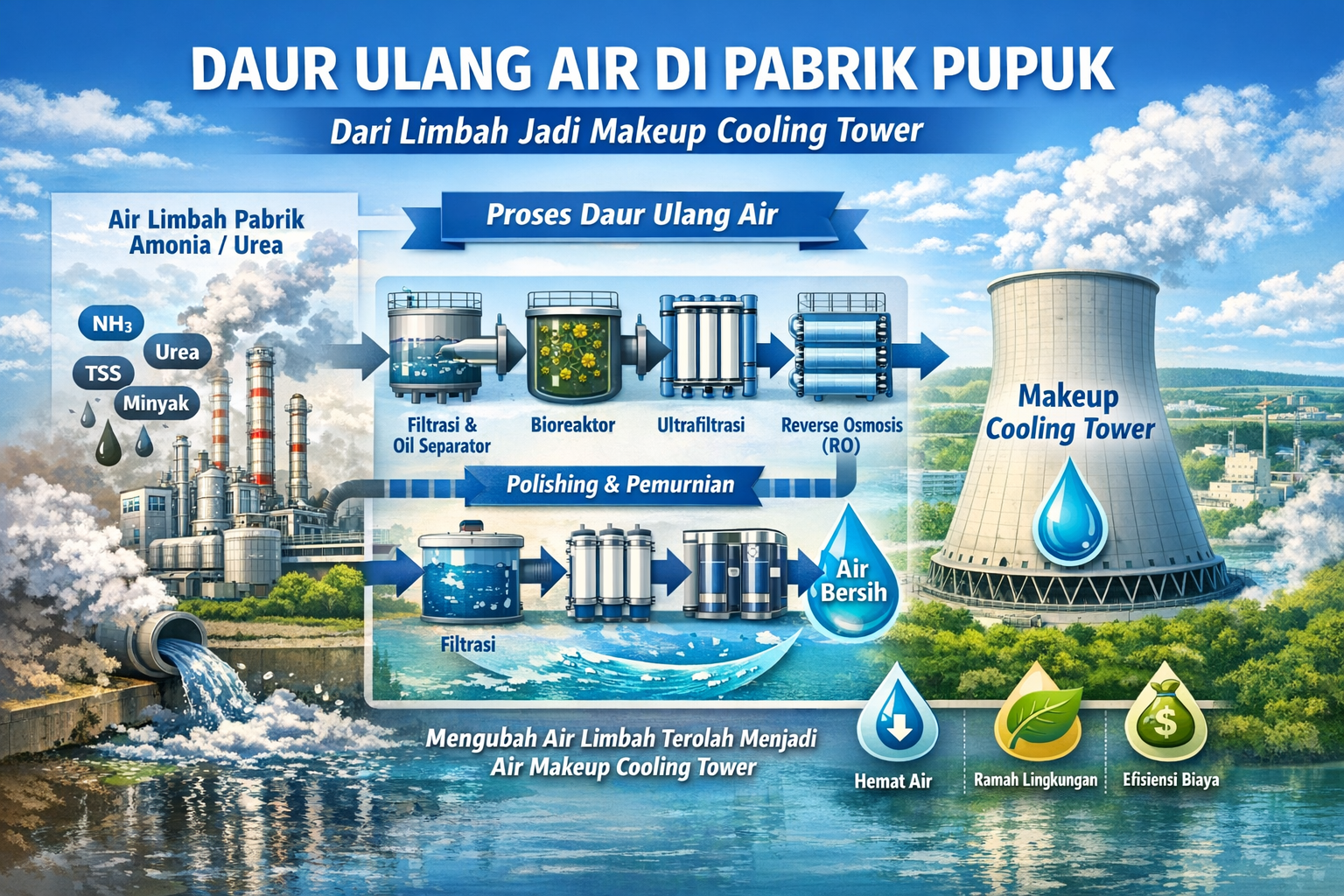
Cooling tower makeup is the biggest target. Recycled process water — once solids, oil, and biologics are removed — can substitute for fresh intake (watertechonline.com). An Indonesian study used ultrafiltration (UF, membrane filtration that screens out fine particles) plus reverse osmosis (RO, a pressure‑driven membrane process that removes dissolved salts) to supply CT makeup, trimming tap water use by ~5.46 m³/day (jurnal.polinema.ac.id).
For higher‑purity duties, process condensate or treated effluent that’s further polished can feed boilers. Stamicarbon urea trains can produce condensate with <1 ppm NH₃ and urea that, after filtration and ion exchange (IX, a resin‑based deionization process), becomes demineralized boiler feed (bcinsight.crugroup.com).
Other uses span scrubber makeup, vacuum pump seal water, compressor cooling loops, irrigation (non‑fabrication areas), and even reusing CT blowdown internally (e.g., boiler feed or landscaping). Plants often first capture clean streams like rainwater and condensate before tackling contaminated effluent — a practical move when floor wash might carry ~1000 ppm NH₃ (slideshare.net).
Cooling tower contaminant guardrails
CTs tolerate moderate ions but not dirt or microbes. Industry practice points to total hardness typically ≤600–1200 mg/L as CaCO₃, minimal chloride (metallurgy‑dependent), iron ≤2 mg/L, and organics/BOD (biological oxygen demand) ideally <50 mg/L to avoid scale and corrosion (watertechonline.com). Moderate ammonia can be acceptable — up to ~20–40 mg/L if copper alloys are absent and surfaces are clean (watertechonline.com).
Fats, oils, and greases (FOG) are different: they’re “a problem – find a way to remove them” (watertechonline.com). Front‑end separation can include screens and clarifiers; compact plate systems like a lamella unit streamline footprint, and gravity beds with sand or multimedia remove remaining grit (watertechonline.com). In practice, that can mean pairing an automatic screen, a lamella settler, and a media bed using sand and silica.
Boiler and steam purity constraints
Boiler makeup is far stricter. Feedwater is typically polished to “demin” quality (near‑zero salts), often via mixed‑bed IX or electrodeionization (EDI), with conductivity targets <1 µS/cm (bcinsight.crugroup.com). Reclaimed water intended for high‑pressure boilers therefore passes deep pretreatment before IX/EDI. Plants commonly leverage a cation/anion ion‑exchange system or an EDI module as the final step after RO.
Treatment train for reuse polishing
Primary solids removal starts with coarse filtration and sedimentation — screens, gravity settlers, and sand/multimedia filtration — to strip grit, algae, and suspended solids (watertechonline.com). Plants often package this stage with physical separation systems and traditional clarifiers to stabilize loadings.
Oil and grease removal follows. API‑type separators or dissolved‑air flotation are typical to strip hydrocarbons before any membranes (watertechonline.com). Many sites deploy a compact DAF unit or dedicated oil removal modules ahead of polishing.
Ammonia/urea control can be biological (nitrification) or physical (air/steam stripping), and many fertilizer ETPs already incorporate nitrification. Suspended‑growth media like MBBR carriers or batch systems can handle variable loads without major civil expansions.
Scale control starts upstream: pH is adjusted to ≈7–8, excess hardness is removed, and alkalinity is tempered. Plants may use a softener to take out Ca/Mg (strong‑acid cation exchange) and a metered acid feed via a dosing pump for alkalinity and pH targets.
To protect downstream membranes, many add UF. A hollow‑fiber UF stage before RO prevented fouling and enabled stable operation in one Indonesian application (jurnal.polinema.ac.id). Typical systems use compact ultrafiltration modules as RO pretreatment.
RO is the workhorse for dissolved solids removal. For CT makeup, a single‑pass RO often suffices; a two‑pass or EDI may follow for boiler feed. One study reported that an RO module effectively removed TDS from cooling tower effluent, and reject recycle reduced the volume needing further treatment (researchgate.net). Many fertilizer sites standardize on brackish‑water RO within integrated membrane systems.
Final disinfection is common. UV or chlorine knock down microbial counts before reuse, with UV/ozone/chlorine all referenced options (watertechonline.com). Facilities frequently adopt UV systems for low‑chemical residuals in open recirculating circuits.
Water quality management and monitoring
Once recycled water is in circulation, operators track pH, conductivity, hardness, iron, ammonia, BOD/COD, and microbiological counts to keep within targets (watertechonline.com). Cartridge barriers help maintain RO health; proper pretreatment (e.g., cartridge filters) is essential to prevent fouling and preserve membrane life (jurnal.polinema.ac.id).
Cooling programs are tuned to water quality. Most plants run scale inhibitors and biocides, with metallurgy‑specific corrosion control layered in (watertechonline.com). Chemistry toolkits typically include scale inhibitors, oxidizing and non‑oxidizing biocides, and corrosion inhibitors, while membrane trains rely on antiscalants and periodic membrane cleaners.
Economic case and payback windows
Capex covers filters, membranes, pumps, and controls; opex includes electricity for RO/UV, membrane replacement, and chemicals. The payoff is reduced freshwater purchases, lower discharge fees, and risk mitigation. U.S. purchased water often runs $0.002–0.008 per gallon ($0.5–2.0/m³) under normal conditions, but can exceed $0.10–0.20/gal ($26–53/m³) in drought‑impacted regions (valicor.com). Treated recycle water via filtration/RO may cost on the order of “a few cents to several dollars per gallon” depending on quality needs, and even if RO‑treated water costs $1–$10/m³ it can undercut scarce‑area fresh water (valicor.com).
Discharge costs fall as volumes shrink — an attractive outcome in Indonesia’s permit‑driven regime (researchgate.net). Reclaimed water also buffers plants against supply interruptions — an economic hedge that avoids downtime — and financial analyses of upgrades to treated‑wastewater RO have shown positive net present value across tested scenarios (mdpi.com).
Reported savings are material: conversions to reclaimed CT makeup have delivered 10–30% cost reductions (watertechonline.com) (watertechonline.com). One academic Indonesian analysis suggests a typical fertilizer plant operating at 12.8 m³/ton across millions of tons could cut water use by millions of m³ per year — saving on the order of millions of dollars annually in water costs alone.
Back‑of‑envelope: a 1 Mt/year urea plant at 12.8 m³/ton uses ≈12.8×10^6 m³/yr. At $0.5/m³, that’s ~$6.4M/yr. Recycling 10% (1.28×10^6 m³/yr) saves ~$640K/yr. If RO + pretreatment capex is ~$2–3M, the payback lands around 3–5 years, excluding lower wastewater fees.
Policy context and market direction
Indonesia’s policy framework emphasizes resource efficiency and wastewater control, with strict effluent standards and required connections to treatment facilities (researchgate.net) (researchgate.net). Globally, the water recycle & reuse market is projected for strong growth through 2030 (sphericalinsights.com).
Design choices, monitoring, and internal recycles
Clever material balances matter. An industry rule‑of‑thumb suggests ~30% of raw water exits as effluent (one ammonia/urea plant reported 32%); the rest is reused internally or lost to steam/evaporation (ammoniaindustry.com). Capturing non‑contaminated condensate, then polishing contaminated drains, maximizes reuse potential.
For CT makeup, a practical train is: multimedia filtration → oil removal → UF → RO → disinfection. For boiler makeup, add deep softening and demineralization. Plants often standardize ancillary hardware — from water‑treatment ancillaries to robust housings — to improve maintainability over the life of the system.
Key takeaways for fertilizer complexes
Cooling towers are especially well‑suited to recycled water once filtered, and industry reports 10–30% cost reductions after switching to reclaimed makeup (watertechonline.com) (watertechonline.com). Ultimate‑purity applications (boiler feed) typically rely on RO followed by IX or EDI (bcinsight.crugroup.com). Case studies confirm tangible freshwater offsets — including 5.46 m³/day at an Indonesian site using UF+RO for CT makeup (jurnal.polinema.ac.id).
The throughline is simple: with the right mix of filtration, biological/chemical steps, and membranes — plus disciplined monitoring and chemical programs — a fertilizer plant can treat effluent as a resource and capture a fast payback.