

Industry: Fertilizer_(Ammonia_&_Urea) | Process: Natural_Gas_Reforming
In modern ammonia/urea plants, hydrogen comes from steam methane reforming (SMR). The reformer furnace is so energy-intensive that only about half of the burner heat is absorbed by the process gas (www.mdpi.com). With the Indonesian government calling for “modernisasi” of fertilizer plants to drive efficiency and sustainability (www.ekon.go.id)—and roughly ≈75% of ammonia raw material mass tied to petrochemicals (www.pupuk-indonesia.com)—even a few percent gas saving moves margins.
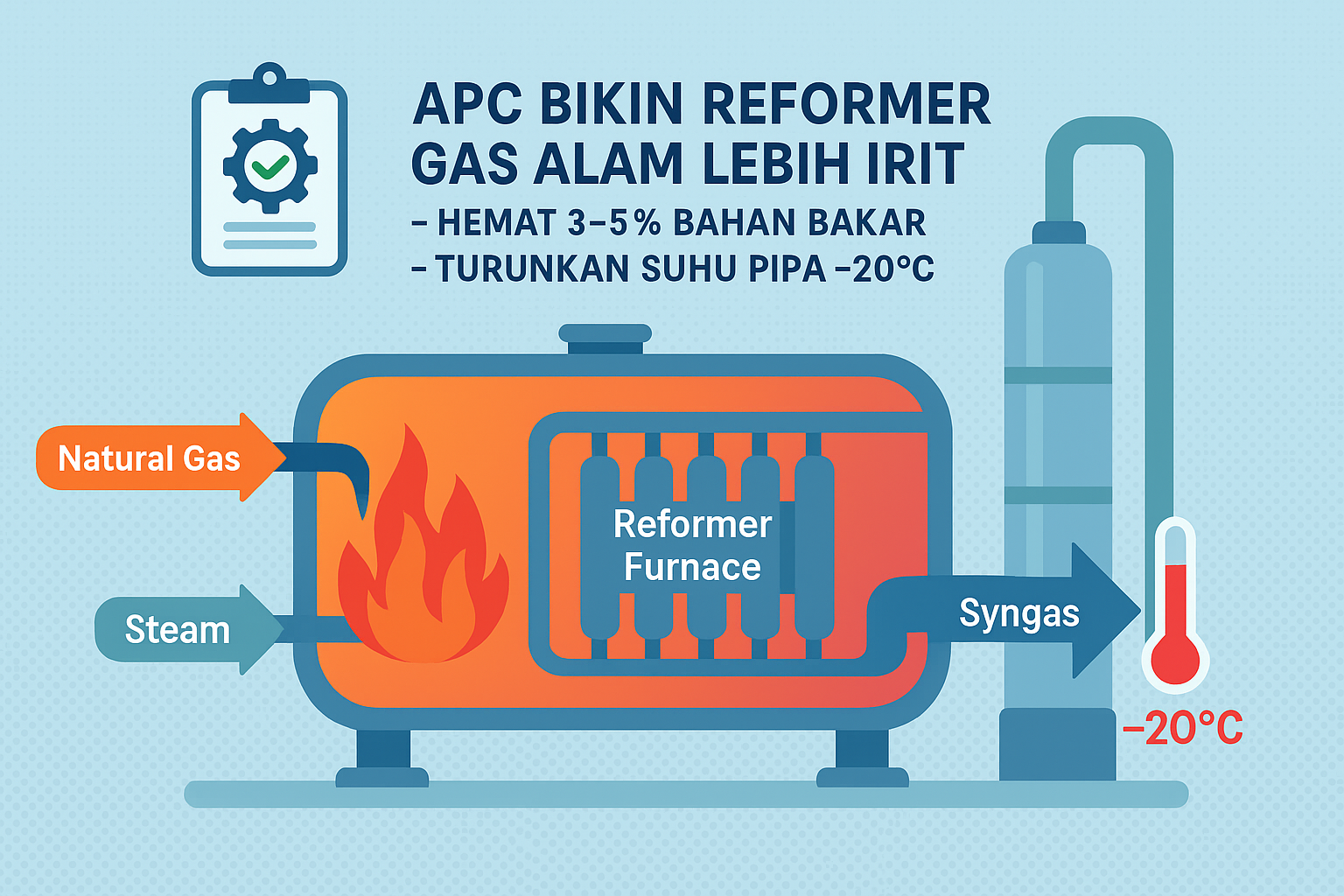
SMR is a strongly coupled, nonlinear system that resists simple tuning. Push the burners to lift throughput and you can overshoot tube-wall temperature limits; under-fire and you waste conversion. Advanced process control (APC) is closing that gap by optimizing reformer temperature, pressure, and the steam‑to‑carbon ratio (S/C) in real time.
Key reformer variables and trade-offs
Reformer firing temperature, furnace pressure, S/C, and feed composition/flow dominate performance. Higher temperatures raise CH₄ conversion but accelerate catalyst and tube aging (www.mdpi.com). Typical industrial S/C ratios sit around ≈2.5–3.0—excess steam helps avoid carbon buildup but costs energy to make (pubs.rsc.org). Pressure effects are subtler: higher pressure disfavors the endothermic reforming equilibrium, so units run at only moderate pressures (often set by downstream needs). Feed fluctuations (gas quality, flowrate) and catalyst deactivation further perturb the process, making basic PID (proportional–integral–derivative) cascades insufficient.
On the utilities side, consistent steam supply underpins S/C control; plants commonly pair APC with clean-steam practices such as demineralized makeup and condensate cleanup, leveraging equipment like a demineralizer or a condensate polisher where appropriate.
Model predictive control architecture
The leading APC approach is MPC (model predictive control, also called Dynamic Matrix Control). An MPC uses a dynamic model to predict future SMR behavior and solve an optimization in real time. One implementation embedded a first‑principles model of a reformer tube network—reaction kinetics and heat transfer included—into the controller (pubs.acs.org). It controlled outlet syngas temperature and outlet methane concentration—reliable indicators of reforming progress (pubs.acs.org)—by manipulating mixed feed flow, preheat temperature, and furnace fuel flow, all while respecting tube temperature limits (pubs.acs.org). A gain‑scheduled strategy handled different S/C regimes.
Setpoint optimization and scheduling
In many plants, an APC optimizer runs on a minutes–hours cadence to compute best setpoints (steam flow, fuel‑to‑air ratio, feed heater outlet) for hydrogen yield or efficiency under current conditions. If the catalyst has aged, it can recommend a slightly richer fuel or higher S/C to maintain conversion. Zečević and Bolf linked an open‑source SMR simulation into the DCS (distributed control system) via a “memory block,” enabling continuous adjustment of firing and S/C (www.mdpi.com).
APC strategies live alongside existing PID loops for flow/pressure/level; the advanced layer computes setpoint offsets. For plants that also maintain boiler chemistry programs to support steam quality, commodity devices like a dosing pump and treatments such as an oxygen scavenger or a scale-control program can be considered part of the same operating envelope.
Disturbance handling and demand ramps
APC excels at disturbance rejection and demand changes. When feed gas heating or flow shifts, the MPC foresees impacts on outlet composition and temperature and adjusts proactively. CFD (computational fluid dynamics) work by Christofides and co‑workers showed advanced feedback control driving the reformer’s H₂ outlet rapidly to setpoint under a live disturbance, with much faster settling than open‑loop (pubs.acs.org). In practice, this enables smooth production ramps to match demand; in one setpoint‑shift simulation, the MPC kept tube temperatures within safe bounds throughout the transition (pubs.acs.org).
Instrumentation and DCS integration
Implementation hinges on instrumentation: accurate flow meters for natural gas, steam, and feed; furnace temperature sensors across multiple zones; and composition or calorimetric sensors on the synthesis gas. Tight DCS integration matters—an embedded modeling block can sync process data and return optimal setpoints to the control system (www.mdpi.com). Periodic model re‑calibration (for catalyst activity) preserves accuracy. Safety and turbine/generator constraints (if co‑generation is present) are encoded as hard limits.
Upstream water treatment that supports steam generation is part of this control ecosystem in many fertilizer complexes; where required, plants may specify high‑purity options like mixed-bed polishers or EDI to help maintain consistent steam quality alongside APC routines.
Energy, stability, and economics
The gains are material. MPC‑driven operation in a top‑fired reformer delivered 3–5% energy savings versus conventional PID control (pubs.acs.org). A continuous optimization model in a live ammonia plant cut natural gas consumption by 3.15% (from 1,045 to 1,012 m³ NG per tonne NH₃) simply by tuning S/C and burner firing (www.mdpi.com). In that test, the methane approach‑temperature (deviation from chemical equilibrium) at the outlet fell by ~10 °C, and reformer tube wall temperatures dropped by ~20 °C on average (www.mdpi.com). Lower tube temperature correlates directly to much longer metal life.
A comprehensive monitoring model predicted up to 3% improvement in overall ammonia‑plant energy performance (www.mdpi.com), echoing Industry 4.0 upgrade gains. Another simulation/DOE (design of experiments) study found that optimizing S/C and furnace conditions could raise overall thermal efficiency to ~70% and exergy efficiency to ~56% (operating near thermal self‑sufficiency) (www.researchgate.net).
Stability improved as well. After implementing model recommendations, reformer tubes operated in a more uniform thermal envelope (www.mdpi.com). The CFD‑based controller likewise kept hydrogen production on target under feed swings, significantly improving dynamic response (pubs.acs.org). This reduces unplanned upsets and improves product quality consistency.
The economics follow. Because natural gas is ~75% of the feedstock cost (www.pupuk-indonesia.com), trimming even 3% of gas use removes roughly 2–2.5% from total production costs. For a large ammonia plant, that equates to savings on the order of millions of dollars per year. Reducing peak temperatures by ~20 °C can also delay expensive tube replacements, and lower fuel use cuts CO₂ emissions.
Industry context and adoption
The push is industry‑wide. Modern fertilizer makers—including PT Pupuk Kaltim in Indonesia—are investing in “green” and “blue” ammonia technologies (www.ekon.go.id) (www.pupuk-indonesia.com), and advanced control is a stepping stone. One industry report noted that APC in ammonia plants not only offsets volatile feed costs, but also “stabilizes and optimizes the plant in the presence of significant feed variations” beyond what PID loops alone can do. Implementation of APC is now standard practice in many new fertilizer units globally, and retrofit projects often pay back within 1–2 years through fuel savings.
For plants upgrading utilities alongside APC rollouts, ancillary filtration can support stable operation; for example, pretreatment options like ultrafiltration are used ahead of high‑purity systems in many industrial water services.
Engineer takeaways and references
In summary, an APC/MPC solution for an SMR furnace typically monitors outlet H₂/H₂O/CH₄ (or combustion flue gas) and tube temperatures, and adjusts the NG and steam flows in real time. It sits on top of the DCS, continuously driving the reformer to its economic optimum—often the minimum feed usage for a desired hydrogen rate—while respecting safety constraints. Case studies show ~3–5% fuel savings (pubs.acs.org) (www.mdpi.com), smoother transients with faster demand response (pubs.acs.org), and considerably lower tube temperatures that extend equipment life (www.mdpi.com).
References: Zečević & Bolf (2020) present an integrated SMR model in Processes with ~3% energy savings (www.mdpi.com) (www.mdpi.com). Zečević (2020) reports ~3.15% NG saving after APC in a real SMR furnace (www.mdpi.com). Quirino et al. (2020) provide a first‑principles SMR simulation used for control design (pubs.acs.org). Lao et al. (2016) demonstrated control of a reformer in Chem. Eng. Sci. (pubs.acs.org). Silva et al. (2013) and others discuss reforming equilibrium (e.g., industrial S/C≈2.5–3) (pubs.rsc.org). Indonesian industry sources (www.ekon.go.id) (www.pupuk-indonesia.com) confirm the push for efficient, gas‑intensive fertilizer production.