

Ammonia/urea facilities can strip zinc and phosphate from cooling-tower blowdown, drive recoveries above 90%, and reuse the water as makeup — easing Indonesia’s water stress and cutting costs.
Industry: Fertilizer_(Ammonia_&_Urea) | Process: Process_Cooling_Systems
In fertilizer plants, cooling towers swallow most of the process water — globally, cooling systems account for about 70% of industrial water use (ResearchGate). That’s why a once‑overlooked stream — cooling‑tower blowdown (the concentrated purge that prevents salts from “cycling up”) — is now prime territory for water savings.
The chemistry is unforgiving: only pure water evaporates, so total dissolved solids (TDS, a measure of all dissolved ions) spikes in the basin, with blowdown often >1,000–1,300 mg/L (MDPI). In one urea‑plant study, blowdown carried ~1.2 mg/L zinc (Zn) and ~6.6 mg/L phosphate (PO₄³⁻) from zinc‑phosphate corrosion inhibitors (MDPI). Running towers at higher “cycles of concentration” (how many times dissolved ions are concentrated relative to makeup) cuts blowdown volume — but elevates hardness, silica, chloride and scaling risk (Araner; Araner). In practice, typical cycles of 3–5 mean 20–30% of cooling makeup is discharged as blowdown; at 5× cycles, ~20%. For a 100 m³/h tower, that’s ~20 m³/h of wastewater to treat or discharge.
With Indonesia facing growing water scarcity — Bali reports a “serious water shortage” prompting reuse initiatives (MDPI) — reclaiming blowdown is both eco‑pragmatic and economically attractive.
Effluent standards and missing metals
Indonesia’s Ministry of Environment KEP‑51/MENLH/1995 (Lamp. A.X) sets conventional limits for urea‑fertilizer wastewater — BOD₅ ≤100 mg/L, COD ≤250 mg/L, TSS ≤100 mg/L, Oil & Grease ≤250 mg/L, NH₃–N ≤500 mg/L, and pH 6.0–9.0 (official regulation via blogspot). Notably, there is no Indonesian limit on Zn or PO₄ in that fertilizer standard. Many international regimes do target phosphorus (typical industrial discharge limits are on the order of 0.5–2 mg/L as P to prevent eutrophication). In practice, cooling blowdown often meets the organic limits easily, but Zn and phosphate can exceed best‑practice reuse targets — making targeted removal essential before discharge or reuse.
pH conditioning and targeted precipitation
A robust blowdown train starts with pH adjustment. If the stream runs above ~pH 9 (common under phosphate corrosion programs), dosing mineral acid such as H₂SO₄ pulls it toward neutral; if below ~pH 7, caustic (NaOH) can lift it to ~pH 8–9 for optimal precipitation. Final neutralization returns pH to 6.0–9.0 per Indonesian rules (official regulation via blogspot). In practice, plants meter acids and bases with precise dosing pumps to hold these setpoints.
Next comes co‑precipitation of Zn and phosphate. Lime (Ca(OH)₂) can form Ca₃(PO₄)₂ and Zn(OH)₂ around pH ~9, also tamping down carbonate scaling. Alternatively — or together — ferric or aluminum coagulants (FeCl₃ or Al₂(SO₄)₃) with polymer bind phosphate as FePO₄(s) while Fe(OH)₃ flocs sweep suspended solids. Conventional jar tests report Ca‑salt, zinc, and phosphate removal up to ~80–95% depending on dose (ResearchGate; ResearchGate). Many facilities standardize feeds using proven coagulants and match them with the right flocculants to settle quickly.
An alternative is electrocoagulation (EC, using sacrificial iron or aluminum electrodes to generate coagulant in situ). One literature review notes that among common technologies, only EC was reported to eliminate Zn and phosphate from cooling blowdown (MDPI). In practice, a lime or ferric co‑precipitation reactor followed by flocculation removes the bulk of these contaminants, often cutting PO₄ by >80–90% and Zn by >90%.
Clarification and dense solids handling
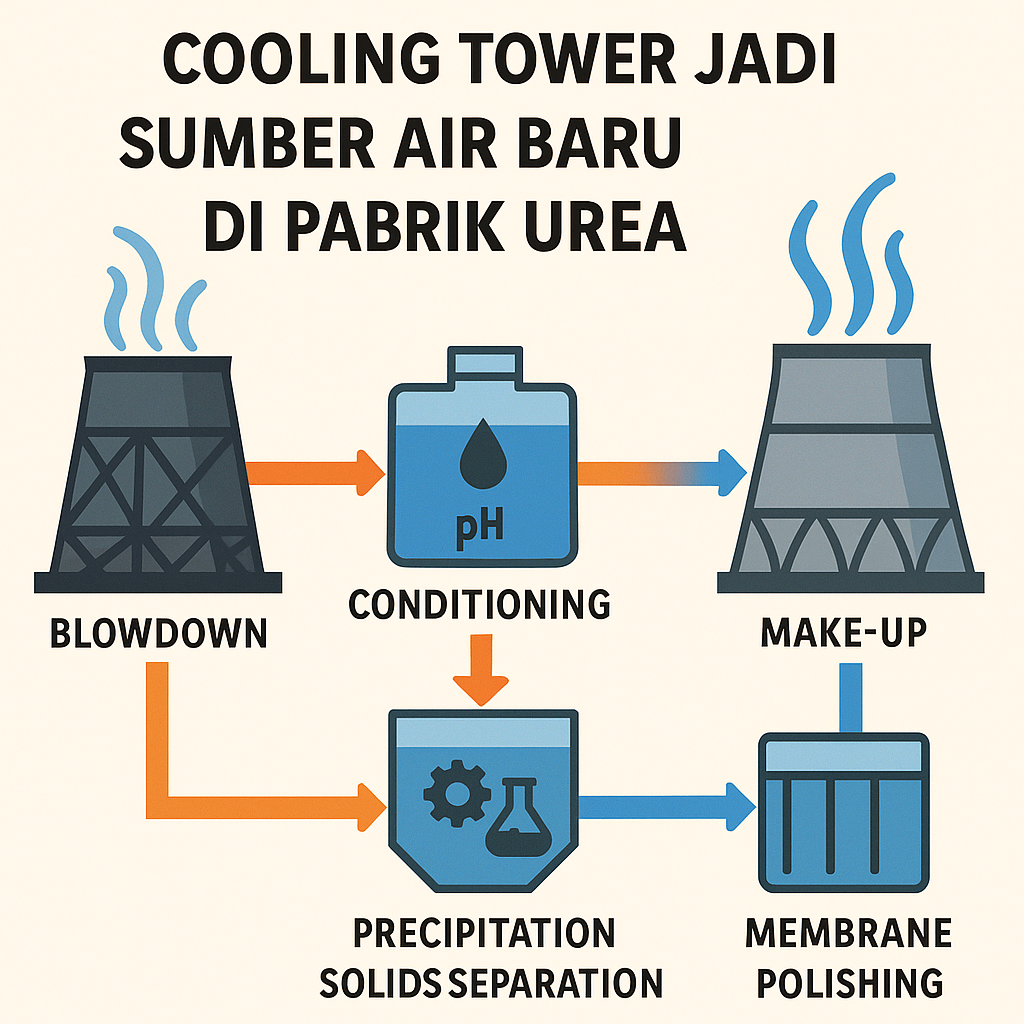
Precipitates are separated in settling equipment — from conventional clarifiers to high‑rate systems like dissolved air flotation (DAF) or ballasted flocculation. Ballasted sand flocculation systems have documented removal of total phosphorus, TSS, iron, and zinc in cooling‑water streams (MDPI). Plants often pair a clarifier with media filtration for residual suspended solids.
Where footprint or loads are variable, a compact DAF unit can boost solids capture ahead of membranes. Downstream, media filters — commonly a sand bed — provide a low‑cost polish; dual‑media approaches that include a sand/silica layer are typical in these services.
In modern designs, the precipitate “sludge” can be exceptionally dense. One IDE demonstration of RO plus precipitation produced dry “salt pellets” at over 95% solids, requiring no further dewatering and cutting disposal volumes (Water Technology Online).
Membrane polishing and high recovery
For discharge under stricter regimes — or for reuse — membranes provide the final polish. A two‑step membrane system (nanofiltration, NF, which selectively removes multivalent ions at lower pressures, or reverse osmosis, RO, a high‑rejection desalination barrier) removes remaining TDS and trace ions. A Chile demonstration using a single‑pass RO with an integrated fluidized‑bed crystallizer — the IDE MaxH₂O Desalter — treated 48 m³/d of blowdown at 96% recovery; the permeate met cooling‑water specs and was reused as makeup (Water Technology Online).
Conventional RO alone is typically limited to ~50–60% recovery due to scaling from CaCO₃, gypsum, and silica, but integrating RO with precipitation can exceed 90% recovery (Water Technology Online; Water Technology Online). Another power‑sector demo ran 60 days and achieved 93.5% water recovery (Water Technology Online). For many facilities, a packaged membrane system is the simplest way to deploy these steps.
Performance data from industry installations show reuse‑grade polishing: an RO‑based plant reported outlet silica <10 mg/L and residual phosphate ~0.7 mg/L (Water Technology Online; Water Technology Online). Plants commonly specify a brackish‑water RO stage for desalting and add nanofiltration where selective hardness trimming improves recovery.
After RO, an ion‑exchange train (cation/anion resins) can further polish hardness or traces if boiler or hydrocarbon feed quality is required. This is typically delivered using a packaged ion‑exchange system, with resin selection supported by specialized resins. For most cooling reuse, though, RO product alone is sufficient once pH and a biocide program are adjusted — many facilities standardize the latter with proven biocides. In all cases, final pH is set within 6–9 per Indonesian discharge rules (official regulation via blogspot).
Closing the loop and cutting intake
The quickest win is to send treated blowdown back as cooling‑tower makeup, effectively closing the loop. In the Chile case, 96% of the blowdown stream was recovered and fed back into the cooling towers as makeup water (Water Technology Online; Water Technology Online). Another recent demonstration achieved 93.5% recovery over 60 days (Water Technology Online), with treated blowdown meeting or exceeding the quality of incoming makeup.
Because blowdown treatment reduces the salt load of makeup, it effectively enables higher cycles of concentration in the cooling system, slashing fresh‑water intake — in some designs doubling or tripling the cycles (Water Technology Online). One project showed that increasing cycles from ~2 (limited by brackish makeup salinity) to higher values becomes feasible when blowdown is reused, freeing up water for expansion (Water Technology Online; Araner).
Beyond cooling, sufficiently clean blowdown can serve elsewhere: at near‑demineralized quality (via RO and/or ion exchange), it can become boiler feed or process dilution water; even non‑critical uses such as equipment washdown or fire water offset fresh intake. Some green‑industry standards in Indonesia already emphasize water recycling in fertilizer production. As a simple yardstick, recovering 95% of a 500 m³/h blowdown stream saves ~475 m³/h that would otherwise be lost. Given Indonesia’s water stress — including Bali’s “serious water shortage” (MDPI) — those gallons matter.
A practical blueprint for ammonia/urea sites
The treatment recipe is clear: pH conditioning, targeted chemical precipitation, solid–liquid separation, and membrane polishing. Together, these steps can reduce Zn and PO₄ by ~95% or more and produce effluent of reuse quality. Industry examples repeatedly show recovery >90% is achievable (Water Technology Online; Water Technology Online). For plants building out capability, specifying the RO/NF block as a brackish RO stage and adding selective nanofiltration where needed provides flexibility as water chemistry or production targets change.
The bottom line: treating cooling‑tower blowdown transforms a liability into a supply. It reduces freshwater purchases and discharge fees, lowers effluent volumes, and aligns with increasingly stringent reuse goals — all while keeping pH in the required 6–9 window (official regulation via blogspot).
Sources: industry reviews and case studies underpin these data and outcomes (MDPI; MDPI; Water Technology Online; Water Technology Online; Araner; Araner), with Indonesian limits taken from official regulations (official regulation via blogspot).