
Semiconductor plants push millions of gallons of water a day through rinse and etch lines. Staying compliant hinges on one unglamorous asset — an equalization tank — and a web of pH/ORP sensors and automated dosing that reacts in minutes, not shifts.
At modern chip plants, the volumes are staggering. A 300 mm wafer fab can use on the order of 10 million gallons (~38,000 m³) of ultrapure rinse water per day (hach.com). Not all of that becomes wastewater, but the scale is clear: TSMC alone reported consuming 101 million m³ of water in 2023 (idtechex.com).
The pollutants are just as unforgiving. Fluoride from HF etching routinely shows up in the hundreds to thousands of mg/L (link.springer.com), and heavy metals such as Ni, Cu, Cr, Zn, and Pb can hit tens-to-hundreds of mg/L. One Indonesian plating plant’s effluent contained ~88–122 mg/L Ni — far above discharge limits (pmc.ncbi.nlm.nih.gov). Sporadic high-strength batches, from end-of-line washes to maintenance dumpings, drive “extreme fluctuations” in flow, pH, and metal load (nepis.epa.gov).
Without buffering, a single concentrated discharge can overwhelm neutralization or precipitation steps. The result: process upsets and permit risk.
Equalization tank as primary buffer
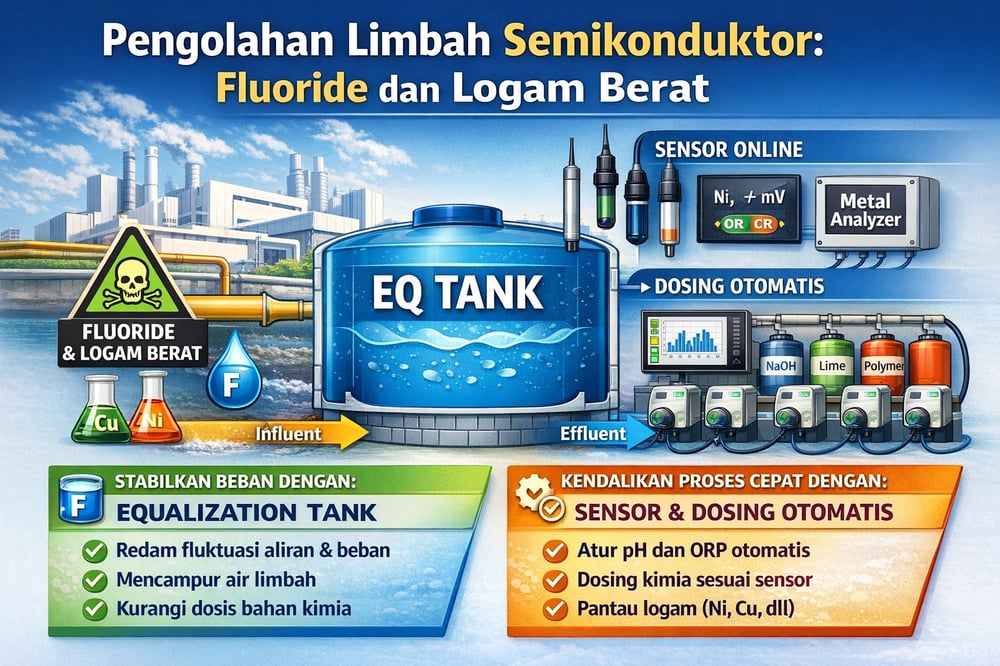
An equalization (EQ) tank — a mixed basin ahead of treatment — levels both flow and concentration. The U.S. EPA’s metal-finishing field manual defines three tasks: (1) flow equalization to damp hydraulic surges, (2) concentration equalization by mixing high- and low-strength streams, and (3) load control to cap spill-through (nepis.epa.gov; nepis.epa.gov).
In practice, fabs size EQ for the largest anticipated surge. If a cleaning step dumps 1000 m³ at 1000 mg/L F⁻ over 8 hours, a basin with ~24 hours of hydraulic retention time (HRT, the average time water remains in a tank) releases diluted, steady flow over a day. Proper mixing prevents dead zones and short-circuiting; turbulent motion keeps solids in suspension (nepis.epa.gov; nepis.epa.gov). Design guides often cite mixers at ~0.02–0.04 HP per 1000 gal to ensure homogeneity (nepis.epa.gov), typically packaged with ancillary equipment such as seals, drives, and mounting skids; plants source these as part of wastewater ancillaries.
EQ tanks also save chemicals. By smoothing extremes before neutralization, operators avoid dosing to worst-case slugs; EPA notes an upstream “smoothing vessel” with enough residence time can “save reagent” in neutralization tanks (nepis.epa.gov).
Online sensors and PLC/SCADA control
Real-time instrumentation turns EQ into a responsive system. Continuous pH probes (acidity/alkalinity) and ORP electrodes (oxidation-reduction potential) feed PLC/SCADA control loops (programmable logic controllers with supervisory control and data acquisition) that adjust chemical addition via PID (proportional–integral–derivative) logic. In chromium removal, holding ORP at a setpoint (e.g., +350–400 mV at pH 9.5–10) yields near-complete reduction in short residence times (nepis.epa.gov). For cyanide, an ORP of about +600 mV at pH >11 is cited as optimal (nepis.epa.gov).
Heavy metals monitoring is now feasible online. Continuous colorimetric/spectrophotometric analyzers can track Cu, Ni, Fe and more; one example is a Cogent OVA5000 on-line heavy-metal analyzer deployed to monitor trace arsenic in drinking water (environmental-expert.com). Industry reporting points to a “significant shift toward real-time monitoring of industrial wastewater,” enabled by sensors and automation (azom.com). Fluoride can be tracked with ion-selective probes or on-line ion chromatography, allowing lime/alum control to precipitate CaF₂ (calcium fluoride). Automated loops meter reagents through an accurate dosing pump, scaling feed within minutes to match incoming spikes.
Automated dosing and removal efficiency
Automation has addressed the delays of manual, off-line testing; one technical review concluded modern dosing “effectively addressed” historical lags and now enables rapid response (azom.com). In practice, if influent Ni or Cu spikes, control loops increase precipitant (e.g., hydroxide or sulfide) and polymer feed to maintain targets. pH-controlled coagulant dosing helps avoid overfeed and downstream pH swings, pairing with process chemicals such as coagulants and, where appropriate, flocculants.
Outcomes are measurable. Bench/plant studies have reported >99% removal when pH/ORP are held precisely. A combined coagulation/ultrafiltration (UF, a pressure-driven membrane process) approach on CMP wastewater achieved 92.9–99.7% fluoride removal (link.springer.com), a configuration directly aligned with industrial membrane pretreatment via ultrafiltration. Another study reported 99.75% Ni removal under optimized conditions (pmc.ncbi.nlm.nih.gov).
Compliance, monitoring frequency, and costs
Regulation pushes toward continuous vigilance. Indonesia’s Permen LH 03/2010 (for industrial estates) requires industrial IPALs to “monitor parameters (including pH and COD) daily” and correct any noncompliance (harumtirtajaya.com). Globally, fabs face strict discharge standards — often microgram-per-liter levels for heavy metals and single-digit mg/L for fluoride — making continuous control essential to stay within limits.
Operationally, EQ plus real-time control smooths operation, reduces upsets, and cuts cost. Equalization reduces required peak treatment capacity and can “save reagent” by avoiding worst-case chemical dosing (nepis.epa.gov). Online monitoring trims labor-heavy off-line tests and catches excursions earlier; industry trend reporting links real-time analyzers with improved efficiency and fewer noncompliance penalties over time (azom.com).
Integrated strategy and expected performance
The playbook is consistent: pair sufficient equalization storage with continuous monitoring and automated dosing. The EQ tank — sized for the largest anticipated surge — levels flow and concentrations (nepis.epa.gov). In parallel, a sensor suite (pH, ORP, conductivity, and specific metals) feeds feedback control for immediate adjustments to influent swings (azom.com; environmental-expert.com). This integrated approach has been shown to achieve >99% removal of fluoride and metals (link.springer.com; pmc.ncbi.nlm.nih.gov), keep effluent within limits, and optimize chemical usage — aligning performance with bottom-line savings.
Reference URLs and sources embedded above include: EPA equalization and control guidance (nepis.epa.gov; nepis.epa.gov; nepis.epa.gov; nepis.epa.gov; nepis.epa.gov; nepis.epa.gov), industry trend analyses (azom.com), real-time metals monitoring (environmental-expert.com), semiconductor water use context (hach.com; idtechex.com), fluoride and CMP treatment performance (link.springer.com; link.springer.com), nickel loading and removal (pmc.ncbi.nlm.nih.gov; pmc.ncbi.nlm.nih.gov), and Indonesian regulatory overviews (harumtirtajaya.com).
Additional products relevant to implementation are referenced contextually above, including accurate chemical dosing, ultrafiltration for membrane-based polishing consistent with the cited study, and supporting equipment via wastewater ancillaries, alongside process chemicals such as coagulants and flocculants.
Sources: Peer‑reviewed journals and industrial reports — Applied Water Science review (link.springer.com; link.springer.com), Heliyon case study (pmc.ncbi.nlm.nih.gov; pmc.ncbi.nlm.nih.gov), EPA guidance (nepis.epa.gov; nepis.epa.gov), industry analyses (hach.com; idtechex.com; azom.com), and Indonesian regulatory context (harumtirtajaya.com).
