

Industry: Landfill | Process: Gas_Collection_&_Flaring
Landfill gas (LFG: a methane-rich mix from decomposing waste) can light homes or vanish up a flare stack. In the U.S., about 63% of current LFG projects generate electricity, often with reciprocating engines. The choice of engine vs. turbine hinges on efficiency, gas volume, and—crucially—what’s in the gas.
Every power option starts with the same reality: LFG is wet, CO₂-heavy, and laced with siloxanes and sulfur that can sandblast hardware from the inside. That’s why nearly every system includes knockout pots, cooling, filtration, and chemical polishing before a single electron is sold.
RECIPROCATING GAS ENGINES (SIMPLE CYCLE AND CHP)
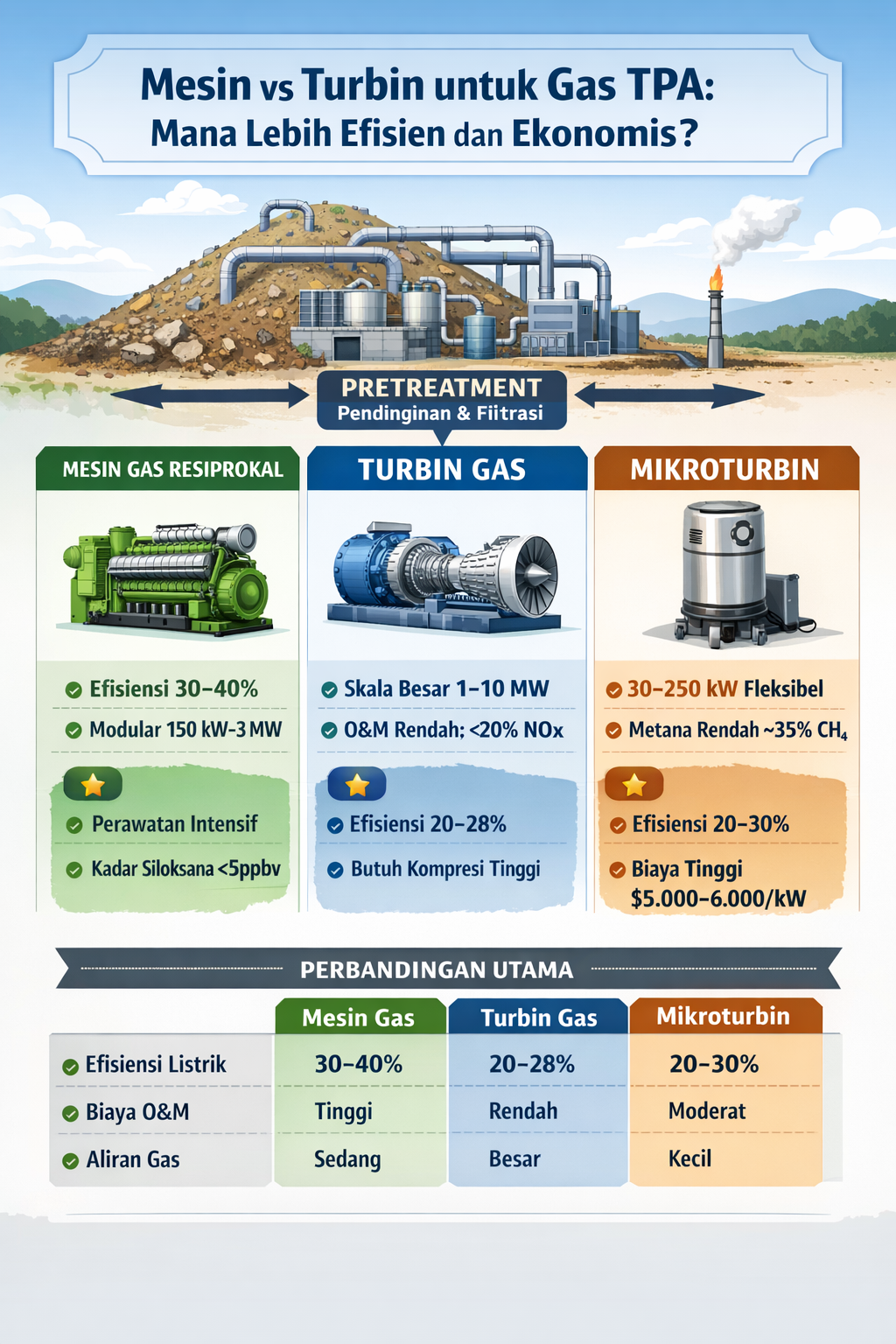
These spark-ignited or dual-fuel piston units dominate LFG power plants for a reason: flexible, modular, and efficient at modest scales. Simple-cycle electrical efficiency typically runs around 30–40% on high-methane fuels, roughly 5–10% lower than comparable natural-gas engines due to LFG’s high CO₂ content. Some literature reports 25–35% in real-world LFG blends.
Sizes span approximately 150 kW–3 MW per engine, paralleled to match gas supply. Each unit can be derated or tuned to follow the landfill’s decline, so multi-engine plants can be added or removed to follow gas flow. They carry lower capital costs and can run CHP (combined heat and power) for more than 80% total efficiency. The flip side: more moving parts means steady maintenance—plugs, injectors, and oil—especially when impurities creep through. One survey pegs more than 70% of landfill power projects using reciprocating engines.
GAS TURBINES (SIMPLE CYCLE AND COMBINED CYCLE)
Small to mid-size turbines (1–10 MW) trail engines on efficiency but shine at higher, steadier flows. Expect around 20–28% electrical efficiency at full load in the field, with a sharp drop off-design. LFG injection requires compression—often above 100 psig—plus flame stabilization, and those parasitic loads dent net efficiency further.
The advantages: turbines digest large, continuous flows, often above 1,300 cfm, yielding at least 1 MW. They tolerate corrosive gases better than pistons and typically emit lower NOₓ (nitrogen oxides). O&M (operations and maintenance) runs relatively low, around $130/kW-year, with fewer but longer outages. Capital cost can pencil out at large scale, for example above 3 MW at around $1,400/kW in 2010 dollars. Combined-cycle add-ons can push net efficiency into the 50–60% range, but few landfills have the heat loads or boilers to justify this, so simple cycle is the norm.
MICROTURBINES (CAPSTONE AND PEERS)
At 30–250 kW per unit, microturbines run where gas flows are small and variable. On LFG, they deliver around 20–30% electrical efficiency. EPA notes they consume about 55% more fuel per kWh than comparable reciprocating engines. Their niches include extremely low flow, down to around 20–50 cfm, and low methane content, with some models running at around 35% CH₄, plus ultra-low emissions and near-silent operation.
The tradeoffs are steep. Capital costs run around $5,000–6,000/kW. Fuel quality must be exceptional: refrigerated dehydration and filtration up front, then nearly total siloxane and particulate removal via adsorbents before the machine. One handbook cites Capstone specs of less than 5 ppbv siloxanes, and EPA flags microturbines as sensitive to siloxane contamination, typically needing more pretreatment than conventional turbines or engines. Notably, some Capstone models accept very high H₂S—up to 5,000–70,000 ppm—but still enforce strict siloxane limits.
EQUIPMENT SELECTION SUMMARY AND TRENDS
In general, reciprocating engines offer the highest electrical efficiency and lowest $/kW for mid-size projects, from hundreds of kW to a few MW. Turbines suit larger, continuous flows with simpler maintenance and lower NOₓ, despite lower efficiency. Microturbines fill the smallest niches but require meticulous gas cleanup. Manufacturer data underscore the pattern: simple-cycle gas engines at around 39–49% electrical efficiency versus around 30–42% for simple-cycle gas turbines. With heat recovery, combined-cycle turbines can exceed 50%, whereas engines in CHP can reach 80–90% total efficiency.
In practice, LFG engines may run slightly below their rated efficiency due to CO₂. Trends reflect the math: engines power the majority of LFG plants; turbines appear where gas rates are large or pipeline injection is an option; microturbines show up at small or remote sites.
MOISTURE REMOVAL AND DEWPOINT MANAGEMENT
Fresh LFG is saturated; unmanaged moisture condenses in lines and prime movers. EPA’s primary treatment block is clear: a knockout pot plus filter plus blower to strip water. Many sites chill the gas in an aftercooler to condense residual moisture, then reheat above dewpoint before the engine or turbine. For the filter stage, operators often specify industrial elements such as a cartridge filter to keep entrained solids from reaching compressors and valves.
SILOXANE REMOVAL (ADSORPTION AND CRYOGENIC)
Siloxanes—volatile silicon compounds from personal-care and industrial products—turn into hard silica on combustion, coating blades, liners, and catalysts. Even low levels, below 10 ppmv, can be damaging over time. Standard practice is scrubbing via adsorption, such as activated carbon or proprietary metal-impregnated media, or chilling the gas. Some systems cool to –70 °C and achieve around 99% siloxane reduction. Many installations run multilayer carbon or silica-gel filters to drive siloxanes to a few parts per billion. Capstone microturbines require less than 5 ppbv. EPA warns that skipping this step leads to progressive loss of performance.
HYDROGEN SULFIDE AND SULFUR CONTROL
Typical LFG carries H₂S at hundreds of ppm, often around 200–500 ppm. It’s toxic and corrodes equipment by forming sulfuric acid. Projects usually scrub H₂S chemically—iron sponge (iron-oxide media) or caustic/potash, such as potassium hydroxide on activated carbon—to reach acceptable levels, often below 25–100 ppm for engines, though some microturbines tolerate higher. EPA groups H₂S with sulfur removal after cooling in typical flowsheets. In all cases, an H₂S removal step is standard to protect gen-sets and meet emissions limits. Indonesian and other regulations often cap stack SO₂ at low mg/Nm³, indirectly forcing H₂S capture. Some operators add targeted chemical steps, such as H₂S scavengers, when load swings or impurity spikes strain fixed-bed units.
Notably, microturbine suppliers cite high H₂S tolerance in some models, such as Capstone at 5,000–70,000 ppm, but still enforce ultra-strict siloxane limits.
OTHER IMPURITIES AND WHEN TO SEPARATE CO₂
VOCs such as benzene and toluene are typically trace, often below 1 mg/m³, and co-removed by the same adsorbents. Nitrogen, oxygen, and excess CO₂ are usually left in the fuel for power generation. Engines and turbines can combust LFG at around 50% CH₄. Only pipeline-quality projects add CO₂ separation. A typical treatment train runs as follows: primary—knockout and cooling to dewpoint; secondary—additional cooling and adsorption to strip siloxanes and H₂S.
Example: EPA’s Landfill Methane Outreach Program highlights cooling to dewpoint, around 5–10 °C, then granular media filters for siloxanes, followed by compression to engine pressure. One Capstone project installed refrigerated pretreatment to –20 °C plus carbon beds to meet the less than 5 ppbv siloxane specification.
BY THE NUMBERS: CAPACITY AND YIELDS
LFG utilization remains limited at grid scale. In 2018, England’s LFG plants totaled around 880 MW installed capacity, and the U.S. has roughly 500 MW operating in LFG-to-energy projects. When gas can’t be used, it is flared—destroying around 98% of methane but yielding no energy. Rough estimates suggest each ton of MSW yields around 0.8 MWh of electricity over its decay life, depending on methane content. Developers track performance closely; reciprocating-engine plants on LFG often deliver around 0.2–0.25 kWh per m³ of gas, assuming CH₄ around 50%.
BOTTOM LINE FOR PROCUREMENT
For most mid-size projects, reciprocating engines win on efficiency, approximately 30–40% with LFG, and modularity. Turbines fit large, steady sites despite around 25% simple-cycle efficiency because maintenance is simple and downtime infrequent. Microturbines excel on small flows but need the strictest pretreatment—especially siloxanes—before they sip a single cubic foot. Across all options, the pretreatment backbone—moisture knockouts, gas chilling to dewpoint, and adsorption for siloxanes and H₂S per EPA guidance—makes or breaks the project economics.
Sources: EPA, INNIO/Jenbacher, Caterpillar, and technical handbooks.