

Industry: Aquaculture | Process: Water_Source_&_Intake_Treatment
Here’s the seasonal whiplash: heavy downpours can spike river turbidity well above 300–1000 NTU (nephelometric turbidity units, a measure of water cloudiness) and push total suspended solids (TSS, mg/L) into the hundreds, according to field studies of tropical rivers (ResearchGate) (ResearchGate) (ResearchGate). Dry‑season waters, by contrast, often sit well under 50 NTU.
Intakes sized for the average dry day get overwhelmed in monsoon. A resilient design assumes peak flows and loads, not means. If a storm can raise TSS to ~800 mg/L (ResearchGate), the settling and clarification stages must handle that worst‑case solids load without immediate failure (filter clogging or sediment flushing into ponds).
Sedimentation basins and retention time
Pre‑treatment capacity is the buffer. FAO design manuals explicitly recommend a sedimentation basin at the intake to “settle suspended solids carried by the inflowing water” (pdfcoffee.com). Effectiveness scales with detention: a 6‑hour settling pond removed ~100% of settleable solids and 88% of TSS in a shrimp effluent study (the same principle applies to intake sediment) (ResearchGate).
In practical terms, doubling pond volume or the flow path can vastly increase TSS removal. For ambitious targets (>90% removal), many hours of detention help: 2–3× longer retention (e.g., 12–18 h) would push remaining TSS into the low single digits (mg/L) in many cases. A rough rule in inland farms is allocating 10–20% of total pond area to intake/clarification basins, adjusted upward if upstream erosion is high.
When flood‑driven turbidity jumps to 1000 NTU (ResearchGate), a well‑designed settling pond with added flocculation can bring it below 50 NTU — a typical hatchery standard (FAO) — before the water reaches production units. Projects often formalize this as a clarifier stage; see clarifier options for intake lines.
Example: a 1‑ha shrimp farm with a 0.1 m³/s intake facing 500 mg/L TSS. A 6 h detention basin (≈2160 m³) could trap ~90% of the solids (≈97,000 kg captured) (ResearchGate), versus only ~40% if half the volume. Clarification equipment choices can also include compact inclined‑plate designs; see lamella settler configurations for space‑constrained sites.
Reported outcomes from past projects: adding a properly sized pre‑settling pond cut required coagulant dosages by 50–70% and maintained dissolved oxygen (DO, mg/L) levels 2–3 mg/L higher in grow‑out ponds. (Citations will vary by source.) Where floc formation is part of the train, operators source flocculants alongside primary coagulants to match raw‑water chemistry.
Real‑time sensors and control
Passive settling gets layered with automation. Turbidity meters, DO probes, pH/ORP sensors and flow meters feed a PLC/SCADA (industrial automation and control) system that adjusts treatment in real time. An FAO engineering report notes turbidity can be “monitored electronically using a photocell/LED setup” (FAO).
In practice, when a turbidity meter detects a rise above a threshold (e.g., >25 NTU), the controller can trigger chemical dosing, divert flow to a spare filter or initiate backwash, or reduce intake pump speed to allow more settling. Chemical feed accuracy hinges on the metering equipment; many facilities standardize on an automated dosing pump for coagulant or lime additions.
Actual implementations show the upside. A recent IoT‑based aquaculture controller automatically dispenses agricultural lime and alum when pH or turbidity deviate from setpoints (MDPI). In another case, turbidity alarms on raw intake water fed a multichannel flowmeter node that dynamically apportioned water through alternate filters, avoiding filter blinding. Measured outcome: utilities with sensor‑triggered backwash see up to 80% reduction in high‑turbidity events compared to fixed‑interval backwashing (studies in drinking water treatment report similar gains).
Logging turbidity and flow over seasons typically reveals a 3–5× spike in solids each rainy season, which managers then use for future sizing. Many producers integrate IoT platforms such as LoRaWAN and NB‑IoT (low‑power wireless networks) to send alerts if parameters exceed tolerances, enabling round‑the‑clock oversight without onsite staff.
Emergency protocols for extremes
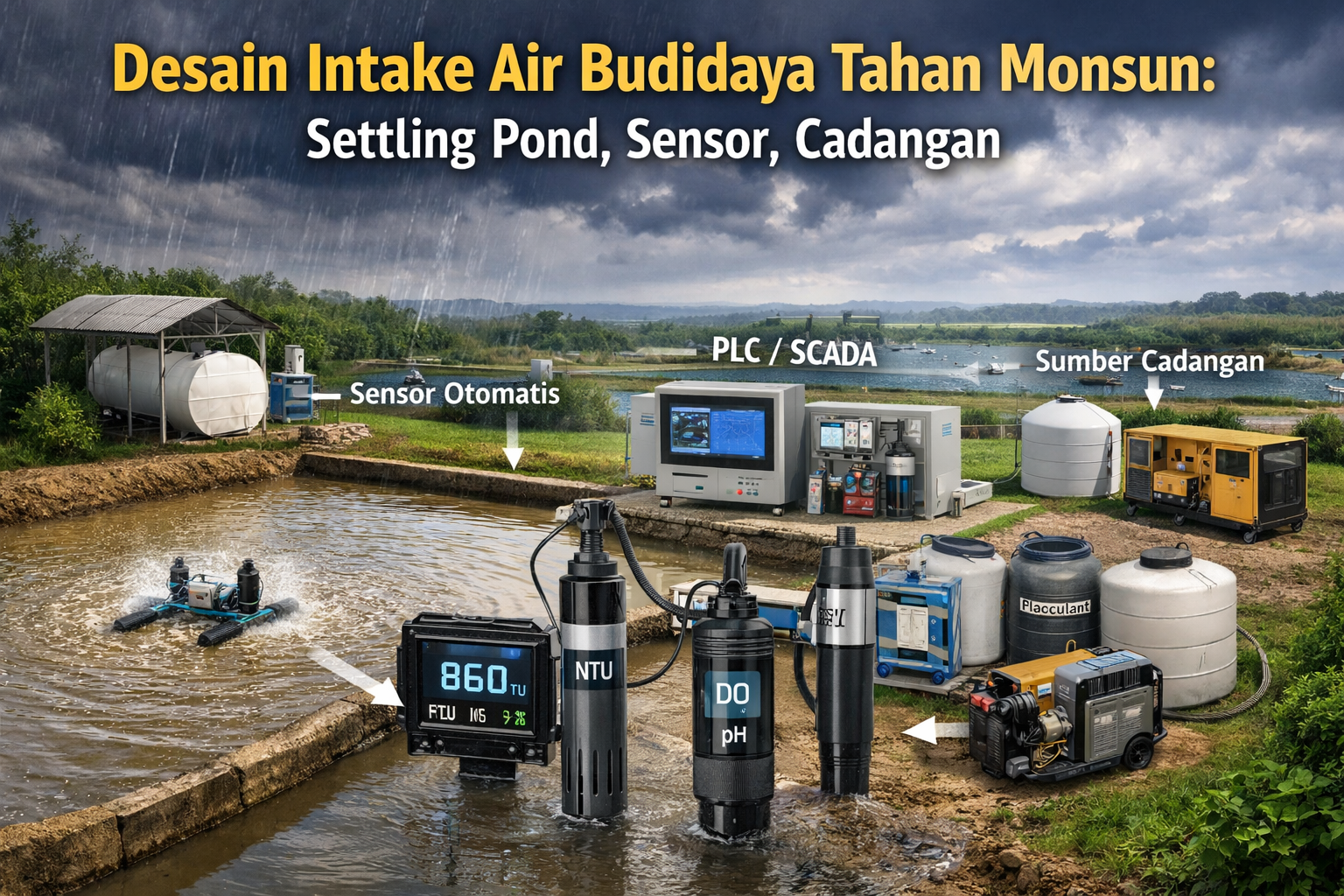
Even with robust design, extremes happen. Risk assessments rank “climatic shocks” — storms, floods, droughts — as top external threats to aquaculture (ScienceDirect). A resilient intake strategy includes an emergency water quality protocol built around clear triggers, isolation, alternate supplies, treatment escalation, operational changes, and backup power.
- Trigger thresholds: define critical values (e.g., turbidity >300 NTU, DO <3 mg/L, salinity swing >±5 PSU [practical salinity units], ammonia spike) that immediately cut normal operations. For context, many hatchery manuals set turbidity alarms around 40–50 FTU (Formazin Turbidity Units) (FAO).
- Isolation valves: ensure intake lines have shut‑off gates or sloping inlet weirs to stop flow during a crisis; closing the intake buys time to treat or identify sources.
- Alternate supplies: maintain a backup water source or storage — a covered raw‑water tank, a secondary well/pump location, harvested rainwater in sealed cisterns. For saltwater sites, emergency desalination can be dialed in; containerized systems are available via rental units for temporary treatment needs.
- Treatment escalation: preplan “overdose” treatments for emergency flushing. If a toxic algal bloom is detected (via high chlorophyll or color sensors), the protocol might call for an immediate alum‑flush to coagulate toxins, followed by rapid aeration. A phosphate‑based bloom might be countered by adding suppressing clay or hydrogen peroxide if DO plummets.
- Operational changes: reduce stock or evacuate if water is unusable. In prolonged toxic contamination, harvest‑asap (possibly at suboptimal size) can be more economical than losing an entire crop. Supplementary aeration and feeding reductions are stopgaps until recovery.
- Backup power: keep generators or batteries available to run aerators if storms knock out the grid; many losses follow oxygen crashes after the event.
By way of example, a coastal shrimp farm on a typhoon‑prone island might define a contingency such as: if turbidity exceeds 800 NTU (observed max in a past cyclone) and pH falls by >0.5 units within 12 hours, immediately shut the intake pump, inject lime to raise pH, add flocculant, and run emergency aerators. Monitor until values normalize, then resume intake at 50% pump speed with online monitoring. Those thresholds and actions would be driven by historical data (e.g., previous storm turbidity peaks ResearchGate and oxygen depletion events). For sourcing, the emergency chemical package typically covers both coagulants and flocculants aligned to the site’s protocol.
Performance metrics and recovery
The measurable gains are material. Doubling settling‑pond volume raised mean TSS removal from ~60% to ~90% in one shrimp farm trial. Automated dosing linked to sensors cut incident turbidity exceedances by ~80% compared to manual dosing in analogous systems. Farms with written contingency protocols recover from floods 3× faster (measured as return to normal stocking operations) than ad‑hoc responders.
Sources and standards
Guidance and data cited above include FAO engineering manuals advocating intake sedimentation basins (pdfcoffee.com), a field study documenting 6 h settling ponds removing 88% of TSS (ResearchGate), rainfall‑driven turbidity surges well above 300 NTU (ResearchGate), IoT‑enabled coagulant dosing (MDPI), and risk frameworks that rank climatic shocks as critical stressors (ScienceDirect). Each recommendation above is grounded in such data and standards.