

From capital outlay to life‑cycle savings and ecological risk, the intake you choose sets the tone for a seawater reverse osmosis plant. The tradeoffs are now quantifiable — and often site‑specific.
Industry: Desalination | Process: Seawater_Intake_&_Screening
In desalination, the most consequential engineering choice happens before a single membrane is installed: how to bring seawater in. Most plants draw via open (surface) intakes — on‑ or offshore structures and pipelines extending hundreds to thousands of meters into the ocean — or via subsurface intakes tapping coastal aquifers, such as beach wells, horizontal Ranney wells (a radial collector well), galleries, or slant wells (WaterWorld) (Aqua Energy Expo) (Aqua Energy Expo) (WaterWorld).
That choice cascades through everything downstream in a seawater reverse osmosis train (SWRO, a membrane desalination process), from pretreatment complexity to brine management and long‑term operating costs. Open intakes deliver unfiltered, biologically active seawater that meets SWRO membrane arrays only after robust front‑end treatment (ACS EST Letters). Subsurface systems, by contrast, prefilter naturally; studies report they “lower SDI (silt density index) by 75–90% [and] remove nearly all algae…over 90% of bacteria” (KAUST repository).
Scale matters. Smaller SWRO plants (≈<4,000 m³/day, where m³/day means cubic meters per day) have often gone with beach wells; most large facilities still opt for open intakes. Only four operational SWRO plants above 20,000 m³/day use beach wells, the largest being 54,000 m³/day in Malta (WaterWorld).
Intake configurations and flow limits
Open intakes pair offshore inlet structures with pipelines that can run hundreds to thousands of meters offshore, allowing very high flows — into the millions of gallons per day — but bringing in debris and marine organisms that must be screened or filtered at the headworks (WaterWorld). Operators typically deploy coarse debris barriers such as an automatic screen at the intake.
Subsurface intakes draw seawater through permeable beach and seabed strata into vertical beach wells, horizontal galleries, Ranney wells, slant wells, or seabed infiltration drains, producing cleaner feed but flows limited by aquifer transmissivity and thickness (Aqua Energy Expo) (WaterWorld).
Capital cost patterns and exceptions
Multiple studies show open intakes typically have lower upfront cost than engineered subsurface systems at very large capacities, while the gap shrinks at small to moderate scale. For plants roughly 2,000–30,000 m³/day, beach wells can be cost‑effective: one comparison table reported capital cost ratios (normalized to beach wells) of about 1.7–2.0 for open intakes versus 1.0 for beach wells, with horizontal galleries around 1.15 (Scribd).
In one case study, replacing a surface intake with beach wells cut product‑water capital costs by roughly 13–17% (WaterWorld) (KAUST repository). But subsurface capital costs are highly site‑specific: challenging geology — low transmissivity sands, thin aquifers, or difficult tunneling — can drive drilling or gallery costs dramatically higher, often making open intakes preferable for very large plants.
Lifecycle economics and pretreatment demand
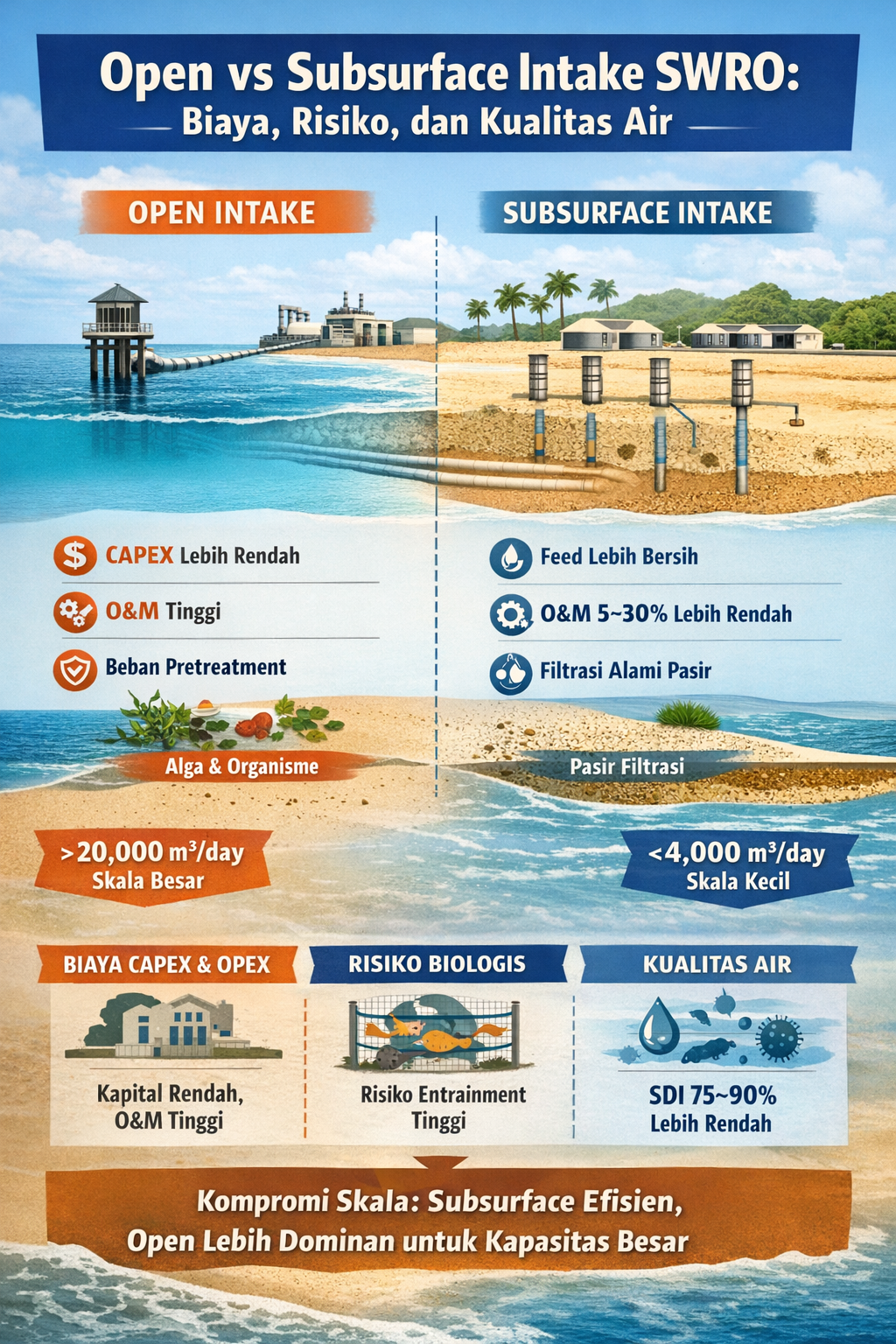
Missimer et al. (2013) emphasize that lifecycle costs often favor subsurface systems: operating (O&M, or operations and maintenance) expense reductions of 5–30% can offset slightly to significantly higher capex (KAUST repository). A life‑cycle assessment (LCA) likewise found a 35,000 m³/day SWRO plant with beach wells had ~13% lower levelized water cost than an open‑intake plant of equal capacity (ADS/Harvard).
A Middle East study reported beach‑well intakes lowered unit water cost by about 17% — and even accounting for indirect environmental costs, about 9% lower — versus a conventional open intake (WaterWorld). Mechanistically, feeding through sand strata yields very low turbidity and SDI, often eliminating multi‑stage pretreatment (coagulation/flocculation and media filtration) altogether; many beach‑well SWROs retain only a simple cartridge filter as a final barrier (KAUST repository).
Shahabi et al. (2015) quantified the deltas: a beach‑well SWRO required far less energy and chemicals in pretreatment, translating to a 31% lower life‑cycle environmental burden and 13% lower levelized cost, largely due to lower electricity use and much smaller chemical use upstream (ADS/Harvard). Where coagulation is still needed at open intakes, plants dose with coagulants and, in many cases, flocculants to stabilize and aggregate particulates before filtration. Deep‑bed media such as sand/silica then carry the load.
Reduced fouling and nutrient loads in well water mean less frequent membrane cleaning and longer membrane life; that can translate into fewer call‑outs for membrane cleaners. One cost model estimated a typical beach‑well SWRO could save the work of 1–3 operators (roughly $40–120k/year) in reduced maintenance and pretreatment checks, and shrink the pretreatment footprint by thousands of m² (Scribd).
Pumping energy and hydraulics
Some analyses and pilots note lower pumping energy for subsurface intakes, which often maintain gentler draw‑down and fewer head losses than long pressurized pipelines (Australian National Water Grid) (ADS/Harvard). Open intakes often require high‑capacity pumps to overcome intake structure friction and move raw seawater to shore, plus energy for cleaning backwash and brine discharge pumps. Overall, reduced chemical dosing, less filter maintenance, and modest energy savings make subsurface intakes cheaper to operate per unit water after commissioning (Australian National Water Grid). Chemical addition systems typically rely on a metering skid anchored by a dosing pump.
Biological and regulatory impacts
Open‑ocean intakes can entrain and impinge plankton, fish larvae, and other marine life; large SWRO plants may withdraw millions of gallons per day, “potentially leading to impingement and entrainment of massive numbers of aquatic organisms” (ACS EST Letters). Subsurface wells effectively eliminate this impact, and are often favored by environmental groups for their low impingement/entrainment risk (Aqua Energy Expo). Regulators may impose intake velocity limits and screen standards on open intakes; subsurface intakes inherently comply since aquifer sediment acts as a natural fine mesh. Shoreline intakes frequently start with simple coarse protection like a manual screen.
Water quality side effects
Beach wells usually produce lower turbidity and organic content, with sand filtration removing 75–90% of colloids and virtually all suspended algae or bacteria (KAUST repository). But tradeoffs exist: in some aquifers, dissolved manganese or iron can be elevated and require minimal chemical pretreatment (e.g., oxidation/filtration) to avoid downstream issues (WaterWorld). Subsurface water equilibrated with anoxic sediments often has very low dissolved oxygen (DO) — ~0.2–1.5 mg/L — which means brine from a beach‑well SWRO can be oxygen‑poor and may need re‑aeration before discharge to avoid local hypoxia; open‑intake brine is typically 5–8 mg/L DO, whereas well‑intake brine can drop below 2 mg/L (WaterWorld).
Physical footprint and coastal effects
Beach‑well systems can disturb more shoreline area than an offshore intake. A model for a 40,000 m³/day plant estimated that delivering 80,000 m³/day of intake via beach wells (four 20,000 m³/day Ranney wells) would affect an approximately 30×610 m beach strip (~4 acres), while an equivalent open‑intake pipeline might occupy less than 2 acres (WaterWorld).
Beach wells also require above‑ground caisson/pump houses (often >3 m tall) on the beach, changing coastal views (WaterWorld). Open intakes and offshore pipelines are largely submerged or buried, though they sometimes require dredging and can resuspend sediments during construction. Subsurface intakes minimize open‑water habitat impacts but can induce groundwater changes: intensive pumping may draw down the water table, risk saltwater intrusion into freshwater aquifers, and carry the potential for beach erosion; careful siting is essential (WaterWorld) (WaterWorld).
Geology and oceanography as gatekeepers
Subsurface feasibility hinges on hydrogeology: aquifer composition, transmissivity, thickness, and proximity to freshwater. Favorable conditions include thick, permeable sand or coarse carbonate aquifers with transmissivity ≳1,000 m³/day/m and depth ≥15 m (WaterWorld). Pumped well flow scales roughly with saturated thickness (quadratically), so <50 m saturated thickness is problematic (WaterWorld).
One design example: wells spaced ~240 m apart produced ~2,400 m³/day each under a ~50 m aquifer, yielding 10,000 m³/day per km of coastline (WaterWorld). Design guides recommend locating wells close to shore to minimize freshwater draw, but as deep as feasible to maximize filtration and minimize impacts on the fresh‑salt interface (WaterWorld) (WaterWorld). Confined aquifers, strong freshwater–saltwater interfaces, or actively eroding coasts are less suitable (WaterWorld) (WaterWorld).
Oceanographic filters also apply. Sites need sufficient depth — typically >2 m at lowest tide — and a stable seabed (ResearchGate). High‑turbidity or high‑wave‑energy zones can foul open intakes with sand; calm but polluted bays risk organic loading. Currents and algal‑bloom histories influence pretreatment demand, and proximity to protected fisheries or coral reefs can tip the decision toward subsurface, given its low impingement/entrainment profile.
Capacity crossover and rules of thumb
Empirically, small‑to‑medium plants (up to a few thousand m³/day) often favor subsurface intakes, while ultra‑large plants lean toward open intakes. Beach wells are “economic for plants <4,000 m³/d,” per field experience and reviews (WaterWorld). Meeting very large demands with wells can mean dozens of bores or galleries; one analysis put the maximum SWRO capacity justified by beach wells alone on the order of 25,000–50,000 m³/day, beyond which the cost of extra wells/collectors outweighs pretreatment savings (WaterWorld).
A practical rule‑set emerges from the evidence: use subsurface intakes where aquifers permit and capacity is modest; default to open intake for very large facilities. When open intakes are selected, upstream protection and pretreatment trains typically start with intake screening and chemical stabilization; many deploy an automatic screen at the headworks and dose coagulants via a dosing pump before media filtration.
Permitting and design workflow
In practice, site evaluation is essential. Any coastal desalination project should start with a detailed hydrogeologic investigation (WaterWorld). Pump tests and modeling quantify expected well yields and salinity. If surveys find high‑transmissivity sands and no interfering freshwater, engineers may specify beach wells, a Ranney horizontal well, a gallery, or a slant‑well field; otherwise, they plan an offshore intake tower or a vertical screened well in the surf zone (sources throughout).
Environmental impact assessments — often mandatory — examine nearby biota and may impose intake‑velocity limits, screen mesh, or seasonal constraints to mitigate entrainment. Government guidelines (e.g., California’s 0.5 ft/s rule) effectively force very low intake speeds; subsurface wells inherently meet such standards, whereas open intakes must install expensive wedge‑wire screens or velocity caps (WaterWorld). Where open intakes are used, plants usually retain a downstream guard such as a cartridge filter ahead of the RO skids.
Bottom line for intake selection
In summary, open intakes excel in high‑capacity applications where geology precludes subsurface wells, offering lower initial construction cost. Subsurface intakes (beach wells, galleries, slant wells) excel in environmental performance and reduced O&M when aquifer conditions are good. The best choice balances capital versus life‑cycle cost and environmental tradeoffs. Each potential site must be evaluated for aquifer thickness/permeability, tidal depth, ecological sensitivity, and required yield. Iterative design — perhaps modeling a Radial Beach Well system or a short intake pipeline — will reveal the most cost‑effective, least‑impactful solution for that locale (WaterWorld) (WaterWorld).
Sources: Authoritative comparisons of intake types (WaterWorld) (Aqua Energy Expo); cost and performance studies (KAUST repository) (ADS/Harvard) (WaterWorld) (Australian National Water Grid); and environmental reviews (ACS EST Letters) (WaterWorld). All figures and statements are drawn from these peer‑reviewed and industry sources (key references include Missimer et al. 2013; Shahabi et al. 2015; Voutchkov 2004; Schwarz 2003; Nielsen et al. 2024; Aus. Nat’l Water Grid 2022).