

Industry: Desalination | Process: Seawater_Intake_&_Screening
When barnacles took over a seawater reverse osmosis (SWRO) intake, operators watched the dynamic water level plunge by about 2 m, from –6 m to –8 m, crippling flow and pushing up pump head (ide-tech.com). That is the unglamorous front line of desalination: keeping organisms off pipes and screens so high‑pressure trains and polyamide membranes keep humming.
The industry splits its arsenal between chemical treatments, chiefly chlorine — still the cheapest biocide — and physical methods like screens, backflushing, and pigging. Non‑chemical options, including copper‑ion generators, aim to avoid added oxidants. Each route works differently, costs differently, and carries different environmental liabilities.
Intake biofouling mechanisms and standard practice
Natural marine microorganisms (bacteria, algae) and macro-organisms (mussels, barnacles, seaweed) quickly colonize intake pipes and screens, reducing flow and raising pump head. Industry‑standard responses pair coarse prefiltration with dosing programs: disinfectant barriers at the mouth, and mechanical cleaning deeper in the system. Intake designers often specify an automatic screen at the headworks to remove debris and larvae before they settle, with strainers downstream for finer interception (scribd.com).
The stakes are immediate. Unchecked fouling escalates energy costs and forces shutdowns for cleaning. Before water ever sees SWRO membranes, the intake must remain hostile to colonizers — without violating discharge limits that increasingly demand near‑zero residuals in coastal waters.
Continuous chlorination parameters and unintended fouling
Continuous chlorination means low‑level sodium hypochlorite (NaOCl) is metered into the intake stream at ≈0.5–2.0 mg‑Cl/L (scribd.com). At these setpoints, free chlorine (hypochlorous acid/hypochlorite) suppresses microorganisms and helps keep coarse screens and strainers slime‑free (scribd.com). Accurate metering is critical; plants typically rely on a dosing pump to hold residuals steady.
But a cautionary data point looms large. In one SWRO trial, a continuously chlorinated intake — with downstream bisulfite neutralization — developed much worse biofilms than a chlorine‑free intake: the RO feed‑brine pressure rose sharply after ~90 days with chlorine, while the untreated train stayed at baseline (mdpi.com). ATP assays showed ≈10× more biofilm in the chlorinated line (mdpi.com), likely because the oxidizing milieu converted natural organics into readily‑assimilable forms that fueled regrowth after dechlorination (mdpi.com). Intermittent “shock” dosing was reported more effective than constant chlorination in that context (mdpi.com).
Continuous programs still produce residual oxidants that must be removed before sensitive equipment and before discharge. For generation, many operators prefer on‑site systems such as electrochlorination rather than bulk chlorine handling; either way, residuals will need subsequent neutralization.
Shock chlorination dosing and neutralization duty
Shock (intermittent) chlorination uses periodic high‑dose pulses — typically 5–10 mg/L free chlorine for short periods (a few minutes) at regular intervals — to knock back organisms. One engineering account reports dosing 5–10 ppm hypochlorite for ~1–5 minutes several times per day to prevent barnacle‑larvae settlement (ide-tech.com). Another source notes 1–5 ppm shocks every few hours on heat‑exchangers (scribd.com).
Action is brief and best at early stages; adult barnacles and shells often survive, so pulses must recur indefinitely (ide-tech.com). High spikes pose safety/material concerns and dump large oxidant loads into the intake; plants then neutralize with sodium bisulfite before downstream use or discharge. Notably, chlorinated intake water “has to be neutralized with bisulfate to prevent damage to the polyamide membranes” (ide-tech.com). Many facilities standardize the step with a dechlorination agent immediately upstream of RO.
Whether continuous or shock, chlorination creates disinfection by‑products (DBPs) — trihalomethanes, haloacetic acids, and others — that must be managed if water is reused or ingested downstream (123dok.com).
Copper‑ion generation performance and trade‑offs
Non‑chemical antifouling methods seek to minimize added oxidants. Copper‑ionization systems dissolve Cu²⁺ from sacrificial anodes or electrolytic cells; copper ions are potent biocides, a lineage that echoes centuries of copper‑based hull coatings (pmc.ncbi.nlm.nih.gov). In treated intakes, Cu²⁺ is typically in the low‑ppm range. Agricultural systems, for example, deliver ~0.1–10 ppm Cu²⁺ (kingdomagriculture.com).
Laboratory studies show ~1–4 ppm free copper can produce >99% kill of bacteria like Escherichia coli within 2–4 hours, with similar log reductions for viruses and other microbes at a few ppm (kingdomagriculture.com). It is not instantaneous: ~2.0 ppm Cu gave ≈97% reduction of a plant pathogen after 4 hours (kingdomagriculture.com). In intakes, copper’s broad toxicity may prevent slimy biofilms and inhibit barnacle settlement; because Cu²⁺ persists, a small residual remains active until diluted or precipitated.
Compared to chlorine, copper avoids halogenated DBPs and does not oxidize membranes or infrastructure. But copper is itself a toxic heavy metal: an EPA assessment of a desal effluent found ionic copper was the primary toxicant impacting marine life, and lab tests on a Key West discharge showed copper alone explained most acute mortalities in local organisms (nepis.epa.gov). Environmental limits are tight: dissolved copper in EU coastal water is capped at 0.04 mg/L (eur-lex.europa.eu), and many guidelines land around ~0.5 mg/L or less. In practice, copper‑ion generation is often paired with downstream precipitation or filtration to avoid discharge.
Mechanical cleaning and pigging case evidence
Physical strategies remain central. Well‑designed intake screens and strainers remove large biota before entry, and backwashing or compressed air can clear accumulations. Coarse headworks may start with a manual screen, followed by a strainer where space or hydraulics require it.
Large SWRO plants increasingly use pigging — launching a tapered brush or bullet through the intake — to scour pipe walls (ide-tech.com). At a 650 MLD plant in Israel, quarterly pigging halved the pressure drop and kept flows up without any chlorine use (ide-tech.com). Pigging does demand robust pipeline design (smooth long runs, pig launchers), and while capital can be higher, the environmental footprint is negligible.
Chlorine discharge limits and ecotoxic thresholds
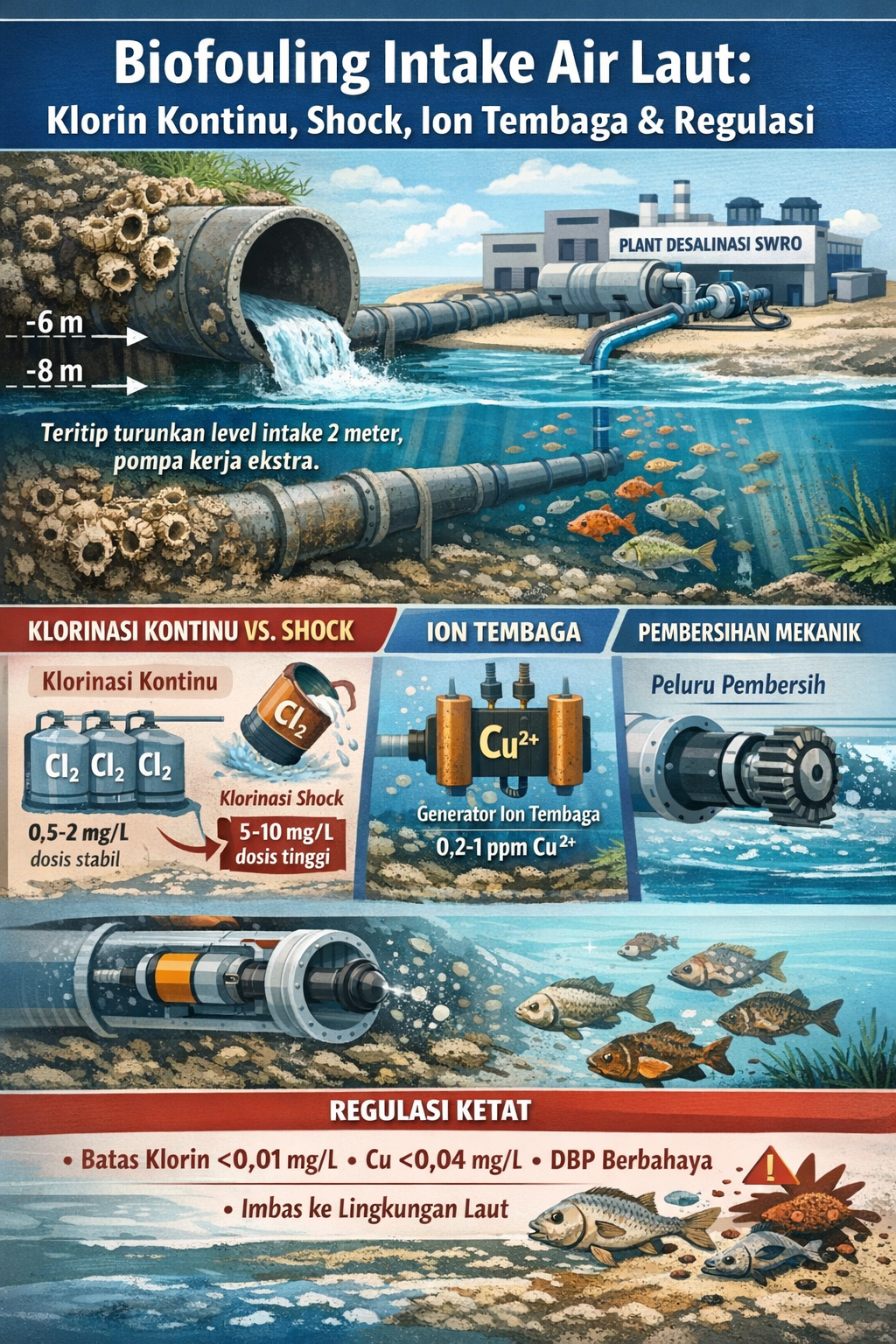
Chlorine discharge is especially scrutinized. Most marine standards demand essentially zero residual chlorine. The EU Bathing Water Directive stipulates total residual chlorine ≤0.005 mg/L (5 µg/L) (eur-lex.europa.eu), and the USA EPA’s marine‑water acute criterion is ~13 µg/L (info.awa.asn.au). In practice this forces operators to neutralize almost all injected Cl₂ before any water returns to the sea, and desal plants routinely add a bisulfite dechlorination step prior to reuse or discharge (ide-tech.com).
The biology is unforgiving: prolonged exposure of 0.04–0.20 mg/L active chlorine can kill most fish (fao.org). For context, an Indonesian survey measured cooling‑drain chlorine at 0.05–0.4 mg/L in coastal water — under Indonesia’s effluent standard of 1 mg/L, but well above ecotoxic thresholds (repository.ipb.ac.id; fao.org). Chlorine decays rapidly in seawater (info.awa.asn.au), yet compliance still drives residuals down to <0.01 mg/L before release in many programs. In Indonesia, any seawater‑to‑sea discharge requires a permit and adherence to quality standards (e.g., PermenLH and PP limbah regulations).
Metal limits and copper discharge management
Heavy metals, including copper, are tightly controlled. EU bathing standards cap dissolved copper at 0.04 mg/L (eur-lex.europa.eu), and Indonesian sea‑discharge rules likewise limit metals to low µg/L ranges depending on Class and zone. Copper’s persistence can be a double‑edged sword: while less frequent dosing may suffice, overflow or purging events can spike concentrations. In one case, maintenance released >45 kg/day copper into a harbor, leading to mass mortality of invertebrates (nepis.epa.gov).
DBPs, chlorination by‑products, and low‑chemical trends
Chlorination of seawater generates halogenated DBPs — including trihalomethanes and haloacetic acids — that complicate both reuse and environmental discharge (123dok.com). Although most RO plants reject organics via membranes, fouling reactors can still generate THMs from residual bromide, so international guidance increasingly favors minimizing halogen disinfectants altogether.
Modern programs reflect that shift. Japan’s “Mega‑ton Water” work has demonstrated long‑term operation without chlorine or bisulfite addition; a one‑year pilot with zero chlorine dosing met design energy use and kept fouling stable (mdpi.com). Biofouling monitoring technologies (e.g., mBFR) now help engineers trim dosing when seawater quality is good, cutting cost and impact.
Scale, regional deployments, and monitoring
With global desal capacity climbing — dozens of plants >100,000 m³/d now operate — the intake problem scales up. In the Middle East/North Africa, several mega‑plants (500,000–1,000,000 m³/d) have started up since 2017, with operators moving toward lower‑chemical pretreatment (mdpi.com; mdpi.com). Some plants report cutting fouling‑related downtime nearly to zero by combining minimal biocide (occasional shock) with regular pigging, rather than aggressive continuous chlorination (ide-tech.com).
Comparative outcomes and layered implementation
Efficacy: Continuous chlorination at ~1 mg/L suppresses most microbial growth in the intake and can let screens self‑clean (scribd.com), but it is only modest against hard shells. Shock pulses (5–10 mg/L for minutes) are more lethal to larval barnacles (ide-tech.com), while adult colonies resist and force repeat shocks. Copper‑ion systems deliver biocidal Cu continuously; at ~1–4 mg/L they achieve ~99% bacterial kill in 1–2 hours (kingdomagriculture.com). Copper does not instantly remove fouling, and some organisms tolerate moderate doses. Mechanical cleaning is often still required for heavy macrofouling.
Cost & maintenance: Chlorine is inexpensive per kg, but needs transport or an on‑site generator and adds O&M for pumps and safety; continuous dosing uses modest volumes, while shocks consume more per event (but less frequently). Copper units have higher capital costs (electrodes, power supplies) but minimal chemical inventory; anodes erode and must be replaced or recharged. Pigging and screen backwashing are dominated by labor and downtime. Regardless of program, residuals must be monitored to meet mixing zone criteria. For plants choosing on‑site generation, electrochlorination integrates readily with dosing and neutralization trains.
Environmental impact: Un‑neutralized chlorine is acutely toxic to marine life (toxic thresholds ~0.04 mg/L, versus allowed discharge ~0.005 mg/L) (fao.org; eur-lex.europa.eu). Copper likewise poisons organisms at low µg/L; decades of maritime practice show copper alloys deter fouling but can kill non‑targets (nepis.epa.gov). Chlorine forms harmful organic by‑products; copper can accumulate in sediments. Non‑chemical methods such as pigging or copper‑ionization avoid halogenated DBPs but shift the burden to metal discharge or mechanical waste management.
Regulatory compliance: Any seawater‑to‑sea discharge requires a permit and adherence to national standards in Indonesia (PermenLH and PP limbah). Indonesian limits historically allow up to 1 mg/L chlorine in effluent (repository.ipb.ac.id), far more lenient than aquatic biology can tolerate (fao.org), so operators dechlorinate and often filter or otherwise neutralize copper before discharge. New regulations and public scrutiny are pushing stricter coastal quality, making heavy chemical reliance increasingly contentious.
Practical program design and monitoring
No single tactic is perfect. Continuous chlorination is simple and cheap but environmentally taxing and prone to diminishing returns as biofilms adapt (mdpi.com; info.awa.asn.au). Shock chlorination clears early‑stage macrofouling when well‑timed (ide-tech.com) but still leaves toxic residues that must be neutralized. Copper‑ionization avoids halogenated DBPs and is effective against bacteria, but it injects Cu²⁺ that must be managed to below tight discharge limits.
The emerging pattern is layered: coarse prefiltration/screens, regular pigging, and the lightest feasible biocide dosing. Given stringent limits (for context, chlorine <0.01 mg/L in practice; copper 0.04 mg/L in EU bathing waters) (eur-lex.europa.eu; eur-lex.europa.eu), plants increasingly rely on engineered solutions — piggable pipelines and automated fouling monitors — to minimize chemical use. Any implementation should quantify outcomes: reduction in cleaning frequency, biofilm formation indices, and effluent compliance. Where chlorination is used to protect RO trains, neutralization with a dechlorination agent remains non‑negotiable.
Sources: Authoritative studies and industry reports underpin this analysis (fao.org; mdpi.com; ide-tech.com; kingdomagriculture.com; eur-lex.europa.eu; eur-lex.europa.eu; repository.ipb.ac.id), with detailed citations in‑line above.