

Industry: Desalination | Process: Brine_Disposal
Desalination’s reject stream is twice as salty as the ocean it came from, and it’s growing fast: by 2017, ~19,400 desal plants were online with ~100 million m³/day of capacity (ResearchGate; ScienceDirect). Because modern Reverse Osmosis (RO) plants typically recover ~40% of intake water, up to 60% becomes brine (ResearchGate).
This concentrate also carries pretreatment chemicals—antiscalants, biocides, and corrosion inhibitors—that pose toxicity risks to marine life if not quickly diluted (IntechOpen). Dense plumes can blanket benthic habitats, harming seagrass, corals and sediment communities if mixing is poor (California Water Library; California Water Library). The engineering mandate is clear: achieve very rapid dilution so that by the edge of the regulatory mixing zone the salinity elevation is minimal.
Disposal pathways and treatment options
Conventional disposal includes surface discharge via marine outfalls with diffusers, deep‑well injection into saline aquifers or salt caves, evaporation ponds that rely on large land areas, and even land irrigation with saline effluent. None is universally applicable, and several are unsustainable at scale (ScienceDirect; ScienceDirect). Evaporation ponds, for instance, require huge areas and risk soil salinization, while injection is limited by geology and potential aquifer impacts (ScienceDirect).
Regulators increasingly push treatment—brine concentration or Zero Liquid Discharge (ZLD) that recovers freshwater and salts to limit what must be released (ScienceDirect). In practice, many coastal plants blend waste streams (e.g., power‑plant cooling water or treated wastewater) with brine to pre‑dilute it (California Water Library). A California expert panel (“Jenkins et al.”) noted that when brine is properly co‑discharged or well‑mixed, “concentrate can be disposed of with minimal environmental effects,” whereas poor initial dilution causes “widespread alterations of community structure” (California Water Library; California Water Library).
Multi‑port diffuser engineering
Modern outfalls lean on multi‑port diffusers—a line or tee manifold with many small nozzles (ports) that split the brine into multiple jets. By dividing the flow, each port’s velocity is lower, which increases entrainment of ambient water and reduces the buoyancy deficit of each jet. A design comparison found a single inclined jet needed >11.9 m water depth and 17.7 m/s discharge velocity (u₀) to hit a target dilution, at a capital+O&M cost of $6.2 M (IntechOpen). An optimized multi‑port alternative used 39 ports of smaller diameter at only 2.7 m depth and 8.5 m/s to deliver the same dilution for about $3.1 M—roughly a 50% cost reduction (IntechOpen).
Across cases, multi‑port submerged designs cut total outfall cost ~40% versus single‑jet submerged, or ~42% if surfacing plumes are allowed; allowing a surface‑reaching plume with a single jet saved only ~6% (IntechOpen). The gains stem from “high dilution…within tens of meters” of the outfall even at low jet momentum (IntechOpen).
Engineers tune variables—number of ports (N), discharge angle (typically 20–40° up from horizontal), port diameter (D₀), spacing, total diffuser length, and intake flow rate—using site studies and models. In shallow water or where seabed slopes are mild, diffusers outperform single jets and can be set closer to shore; single jets dominate only in very deep, uniformly deep water (IntechOpen). Practice often favors staged arrays: a close cluster of ports acting as one long line.
Computational and field work confirm dilution scales with port count—e.g., moving from 9 to 21 ports increased near‑field dilution from ~5× to ~5.5× (ResearchGate). Submerged (steep‑angle) diffusers achieve greater initial dilution than surface‑reaching jets in deep water, though in very shallow sites a surface plume may be unavoidable (IntechOpen; IntechOpen).
Key outcomes are practical: multi‑port diffusers enable lower discharge velocity and shallower placement for the same dilution target. In one plant, the required mixing depth fell from ~12 m (single port) to ~3 m (multi‑port) using N=39 ports (IntechOpen). Where needed, design models solve two‑dimensional advection‑diffusion equations—or use empirical tools like CORMIX—to choose N, D₀ and nozzle angles that guarantee brine is diluted to acceptable concentrations (e.g., <2–5 ppt [parts per thousand] above background) by the mixing zone boundary (IntechOpen; ResearchGate).
Hydrodynamic modeling and mixing zones
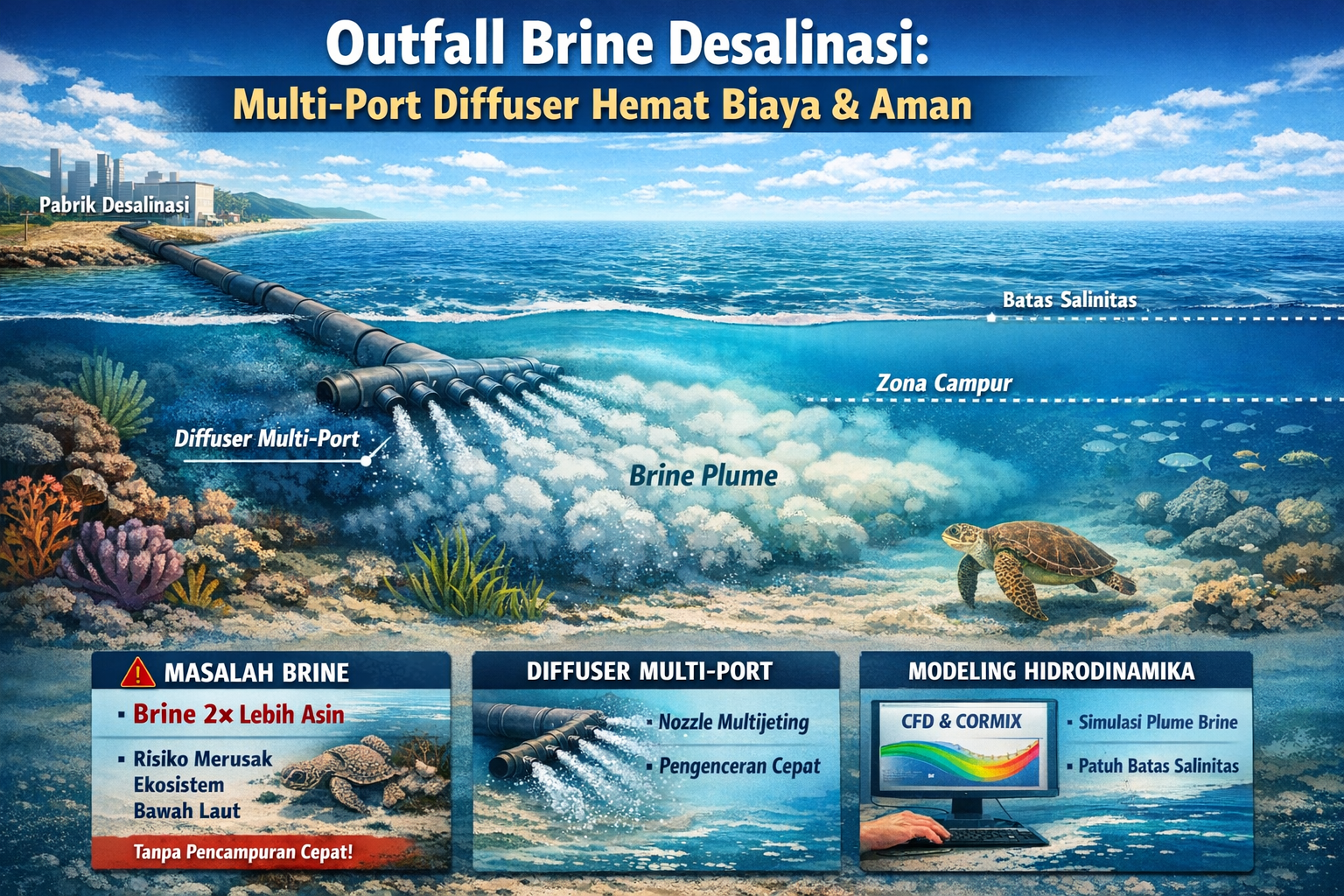
Predictive modeling is now essential. Industry tools like CORMIX (US EPA), EFDC, MIKE3 (DHI), and CFD (computational fluid dynamics) simulate turbulent jet entrainment and ambient currents to map plumes in real coastlines. In a Hong Kong desal EIA, CORMIX predicted that at 80 m from the outfall the brine was diluted ~18.5×, leaving a residual anti‑scalant concentration of 0.162 mg/L—over 100× lower than its algal toxicity threshold (EPD Hong Kong). Models incorporate tidal currents, stratification, and shoreline geometry to predict time‑averaged plume extent and to design the “mixing zone,” the area over which elevated salinity is allowed before compliance limits apply.
Typical criteria require meeting limits at the mixing zone edge. A California expert panel recommended a 100 m mixing zone radius and an allowable salinity increase of ≤5% (≈1.7 ppt) at that boundary (ResearchGate). Panels note that initial dilution and flushing can limit impact to “a few tens of meters” around a well‑designed discharge (California Water Library), but they conservatively set 100 m for regulation (ResearchGate).
In Indonesia specifically, formal brine‑specific rules are not clearly articulated; facilities apply generic marine water quality and EIA standards (e.g., those analogous to Kep.51/2004 on seawater quality). In practice, designers follow the international norm: ensure near‑zone dilution limits salinity rise to only a few PSU (practical salinity units) or a few percent of ambient before the mixing zone boundary.
Scenario runs are the workhorse: models test extreme low‑current conditions or worst‑case stratification and then adjust diffuser layout. Results routinely show that increasing port count or discharge height can produce diluted plumes that sink later and spread more widely horizontally, lowering concentrations at sensitive sites. This guides whether a diffuser line must be lengthened, angled differently, or paired with co‑discharge pre‑dilution to meet mixing‑zone salinity criteria (California Water Library; ResearchGate).
Designing for compliance and cost
The endgame is quantifiable: hit thresholds like “salinity ≤2 ppt above background at 100 m” while protecting ecosystems. Notably, a multi‑port, submerged diffuser can halve capital and operating costs versus a single‑jet solution for the same mixing goal (IntechOpen; IntechOpen). Achieving rapid initial dilution is paramount; poorly mixed, slow jets have caused large ecosystem impacts in real cases. The current best practice—advanced multi‑port geometry plus thorough modeling—aims to ensure that by the mixing zone edge, the plume is diluted to harmless levels (California Water Library; ResearchGate).
In short, modern brine disposal couples multi‑port diffuser hardware with hydrodynamic modeling. That combination delivers high dilution (often >10×) within tens of meters, meets imposed salinity limits, and minimizes ecological impact—backed by data that drive everything from diffuser geometry to monitoring plans (IntechOpen; ResearchGate).