

Industry: Desalination | Process: Reverse_Osmosis_(RO)
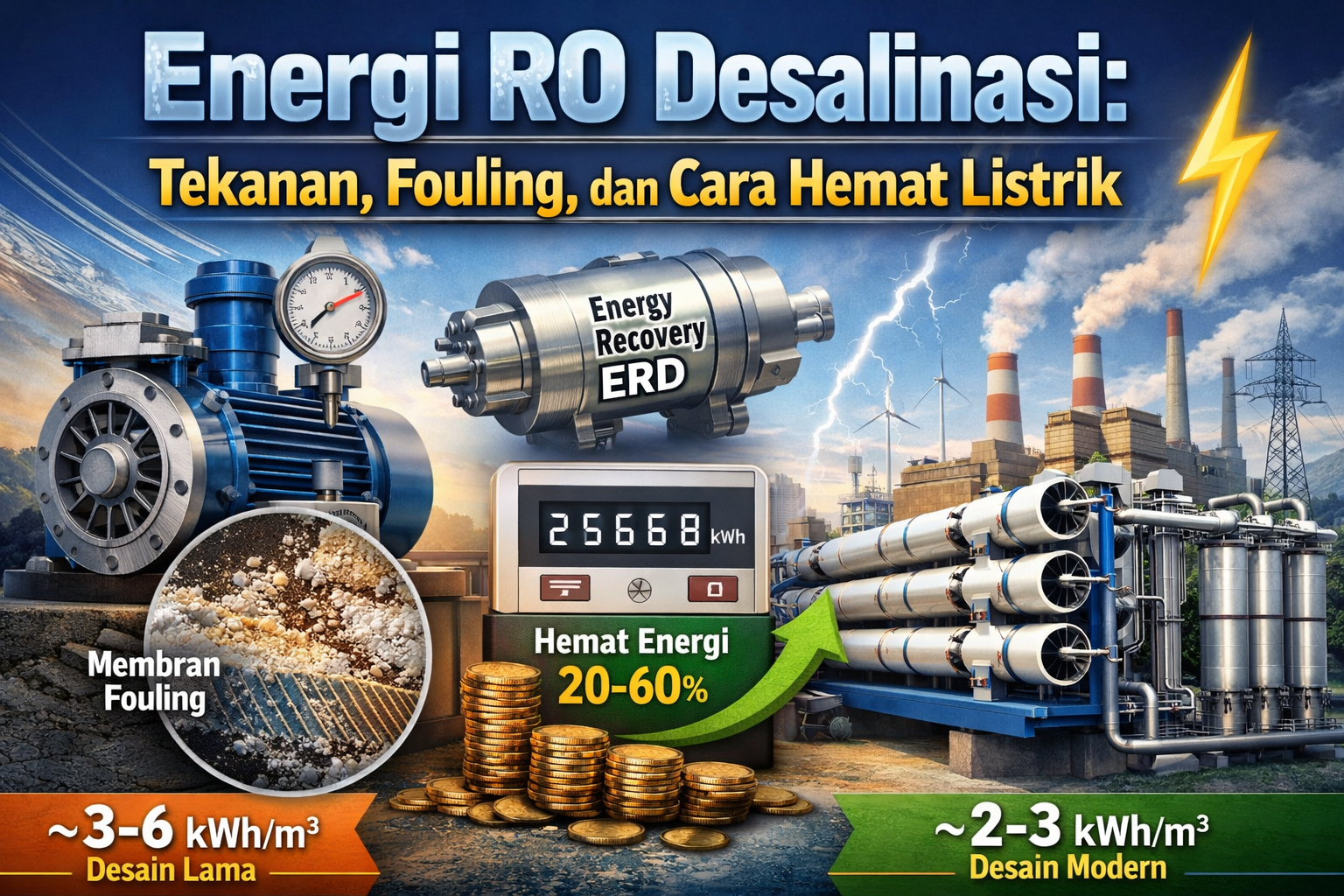
Reverse osmosis (RO) energy use isn’t a mystery; it’s a balance of product flow, feed salinity, recovery rate, and frictional losses. Specific Energy Consumption (SEC, kWh/m³) for older large SWRO plants typically ranges from 3–6 kWh/m³, while modern designs clock in around ~2–3 kWh/m³ (ResearchGate) (ResearchGate). One survey reports SWRO plants averaging ~5.1 kWh/m³ (range 3.8–6 kWh/m³) (ResearchGate), whereas new high‑recovery plants routinely run at ~2 kWh/m³ (ResearchGate).
Energy typically accounts for 20–40% of total water production cost (MDPI). At ~IDR1,115/kWh ≈ $0.068/kWh in Indonesia (GlobalPetrolPrices), every 1 kWh/m³ saved typically cuts desalinated water cost by about ~$0.07/m³.
Operating parameters and SEC
SEC depends on feed salinity, temperature, recovery, and whether energy recovery is used. Data‑driven models show that higher feed total dissolved solids (TDS, dissolved salts) and stricter product quality raise SEC, while energy recovery and higher operating pressures lower it (MDPI).
Quantitatively, one regression model found each 1 bar rise in feed pressure cut SEC by ≈0.34 kWh/m³, and activating an energy recovery device (ERD, which recycles concentrate pressure) reduced SEC by ~5.4 kWh/m³ (MDPI). By contrast, raising feed salinity by 1,000 mg/L (0.62% TDS) increased SEC by ~0.62 kWh/m³ (coefficient 6.2×10⁻⁴ per mg/L in the same model) (MDPI).
In short, “dirtier” feed (higher osmotic pressure) or higher recovery drives pump pressures—and thus energy—upward, whereas help from ER devices drives it down.
Fouling, scaling, and pump pressure
Any fouling or scaling increases membrane hydraulic resistance, forcing higher feed pressure to maintain the same permeate flow. Biofouling in particular “increases both energy use and cleaning frequency” (WaterWorld).
That’s why materials matter: advanced “low‑energy” RO membrane elements with fouling‑resistant coatings have been shown to operate with ~30% less energy than conventional (older fouling‑resistant) membranes (WaterWorld). Effective pretreatment and periodic cleaning are validated tactics: one membrane design study achieved up to 60% energy savings (vs. a naïve design) by reducing fouling mouths and optimizing stage recovery (RSC). In practice, many operators pair pretreatment steps with chemical cleaning programs; for example, plants frequently deploy ultrafiltration ahead of RO and rely on membrane cleaners and antiscalants to manage biofilms and scale. References to specific RO membranes are common in design specifications, including brands such as FilmTec RO elements.
Energy recovery devices and pressure recycling
Recovering pressure from the brine (concentrate) stream is essential. Early centrifugal ERDs (Pelton turbines, Francis turbines, turbochargers) delivered ≈75–85% efficiency, while today’s isobaric devices (Pressure Exchangers, DWEER) achieve ~95–97% pressure‑transfer efficiency (Frontiers).
The payback is direct: SWRO lines with Pelton wheels consume ~3.5–5.9 kWh/m³, whereas the best modern pressure‑exchanger systems run at ~3.0–5.3 kWh/m³ (Frontiers). In some cases, switching from Pelton turbines to isobaric DWEER™ exchangers cut total SEC by ~4.8% (MDPI)—in addition to the inherent ~10–20% jump from Pelton to PX efficiency.
Many SWRO systems today report SEC around 2–3 kWh/m³ under full recovery, while without any ERD they would need 4–6 kWh/m³ or more (ResearchGate). For context, theory puts the absolute thermodynamic minimum for 35 g/L SWRO at 50% recovery at ~1.06 kWh/m³, and most plants are already near the “practical” floor ~1.5–2 kWh/m³ (ResearchGate).
In sum, ERDs recycle the brine’s high pressure into useful work, typically reducing pump power by 20–60%. One manufacturer reports the best PX units recover ~98% of pressure and can cut SWRO energy demand by ~60% compared to no recovery (EnergyRecovery). Many plants now push SEC into the low 2’s (kWh/m³) thanks to ERDs plus high‑efficiency pumps (Frontiers) (Frontiers). Even with ERDs, control strategy matters: a design with three staged feed pumps running at 33%, 66% and 100% (shutting extra PX units at partial flow) lowered SEC from ~2.10 to 2.01 kWh/m³ (MDPI).
RO staging and element layout
RO design—stage count, element count per vessel, feed splits—sets the pressure budget. Adding a second SWRO stage after partial pre‑treatment raised total recovery by ≈18–19% and trimmed SEC by ~0.5–0.6 kWh/m³ in one analysis (ResearchGate). In another case, a two‑pass RO with intermittent partial carbonate removal boosted overall recovery from ≈31% to ~34% and cut energy by 0.56 kWh/m³ (ResearchGate). Split‑flow designs (feeding a fraction of brine into a second pass) can equalize osmotic loads and reduce peak pump pressure.
The number of membranes per pressure vessel also matters. Typical 8″ trains use 6–8 elements per vessel. Fewer elements per vessel mean more vessels (and piping) for the same capacity, increasing pump energy; too many elements increase frictional pressure drop inside the vessel. Designers optimize this “elements/vessel” lever. In one brackish RO analysis, rearranging the cascade and pump staging (6 vs. 7 elements/vessel in later stages) yielded a few percent SEC improvement; another project found that retrofitting with taller pressure vessels (more elements) plus upgraded control cut SEC ~4% (MDPI). Such layout refinements are common in brackish‑water RO redesigns as well as seawater trains.
Recovery limits and part‑load efficiency
Operating at extremely high recovery is costly: models show SEC rises steeply as recovery approaches unity because of the 1/(1–R) osmotic‑pressure term (MDPI). Most designs therefore limit any one‑stage recovery to ~30–50%.
Part‑load operation also deserves attention. Installing multiple pumps with variable‑speed drives can maintain high pump efficiency across flows; one design kept ~85% pump efficiency down to 33% flow (MDPI). Taken together, these design optimizations—stage recovery, elements per vessel, pump staging—routinely shave several percent off energy use. Advanced RO design and control schemes now report total SEC well under 3 kWh/m³ for seawater feed (ResearchGate) (ResearchGate).
Sources and context
Sources: Stillwell & Webber 2016 (MDPI), Feo‑García et al. 2016 (ResearchGate), Wei et al. 2017 (ResearchGate), Huang et al. 2020 (MDPI), Schunke et al. 2020 (Frontiers) (Frontiers), and technical articles (WaterWorld 2013: link, link). Indonesian context: industrial power is ~IDR1,115/kWh ($0.068/kWh), so each 1 kWh/m³ saved cuts desalinated‑water cost by ~$0.07/m³ (GlobalPetrolPrices).