

Desalination plants are swapping persistent antiscalants and cleaners for biodegradable alternatives that break down faster. The trade‑off: less long‑lived pollution in brine, but a higher chance of biofilm growth inside reverse osmosis systems.
Industry: Desalination | Process: Brine_Disposal
Most reverse‑osmosis (RO) desalination systems — pressurized membrane trains that reject salts to produce fresh water — depend on chemical programs to control scale and fouling. Traditional blends work, but they persist in the environment and accumulate in brine discharge. New biodegradable recipes are arriving with strong lab data, yet operators face a classic engineering trade‑off: persistence versus bio‑growth.
In lab RO tests, polyaspartic acid (a polyamino‑acid) and a sulfonated derivative (PASP–SEA) inhibited more than 94–100% of calcium carbonate scale at 1 mg/L dosing, while a natural polymer like carboxymethylcellulose (CMC) managed only about 38% under the same conditions (pubs.rsc.org). These “green” polymers are also biodegradable, with PASP showing rapid degradation and PASP–SEA degrading much faster than conventional polymers (pubs.rsc.org) (www.membranechemicals.com). For context, many municipal and industrial plants deploy RO, NF, and UF systems for industrial and municipal water treatment and seawater units; large power and industrial users rely on industrial/power plant uses a lot of our RO systems.
Traditional desalination chemistries and persistence
Common antiscalants — phosphonate‑ or polyacrylate‑based polymers such as ATMP and HEDP — are typically blended for broad action. They are classic scale inhibitors in RO desalination. Cleaning agents often include strong acids (hydrochloric, nitric), alkalis (sodium hydroxide), synthetic surfactants, and aminopolycarboxylate chelants (EDTA/DTPA) used to soften metals during CIP (clean‑in‑place) on membrane cleaning programs.
The environmental side‑effects are well documented: phosphonate antiscalants resist degradation due to stable carbon–phosphorus (C–P) bonds and can persist in seawater for months (www.mdpi.com). Areawide discharge of “tons of thousands” of such inhibitors is reported annually (www.mdpi.com). Even if not acutely toxic at low dose — many meet NSF potable‑water standards (www.membranechemicals.com) — they accumulate in marine ecosystems, releasing nutrients or converting to metabolites like aminomethylphosphonic acid (AMPA) (www.mdpi.com) (www.membranechemicals.com).
Meanwhile, EDTA and DTPA (aminopolycarboxylate chelants used in cleaning/softening) are essentially non‑biodegradable (pubmed.ncbi.nlm.nih.gov). Polyethylene glycol‑surfactants or other synthetic cleaners similarly degrade slowly. The result is elevated organics, phosphates, and biofouling nutrients in brine. In short, traditional chemistries maximize performance but leave long‑lived residues.
Biodegradable antiscalants and chelants
Regulatory and community pressure is driving a shift to biodegradable antiscalants and cleaners. Development has focused on polyamino‑acid polymers and bio‑derived chemicals — including polyaspartic acid (PASP) and its sulfonated derivative PASP–SEA — with >94–100% CaCO₃ inhibition at 1 mg/L in RO tests and markedly faster degradation than conventional polymers (pubs.rsc.org) (pubs.rsc.org). Polyaspartates are described as totally biodegradable (www.membranechemicals.com). Other emerging antiscalants include polyepoxysuccinic acid (PESA) and polyglutaric acid — all carboxyl‑rich polymers with amino‑acid backbones. These are part of a new generation of membrane antiscalants aimed at reducing persistence.
For CIP, chelants replacing EDTA now include methylglycinediacetic acid (MGDA) and GLDA (glutamic acid diacetic acid), both derived from amino acids and showing high OECD 301 “ready biodegradability” scores (pubmed.ncbi.nlm.nih.gov). Citric acid or acetate mixes are used for mild cleaning as a hydrochloric acid replacement. Operators have also begun using enzymatic cleaners or hydrogen peroxide‑based biocides (vs. chlorine) for biofilm removal. In short, a suite of biodegradable chemistries — amino‑acid chelants, plant‑sourced surfactants, and organic acids — now exists that can substitute many non‑degradable agents (pubmed.ncbi.nlm.nih.gov) (pubs.rsc.org).
Environmental fate and toxicity trade‑offs
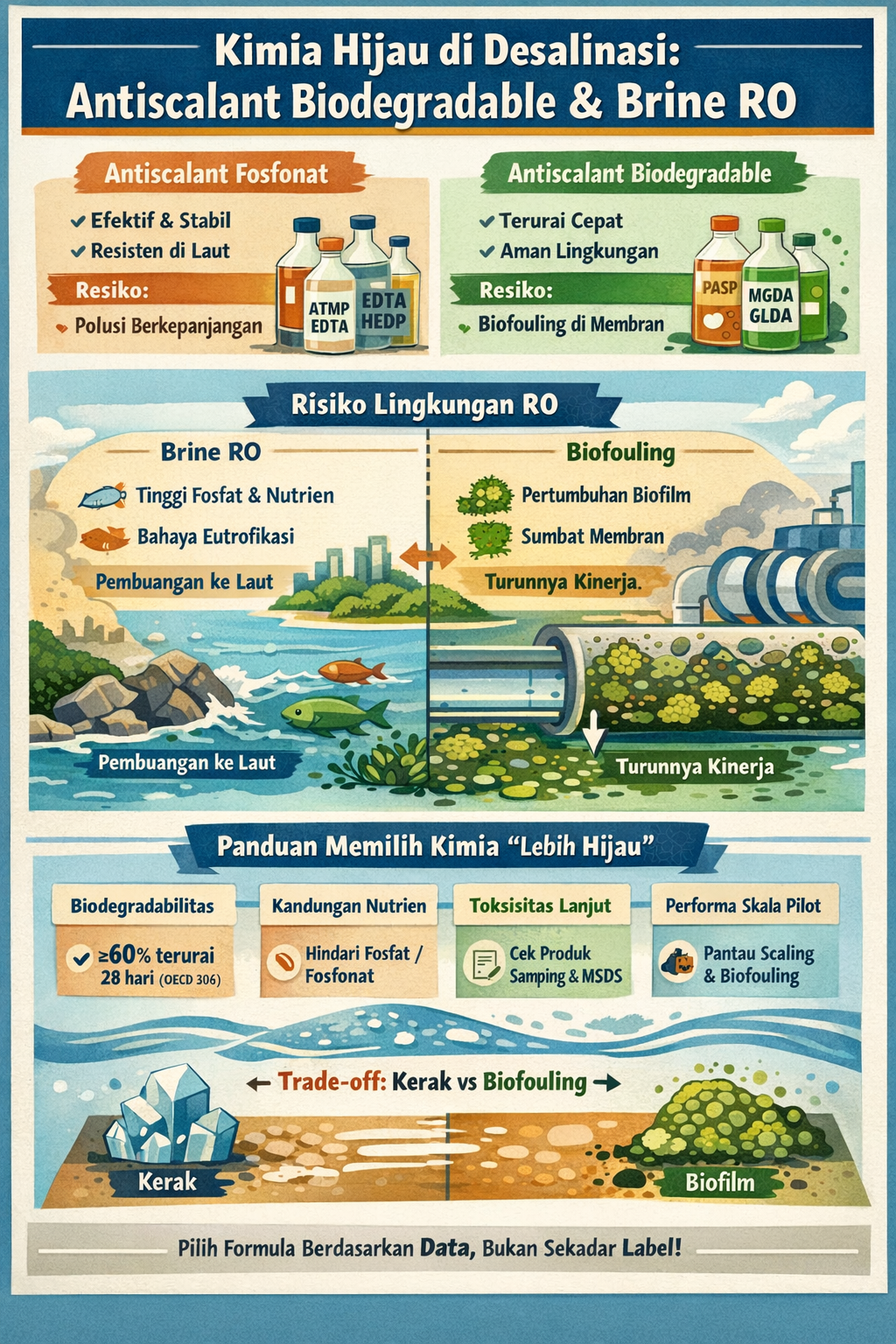
Biodegradability is typically defined as achieving ≥60% degradation in 28 days under OECD or OSPARBOD tests (www.mdpi.com). One study cited polyacrylate antiscalants degrading ~52% in 35 days under seawater conditions — evidence that much of the polymer was consumed by microbes (www.mdpi.com). By contrast, phosphonate antiscalants showed only very slow loss of material even after 360 days (www.mdpi.com) (www.researchgate.net).
When biodegradation occurs, byproducts like CO₂, nitrate, and phosphate are generated. Even these can pose ecological hazards: phosphate‑based inhibitors fully hydrolyze to orthophosphate (PO₄³⁻), a fertilizer nutrient that can fuel algae blooms if concentrated (www.mdpi.com). Phosphonate polymers (bearing C–P bonds) release orthophosphate far more slowly and yield trace metabolites like AMPA that persist (www.mdpi.com). In other words, degradation reduces chemical persistence but may introduce nutrient load.
Toxicity profiles are nuanced. Archived data suggest both traditional and green antiscalants are low‑acute‑toxic at normal doses; many NSF‑approved formulations are labeled “non‑toxic” by ingestion criteria (www.membranechemicals.com). However, biodegradable inhibitors inherently serve as microbial food: lab trials report that adding fully biodegradable antiscalant stimulates bacterial growth and biofilm formation (www.membranechemicals.com). An experienced supplier warns that biodegradability does not equal net environmental gain inside membranes, because biofouling — and thus energy/water losses — may rise (www.membranechemicals.com).
Consequently, biodegradable chemistries can deliver rapid mineral‑scale control but require caution to avoid boosting bio‑growth (for example, via biocide rotations). Persistent inhibitors can sometimes be used at lower frequency but should be dosed carefully — using accurate chemical dosing — to minimize nutrient discharge (www.mdpi.com) (www.membranechemicals.com).
Selection criteria and operating practices
Choosing greener chemical programs means balancing efficacy, environmental fate, and regulation, with data to quantify trade‑offs.
- Biodegradability certifications: Preference for antiscalant/manufacturer data showing ≥60% marine biodegradation (OECD 306, Marine BODIS) (www.mdpi.com) (patents.google.com). For chelants and surfactants, OECD 301 results in the >70–90% range indicate strong readiness.
- Nutrient content: Avoidance of phosphates or organophosphonates where eutrophication risk exists; preference for polycarboxylate chemistries. For acids, organic acids (citric, acetic) are fully metabolizable.
- Toxicity and byproducts: Review of MSDS/end‑of‑life data. EDTA is essentially non‑biodegradable (pubmed.ncbi.nlm.nih.gov), whereas MGDA/GLDA degrade to small acids and ammonium. Confirmation that degradation pathways avoid fluorinated surfactants.
- Performance versus dose: Biodegradable antiscalants may require slightly higher dose or more frequent dosing for equivalent protection (www.membranechemicals.com) (pubs.rsc.org). Site pilots should quantify scale control (scaling indices such as LSI) and track membrane pressure; any extra cleaning due to biofouling should be measured.
- Regulatory compliance: Effluent must meet local standards. In Indonesia, industrial wastewater permits (Permen LHK 5/2014) set limits for pH, BOD/COD, TSS, phosphates, etc., even if specific antiscalant residues are not itemized. National guidelines and discharge impact assessments may be required.
- Lifecycle considerations: Overall impact (scope 3) matters — greener chemicals can cost more yet reduce disposal or brine‑treatment costs. Suppliers increasingly provide eco‑labels and OSPAR compliance for offshore use; transparency on surfactant/carrier formulas should be requested.
In practice, a program reform can proceed by testing candidate biodegradable antiscalants (e.g., polyaspartate, polyepoxysuccinate) on‑site for scale control and membrane recovery; if successful, adopt them with monitoring of feed chemistry and permeate quality on systems such as industrial/power plant uses a lot of our RO systems. In parallel, pilot greener CIP mixes — for example, citric acid plus biodegradable chelant (GLDA/MGDA) instead of HCl+EDTA — within membrane cleaning practices, and rotate oxidative cleaners (hydrogen peroxide with minimal additives). Disposal impacts should be tracked closely (effluent organics, nutrients), documented reductions in persistent pollutant loading (for example, lower total organic phosphorus in brine) weighed against any slight increases in operating cost or cleaning frequency. Complementary measures (enhanced antifoams, routine membrane biocleaning, etc.) can maintain RO performance.
Bottom line: no single drop‑in solution exists. Data‑driven trade‑offs are required, with vendor testing data (for example, Scale Inhibition Efficiency versus biodegradation rates) and site pilots. Key metrics include required dosage (mg/L), scaling indices, and biodegradation half‑life (from standardized tests). Specialty suppliers of membrane cleaning, antiscalants and emission reductions can support the transition.
Source documents and references
Recent studies and industry guidelines report on both the feasibility and caveats of “green” desalination chemistry: (www.mdpi.com) (www.membranechemicals.com) (pubs.rsc.org) (pubmed.ncbi.nlm.nih.gov) (patents.google.com).
- Al‑Ashhab et al. (2022), Microorganisms 10(8):1580, “Antiscalants Used in Seawater Desalination: Biodegradability and Effects on Microbial Diversity” (www.mdpi.com) (www.mdpi.com).
- Hassan et al. (2025, accepted), Environ. Sci.: Water Res. Technol., “Novel eco‑friendly antiscalant for … scaling control” (pubs.rsc.org) (pubs.rsc.org).
- Pinto et al. (2014), Environ. Sci. Pollut. Res. Int. 21:2194, “Biodegradable chelating agents for industrial… applications” (pubmed.ncbi.nlm.nih.gov) (pubmed.ncbi.nlm.nih.gov).
- MembraneChemicals Inc. FAQs (2023), “Are Antiscalants Biodegradable? Environmental Impact…” (www.membranechemicals.com) (www.membranechemicals.com).
- European Patent EP1976805B1 (Kemira, 2013), “Improved biodegradability of antiscalant formulations” — includes OECD marine BODIS test results (patents.google.com).
- Permen LHK No.5/2014 (Indonesia) — national wastewater quality standards (pH, BOD/COD, etc.).