

Energy recovery devices turned seawater reverse osmosis from power‑hungry to bankable. Turbine ERDs trim power by ~30%, but pressure exchangers slash ~50% — with 35,000+ PX units saving about US$6 billion and ~19 Mt of CO₂ a year.
Industry: Desalination | Process: Energy_Recovery_Devices
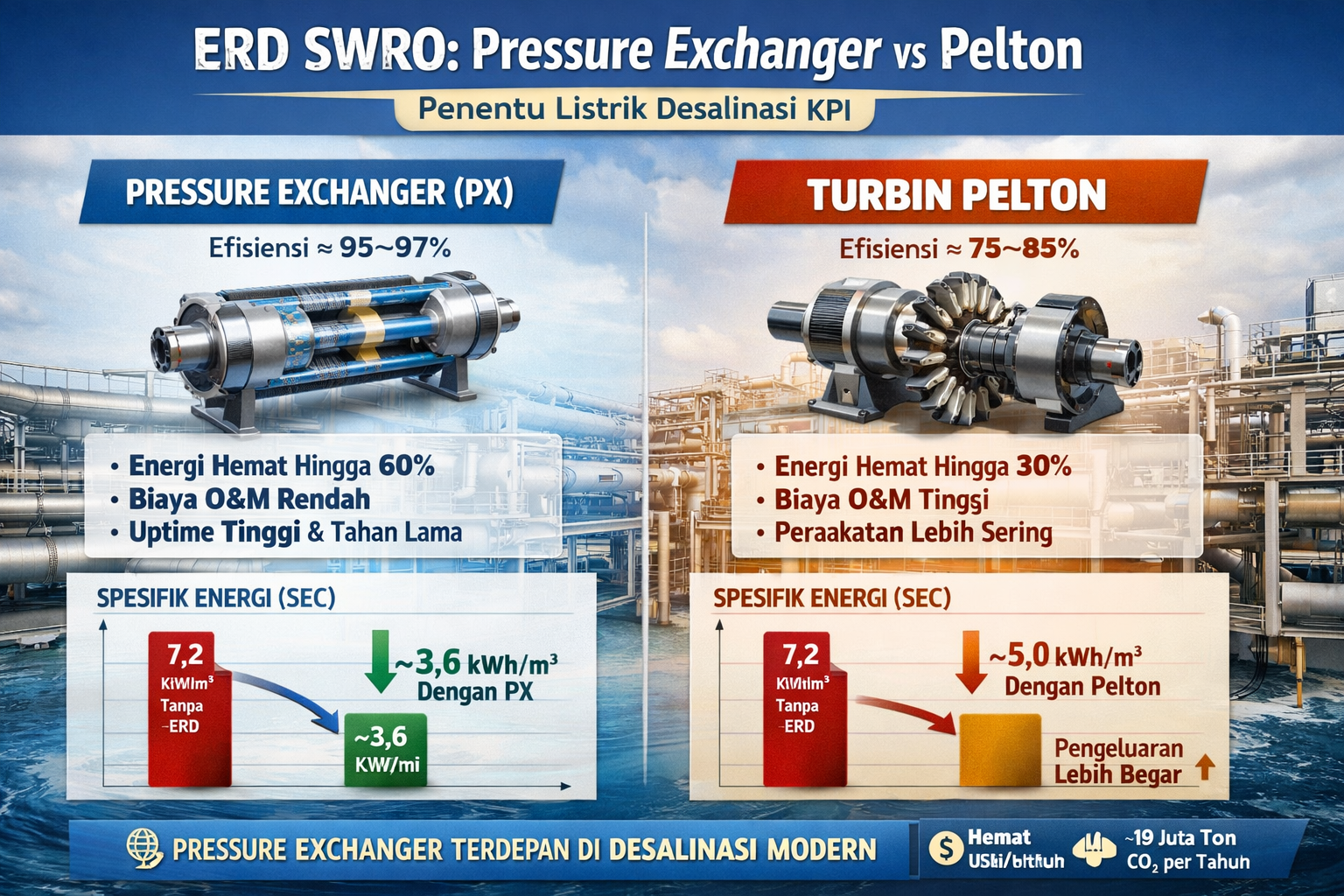
Modern seawater reverse osmosis (SWRO) — high‑pressure membranes that separate fresh water from seawater — only became truly competitive when energy recovery devices (ERDs) entered the train. Studies show adding a turbine‑type ERD (Energy Recovery Turbine, ERT) cuts a plant’s total power by ~30%, while a pressure exchanger (PX, an isobaric device that directly transfers pressure from brine to feed) cuts it by ~50% (researchgate.net) (frontiersin.org).
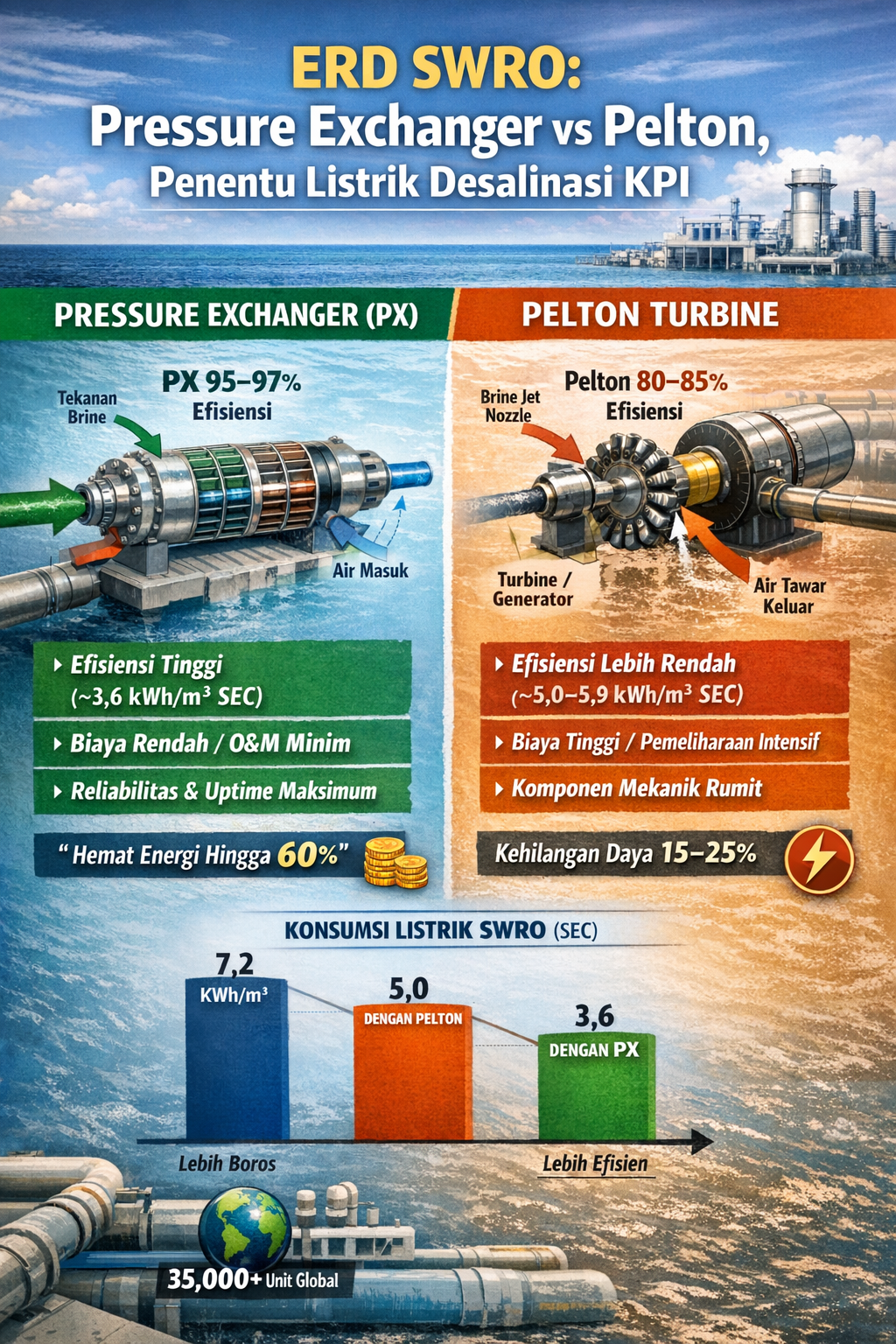
In one parametric case, the specific energy consumption (SEC, kWh per cubic meter of permeate) dropped from 7.2 kWh/m³ with no ERD to ~5.0 kWh/m³ with an ERT and ~3.6 kWh/m³ with a PX (researchgate.net) (frontiersin.org). Industry reviews put the average energy cut from ERDs at roughly 25–40% versus running without one (frontiersin.org).
The PX maker Energy Recovery Inc. says its units can reduce SWRO power demand by “up to 60%” relative to no ERD (energyrecovery.com). Global uptake is broad: more than 35,000 PX units are installed (≈36×10^6 m³/day capacity), saving roughly US$6 billion in energy costs each year and cutting ~19 million tons of CO₂ annually (energyrecovery.com). Without ERDs, an SWRO plant would consume several kWh more per m³ and spend much more on power — today, ERDs are essential (scribd.com) (frontiersin.org).
These gains now define how vendors package SWRO trains, from multi‑train plants to compact units; think of complete systems built around sea-water RO packages and integrated ERDs.
Energy recovery efficiencies and SEC
On pure hydraulics, PX devices dominate. A recent review reports pressure‑exchange (isobaric) efficiency at ≈95–97% (recovered energy/feed energy) versus ~75–85% for Pelton/turbine ERDs (frontiersin.org). A related survey cites Pelton wheels ~85% while “isobaric chambers” like PX reach 95–97% (frontiersin.org).
Double‑conversion losses in turbines add up; PXs recover almost all the brine pressure with minimal loss, whereas Peltons waste ~15–25% (scribd.com) (frontiersin.org). The SEC shows it: SWRO trains using Pelton wheels typically run ~3.5–5.9 kWh/m³, while those on PX or other piston‑type ERDs land ~3.0–5.3 kWh/m³ (frontiersin.org). That mirrors the 7.2→~5.0→~3.6 kWh/m³ example above (researchgate.net).
These ERDs sit downstream of pretreatment and membranes; plant designers often bundle them with RO membrane systems to hit target SEC without sacrificing operability.
Pressure rating and recovery sensitivity
PX devices also scale to higher duty. Modern high‑pressure and ultra‑high‑pressure PX units are sold for the most saline feeds — some to ~130 bar (energyrecovery.com). Traditional Pelton designs were proven on 40–70 bar desalters; a classic Jeddah plant ran a Pelton at ~53 bar (thewaternetwork.com). Both can be engineered for full SWRO pressures, but ratings and efficiency at the design point must be verified.
Operating sensitivity matters: raising RO feed pressure 30% (from 6.5 to 8.5 bar) increased permeate flow by ~72% but simultaneously decreased the Pelton’s recovered power by ~72% (from 960 W to 270 W) (sustainenvironres.biomedcentral.com). PX units directly exchange pressure regardless of flow split, so efficiency stays near‑constant across recoveries — though they add a small amount of feed salinity.
Reliability and uptime profiles
PX has become the industry’s reliability default. There’s no high‑speed geartrain or generator — essentially a spinning, ceramic‑lined cylinder that continuously transfers pressure from brine to feed. Energy Recovery Inc. cites 35,000+ PX installations worldwide with “consistent performance, making it extremely reliable and durable, requiring low maintenance and providing maximum uptime” (energyrecovery.com) (energyrecovery.com).
By contrast, Pelton wheels couple a turbine, shaft, seals/bearings, and typically an electric generator or booster pump — more moving parts and more failure points. Industry comparisons note that next‑generation isobaric units (e.g., Hydraulic Pressure Boosters) are more compact, lower‑weight, and easier to maintain than Peltons (fedco-usa.com) (fedco-usa.com). PX installations also report low vibration, simple controls and “fail‑safe” operation over long service lives (researchgate.net)).
In practice, major new SWRO plants have almost universally switched to PX or piston‑type ERDs since ~2000 (scribd.com) (frontiersin.org). Legacy facilities like Saudi Arabia’s Ras Al Khair originally used Pelton or Francis‑type turbines, but nearly all large new projects choose PX.
Membrane packages from established platforms — for example, plants integrating RO membranes within complete SWRO trains — are now routinely paired with PX to maximize uptime.
Selection guidance by capacity and pressure
Capacity: PX now covers small plants as well as mega‑trains. ERI’s PX45 is rated for ≈100 m³/day and the PX90 for ≈300 m³/day (researchgate.net). Pelton wheels have worked in very large plants — for example, Peltons operated SWRO trains of ~192,000 m³/day at Rabigh and 216,000 m³/day at Shuqaiq (thewaternetwork.com). Modern practice still equips even the biggest new plants with PX, primarily for the efficiency gain (scribd.com) (frontiersin.org).
Guidance: For small to moderate plants (<1,000 m³/d), engineers might accept the simpler (often lower‑capex) Pelton setup, though PX options are fully available. For very large plants (≫10,000 m³/d) or multi‑train installations, PX is typically preferred to minimize energy costs over the plant life (frontiersin.org) (researchgate.net).
Operating pressure (salinity): Both ERDs can be engineered for high pressure, but pressure affects design. If very high feed salinity pushes >70–80 bar, ensure ratings accordingly; ultra‑high‑pressure PX units are available up to ~130 bar (energyrecovery.com). Pelton performance falls at high recoveries; the 6.5→8.5 bar test raised permeate ~72% but cut Pelton‑recovered power ~72% (960 W→270 W) (sustainenvironres.biomedcentral.com). PX efficiency is essentially constant up to its design limit.
Guidance: For very high duty (high TDS requiring very high pressure), PX is typically safer and more effective. If pressure swings or partial‑flow operation are expected, PX will more stably recover energy. In compact or remote deployments — including Indonesian island desalters (nuwsp.web.id) — containerized trains such as SWRO rental units can pair with PX for predictable duty.
Integration and piping considerations
PX devices install inline between the high‑pressure pump (HPP) feed and the brine discharge; there are no rotating shafts or gearboxes to align. Pelton ERDs mount on the brine line, where a high‑velocity jet hits buckets on a wheel to drive a generator or a booster pump (often on the same shaft as the HPP) (scribd.com). Designers must allocate space for the turbine and coupling and ensure clean brine supply for the jet — screening solids is critical. PX units require careful piping to balance flows but are more compact and simpler to plumb (fedco-usa.com).
Guidance: Check mechanical integration — a Pelton usually feeds power back into the plant (it may directly drive the HPP or produce electricity), whereas a PX simply boosts feed pressure. Pretreatment choices upstream — such as using ultrafiltration to stabilize feedwater — and consumables like cartridge filters elsewhere in the train help manage solids loads around high‑pressure equipment.
Capital and life‑cycle cost tradeoffs
Pelton‑driven solutions generally require a large turbine and generator, driving higher installation costs than a compact PX (which is roughly 50% of Pelton cost in some comparisons) (fedco-usa.com) (sustainenvironres.biomedcentral.com). One RO+Pelton pilot selected the Pelton solely for lower initial cost (sustainenvironres.biomedcentral.com) — though that may sacrifice ~10–15% efficiency.
Over time, PX’s higher efficiency often yields lower lifecycle cost, especially where energy is expensive. Guidance: if the upfront budget is very tight and energy costs are low, a Pelton may be considered. Most analyses, however, find PX energy savings outweigh its extra capex, particularly for larger or longer‑lived plants (scribd.com) (frontiersin.org).
Bottom line for plant designers
Pressure exchangers are generally the most energy‑efficient and reliable ERDs for SWRO, especially at large scale and high pressures (frontiersin.org) (energyrecovery.com). Pelton wheels still serve in smaller or low‑cost projects, but their lower (~80–85%) efficiency and more complex mechanics mean more power draw and more maintenance (frontiersin.org) (sustainenvironres.biomedcentral.com).
The practical choice is to minimize life‑cycle cost for the given capacity and pressure. In practice today, almost all new medium‑to‑large SWRO plants adopt PX ERDs to hit the lowest SEC — often ~3–4 kWh/m³ (researchgate.net) (frontiersin.org), with Peltons largely reserved for niche applications or legacy retrofit designs.
For pretreatment and system packaging around ERDs, designers typically align with existing RO infrastructure — from ultrafiltration pretreatment to complete sea-water RO and membrane systems — to stabilize operations before and after the energy recovery stage.