

Industry: Desalination | Process: Post
Desalination plants that rely on reverse osmosis (RO) produce exceedingly “pure” water—so pure it can attack pipes. Permeate (the RO product stream) is stripped of calcium, magnesium, and carbonate alkalinity and typically trends slightly acidic, making it aggressively corrosive to metals and concrete (IntechOpen; ScienceDirect). Untreated, it dissolves lead, copper, and iron from distribution systems, with documented health hazards and toxicity concerns (IntechOpen; IntechOpen).
The asset implications are vast. A U.S. analysis has pegged corrosion-related pipe replacement near US$300 billion over 20 years (IntechOpen). That is why World Health Organization and industry guidance emphasize buffering, alkalinity, and hardness to reach a non-aggressive “calco‑carbonic equilibrium” (IntechOpen; ScienceDirect).
Most seawater plants lean on sea-water RO to push salt out; brackish sources are handled by brackish-water RO. Both are commonly deployed within larger membrane systems trains.
Remineralization targets and stability
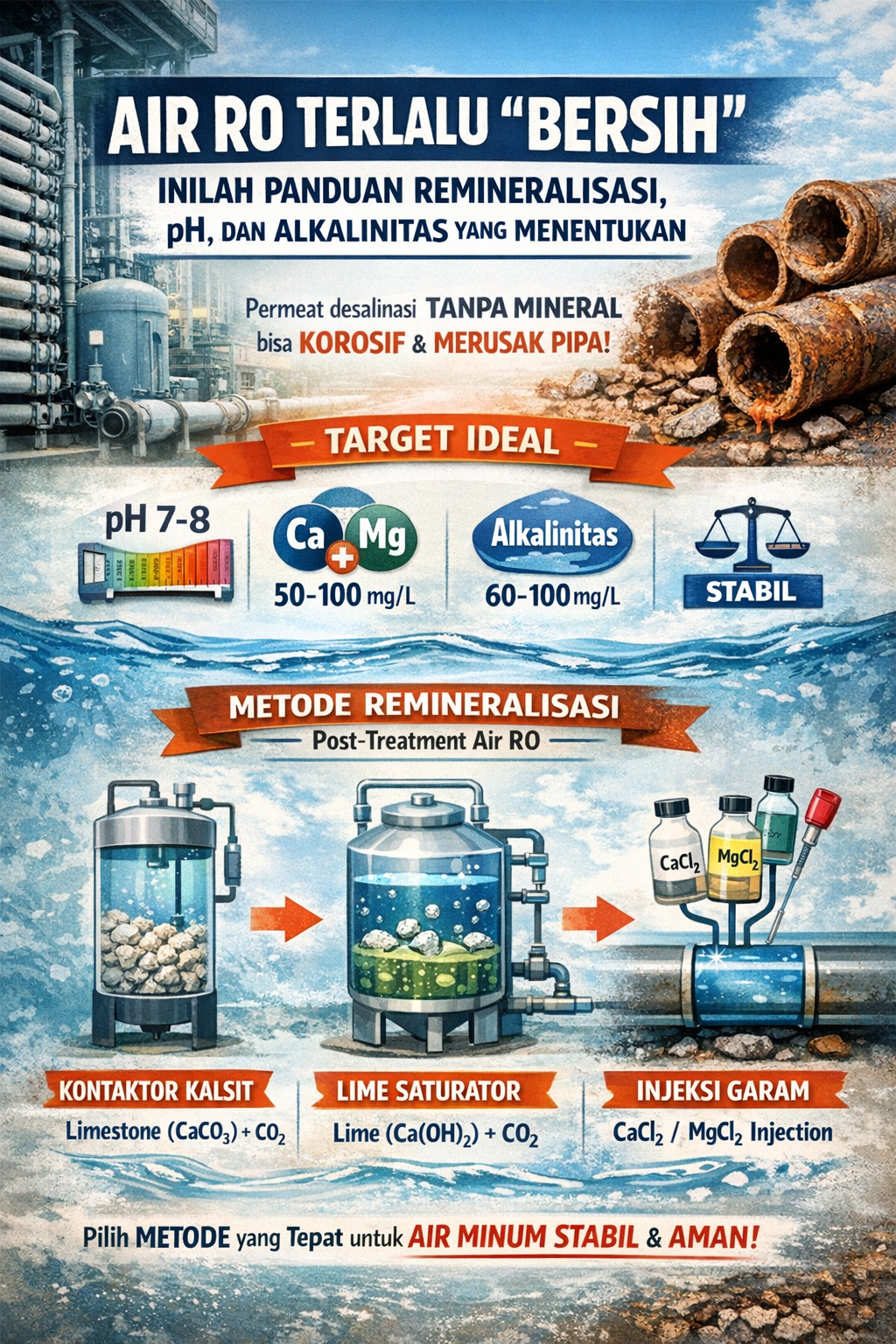
Post-treatment aims for neutral to slightly alkaline water. Typical pH targets are ~7.0–8.5, with Indonesia’s Permenkes standard at 6.5–8.5 (Permenkes 907/2002). Alkalinity (as HCO₃⁻, measured as CaCO₃) is set in the tens of mg/L to buffer pH—often in the ~60–100 mg/L range per WHO/AWWA guidance—and calcium hardness is commonly lifted to ~40–80 mg/L as CaCO₃ (≈20–35 mg/L Ca²⁺) for corrosion control and taste (ScienceDirect).
“Soft” RO water frequently emerges with pH ≈6–7 and less than 10 mg/L of combined Ca+Mg (Lenntech). Operators dial the Langelier Saturation Index (LSI) to ~0 (±0.3) to avoid both corrosion and scaling (IDE).
Magnesium is back in focus too. WHO background documents note health benefits and imply Mg ≥10 mg/L as a sensible minimum (IntechOpen), and low Mg (<~5 mg/L) in water has been linked with higher cardiovascular risk in epidemiology (IntechOpen). Some jurisdictions now mandate it: Saudi Arabia’s 2024 standard sets ≥5 mg/L Mg in desalinated water (IntechOpen; Springer). Where regulations exist, “not exceed” maximums apply too—Indonesia caps hardness at ≤500 mg/L as CaCO₃ and sodium at ≤200 mg/L (Permenkes 907/2002).
Limestone contactors (calcite dissolution)
The workhorse method is a calcite (limestone, CaCO₃) bed with upstream acidification by CO₂ or mineral acid. The chemistry is straightforward: CaCO₃(s) + CO₂(g) + H₂O → Ca²⁺ + 2HCO₃⁻ (Eq. (3)) (IntechOpen). This single step restores both calcium hardness and carbonate alkalinity, and pH rises as bicarbonate forms.
Materials are inexpensive and widely available—calcium carbonate accounts for ~4% of Earth’s crust—and high-purity chips (≈99%+) minimize insoluble waste (IntechOpen). Critically, calcite dissolution consumes just 1 mol of CO₂ per mol of CaCO₃, whereas lime routes need 2 mol of CO₂ per mol of Ca(OH)₂, doubling CO₂ demand (IntechOpen; IntechOpen).
Costs skew low. To add ~80 mg/L CaCO₃ hardness, operating examples cite ≈65 mg/L limestone and ≈46 mg/L CO₂ (with extra CO₂ aiding kinetics) (IntechOpen). A Table 3 case shows limestone chips (~100 €/t) at about an 81 mg/L dose contributing ~€0.008/m³, CO₂ (~200 €/t) at 46 mg/L ~€0.009/m³, and a final polish of ~2.5 mg/L NaOH ~€0.002/m³—≈€0.019/m³ in total (IntechOpen; IntechOpen).
There are operational constraints. Calcite’s solubility in pure water is only ~13 mg/L, so reaction rates taper as saturation nears, often prompting over‑acidification (extra CO₂ or sulfuric acid) to drive kinetics (IntechOpen; IntechOpen). Effluent may carry residual CO₂ and emerge low in pH, so a pH-adjustment step is routine: stripping in a degasser or a small NaOH dose (in the example above, ~2.5 mg/L) to hit neutrality (IntechOpen; IntechOpen). Media beds also shed turbidity “fines” and need backwashing and periodic refills, and the columns can be large, increasing footprint (IntechOpen). Even so, many sites favor calcite for its simplicity and lower chemical cost where space allows (IntechOpen).
Lime saturators and alkaline dosing
Lime (Ca(OH)₂) dosing solves the same problem via a different route. Slaked lime slurry is clarified to a saturated solution and dosed—often with CO₂—to generate Ca²⁺ and bicarbonate: Ca(OH)₂ + 2CO₂ → Ca²⁺ + 2HCO₃⁻ (Eq. (2)) (IntechOpen). High calcium levels (up to ~1700 mg/L solubility) make the equipment compact relative to calcite reactors (IntechOpen), and achieving 80 mg/L as CaCO₃ needs about 65 mg/L Ca(OH)₂—similar to calcite doses (IntechOpen).
Trade‑offs show up in operations and emissions. Hydrated lime contains ~5–15% insolubles that must be settled and disposed (IntechOpen), with waste around 22 mg per liter produced (IntechOpen). Lime manufacture has a higher carbon footprint—~0.785 kg CO₂ per kg quicklime—and lime routes need 2 mol of CO₂ per mol of Ca(OH)₂, increasing CO₂ use compared with calcite (IntechOpen; IntechOpen). A worked example for ~80 mg/L remineralization puts Ca(OH)₂ at ~€0.016/m³, CO₂ ~€0.014/m³, and waste disposal ~€0.001/m³—≈€0.031/m³ total (IntechOpen).
Lime trains add complexity—slurries, clarifiers, and the risk that unintended CO₂ absorption can cause re‑precipitation and turbidity in the saturator (IntechOpen). That said, properly tuned lime systems often deliver the desired bicarbonate alkalinity and pH without a separate downstream pH correction step. Plants that go this route typically integrate a clarifier for sludge handling.
Caustic soda and operator experience
Some sites try sodium hydroxide (NaOH) directly to raise pH and alkalinity. It is clean to handle, quick to act, and can fine‑tune post‑calcite effluent with very low doses (e.g., ~2.5 mg/L NaOH in the calcite example) (IntechOpen). But without calcium addition, NaOH alone can leave water corrosive. A Moroccan plant that initially used NaOH switched to a lime saturator and stabilized LSI, highlighting the limitation of caustic‑only post‑treatment (ResearchGate; ResearchGate).
Direct salt and carbonate dosing
Operators can also inject soluble salts. Calcium and alkalinity can be provided via CaCl₂ combined with Na₂CO₃ (soda ash) or NaHCO₃ (sodium bicarbonate), or by Ca(OH)₂ slurry. In combined CaCl₂ + carbonate dosing, calcium carbonate can precipitate in situ, which then must be filtered out. Many modern trains still favor CO₂ dosing—forming carbonic acid—coupled with limestone or lime to build alkalinity efficiently.
Magnesium supplementation and dolomite media
RO removes nearly all Mg²⁺, prompting renewed interest in supplementation for health and regulatory compliance. Direct MgCl₂ or MgSO₄ injection is precise and relies on highly soluble salts, but remains “extremely expensive,” so replenishment of magnesium salts is rarely performed despite WHO noting benefits (Mg ≥10 mg/L suggested) (IntechOpen; IntechOpen). The broader health context spans cardiovascular impacts and more (IntechOpen).
Where standards tighten—such as Saudi Arabia’s ≥5 mg/L Mg in 2024 (Springer)—dolomite (CaMg(CO₃)₂) offers a practical fix. Swapping dolomite chips into existing calcite contactors in two KSA plants raised Mg by ≈2.4–2.9 mg/L at similar media cost, helping meet the 5 mg/L guideline (Springer). It is “most likely” that such supplementation trends will strengthen; however, approaches remain site‑specific (Springer).
pH and alkalinity control systems
Fine control comes from measured dosing and simple physics. Carbon dioxide (CO₂) feed can pre‑acidify water entering a calcite bed or trim pH/alkalinity downstream by forming bicarbonate, and large plants sometimes recover CO₂ from flue gas on site (IntechOpen; IDE). In other schemes, dilute acid (often H₂SO₄) improves limestone dissolution kinetics, with neutralization staged later (IDE; IntechOpen).
Residual acidity is corrected with carefully metered caustic (NaOH) or lime, using flow‑paced control and redundancy around pH monitors; a small NaOH dose (a few mg/L) often suffices after calcite (IntechOpen). Plants routinely pair automated skids with an accurate dosing pump and a degasifier/aeration stage to strip excess CO₂ and stabilize pH around LSI ≈0. Downstream chlorination is timed to avoid excessive free chlorine demand before a robust alkalinity buffer is established.
Performance and cost comparison
The numbers are blunt. For ~80 mg/L CaCO₃ hardness, a calcite contactor pathway tallies ≈€0.019/m³, while a lime saturator comes in near €0.031/m³ (IntechOpen; IntechOpen). Calcite reactors produce negligible sludge (insolubles remain as media), but need space, backwashing, and media management; lime systems are compact yet generate a filter cake (~0.022 g/L) and involve clarifiers and scraper maintenance (IntechOpen; IntechOpen; IntechOpen).
Direct salt dosing (e.g., CaCl₂ + NaHCO₃) trims capital but can precipitate CaCO₃ that must be filtered, and it shifts the balance of sodium and chloride. Mineral reactors integrate the chemistry in situ and are often preferred. Regardless of method, maintaining stable final alkalinity remains central to corrosion control and concrete reservoir protection (IntechOpen).
Magnesium addition is the outlier: precise MgCl₂/MgSO₄ dosing works but is rarely performed due to cost, even as health‑based and regulatory targets gain traction (e.g., KSA ≥5 mg/L Mg) (IntechOpen; Springer). Cost‑effective alternatives like dolomite media and recovery of divalent ions from brine via nanofiltration or ion‑exchange are under exploration (ScienceDirect). Plants piloting such schemes may reference nano‑filtration and ion‑exchange options.
Implementation notes and technology trends
Execution is as important as chemistry. Feedback loops on flow and pH, inverter‑driven dosing, and continuous or hourly checks of pH, conductivity, and alkalinity are routine. Many standards, including Indonesian ones, call for regular pH/alkalinity testing (weekly in some regimes) (Permenkes 907/2002). In this control environment, supporting skids and instruments sit alongside the RO and post‑treatment as part of the plant’s ancillaries.
New ideas are emerging. Membrane‑calcite reactors, which suspend ultrafine CaCO₃ inside a UF (ultrafiltration) module, have been reported to speed dissolution (IntechOpen), a natural fit for plants already deploying ultrafiltration in drinking‑water trains. Some sites recover CO₂ from flue gas and generate NaOCl on site to cut deliveries, and lime saturators are being paired with high‑flux modules in modern layouts (IDE; IDE). Regulatory currents are shifting too: WHO’s 2011 guideline review acknowledges the role of Ca/Mg in water, and Saudi Arabia’s Mg mandate signals tightening standards (IntechOpen; Springer).
A niche but notable concept balances Ca²⁺, Mg²⁺, SO₄²⁻, and alkalinity via ion‑exchange in the desalination sequence, with reported marginal costs around €0.004/m³ for adding ~12 mg/L Mg (PubMed). Plants evaluating such routes can align them with existing membrane systems and brine management strategies.
Example doses and costs in practice
For a target of 80 mg/L CaCO₃ hardness (mg/L as CaCO₃ denotes milligrams per liter expressed as calcium carbonate equivalent):
- Calcite contactor: ≈65 mg/L CaCO₃ (≈99% purity), ≈46 mg/L CO₂ (≈30% extra for kinetics), plus ~2.5 mg/L NaOH; applying prices (CaCO₃ €100/t, CO₂ €200/t, NaOH €800/t) yields ~€0.019/m³ (IntechOpen; IntechOpen).
- Lime saturator: ≈65 mg/L Ca(OH)₂ (≈90% purity) plus ≈70 mg/L CO₂, with about 10% sludge removal; total cost ~€0.031/m³ (IntechOpen; IntechOpen).
Bottom line and compliance context
Remineralization is not optional. Whether by limestone/dolomite reactors, lime saturators, or direct salt dosing, post‑treatment must add alkalinity and calcium—and often magnesium—to deliver stable, non‑corrosive water with pH ~7–8 and LSI ≈0. Calcite systems are simpler and cheaper on chemicals but bulkier; lime systems are compact yet costlier and produce sludge (IntechOpen; IntechOpen; IntechOpen). Selection turns on targets, space, chemical logistics, and economics, with an eye on tightening magnesium expectations (e.g., Saudi ≥5–10 mg/L Mg context from WHO and KSA) (IntechOpen; Springer).
Globally, post‑treatment adds on the order of €0.02–0.03 per m³, modest in unit cost but massive at scale. Carbon considerations may further tilt designs toward limestone due to lime’s higher CO₂ footprint (IntechOpen). What does not change: safe drinking water out of RO depends on this step, from Indonesia’s pH 6.5–8.5 ranges and hardness limits to international guidance on buffering and health (Permenkes 907/2002; IntechOpen).