

Automated Clean‑in‑Place routines, the right sanitizer, and sterile CO₂ purging are pivotal on the brewery cold side — and the data show why. Optimized cycles can cut chemicals, water, and oxygen pickup while meeting HACCP/ISO standards and stopping lactic bugs in their tracks.
Industry: Brewery | Process: Fermentation_&_Maturation
Breweries run automated Clean‑in‑Place (CIP, automated cleaning without disassembly) on every piece of “cold‑side” kit — wort coolers, transfer pipes, fermenters, and even packaging lines — and the method is standardized across beverage plants (christeyns.com). The classic four‑phase Sinner’s circle — pre‑rinse, alkaline (caustic) wash, acid wash, and final rinse/sterilization — is the backbone (academicjournals.org).
One UK analysis goes further: a 35‑minute caustic cycle is recommended (1.5–3.5 m³/h per metre circumference), followed by a rinse and an acid sterilization step, for example 1% v/v (volume/volume) of 5% peracetic acid (PAA) for ≥10 minutes (academicjournals.org) (academicjournals.org). Mechanical action matters: lines should see ≈1.5–1.8 m/s flow (a Reynolds number — a dimensionless indicator of turbulent flow — >~50,000) to shear biofilms (christeyns.com). In practice, breweries log and validate parameters and use ATP swabs targeting <30 RLU (Relative Light Units) as a “clean” threshold for a tank (academicjournals.org).
baca juga:
Pabrik Air Modular Dewatering Nikel: 3 Tahap, Skala Kilat
Beer spoilers and standards pressure
Even with beer’s alcohol, hops, and low pH, lactic and acetic bacteria can ride along and spoil whole batches: “beer spoilage causes economic losses to breweries and even the loss of consumers’ confidence” (mdpi.com). Lactic acid bacteria (LAB) such as Lb. brevis and Pediococcus damnosus account for ~60–90% of contamination incidents in breweries (mdpi.com), and smaller craft operations — with fewer pasteurization or sterile‑filtration steps — are most vulnerable (mdpi.com).
That’s why U.S. and EU food‑safety regimes — and Indonesian ISO 22000/HACCP requirements — demand validated cleaning protocols (mdpi.com) (indonesiatodays.com). Case in point: Indonesian brewery PT Jobubu Jarum (“BEER”) certified ISO 22000/HACCP in 2023, signaling rigorous documented cleaning and sanitization practices (indonesiatodays.com).
CIP parameters and verification
Validated CIP isn’t just chemistry; it’s hydraulics. Turbulent flow at ≈1.5–1.8 m/s (Re >~50,000) provides the shear to strip biofilms from pipe walls (christeyns.com). Time, temperature, and concentration are tracked and verified with microbiology — for example, ATP swabs <30 RLU and follow‑up plate counts (academicjournals.org). Accurate chemical dosing for targets such as 1–3% NaOH or 0.05–0.2% active PAA is aided by equipment designed for precise metering, such as an accurate chemical dosing pump.
A UK study’s benchmark — 35 minutes of caustic at 1.5–3.5 m³/h per metre circumference, then rinse and 1% v/v of 5% PAA for ≥10 minutes — offers a data‑backed template (academicjournals.org) (academicjournals.org).
Wort cooler and heat exchanger CIP
Plate wort coolers accumulate hop and yeast debris and wort solids; even “drained,” soils remain and must be flushed out (academicjournals.org). After a brew, run full‑flow hot water or CIP detergent through the exchanger; then circulate 1–2% NaOH, cold rinse, and finish with an acid sanitize (phosphoric or peracetic) (academicjournals.org). Rinse volumes matter: one report showed a single 100 L rinse sufficed for a 1200 L vessel, with an extra 100 L required when a heat exchanger was attached (academicjournals.org).
Optimizing this sequence can save hundreds of liters of water per clean — good news for costs, sewerage systems, and the environment (academicjournals.org). Neglected coolers risk carryover infection (Pediococcus) and degraded heat transfer on subsequent brews.
Transfer line cleaning regimes
All transfer hoses and pipes — from kettle to fermenter to brite — are cleaned after each use. Where possible the same CIP skid circulates detergent through the lines; if a sprayball circuit can’t be reached, brewers use dedicated pumps or CIP return lines. The lines are then flushed to neutral pH and treated with sanitizer (christeyns.com).
Skipping this step allows residue build‑up and cross‑contamination. Practical guides emphasize maintaining a continuous LRU flow (laminar→turbulent) to sweep out clinging films (christeyns.com).
Fermenter and conditioning tank SOPs
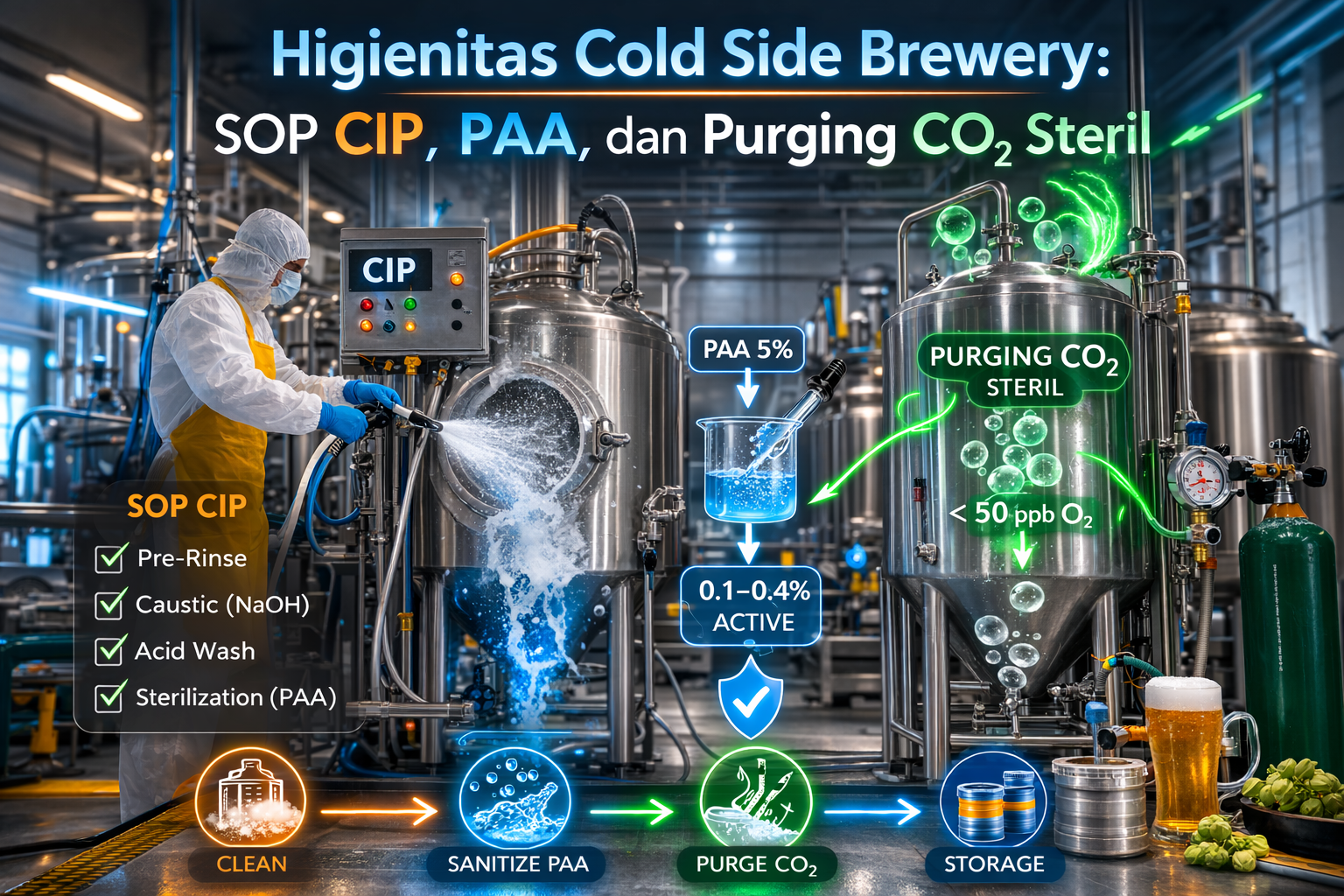
Fermenters are CIP‑ed immediately after emptying: (1) a cold water or CO₂ purge removes gross solids; (2) a hot caustic wash (~1–3% NaOH) runs ~30–60 minutes, longer on tall tanks; (3) intermediate rinse; (4) an acid wash (often phosphoric or nitric, ~1–2%) dissolves beerstone; (5) a final sanitize with PAA (0.05–0.2% active) for 5–15 minutes; (6) final water rinse or CO₂ flush (academicjournals.org) (academicjournals.org). High shear from a rotating spray ball is critical to reach all surfaces (christeyns.com).
Data‑driven SOPs suggest 2% v/v NaOH for 35 minutes yields a thorough clean, followed by 1% v/v of 5% PAA for 10 minutes to effectively sterilize (academicjournals.org) (academicjournals.org). Failure to CIP fermenters appropriately can seed the next batch with Pediococcus/Lactobacillus, forcing rework and causing losses.
Baca juga:
Rencana Monitoring Leachate Landfill: Ukur Debit & Level
Sanitizer selection: PAA vs iodophor
After physical cleaning, sanitization finishes the job. Peracetic acid (PAA, a strong oxidizer) is effective against bacteria, yeast, mold, and even spores; it oxidizes proteins and cell walls, then decomposes to acetic acid and oxygen (pmc.ncbi.nlm.nih.gov). In tests, a commercial PAA sanitizer (≈500 ppm active) achieved >6.5‑log reductions of Listeria and E. coli biofilms in 5 minutes (pmc.ncbi.nlm.nih.gov). Breweries typically use 0.1–0.4% v/v of a 5% PAA stock (~50–200 ppm active), often no‑rinse because PAA auto‑degrades, and it works cold or warm with low foaming across pH 3–7.5 (kersia.uk) (pmc.ncbi.nlm.nih.gov). Regulatory note: in the U.S., FDA guidance caps no‑rinse food‑contact use at ≤200 ppm; typical brewery use is well below that (pmc.ncbi.nlm.nih.gov).
Iodine‑based sanitizers (iodophors) also kill broadly — often faster than PAA at similar use dilutions — and tolerate some soil at low temperatures, but they stain equipment yellow/brown and can impart iodine flavor or color if not well drained/rinsed (kersia.uk). Kersia notes EU restrictions limiting iodophors to non‑food uses in practice, pushing many breweries away (kersia.uk). When used, ~12.5% stock at 1:100 (~120 ppm I₂) for 1–2 minutes is typical, followed by a water rinse. Bottom line: both PAA and iodophors can deliver >99.99% (4–5 log) kill of common brewery spoilers within minutes, but PAA’s broader spectrum (including molds/spores) and no‑residue decomposition simplify brewery operations (pmc.ncbi.nlm.nih.gov) (kersia.uk) (kersia.uk).
Other options exist — acidic/quaternary ammonium blends (QAC; for example, phosphoric acid/QAC mixes) that act quickly at low pH (~1.3–2.5) and are popular in craft settings, hydrogen peroxide or ozone for specialized bottle or water lines, and chlorine‑based sanitizers that are generally avoided on stainless due to pitting — but these have narrower spectra and limitations compared with PAA (e.g., spores) and can be inactivated by organics.
Sterile gas purging and oxygen control
After CIP, tanks and lines are purged with sterile inert gas — typically CO₂ or nitrogen — to expel air and limit oxygen uptake. Breweries prefer CO₂ (food‑grade, inexpensive, available from fermentation recovery). By purging multiple tank volumes at gentle pressure, headspace O₂ can be driven near zero; industry guidance targets dissolved O₂ in packaged beer below ~50 parts per billion (ppb), with the goal “the lowest O₂ concentration possible (<50 ppb)” via CO₂ purging, foaming (“fobbing”) the tank, and minimizing air exposure (brewingforward.com).
Sterile gas also avoids introducing microbes from plant air. Tanks are purged after CIP (to dry) and kept CO₂‑blanketed until filling; lines are purged immediately before use. If compressed air is ever used, it must be sterile through a 0.2 µm (micrometer) filter — and air still adds oxygen. A single gentle CO₂ purge dislodges ~70–80% of air (mathematically a 75% reduction per purge at 1 bar); multiple purges quickly approach negligible residual O₂. The payoff is longer shelf‑life: beer at <50 ppb O₂ oxidizes far more slowly, with markedly improved taste stability (brewingforward.com). For sterile filtration hardware, breweries often select food‑grade housings such as 316L stainless steel cartridge housings for hygienic service.
Costs, water, and ROI
Optimizing caustic CIP — balancing concentration, time, and temperature — saved microbreweries over £1,000 per year in avoided chemical, water, and energy costs in one analysis (academicjournals.org). Findings included that ambient caustic and only the necessary rinse volumes achieved equivalent cleanliness, with extra rinse volume needed when a heat exchanger was in circuit (academicjournals.org) (academicjournals.org). Routine ATP swabs and plate counts then verify that CIP leaves surfaces clean (academicjournals.org).
Baca juga:
Pipa LCS Tersumbat: Jetting vs Chemical Cleaning Tanpa Merusak Liner
Bottom line: safety, stability, profitability
A rigorous cold‑side CIP program — with validated Sinner’s circle stages, turbulent flow targets, and sanitizer choices based on PAA or iodophor performance — is non‑negotiable for quality and compliance (academicjournals.org) (mdpi.com). Pairing that with sterile CO₂ purging to <50 ppb O₂ further safeguards shelf‑life (brewingforward.com). The economics are real — thousands saved annually — and so are the risks of skipping steps: LAB‑driven spoilage (often 60–90% of contamination incidents) and the brand damage that follows (mdpi.com) (mdpi.com).
Sources: Authoritative brewing chemistry and sanitation studies, industry guidelines, and regulatory reports — including academicjournals.org; academicjournals.org; christeyns.com; mdpi.com; mdpi.com; mdpi.com; kersia.uk; kersia.uk; brewingforward.com; pmc.ncbi.nlm.nih.gov; academicjournals.org; and indonesiatodays.com.