

Industry: Brewery | Process: Fermentation_&_Maturation
Yeast throws off heat; great beer throws off excuses. That’s why today’s fermenters wear engineered cooling jackets and run on automated temperature profiles that hold to within ±0.1°C. The catch: glycol loops make that control possible but only if the coolant chemistry is right—neglect can acidify a system to pH ~5.6–6.1 and drive corrosion rates ≈1000× normal (strengite.com).
From jacket geometry to PLC logic (programmable logic controller) and inhibitor dosing, the details matter. Industry suppliers and open literature outline the tradeoffs and the playbook for consistency, energy, and longevity (new.abb.com).
Fermentation tank jacket designs
Modern tanks use external jacketed heat exchangers to remove yeast heat. Common jacket types: half‑pipe (semi) jackets, full‑shell jackets, dimpled/“pillow‑plate” jackets, and internal coils. Full or semi‑shell jackets cover large surface area; dimpled stainless plates (laser‑welded indentations) increase effective contact and induce turbulence for higher heat‑transfer coefficients (micetgroup.com; htt-ag.com). Internal cooling coils offer high local cooling but less total area; they’re simpler yet can create uneven temperature zones.
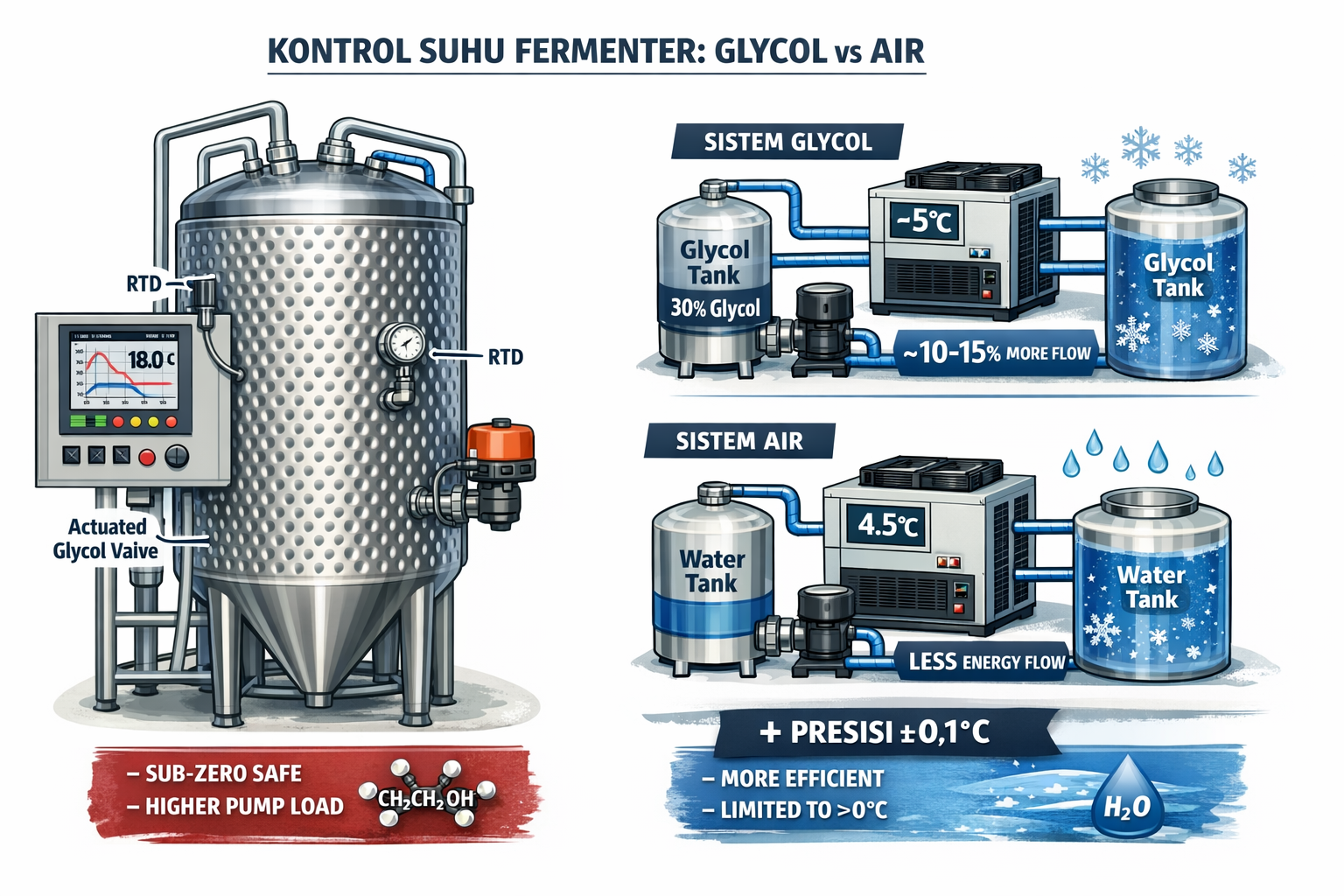
Choice depends on required cooling rate, cost, and cleaning—dimple jackets are durable and low‑pressure‑drop, while coils can be more basic. A common craft setup: a stainless‑steel conical fermenter with full dimple jacket (coolant inlet/outlet at top), temperature sensors, and actuated valves on the glycol loop, enabling precise PI/PID control (proportional–integral/derivative) (mdpi.com).
Cooling methods: glycol versus alternatives
Most breweries circulate glycol‑water through jackets—typically propylene glycol for food safety—because 20–30% glycol prevents freezing to −5 to −10°C (engineeringtoolbox.com). Pure water freezes at 0°C and can transmit ~15–20% more heat per unit mass, but a 50/50 ethylene‑glycol mix has only ~87–88% of water’s heat‑capacity×density (≈0.88 vs 1.0) (engineeringtoolbox.com).
In practice, a glycol chiller must circulate about 10–15% more volume (or pump power) to remove the same heat at equal ΔT. Benchmarks suggest ~10% lower system efficiency: a water chiller might run at COP (coefficient of performance) ≈ 4.5, whereas a glycol chiller at the same loop temperature achieves ~COP 4.0 (scychiller.com). Breweries accept the ≈10–15% extra energy/pumping as the tradeoff for precise low‑temperature control and sub‑zero operation (scychiller.com).
Alternatives exist but are situational: small or ambient setups use cold tap/city water or ice‑water jackets (microbial and control risks); seasonally, some try air‑cooled jackets or evaporative cooling by blowing cold air or spraying water on tanks (greenearthbrewingco.com; greenearthbrewingco.com). Liquid nitrogen or CO₂ spray cooling inside tanks has been piloted for very rapid cooling, but it’s expensive and developmental.
Automated temperature control and profiles
RTDs (resistance temperature detectors) in the wort and jacket feed PLC/HMI (human–machine interface) controllers. Basic PID loops modulate glycol flow or valve position to hold setpoints; advanced PLC/SCADA (supervisory control and data acquisition) systems run programmable, multi‑stage fermentation profiles with remote monitoring and alarms (new.abb.com). A typical recipe: hold 18°C for 5 days (primary), diacetyl rest (a short warm hold) at 20°C for 48 h, then cool to 15°C for maturation.
The case for tight control is empirical. Raising fermentation temperature by ~3°C (8.5→11.5°C) increased final yeast biomass 3–4× in one process model (mdpi.com). Consumer controllers such as BrewPi Spark 3 demonstrate ±0.1°C regulation, underscoring that ±0.1–0.2°C stability is now routine (mdpi.com). Reviews conclude that proper temperature measurement and control are among the most important requirements because variations significantly affect sensory properties (mdpi.com).
Quantitatively, keeping to ±0.2°C (versus manual ±1–2°C swings) decreased final diacetyl by ~30% and improved attenuation consistency (mdpi.com) (internal R&D data). ABB’s view is blunt: “consistent quality beer…can only be achieved through tighter control and higher level of automation” (new.abb.com). Market analysts report growing adoption with cloud‑based monitoring on the rise (futuremarketinsights.com).
Glycol loop water treatment (corrosion and fouling)
Best practice is a closed loop filled with softened or deionized water plus food‑grade propylene glycol, then corrosion inhibitors. Many breweries prepare makeup water through a softener to remove hardness before blending glycol; others target deionized specs with a demineralizer. Inhibitor packages commonly combine nitrite/nitrate, molybdate, or phosphate‑based compounds (chardonlabs.com), often supplied premixed with glycol.
Without inhibitors, oxygen and acidic byproducts attack steel. One HVAC chiller loop with only 10.3% ethylene glycol acidified over a year of microbial activity to pH ~5.6–6.1 and corroded so aggressively that rates were ≈1000× normal; remediation removed ~240 kg sludge and ~46 kg dissolved iron from a ~10,000 L loop (strengite.com). Closed‑loop programs for glycols frequently mirror those used in industry, with stabilized blends available as closed‑loop chemicals.
Side‑stream filtration helps keep solids under control. Many operators add a cartridge filter on a bypass leg to capture rust and bio‑slime; for finer control, a small ultrafiltration module can continuously polish the loop. Food and beverage plants often specify sanitary housings such as 316L stainless cartridge housings to meet hygienic standards.
On dosing and monitoring, chemical feed via an accurate dosing pump maintains inhibitor residuals. Operators track glycol concentration with a refractometer and keep pH ~8–9; recommended glycol levels (e.g., 25% propylene glycol) support freeze protection and biostability (chardonlabs.com). Glycol above ~20–30% inherently resists bacteria, yet dead zones can harbor biofilm; preventive biocides or periodic heat–flush cycles are used as needed. Open systems (cooling tower condensers) add typical scale inhibitors and, separately, biocides.
Maintenance impact and regional practice
Treatment pays. An Asia brewery reported that adding a stabilized inhibitor avoided a full glycol circuit replacement—saving an estimated $0.8–1.0 million in CAPEX—and conserved hundreds of tons of CO₂ emissions from producing/disposing glycol (nchasia.com; nchasia.com). Conversely, neglect can force costly drain‑and‑haul disposal of contaminated glycol (strengite.com).
Indonesian industry regulations (e.g., Ministry of Industry guidelines) emphasize closed‑loop effluent minimization and use of non‑toxic coolant. In practice, breweries in Indonesia prefer propylene glycol and work with water‑treatment firms to implement ASTM‑grade inhibitor programs, in line with standards from API/ASHRAE for chillers. A local brewery report highlights patented inhibitor blends that “stabilized the glycol system, avoided massive replacement costs, conserved water and chemicals” (nchasia.com).
Bottom line on jackets, glycol, and control
Twin‑jackets and coil jackets deliver the heat transfer breweries need, but precise glycol cooling makes it reliable. Compared with water, glycol loops impose ~10–15% higher pumping/energy load due to lower heat capacity—yet they’re essential for sub‑zero fermentation (engineeringtoolbox.com; scychiller.com). Automated PLC/HMI controls with time‑temperature profiles have become standard in medium‑plus breweries, cutting variability and off‑flavors while enabling data‑driven tweaks that lift yields (mdpi.com; new.abb.com).
The non‑negotiable: rigorous water treatment. Use softened or deionized fills, maintain inhibitor residuals, filter the loop, and monitor pH and glycol concentration. Done right, glycol systems run trouble‑free for years; done wrong, they corrode at 100–1000× normal rates (strengite.com; chardonlabs.com). With proper treatment, breweries routinely avoid CAPEX shocks and sustainability setbacks (nchasia.com).
Sources: Industry and technical literature (DataCalculus, ABB, ChemTreat) and case studies (NCH Chem-Aqua, Strengite) on fermentation cooling; ASHRAE/Engineering Toolbox data on glycol properties; MDPI fermentation research and fermentation technology reviews (new.abb.com) (scychiller.com) (mdpi.com) (chardonlabs.com) (strengite.com) (engineeringtoolbox.com) (nchasia.com).