

Industry: Coal_Mining | Process: Coal_Washing_&_Preparation_(Prep_Plant)
Dry stacking is squeezing out the era of big slurry dams. Move tailings through gravity thickeners, then into belt filters or centrifuges, tune the chemistry, and a coal plant can trade wet storage for stackable cake.
The numbers are blunt. Thickening alone typically yields 50–60% solids, with high-rate or high-density units topping out at ≤65% solids; even a 32 m unit at the Kidd Creek mine produces ~60–65% solids (tailings.info)). Filtering pushes much further: belt presses routinely deliver ~75–85% solids, and high‑pressure plate filters can reach ~85–90% solids (MDPI).
The prize is water. In a 100,000 t/d case (28% feed solids), filtering to ~80% solids cuts retained water to ~289 L/s versus 772 L/s for thickened tails, lifting total recovery to ~93% versus ~83% with thickening (MDPI).
Gravity thickening: throughput versus dryness
High‑capacity thickeners (gravity settlers that concentrate pulp under gravity) thrive on volume, running at throughputs up to hundreds of thousands of m³/day with low operating cost. But they typically yield only 50–60% solids by weight (40–50% moisture), and even high‑rate or high‑density units usually deliver ≤65% solids (tailings.info)).
Coal plants commonly dose high‑performance anionic polyacrylamide (PAM) flocculants at roughly 20–50 g/t of slurry to accelerate settling and compress flocs. Bench work reports that ~32 g polymer per tonne of solids gave very rapid settling of coal fines (SCIELO), and dual‑polymer or coagulant–flocculant sequences can cut polymer demand by 3×–5× (MDPI).
Still, underflow at 60–65% solids remains too fluid to “stack” without re‑wetting; its yield stress is low (10–30 Pa) and has been described as “like toothpaste” (McLanahan). Thickeners reduce impoundment volumes but still require a dam or pond to store the underflowed slurry.
Vacuum belt presses: continuous filtration and drier cake
A belt filter press (a continuous dewatering filter using a woven belt, vacuum, and pressure rollers) typically yields cake at ~75–85% solids (15–25% moisture) in tailings duty and handles on the order of 1,000–2,000 tonnes of solids per day per line (MDPI). In practice, polymer doses are ~20–40 g/t; for coarse coal tailings, high‑molar‑mass anionic PAMs are common (MDPI).
Modern installations often produce tailings at ~18–22% moisture (78–82% solids), which then slowly drain and dry on the stack (MDPI). Advantages include continuous operation and modest capital outlay; drawbacks include moderate cake moisture and the footprint of belts and conveyors (MDPI).
The water balance shifts markedly versus thickening alone. In the 100 kt/d scenario, filtering to ~80% solids reduced retained water to ~289 L/s (vs 772 L/s thickened), lifting total water recovery to ~93% (vs ~83% with thickening) (MDPI).
Decanter centrifuges: compact, continuous, energy intensive
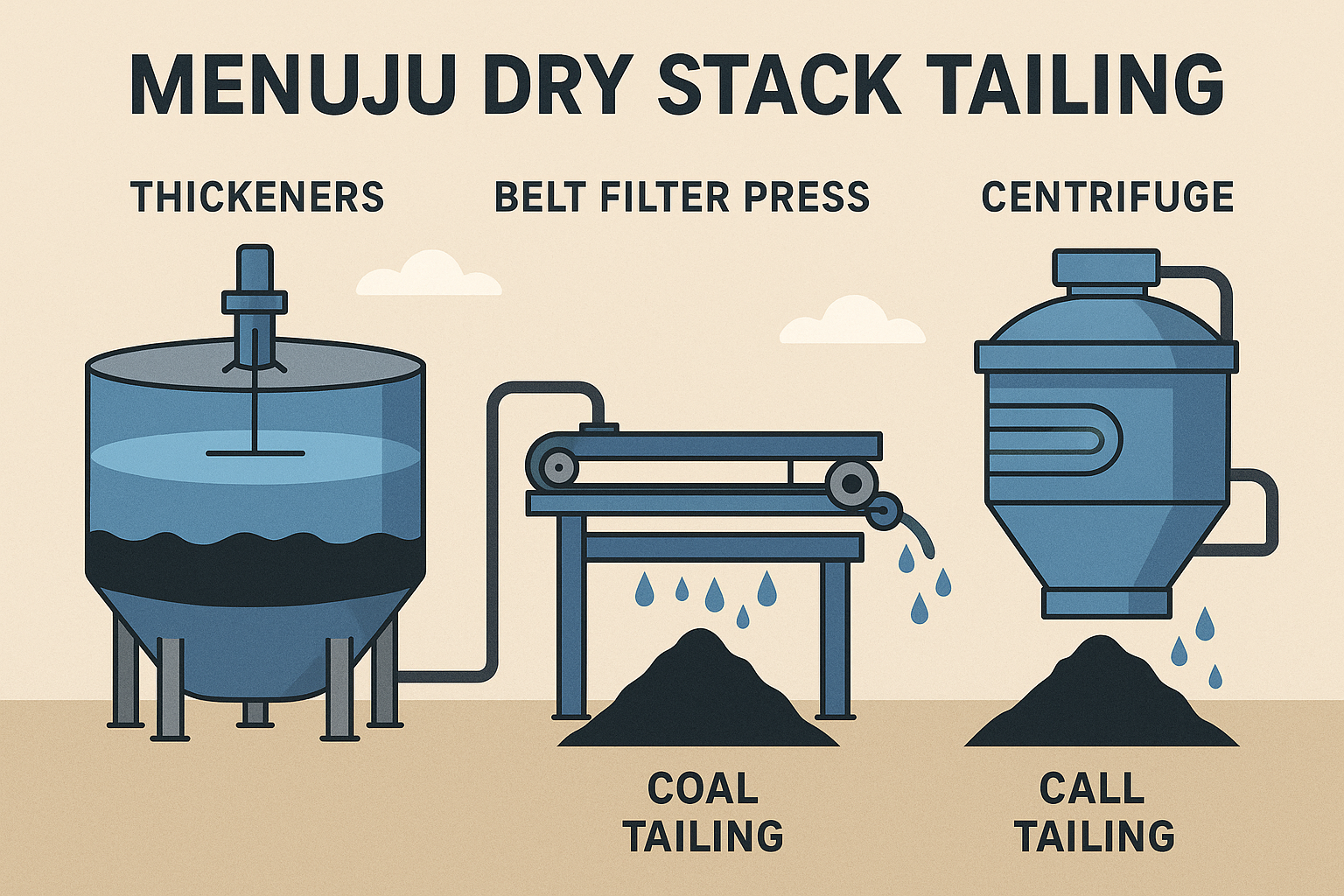
Decanter (scroll) centrifuges spin slurry at high g‑force to separate solids, producing a cake and a clarified centrate. Typical cakes land around 60–70% solids (~30–40% moisture), with patent data on coal slurries showing two‑stage dewatering delivering a combined cake at ~30% moisture (~70% solids) (patents.google.com).
Units commonly handle 50–200 m³/hr per machine (hundreds of tons/day), with capacity scaled by larger bowls or multiple units. They usually require flocculant dosing comparable to belt filters or coagulant pretreatment. Strengths are compact footprint and continuous operation; weaknesses include higher energy use and somewhat lower dryness. Compared with belt presses, centrifuges often yield slightly wetter cake but capture more solids in the cake (belt filters can lose a few percent to filtrate). Even so, vendors report modern decanters can match multi‑meter belt presses for throughput, “need less manpower,” and produce drier underflow with ~40% lower solids handling cost in one switch‑over example (HQ Filter Belts) (HQ Filter Belts)).
Water recovery remains below full filtration; the same 100 kt/d case shows thickened‑like operation (i.e., centrifuge‑level dryness) at ~83% recovery versus ~93% when filtered to ~80% solids (MDPI).
Comparative dryness and water recovery
The gradient is consistent: thickening delivers ~50–65% solids (too fluid to stack), belt presses ~75–85% solids, centrifuges ~65–70% solids, and high‑pressure filter presses up to ~85–90% solids (10–15% moisture) (tailings.info)) (MDPI).
The water metric tracks with dryness. In a 100,000 t/d tailings case (28% feed solids), thickened tails at ~60% solids recovered ~83% of water, while filtered tails at ~80% solids reached ~93% recovery (MDPI). The drier cake is “stackable,” enabling dry stacks with higher side slopes that avoid large slurry ponds; studies report dry‑stacked systems need ~3.5× less freshwater make‑up (0.2 m³/t vs 0.7 m³/t) than slurry dams (MDPI).
Capex rises as plants move from gravity to mechanical dewatering, but water savings and smaller footprints counterbalance. One study shows eight large filter presses (each 150–175 t/cycle) dewatering 100 kt/d while recovering 500 m³/h of process water; each press contributes roughly ~12,000 tpd of capacity (MDPI) (MDPI).
Chemical programs: flocculant and coagulant sequencing
Across steps, chemical aggregation of fines is essential. Typical flocculant dosing is ~20–70 g/t of tailings (MDPI). For coal fines, anionic high‑molar‑mass PAMs generate large, porous flocs that accelerate drainage (MDPI), whereas cationic flocculants (or organics such as polyDADMAC) are mainly used to target clay fractions; they form denser, less‑permeable cakes and are rarely used alone at large scale (MDPI).
A two‑stage sequence boosts performance: dose an inorganic coagulant first—examples include polyaluminum chloride, ferric chloride, or even CaCl₂—to neutralize surfaces and form micro‑flocs, then add the long‑chain flocculant to bridge particles (MDPI). Studies show this coagulation–flocculation step greatly increases floc size and density while substantially reducing polymer need (MDPI).
Laboratory tests found CaCl₂ added before an anionic PAM produced much larger flocs with excellent turbidity removal (MDPI). Modern “barrier” or dual‑polymer systems have been reported to cut polymer consumption by 3–5× for comparable settling (MDPI). In practice, high‑clay slurries may need 50–70 g/t and pH adjustment to precipitate metasilicates, while coarser coal slurries settle well at 20–30 g/t.
Where polyaluminum chloride is selected, many plants refer to PAC; integration with procurement or spec packages is straightforward via PAC offerings aligned to tailings chemistry.
System integration and dry stacking outcomes
The pattern holds: moving from dilute tails to thickened or filtered tails demands better polymer chemistry and more sophisticated equipment, but yields dramatic benefits. Where feasible, integrating high‑capacity thickeners with downstream filters or centrifuges—while optimizing flocculant/coagulant regimes—produces near‑dry cake that can be conveyor‑stacked, reducing reliance on slurry impoundments. Recent large‑project designs assume filter cakes of ~80% solids, water recovery >90% (MDPI), and tailings stack slopes of a few degrees.
Across published cases, combining efficient thickeners with belt filters or centrifuges and modern polymers can cut tailings water by 50–80% and produce cake suitable for dry stacking (MDPI) (MDPI). Disc‑stack centrifuges—for very fine slimes—tend to produce even wetter flocs and are less common for thickening.