

Industry: Coal_Mining | Process: Preparation
Coal preparation is a grind—literally. Slurries loaded with coal fines, sand, and clay chew through ordinary steel, forcing maintenance teams into costly rebuild cycles. The fixes making a difference are surprisingly straightforward: hard linings, hard alloys, and pumps operated where they were meant to run.
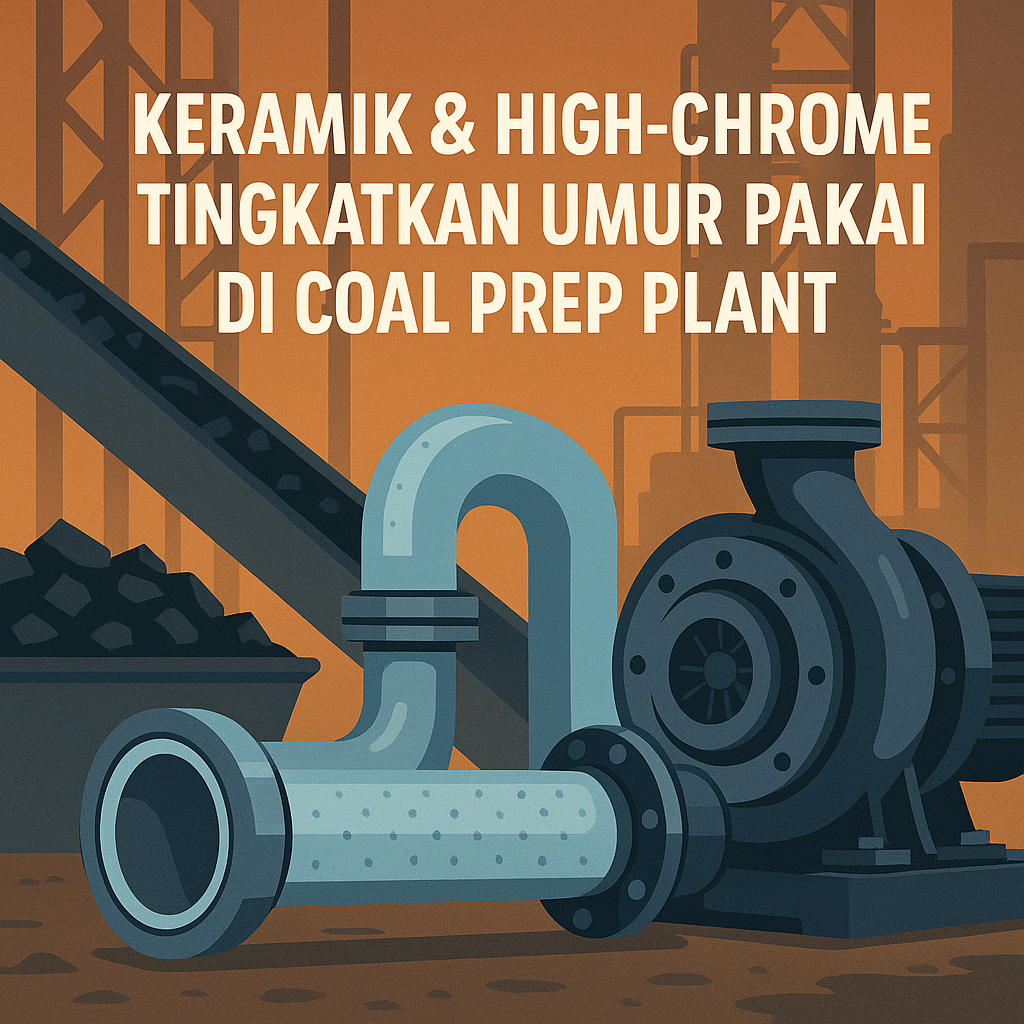
Across industry cases, those upgrades multiply component life by orders of magnitude, with commensurate savings. Ceramic-lined pipelines and high-chrome pump internals are the headline moves, backed by operating discipline that minimizes turbulence, air, and cavitation.
Abrasion‑resistant ceramic‑lined pipelines
Ceramic-lined pipe—typically alumina (Al₂O₃) or silicon carbide inserts inside steel—resists slurry erosion far better than bare metal. Tests and field data put the advantage at 3–10× longer life than steel (csceramic.com).
In Chinese coal power plants, ceramic-lined coal pipes reportedly recorded less than 0.2 mm wear after five years, while bi‑metal steel pipes under the same conditions needed replacing in 1–2 years—a roughly 3× lifespan gain (abrasionresistantpipe.com). In one project, a high‑hardness pipe cladding handled over 320,000 tonnes of throughput per millimeter of wear, about 30× better than an uncoated pipe (womp-int.com).
The compounding effect is long-lived infrastructure: a ceramic-lined slurry pipeline is projected to run out decades—approximately 19 years—without replacement (womp-int.com), shaving downtime and spares.
High‑chrome alloys in slurry pumps
Inside the pump, material choice matters. Replacing ordinary cast steel with chrome‑rich white iron or alloy steels (often 12–30% Cr) lifts hardness to roughly 60 HRC (Rockwell C hardness scale), compared with ~30 HRC for plain steel, improving erosion resistance. Modern slurry pump lines (e.g., Warman/AH‑series) offer wear parts in Hi‑Chrome, CD4MCu, and Hastelloy (e-mj.com).
Although duty cycles vary, the pattern is consistent: higher‑chrome internals push rebuilds out. One upgrade extended maintenance intervals from weekly to quarterly, saving “thousands of dollars” per month (e-mj.com). Another case redesigned a pump to run at lower speed, which “made everything last longer”—the suction line went from a six‑month life to over two years (e-mj.com).
Supplemental linings and overlays
Beyond ceramics and chrome alloys, coal plants commonly deploy bimetallic hardfacing, cast basalt tiles, and polymer–ceramic composites on wear zones. Screens, chutes, augers, and cyclones are frequent targets for bimetal or ceramic overlays to resist impact and abrasion (weartech.kz) (weartech.kz).
Coatings such as fused oxides or overlay welding can be retrofitted to existing equipment, balancing cost and protection. Any surface subject to slurry impingement in the wash plant is a candidate for a wear lining.
Duty matching and best efficiency point
Selection and operation are as critical as metallurgy. Sizing each slurry pump to required head and flow is, as one supplier puts it, “custom‑making a suitable tool”—balancing head, flow rate, and shaft power (topslurrypump.com).
Oversizing invites recirculation wear: at very low flows, slurry churns inside the casing. In contrast, a larger‑diameter impeller at lower speed reduced turbulence and “made everything last longer,” with the suction line life improving from six months to over two years (e-mj.com). Running near the BEP (best efficiency point) minimizes internal turbulence and abrasion, and modern designs add adjustable wear rings or variable‑volume casings to broaden the usable range (e-mj.com) (e-mj.com).
Air entrainment and cavitation control
Air bubbles and cavitation dramatically accelerate wear. During operation, all air admission valves on the slurry feed should remain sealed; if high‑pressure air enters the inlet, it expands and “violently impact[s] the volute and liner…accelerating equipment wear,” potentially fracturing the casing (topslurrypump.com).
Maintaining adequate NPSH (net positive suction head) avoids cavitation—vapor bubble formation that collapses, pitting metal and crushing efficiency. In practice, operators keep well within the rated inlet height and avoid suction conditions that produce vapor bubbles (topslurrypump.com). These precautions can save thousands in repairs, since cavitation and air damage can ruin a pump in hours.
Seals, bearings, and vibration
Seal design matters: multistage expellers and purpose‑built arrangements reduce leakage into bearings. Where water shortage or slurry backpressure is a factor, Warman‑type Hi‑Seal designs can improve seal life. Proper lubrication and alignment of shafts and bearings limit vibration, and vibration accelerates lining wear.
Inspection schedules and regulatory context
Regular inspection and record‑keeping catch wear trends before failures. Indonesian mining safety regulations (Permen K3) explicitly require pre‑operation inspections and periodic maintenance of mechanical equipment, with a designated engineer scheduling and documenting checks (fr.scribd.com).
In practice, maintenance engineers measure wear‑liner thickness, log pump vibration and pressure, and compare against tolerances—often swapping liners at, for example, 50% wear to prevent catastrophic failure.
Quantified service‑life outcomes
The payoffs are measurable. One report documented a lined pipeline losing only 0.035 in (0.9 mm) after delivering 288,000 m³ (about 288,000 tons) of concrete slurry in 30 months—about 320,000 tons per mm lost—versus only 10,500 t/mm with bare steel (womp-int.com). More broadly, ceramic alloys deliver 3×–10× the component life of steel (csceramic.com), and a lined pipeline has been projected to run roughly 19 years (womp-int.com).
In the field, replacing an older setup with a properly sized, hard‑alloy pump program cut maintenance checks from weekly to once every three months, stabilizing production and saving “thousands of dollars” (e-mj.com). One operator that logged head and power while inspecting chrome liners quarterly saw unplanned downtime drop by over 60% within a year. Recording pipeline abrasion gauge readings allowed replacements to be scheduled in planned outages rather than emergencies.
Reported cases include pipeline service life extended from about one year to 3+ years (abrasionresistantpipe.com), and pump component lives stretching from weeks to years (e-mj.com) (e-mj.com). Overall wear rates are slashed by factors of 3–10 or more (csceramic.com) (womp-int.com). The net effect: thousands of dollars saved per pump per year, far fewer emergency repairs, and higher plant availability—a key challenge for the plant’s maintenance engineers.