

Industry: Coal_Mining | Process: Coal_Washing_&_Preparation_(Prep_Plant)
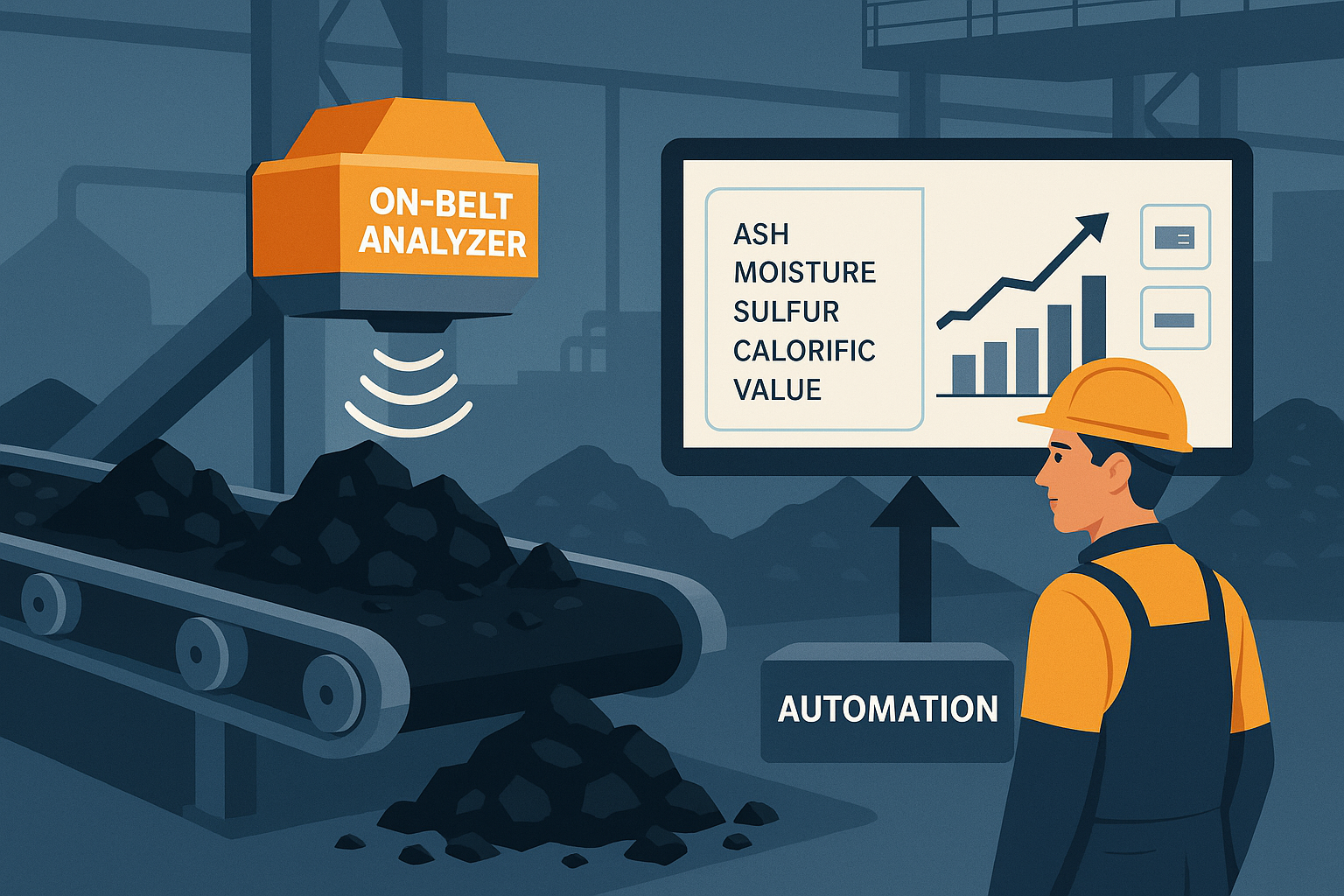
The coal washing plant is getting a nerve system. Modern on‑belt elemental analyzers—typically PGNAA (a neutron‑based elemental scan) or PFTNA (a pulsed neutron analysis)—scan the entire coal stream and report ash, moisture, sulfur, and calorific value every 1–5 minutes, replacing hours‑ or days‑later lab results and slashing sampling bias (www.drycargomag.com; commerce.thermofisher.com).
The adoption is broad—Dry Bulk notes “the largest companies in Indonesia, China, Taiwan, Vietnam and Thailand are all using [PGNAA on‑belt analysis]” to monitor coal in real time (www.drycargomag.com). Scantech’s COALSCAN series is emblematic: over 150 COALSCAN 3500 units are installed, and “hundreds of plants around the world are using COALSCAN analysers to increase yield” (scantech.com.au).
With microwave moisture meters and X‑ray analyzers adding continuous moisture or ash readings, operators gain immediate awareness of feed and product quality across the plant. Critically, on‑belt analysis updates “every one, two or five minutes as compared with laboratory analyses of samples…available hours or even days later,” ensuring “all of the material of interest is ‘seen’” and effectively eliminating sampling error (www.drycargomag.com).
Whole‑stream analysis on the conveyor
Thermo Fisher’s commercial PGNAA/PFTNA offerings underscore the shift: marketed to “provide coal producers with accurate data on sulfur, ash, moisture, calorific value and other key parameters” for real‑time quality control (commerce.thermofisher.com), they give plants a live view of variability at run‑of‑mine, cyclone product, and clean coal bins. Industry sources add that modern systems have minimal drift and remote connectivity; Scantech, for instance, provides internet access for diagnostics and rapid support, letting engineers audit and calibrate remotely (www.drycargomag.com; scantech.com.au).
Closed‑loop controls in dense‑medium circuits
Plants are wiring that data into SCADA/DCS (Supervisory Control and Data Acquisition/Distributed Control System) to run closed‑loop automation. Analyzer outputs—belt ash/moisture values, feeder speeds, density meter signals—feed PID (proportional‑integral‑derivative) or model‑based controllers that adjust setpoints on the fly. In heavy‑medium separation, gamma density gauges track medium specific gravity (and sometimes reject ash) and manipulate valves or pumps to add make‑up water or magnetic medium; one implementation used cascade control to a water valve to maintain target dense‑medium density by modulating fresh water supply (www.scielo.org.za).
At Exxaro’s Grootegeluk complex, engineers built a “digital twin” model combining geology, dispatch, and wash‑table data, then ran a statistical predictive controller that set dense‑medium cut densities for all 15 cyclone modules—10 in primary wash, 5 in secondary—in real time. After ten days of continuous operation, semi‑soft coking coal (SSCC) ash variability tightened: the standard deviation fell from ~1.39% to ~1.24% ash, and the plant was described as “the first fully automated quality control plant” in that company (www.scielo.org.za; www.scielo.org.za; www.scielo.org.za). The controller remained operator‑supervised via SCADA but autonomously adjusted medium densities to keep product qualities on target.
Thickener chemistry and ML dosing
In fine coal circuits, on‑line turbidity or density sensors in thickeners can auto‑adjust chemical dosing. A 2025 case study from a Chinese coal prep center used an ML‑based controller driven by overflow turbidity and ash to dose coagulants and flocculants; coagulant use fell ~31.6% and flocculant ~37.2% while meeting the same turbidity target (www.mdpi.com). In practice, sensors (turbidity, underflow solids, ash feed) feed predictive models (e.g., LSTM) that compute ideal dosages in real time and actuate pumps accordingly.
For accurate, automated dosing, plants typically rely on precise pump actuation; many specify dosing pumps to turn the controller’s setpoints into stable reagent flows. Where chemistry is the lever, plants standardize on coagulants and, separately, on flocculants that match coal fines and water chemistry, then let the control loop trim rates minute by minute.
Product‑ash feedback and optimal cut strategy
Beyond feed‑forward control, some dense‑medium systems tune the cut using final product ash. One “intelligent density control” scheme added XRF ash analyzers on product belts and used those signals as the basis for medium density adjustments—low‑ash (refined) lines stabilized the cut with their analyzer, and thermal (higher‑ash) lines similarly drove the loop (hotminingepc.com). The theoretical target in multi‑circuit plants is to “wash all streams to the same incremental ash,” a strategy that maximizes total yield at fixed product specs (www.researchgate.net; hotminingepc.com).
Additional automated moves include belt feeders that slow when high‑ash coal arrives, hydrovein valves adjusting overflow in spirals/cyclones, and feedback from post‑froth column analyzers.
Yield, blending, and the cost stakes
Quality consistency gains are already measured. At Grootegeluk, automated density control narrowed the SSCC ash spread and dropped the standard deviation from 1.39% to 1.24% ash (www.scielo.org.za). Yield wasn’t reported, but stabilizing ash at the lower end lets operators load ash cutbacks and likely lifts saleable tonnage. In practice, even a small lift matters: a 1% yield gain on a 10 Mtpa plant is ~100 kt/year of extra coal, worth millions of dollars.
Real‑time analyzers also underpin blending: with live ash and energy data, software can blend ROM by grade to hit a composite spec, and on‑the‑fly sulfur measurements enable adding low‑S coal to meet emissions caps (www.drycargomag.com; commerce.thermofisher.com). The stakes are high: one fuel‑quality survey estimated coal‑related costs—ash fouling, forced outages, blending compliance—at ≥US$1.2 billion per year for U.S. coal power plants (www.researchgate.net).
From pilots to plant standard
Industry experience now spans “hundreds of plants worldwide,” with systems processing “billions of tonnes of coal … more efficiently” (scantech.com.au). The control philosophy is clear: monitor incoming feed and final product continuously and correct process settings—valve positions, pump rates, reagent flows—immediately. Or as one industry summary put it, online analyzers let “operators control their plants according to the ore quality they are actually processing, not what they think they are processing,” delivering “more efficient plant operations and better asset management” (www.drycargomag.com).