

Industry: Coal_Mining | Process: Preparation
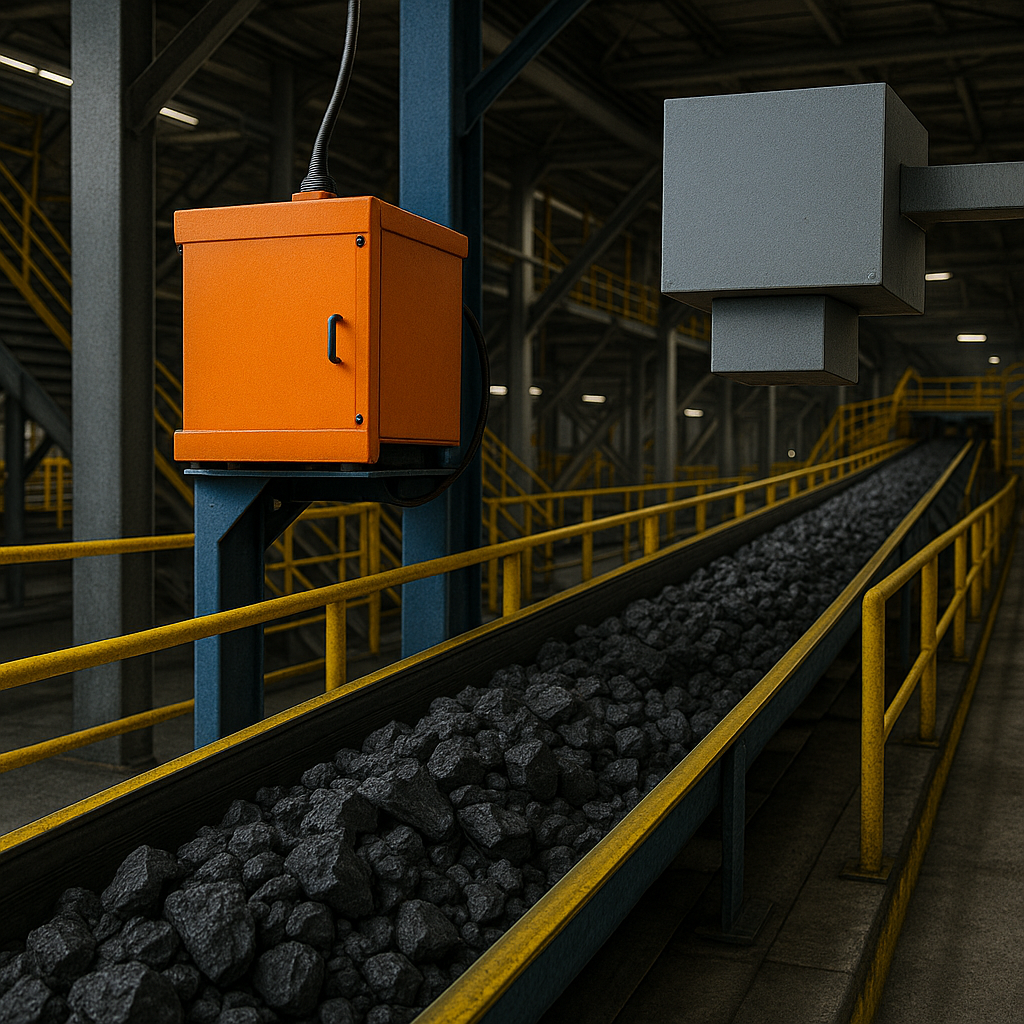
Modern coal preparation is turning into a real-time exercise in measurement and control. Non‑contact analyzers — prompt‑gamma or XRF “ash” meters (XRF: X‑ray fluorescence; PGNAA: prompt gamma neutron activation analysis), near‑infrared (NIR) moisture sensors — continuously track ash, calorific value (CV, the energy content), moisture, sulphur, or other elemental markers directly on conveyors or at process points (enelex.cz) (marketresearch.com).
Those readings feed the plant SCADA/DCS (supervisory control and data acquisition/distributed control system) for immediate feedback control. ENELEX puts it plainly: its radiometric analyzers “monitor the immediate quality of fuel online, directly on the conveyor belt,” measuring ash, heating value and throughput so operators can adjust processing on the fly (enelex.cz).
In Indonesia’s export trade, where grades typically run 1–10% ash and 15–22% moisture with a grinding hardness of 40–50 HGI (Hardgrove Grindability Index, a relative measure of grinding difficulty) (globalenergycertification.org), that kind of real‑time verification lets a plant catch high‑ash or high‑moisture batches instantly and respond before shipments drift off spec.
Non‑contact analyzers and SCADA integration
Coal prep plants deploy a mix of online sensors. Ash/calorific analyzers built on XRF or PGNAA scan the burden on the belt to report ash and energy content (enelex.cz) (marketresearch.com); for instance, the GE4000 series uses dual gamma detectors plus flow measurement to deliver ash and CV in real time (enelex.cz).
NIR or microwave moisture probes provide continuous moisture tracking — critical for low‑rank coals with typical 15–25% moisture (enelex.cz) (globalenergycertification.org). Plants may add elemental analyzers for sulfur, carbon, or trace elements, and mechanical belt samplers that collect discrete samples under analyzer supervision for verification and calibration.
Coal quality management systems in operation
Together, these sensors form a coal quality management system (CQMS). One Czech wash plant installed 29 online ash meters plus belt samplers to “monitor the quality of input and output products” and to “control treatment technology” (enelex.cz) (enelex.cz).
By mapping quality along stockpiles, wash circuits, and load‑out conveyors, operators gain full visibility of material flow: incoming ROM (run‑of‑mine) coal quality is known to the second at entry, and product quality is checked continuously at discharge or stacker rather than only via slow laboratory samples.
Dense‑medium cyclone control algorithms
Real‑time quality data drive automated setpoint changes. In dense‑medium separation, track‑borne ash analyzers upstream of cyclones allow automated medium density control. Zhang et al. proposed a controller that “adjusts the density of medium…according to measurements on percentages of different components in raw coal” to meet a target clean‑coal quality (researchgate.net).
Simulations show such controllers can maintain target quality and minimize power costs even as feed changes (researchgate.net) (researchgate.net). In practice, the controller writes new density setpoints into PLCs (programmable logic controllers) via cascaded PID loops (proportional–integral–derivative control) that manipulate fresh magnetite or water valves to correct for variability.
Exxaro implemented the concept at its Grootegeluk washery: a digital‑twin controller adjusted medium density in each cyclone module on an hourly basis, using GPS‑tagged ROM tip data and geological models (scielo.org.za) (scielo.org.za). Once tuned, it steadily held the target ash, whereas manual control had allowed drift.
Flotation reagent dosing and stability
Fines circuits layer on more automation: pulp level probes, online ash sensors on froth, and even machine vision of froth can enable automated reagent dosing. In a Chinese plant, a hybrid fuzzy‑expert controller for a flotation column used on‑line grade estimators to optimize froth depth and reagent addition in real time. Over a 60‑day trial on parallel cells, the automated cell delivered slightly lower ash (10.17% vs 10.21%), higher recovery (55.04% vs 54.06%), and tighter stability (ash SD 0.47% vs 0.65%; recovery SD 2.64% vs 3.59%) (pmc.ncbi.nlm.nih.gov).
Crucially, reagent use fell by ~13% (14% less frother, 12% less collector) under control (pmc.ncbi.nlm.nih.gov). That dynamic behavior — reducing chemical dosing when quality sits within spec and increasing only when “feed complained” — often relies on accurate metering via plant‑grade dosing pumps integrated to the same control logic.
Automated blending and diverter gates
Quality data also drive conveyor splitters. Enelex describes systems that sort coal into “high” and “low” quality bunkers using analyzer‑controlled diverter gates (enelex.cz). If the analyzer sees coal above or below spec, a gate opens to the appropriate bunker, with sequential filling and discharge logic reblending material to the target composition (enelex.cz).
After blending, another online analyzer confirms final product quality — and can automatically adjust further steps — to achieve uniformity “with coal of an even quality” at load‑out (enelex.cz).
Throughput, setpoints, and alarms
Beyond circuits, real‑time quality signals let the DCS trim feed rates, split ratios, and other setpoints. If an ash meter trends up, control may reduce primary screen load or slow feed to the dense‑medium bath to avoid overload while maintaining spec. Plant DCS screens can then maximize throughput without tripping product specifications.
Where chemical additions are part of the response — from medium density correction to froth chemistry — automated loops typically meter precisely through dosing pumps, keeping the control “closed” from analyzer to actuator.
Yield, quality, and monetary outcomes
Plants adopting sensing‑and‑control consistently report either higher yield at the same quality or tighter quality at the same yield. In the flotation trial above, yield jumped by +0.98 percentage points (54.06% → 55.04%) while holding ash to spec and cutting reagent use (pmc.ncbi.nlm.nih.gov). At Exxaro’s washery, digital control reduced scatter in ash for semi‑soft cake coal, lowering the standard deviation from 1.39% to 1.24% ash (scielo.org.za).
The dollars add up. Industry sources estimate coal quality deviations cost utilities and producers heavily: for US power plants alone, one study put ash deposition at ~$943M/yr and coal mis‑specification at $267M/yr (slideserve.com). Maintaining target CV via online sensors can optimize coal consumption and reduce fuel cost (enelex.cz) (marketresearch.com). Firms often cite ROI periods of <1–2 years on analyzer installations due to yield uplift and grading efficiencies.
Environmental and regulatory alignment
Automation reduces waste (less reject to tailings) and ensures the feed that reaches a boiler matches its design. Continuous measurement “ensur[es] sufficient quality … for proper boiler operation,” allowing power stations to adjust blending or alternative fuel injection as needed (enelex.cz). Monitoring sulfur and ash upstream also tightens emissions control.
Digital adoption and payback trajectory
The trajectory is clear: coal prep is becoming fully digital and real‑time. A 2022 report highlighted Exxaro’s site as “the first fully automated quality control plant” within its group (scielo.org.za). Major producers now integrate online analyzers with DCS and apply data analytics — even machine learning — to continuously optimize. Market research points to strong CAGR growth in online analyzer adoption, driven by efficiency needs and customer guarantees (marketresearch.com).
In short, prep plants with modern sensors and control loops meet contractual quality day‑to‑day at maximized yield and lower cost — a competitive edge traceable to data‑driven process control (enelex.cz) (pmc.ncbi.nlm.nih.gov) (enelex.cz).
Sources: recent industry and academic studies of coal wash plant automation and analyzers (enelex.cz) (enelex.cz) (enelex.cz) (researchgate.net) (scielo.org.za) (pmc.ncbi.nlm.nih.gov), as well as market and technical reports on coal quality control (marketresearch.com) (globalenergycertification.org).