
Coal preparation plants can discharge blowdown loaded with 1,000–10,000 mg/L suspended solids and dissolved metals. A tightly run chemical precipitation, pH control, and clarification system brings those numbers down to single digits and under Indonesia’s PP 22/2021 limits.
Blowdown water from a coal prep circuit often comes out as a dense slurry of coal fines and clays, plus dissolved metals from the ore and process. Suspended solids can hit 1,000–10,000 mg/L, according to Yokogawa. Raw pH can be depressed—one case study recorded pH ~3.5—especially when acidifiers or certain flocculants are used (ISCA).
Regulators are watching. Indonesian discharge standards under Government Regulation No. 22/2021 (PP 22/2021) typically require Fe and Mn below 0.5–1 mg/L, TSS under 50–100 mg/L, and pH between 6–9 for receiving waters. A referenced prep plant hit Fe ~0.11 mg/L, Mn <0.01 mg/L, Al <0.01 mg/L, and TSS 10 mg/L post‑treatment (with raw TSS at 1,000 mg/L), all well below mining effluent limits (ISCA).
Blowdown characteristics and regulations
Beyond the fines, heavy metals in raw blowdown commonly include iron (Fe), manganese (Mn), and aluminum (Al) from both ore and process inputs, plus trace toxic metals such as lead (Pb) and arsenic (As) adsorbed onto solids. The 1,000–10,000 mg/L suspended solids band is a typical starting point for coal washer effluent (Yokogawa). Indonesian PP 22/2021 sets the compliance frame: Fe and Mn generally under 0.5–1 mg/L, TSS 50–100 mg/L, and pH 6–9.
One Indonesian case demonstrates the endpoint: treated effluent with Fe ~0.11 mg/L, Mn <0.01 mg/L, Al <0.01 mg/L, and TSS 10 mg/L (ISCA). That performance compares to raw TSS near 1,000 mg/L (ISCA).
Chemically assisted treatment train
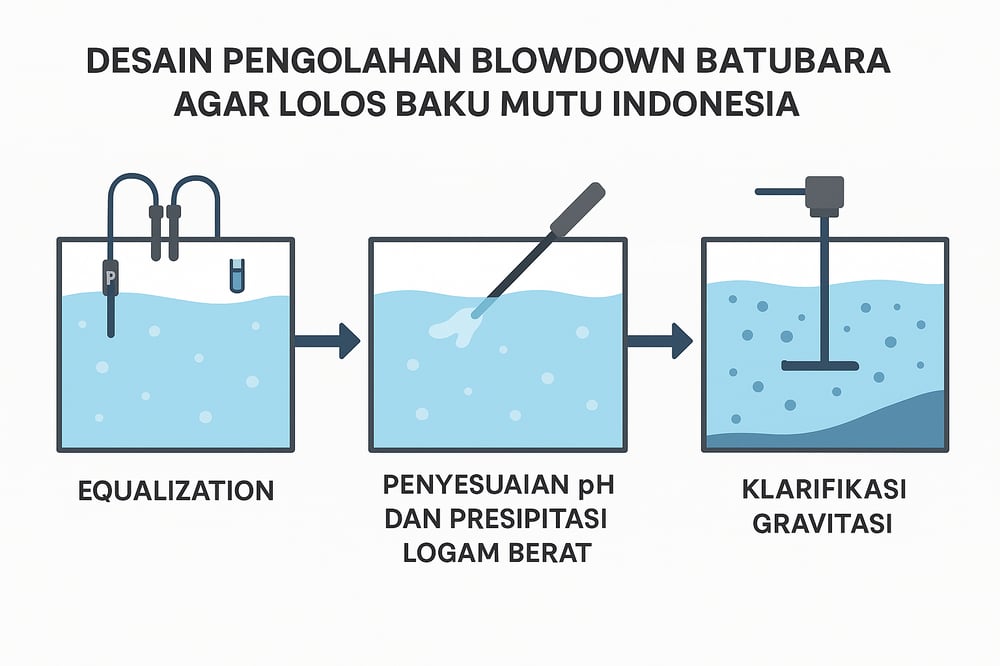
The recommended system follows a conventional sequence: equalization/mixing, pH adjustment and heavy‑metal precipitation, coagulation/flocculation, and final clarification. In practice, the equalization basin buffers flow and load swings while blending chemical feeds, with automatic pH control to establish a stable baseline. One Indonesian design used a 960 m³ equalization pond upstream of dosing (ISCA).
For chemical feed accuracy, plants commonly deploy flow‑proportional or pH‑triggered dosing pumps with instrumentation from water‑treatment ancillaries, then send the conditioned flow forward to the precipitation step.
pH adjustment and heavy‑metal precipitation
Precipitation is the principal method for heavy‑metal removal in industrial wastewater, forming insoluble metal hydroxides at elevated pH (ChemTreat; IntechOpen). Hydrated lime (Ca(OH)₂) or caustic (NaOH) typically raises pH into the 9–10 range where Fe, Al, and Mn precipitate effectively as Fe(OH)₃, Al(OH)₃, and Mn(OH)₂ (ChemTreat; ITRC; IntechOpen). Lime is favored in mining because it can achieve higher pH than limestone (ITRC).
Depending on the influent, soda ash or magnesium hydroxide (Mg(OH)₂) can substitute where less extreme pH is needed (ChemTreat). Operators stabilize the pH setpoint (e.g., 9.0–10.0) before moving to coagulation.
Coagulation and flocculation
To aggregate the fine metal hydroxides and colloids, plants dose coagulants such as ferric chloride or alum, and follow with polymeric flocculants for gentle‑mix floc growth (Veolia Water Technologies Handbook). In one case, a cationic polymer identified as “N8100” at 5 mg/L with pH adjusted to 6–8 gave excellent TSS removal (ISCA).
Jar tests (bench‑scale beaker trials to tune doses) set the baseline; heavy metal removal above 95% and TSS removal above 90% are typical when optimized. If raw pH is very low, an initial neutralization or simultaneous lime–floc dosing, as reported in the cited design, stabilizes performance (ISCA). Plants often source coagulants and flocculants to match jar‑test outcomes.
Final clarification and polishing
Gravity settling in a clarifier (a tank designed for solid/liquid separation) completes the separation. Typical designs run ~1–3 hours of retention with surface overflow rates around 0.5–1.0 m³/m²·h. One referenced plant used three identical sedimentation ponds at 675 m³ each operating in parallel, retaining solids for roughly three months between cleanouts (ISCA). In well‑tuned operation, effluent TSS falls below 20 mg/L; the case achieved ~10 mg/L with Fe down to ~0.11 mg/L and Mn/Al below 0.01 mg/L (ISCA).
Facilities commonly specify a standard clarifier, and where footprint is tight, a lamella settler acts as the compact alternative. If a final polish is needed, dissolved air flotation (DAF) or filtration may be added; operators sometimes deploy a DAF unit or a sand filter such as sand/silica filtration to trim remaining fines. For trace metals or organics, ion exchange and adsorption are relevant; plants match media such as ion‑exchange resin or activated carbon to the specific discharge profile.
Sludge handling and disposal
Metal hydroxide sludge plus captured coal fines adds up. Sludge volume can be high—often 300–500 kg wet sludge per m³ of precipitated metal (ChemTreat). In the sedimentation‑pond example, desilting every ~3 months yielded about 105 m³ of settled solids per pond (ISCA).
Dewatering via centrifuge or filter press reduces volume; dry solids production typically runs 0.2–0.5 kg per kg of metal precipitated (ChemTreat). Disposal follows local hazardous‑waste (B3) requirements. Plants add sludge treatment steps as needed to improve dewatering characteristics.
Operator control and compliance guide
- pH control: Continuous pH monitoring in equalization or precipitation tanks anchors performance. Target pH 9.0–10.0 for precipitation; sufficient alkalinity avoids re‑dissolution of metals during any pH dips. Logging pH and residual alkalinity supports dose tuning (ChemTreat).
- Chemical dosing: Flow‑proportional or pH‑triggered pumps set the baseline; jar tests establish starting doses, then feed‑forward (flow/turbidity) and feedback (effluent) adjustments refine the setpoints. Reported practice includes ~10–50 mg/L polymer plus comparable mg/L lime, calibrated to site conditions. One cost comparison showed polymer at ~US$10/day versus FeCl₃ at ~US$119/day (ISCA). Plants typically use dosing pumps for coagulant and flocculant feeds.
- Clarifier operation: A stable sludge blanket and gentle inflow protect the settle zone. An online turbidity meter helps track performance. Sludge depth probes indicating >0.5 m thickness can signal a ~3‑month cleanout interval in ponded systems (ISCA).
- Monitoring and compliance: Routine sampling for pH, TSS, and key metals (Fe, Mn, Al, plus others of concern) underpins compliance. Weekly lab checks or as required by permit keep the plant within limits. Typical internal targets: TSS < 20 mg/L, Fe < 0.5 mg/L, Mn < 0.1 mg/L. The cited plant’s Fe at ~0.11 mg/L illustrates headroom when chemistry and clarification are in line (ISCA).
- Waste and sludge management: Dewatering (centrifuge or filter press) reduces volume; expected dry solids of 0.2–0.5 kg per kg of metal precipitated is a planning guide (ChemTreat). Disposal follows local B3 rules.
Performance benchmarks and outcomes
When precipitation and clarification are dialed in, removal efficiency typically lands in the 90–99%+ range. Fe and Al removals of 99%+ at pH 9–10 are common (ChemTreat). In the Indonesian reference case, blowdown TSS dropped from ~1,000 mg/L to 10 mg/L, with turbidity cut from 150 NTU to 3 NTU. Dissolved metals fell from tens or hundreds of mg/L in the raw to below detection in the effluent (Fe ~0.11 mg/L; Mn/Al <0.01 mg/L) (ISCA).
Key operational metrics include final effluent TSS and metal concentrations, chemical feed rates, and sludge yield. A standard clarifier with the right coagulation/flocculation chemistry, supported by properly selected coagulants and flocculants, underpins this consistency.
Economic and regulatory trends
The coal sector is trending toward zero‑liquid‑discharge (ZLD) and internal reuse to reduce environmental impacts. PP 22/2021 tightens heavy‑metal and solids limits, and water‑scarce sites sometimes close the loop with advanced treatment such as evaporation and reverse osmosis (RO), albeit at increasing cost as purity requirements rise (ChemTreat). Where reuse is viable, plants may consider RO packages like brackish‑water RO under a broader membrane systems strategy, though many sites meet compliance and cost goals with precipitation/clarification alone.
Summary
A sequential system of equalization, pH adjustment (lime dosing), chemical coagulation/flocculation, and final clarification reduces coal prep blowdown TSS and heavy metals below regulatory discharge limits. With optimized chemistry and settling, effluent generally meets TSS < 20 mg/L and key metals < 0.1–0.5 mg/L, per the cited case (ISCA; ChemTreat). Routine monitoring, sludge management, and fit‑for‑purpose polishing—using options such as DAF, sand filtration, ion exchange, or activated carbon—support consistent compliance.
Sources
Design guidance and data were compiled from industry and technical references including Indonesian case studies and treatment manuals: ISCA; ChemTreat; Veolia Water Technologies Handbook; Yokogawa; ChemTreat. Additional precipitation specifics are discussed by ITRC and IntechOpen.
