

Industry: Coal_Mining | Process: Wastewater_Treatment
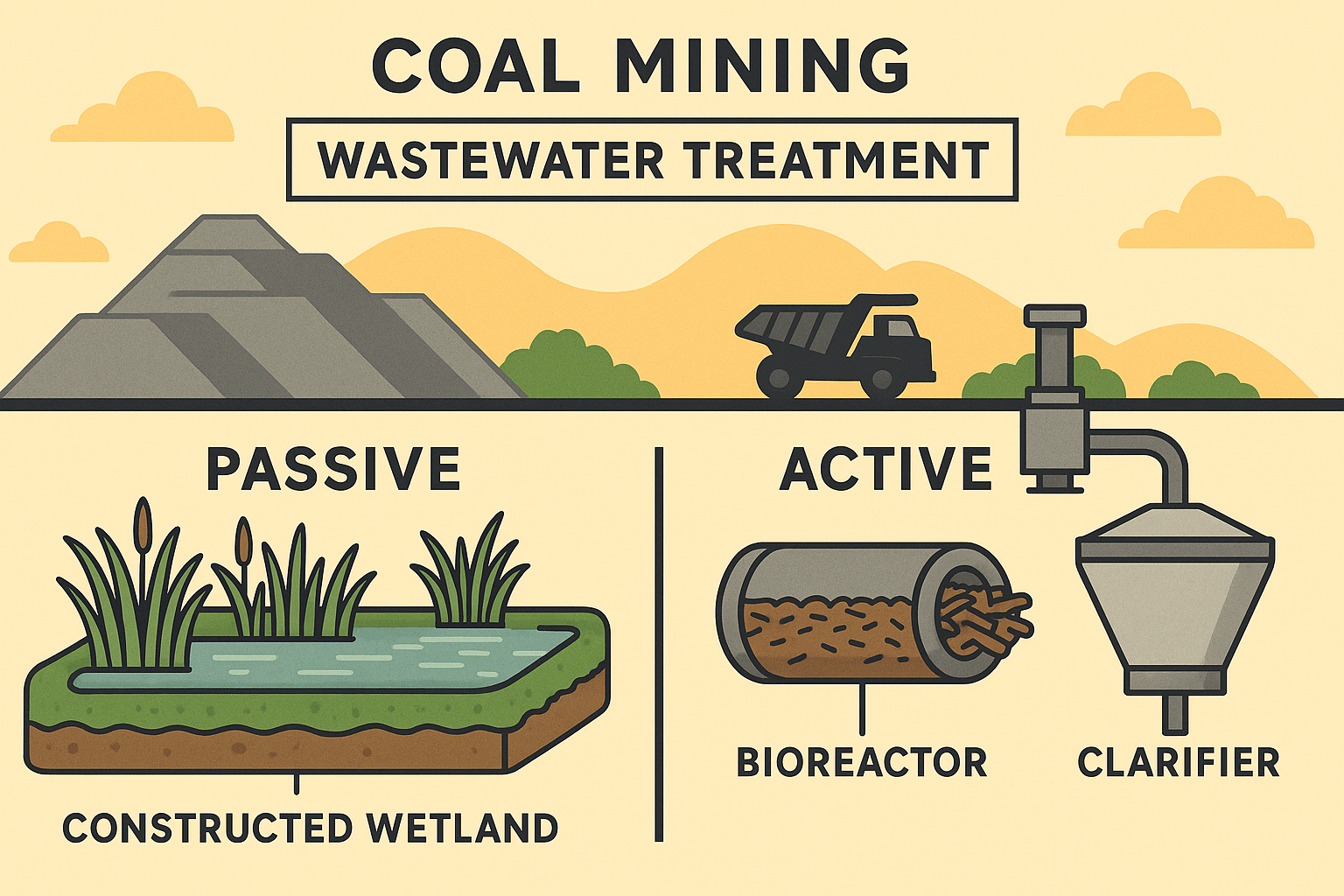
Passive (nature‑based) systems are moving from environmental pilot to mainstream unit operation at coal mines. These constructed wetlands and biochemical beds “polish” mine effluent after conventional treatment, relying on plants, sediments, and microbes rather than motors and chemical drums — ideally with no grid power or injected chemicals beyond initial setup and only occasional maintenance such as vegetation harvest (link.springer.com) (link.springer.com).
Active systems, by contrast, depend on continuous lime/chemical dosing, aeration, pumps and clarifiers (link.springer.com) — think a lime circuit feeding a clarifier to settle precipitated metals. The sector’s experience base has widened: thousands of mine sites now use passive technology, and well‑designed systems have treated flows up to ~75 L/s (liters per second) (link.springer.com) (link.springer.com). For operating mines, a semi‑passive hybrid adds upsizable controls or periodic feeding — even simple nutrient injection — while still avoiding a full active footprint (link.springer.com).
Polishing metals and nitrate removal
Constructed wetlands and bioreactors are delivering tangible gains on residual metals and nitrates. In an Indonesian coal‑mine runoff trial, a polishing wetland cut manganese (Mn) by 25%, from 3.70 to 2.75 mg/L (milligrams per liter), and all post‑wetland parameters then met Indonesian discharge standards; iron (Fe) rose from 0.05 to 0.31 mg/L but remained well below the 7 mg/L limit (ijfac.unsri.ac.id) (jiss.publikasiindonesia.id). In another area, a multi‑compartment wetland lifted pH from 6.70 to 6.90 and met manganese/iron limits (jiss.publikasiindonesia.id).
Nitrate (NO₃⁻) — common from blasting residues and runoff — is removed by denitrifying bacteria in anaerobic zones, with field studies showing 40–90% NO₃ removal in well‑designed wetlands (mdpi.com) (mdpi.com). In Australia, constructed wetland “polishing” cells reduced dissolved inorganic nitrogen (DIN) from 2.3 to 0.2 mg/L — roughly 91% removal (mdpi.com). On engineered options, high‑performing treatment wetlands have delivered nitrogen removals for USD17–37 per kg‑N, compared with regulatory benchmarks around USD110–150/kg (mdpi.com) (mdpi.com). By comparison, active methods like ion‑exchange or RO (reverse osmosis) often cost hundreds of dollars per kg‑N; mines that do pursue end‑of‑pipe options tend to use engineered ion exchange or modular membrane systems for specific regulatory drivers.
Anaerobic woodchip bioreactors — a simple denitrifying bed — likewise remove over 80% NO₃ when well managed (mdpi.com). For context, these biological pathways overlap with conventional nutrient removal trains, where engineered systems focus on nitrification–denitrification; mines that supplement polishing with engineered steps often consider nutrient removal systems upstream for load reduction.
Bench-scale and field metrics
Hybrid bioreactors have demonstrated metal performance closer to active systems. Bench‑scale tests achieved 85–90% zinc (Zn) removal in 96 days by fermenting a carbon source and precipitating metals in two stages, showing passive‑like systems can approach active removal efficiencies (link.springer.com). Field wetlands consistently lower Fe/Mn loads; measured removal fractions vary by site but are often 20–60%.
For nitrogen, wetlands typically attain 40–90% denitrification (mdpi.com) (mdpi.com). Vegetation uptake adds a minor benefit (<10% of N). Case studies report wetland effluent N reductions of about 0.2–0.5 mg/L for agrarian inflows around 0.5–2.0 mg/L (mdpi.com).
Capital and operating costs
Constructed wetlands trade concrete for land. Published U.S./Australia data suggest roughly $50–75 per m² of wetland — about $500,000–730,000 per hectare — and a “rule‑of‑thumb” of ~$500,000 per hectare for design and construction (ewater.atlassian.net) (ewater.atlassian.net). Bioreactor trenches or tanks (e.g., woodchip beds) are similar to build but often require less than 10% of the footprint of full wetlands. Active chemical plants sized for multi‑MLD (megaliters per day) flows can land in the $1–10M CAPEX range, though site specifics dominate.
OPEX is where passive shines. Aside from periodic trimming, dredging or media replacement, ongoing expenses are minimal; passive wetlands require no grid energy, no added chemicals after construction, and only occasional oversight (link.springer.com). A typical maintenance rule is ≈2% of CAPEX per year — about $10,000–$20,000 per hectare annually — with reported cases around $5–8k/ha‑yr (ewater.atlassian.net) (ewater.atlassian.net). Active trains incur ongoing reagent and power costs, from lime at roughly $0.10–0.50 per kg to the electricity for pumps and mixers — fed by dosing pumps — and treating tens of gpm (gallons per minute) can generate monthly chemical bills in the thousands. Sludge handling and media change‑outs add to life‑cycle costs, which consistently skew higher than passive on energy and reagents.
Cost effectiveness and carbon impacts
A cost‑effectiveness study underscores the delta: constructed wetlands removed nitrate at USD17–596 per kg‑N (median ~$40/kg), while end‑of‑pipe goals imply about USD110/kg; in other words, optimal wetlands achieved cost per kg‑N that is 3–5× lower than typical targets (mdpi.com) (mdpi.com). While there is no direct metal‑removal cost per kg reported, the same dynamic holds: passive precipitation and sorption avoid recurring reagent purchases that come with chemical programs. Passive systems also sequester carbon in biomass, whereas lime neutralization emits CO₂ through lime creation and use (link.springer.com).
Hybrid treatment trains
The emerging standard is hybrid: use conventional treatment to neutralize acidity and remove bulk metals, then feed near‑neutral effluent to a passive polishing stage. A typical layout raises pH with lime to precipitate Fe/Al, settles the sludge in a clarifier, and then channels the clarified flow through wetlands or bioreactors. The polishing stage can be compact on a flow basis because it targets residual pollutants rather than bulk load.
Benefits accrue on OPEX and compliance. Chemicals are used sparingly, with gravity doing much of the polishing work. Sludge generation drops — instead of frequent lime‑sludge disposal, metals accumulate slowly in wetland sediments — and a two‑stage design using fermented carbon drivers precipitated metals in a separate tank, enabling metal recovery and minimizing in‑situ sludge (link.springer.com). Passive wetland effluent flows rarely spike and benefit from ecological buffering, easing compliance. Corporate case studies (e.g., a smelter where a wetlands “tertiary” cut metals to meet discharge rules) show passive polishing can transform a borderline discharge into compliance.
Designers sometimes incorporate a semi‑passive element — for example, simple nutrient injection to maintain microbial performance — which can be as straightforward as provisioning a nutrient feed while avoiding a fully active plant footprint.
Trade-offs and site examples
Up front, hybrids demand land and engineering (wetlands plus bioreactors), but savings accumulate over time: lower chemical bills, minimal energy, and reduced labor. If nitrates are reduced by an added wetland at $20/kg‑N rather than by ion exchange at roughly $200/kg‑N, the avoided cost is material. In Queensland, high‑performing polishing wetlands posted annualised costs of only ~$2.8–31k per hectare (mdpi.com), whereas an active treatment line handling the same flow might easily cost eight figures to build and hundreds of thousands annually to run, depending on chemicals and power.
Where space allows, the hybrid yields measurable savings with maintained water quality. One project reported operating‑cost reductions of about R760k/month (South African rand) after optimizing an active plant and enabling greater onsite reuse (watercareinnovations.com) — while that specific case largely recycled clean fissure water, it illustrates how reducing external inputs generates savings. In the Indonesian coal context, additional wetland polishing could trim residual Mn from, say, 3 mg/L to below 1 mg/L, far beyond local regulatory needs (jiss.publikasiindonesia.id) (ijfac.unsri.ac.id). If such polishing avoided even 10 mg/L of annual lime use over millions of liters, the OPEX savings would repay the wetland in a few years; models suggest that for moderately polluted mine effluent, replacing part of the lime circuit with a vertical wetland could cut O&M by 30–50% without sacrificing effluent quality.
Active alternatives still matter for specific targets and seasons; many operators keep engineered capacity on standby and procure reagents through established water and wastewater chemical programs.
Constraints and design considerations
Space is the primary constraint. Wetlands often need many square meters per cubic meter of flow per day — commonly on the order of 5–10 m² per m³/d — to deliver 3–5 days of hydraulic retention. Seasonality matters too: very cold or dry conditions slow biological reactions, so hybrid designs sometimes include supplemental carbon inhibition (adding methanol or ethanol) or recirculation options, supported by standard wastewater ancillaries.
Bottom line on hybrid polishing
Peer‑reviewed and industry data converge: adding a passive polishing stage can materially reduce life‑cycle costs for coal‑mine effluent. Constructed wetlands and passive bioreactors show heavy‑metal removals on the order of 20–90% and nitrate removals up to ~90% (jiss.publikasiindonesia.id) (mdpi.com). Although capital costs can run to ~$500k/ha, operational savings are large: OPEX can be less than 5% of a comparable active system, especially when chemical dosing is replaced. In financial terms, the cost per kg of pollutant removed via passive polishing is typically a fraction of active methods (mdpi.com) (mdpi.com), with added benefits for carbon and habitat.
Sources and regulatory context
Recent engineering studies and reviews — Sobolewski 2023 (link.springer.com) (link.springer.com), Collins et al. 2021 (link.springer.com), and Kirkby et al. 2021 (mdpi.com) (mdpi.com) — provide performance and cost data cited above. Indonesian regulatory practice caps Mn at 4 mg/L and Fe at 7 mg/L (ijfac.unsri.ac.id), with targets met after wetland polishing in the referenced field work (jiss.publikasiindonesia.id). Cost references include watershed‑cost manuals and surveys (ewater.atlassian.net). All figures and outcomes derive from these technical sources.