

Surfactants, hygroscopic salts, and polymer binders are cutting dust — and water use — from hours‑long spray cycles to weeks or months of control. The numbers point to big water savings and fewer truck passes, with trade‑offs in cost and environmental profile.
Industry: Coal_Mining | Process: Dust_Suppression_Systems
Water is the blunt instrument of coal dust control, but it demands vast volumes and constant reapplication, even in heavy tropical rainfall (link.springer.com). Coal’s natural hydrophobicity (tendency to repel water) accelerates evaporation and rebound emissions (link.springer.com), so trucks keep spraying haul roads on repeat.
Regulation reinforces the habit. Indonesian rules (Kepmen 1827/30/MEM/2018) explicitly mandate water spraying on haul roads (greenchem.co.id). But mines are increasingly turning to specialty additives — including off‑the‑shelf options such as a coal dust suppressant — to stretch each liter further and cut reapplication.
Surfactant wetting agents performance
Surfactants (surface-active agents that lower water’s surface tension) are blended into spray water so droplets fully wet hydrophobic coal particles. By replacing air–coal interfaces with liquid, they boost capture efficiency (link.springer.com).
In lab and field tests, surfactant-enhanced sprays achieved 80–95% dust removal — roughly +40% higher than plain water (researchgate.net). Respirable dust (“about PM10”, particulate matter of 10 microns) removal is only ~1% lower than total, so similar gains apply. Tessum & Raynor (2017) reported nonionic and cationic sprays capturing ~76–78% of coal dust (ncbi.nlm.nih.gov).
Dosages are typically 0.1–0.5% v/v (volume fraction), making the chemical cost per liter only a few cents — often <$0.05 per cubic meter of spray (researchgate.net). Anionic or nonionic surfactants yield the strongest wetting on coal, and binary mixtures can extend wetting better than single agents (link.springer.com). In practice, a given volume of treated water traps as much dust as ~1.4× that of pure water — translating to ~30–40% less water for the same suppression level (researchgate.net).
Because surfactants act at the spray interface and do not leave a durable film, frequent re-wetting (hours apart) is still required. Many operators retrofit spray trucks with an accurate dosing pump to meter surfactant on‑truck. Indonesian mines could add a biodegradable surfactant to water trucks to meaningfully reduce total water usage without changing practice.
Hygroscopic salts (MgCl₂/CaCl₂)
Hygroscopic salts (compounds that attract moisture from air via deliquescence) like magnesium chloride and calcium chloride are applied as brine to keep surfaces moist without constant water. A 20–30% MgCl₂ solution can maintain dampness for days to weeks, extending control without new spray (globalroadtechnology.com).
In practice, a single MgCl₂ application can suppress road dust for 1–4 weeks, reducing daily spray. Treated sections stay moist at ≥29–32% relative humidity (RH), and MgCl₂ deliquesces only above ~32% RH (globalroadtechnology.com). Measured performance is strong: chloride-based suppressants can achieve 70–80% PM reduction over their effective life (envirotacinc.com), and one gelled hygroscopic formula cut PM₁₀ by 77% and PM₂.₅ by 85% (link.springer.com).
In humid climates like Indonesia’s (ambient RH often >50%), hygroscopic action is particularly effective. Each brine application can replace many waterings: if a haul road needed daily spraying, one MgCl₂ application can eliminate ~95% of those applications during its effective period — cutting water volume by an order of magnitude (a U.S. case found chloride brine instead of road salt yielded ≥50% lower annual costs) (globalroadtechnology.com).
Trade‑offs: MgCl₂ is moderately priced (~$300–$500/ton), but corrosive and ecotoxic at high levels. It needs humidity to work and can harm vegetation or leach into water (envirotacinc.com) (link.springer.com). Where road programs are formalized, mines often specify a hauling road dust suppressant to manage consistency and application intervals.
Polymer-based binders and emulsions
High‑molecular‑weight polymers (e.g., acrylic emulsions, polyacrylamides, lignin or starch‑derived bio‑polymers) form films or gels that coalesce particles into a hardened crust, resisting wind and rain (envirotacinc.com) (globalroadtechnology.com). Unlike water, polymer films last weeks or months once dried (envirotacinc.com).
Industry sources note polymer suppressants remain effective “for weeks or even months,” while water works only “a few hours” and must be reapplied multiple times daily (envirotacinc.com). This translates to 85–95% less water compared to spraying water alone (envirotacinc.com). One maker reported ~85% measured water savings at an Andean mine — equivalent to millions of liters saved (cypherenvironmental.com).
Typical polymer systems deliver ~75–90% dust reduction; a field example (Applied Sciences 2022) maintained >78% PM₁₀ capture after drying (mdpi.com). They also reduce erosion, with treated roads resisting runoff and wind for longer (globalroadtechnology.com). While unit costs are higher (concentrates can be hundreds of dollars per cubic meter), application rates are low (often <1 L/m²), so whole‑life cost often favors polymers: fewer reapplications, lower water, fuel, and labor (globalroadtechnology.com).
Comparative water and cost metrics
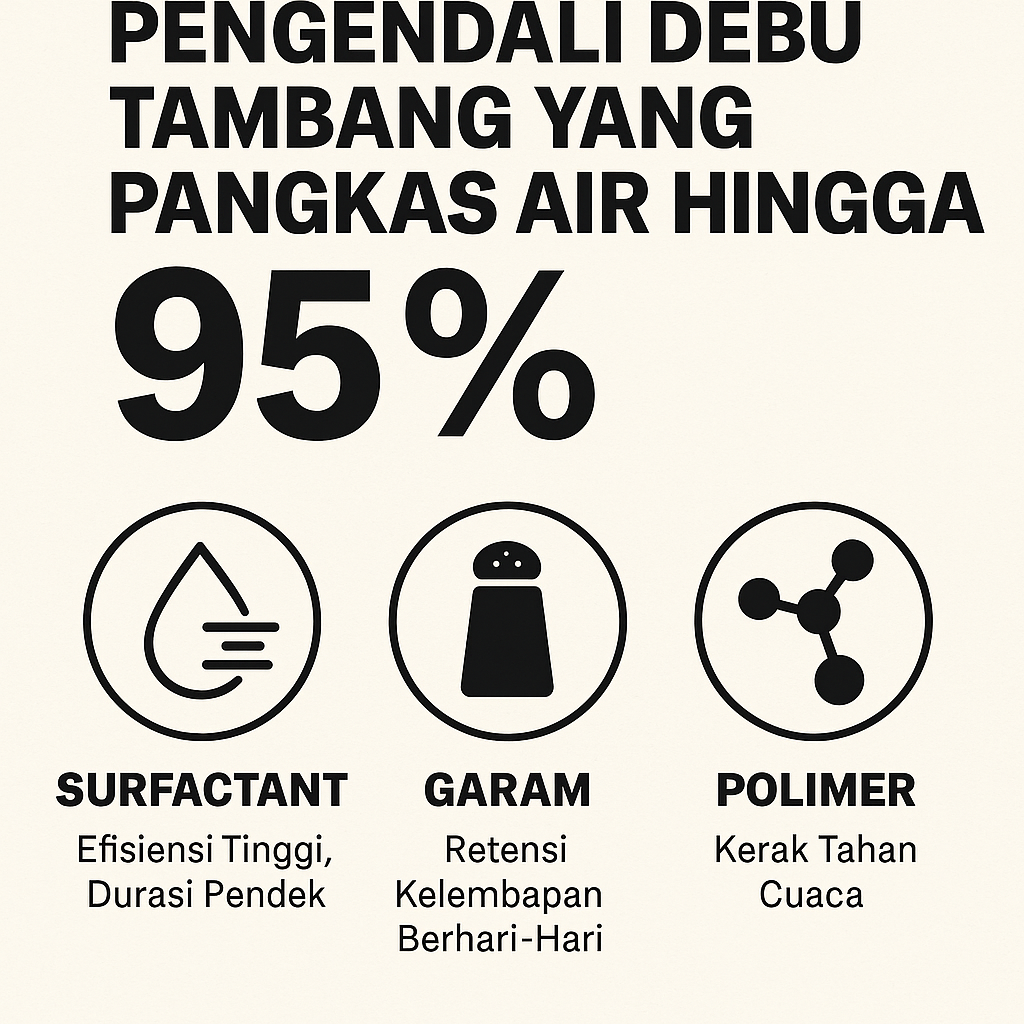
Water use reduction: Surfactants speed wetting but still require frequent spraying; they might cut water usage by roughly 30–50% per cubic meter of dust suppressed, reflecting the ~40% gain in efficiency (researchgate.net). Hygroscopic salts extend a wet surface for weeks, slashing watering frequency by ~85–95% (one brine per 1–4 weeks versus daily) (envirotacinc.com). Polymers cut water needs the most, with up to 85–95% less water used (envirotacinc.com), saving hundreds to thousands of megaliters per year on large sites (cypherenvironmental.com) (cypherenvironmental.com).
Application frequency: Water-only control often means multiple sprays per day in arid conditions. With surfactants, intervals remain on the order of hours. With MgCl₂ brine, one application can last 1–4 weeks, so watering may drop to weekly or monthly (envirotacinc.com). With polymers, a single coat can last months (cypherenvironmental.com).
Dust suppression efficiency: Surfactant-treated sprays reach ~80–95% reduction (researchgate.net). Chloride salts deliver roughly 70–85% PM reduction during their effective life (envirotacinc.com). Polymers typically achieve ~75–90% on poorly consolidated dust, often measured as 75–95% reduction (envirotacinc.com) (globalroadtechnology.com).
Cost considerations: Surfactants add only cents per cubic meter of water. Salts are moderately priced (~$200–$500/ton is the broader range cited for chlorides; MgCl₂ ~$300–$500/ton FYI) and a single treatment costs less than daily watering’s fuel+labor. Polymers are pricier per volume, but fuel and labor for water trucks often dominate: raw water can be ~US$0.40/m³ in Australia, while truck fuel may be 5–10× that (cypherenvironmental.com) (cypherenvironmental.com). Cutting truck runs by 85–95% can outweigh higher material cost, and multiple analyses note net savings over time (globalroadtechnology.com) (globalroadtechnology.com).
Environmental and regulatory factors
Surfactants — especially biodegradable formulations — generally have low residual risk, but any additive in runoff must meet discharge standards. Chloride salts can violate land/vegetation and water-quality rules due to corrosion and toxicity; some jurisdictions limit chloride use (e.g., California de‑icing bans) (link.springer.com) (envirotacinc.com). Polymer products vary: some polysaccharides or lignin biodegrade, while acrylics are often non‑toxic but persistent. Indonesian rules on ambient dust reinforce adoption of any approach that lowers PM for worker safety (greenchem.co.id).
Vendors serving mines typically bundle dust suppressants with broader portfolios; some operators fold procurement into a complete range of chemicals for mining strategy, alongside supporting water and wastewater chemicals where site runoff treatment is in scope.
Program design and mixed strategies
Because mechanisms differ — surfactants improve wetting; salts maintain moisture; polymers immobilize fines — mines often pilot to quantify local savings. A mixed strategy can be optimal: a surfactant‑laced MgCl₂ solution, or a polymer emulsion with a humectant (envirotacinc.com) (globalroadtechnology.com). For haul roads specifically, standardizing product choice via a hauling road dust suppressant can simplify intervals and compliance.
Bottom line
Compared to plain water, surfactants deliver ~40% higher capture (with ~30–40% water savings) at minimal cost (researchgate.net). MgCl₂/CaCl₂ brines suppress 70–80% of PM for weeks (often halving or better the number of needed waterings) (envirotacinc.com) (globalroadtechnology.com). Polymer films last months and often save 85–95% of water (envirotacinc.com) (envirotacinc.com). On cost, the biggest lever is fewer truck passes — fuel and labor often dwarf raw water — and the chemistry pays back by cutting application frequency.
Sources: Peer‑reviewed reviews and experiments on dust suppression (researchgate.net) (link.springer.com) (link.springer.com) (envirotacinc.com) (globalroadtechnology.com), industry case studies and technical reports (globalroadtechnology.com) (envirotacinc.com) (envirotacinc.com) (globalroadtechnology.com), and Indonesian regulatory guidelines (greenchem.co.id). (All citations given inline.)