

Industry: Coal_Mining | Process: Extraction
Rather than chase drainage after it forms, the most effective AMD (acid mine drainage) management begins early by controlling waste composition and pH in situ. Modern mine planning uses Acid/Base Accounting (AP/NP — an assessment of acid potential versus neutralization potential) to classify waste rock as “potentially acid-forming” (PAF) or non‑acid‑forming/buffer (NAF). Proven practice is to segregate PAF rock and encapsulate it within or beneath NAF material, so that the latter’s alkalinity neutralizes any acid as it forms (mineclosure.gtk.fi) (www.ausimm.com).
At Freeport’s Grasberg mine (Papua, Indonesia) overburden is 70% PAF and 30% limestone (www.ausimm.com). Grasberg established trial waste dumps blending PAF and limestone: they found that well‑mixed dumps developed carbonate “armouring” on sulfides that slowed oxidation so effectively that limestone alkalinity eventually exceeded acid generation. The result was near‑neutral, low‑metal drainage from the blended piles (www.ausimm.com). By contrast, sections dumped by truck (with poor mixing) showed stratification and persistent acidity during the 4‑year trial (www.researchgate.net) (www.researchgate.net).
Well‑engineered mixing or encapsulation of PAF waste within NAF layers (or even placing PAF inside a mined‑out pit with water cover) can greatly delay or eliminate AMD. Studies show that passing acidic pore water through a thick NP‑rich layer dramatically attenuates contaminants — one column test reported that “concentrations of most soluble constituents in the neutralized pore water were attenuated or mitigated to low values” as acid seeped through alkaline tailings (www.gardguide.com).
Waste characterization and selective handling
Selective handling has large cost benefits. Geochemical resource modeling (block‑by‑block) can shrink the volume of PAF waste needing special management, cutting long‑term monitoring and treatment costs (www.srk.com) (www.srk.com). For example, SRK Consulting helped a Nevada mine build a waste‑rock model that identified only the small fraction of blocks likely to generate ARD, allowing those to be separately managed. The clean majority could then be reused in mine construction, and “substantially reduced the overall cost” of AMD monitoring and disposal (www.srk.com) (www.srk.com).
In contrast, reactive remediation after AMD is costly: one Indonesian review notes that small mines typically do nothing but dump O₂‑exposed waste and later “neutralize with lime,” whereas large operators now favor integrated mining–geochemical plans (www.researchgate.net).
Encapsulation design and carbonate cover
A key tactic is to lay down or pile NAF waste (or other alkaline material) as a cap or liner on PAF zones. The Global Acid Rock Drainage (GARD) guide describes the “encapsulation” method (waste rock inside alkaline cover) as placing sulfide‑bearing rock “inside acid‑consuming materials, such as alkaline waste rock, soils or synthetic liners” (mineclosure.gtk.fi). Typically, a base layer of carbonate‑rich waste is built, then PAF material is placed above or within it, then capped with more NAF waste (or engineered cover). This physically isolates sulfides and supplies alkalinity as water percolates.
A classic case was at Pamour Mine (Timmins, Canada), where historic sulfidic tailings were re‑deposited on a high‑carbonate tailings stack and covered with additional carbonate tailings. Laboratory columns showed that as acidic water migrated through that carbonate layer, pH quickly rebounded and metals precipitated — essentially filtering the acid. In fact, the “pore water was mitigated to low values” for most metals by the time it emerged (www.gardguide.com). Field monitoring confirmed that encapsulation greatly reduced acidic leachate. The MEND report on Pamour concluded that enough NP was present to consume all acidity, so drainage concentrations were very low (www.gardguide.com).
In other mines around the world, similar concepts have succeeded. In Australia a sulfidic tailings dam was re‑covered with limestone‑rich sands as part of a “wet cover” design (consistent with INAP/MEND guidelines). In some projects engineers even place NAF liner layers beneath PAF waste (“limestone liners”) to neutralize any seepage from below (mineclosure.gtk.fi).
Alkaline layers and industrial by‑products
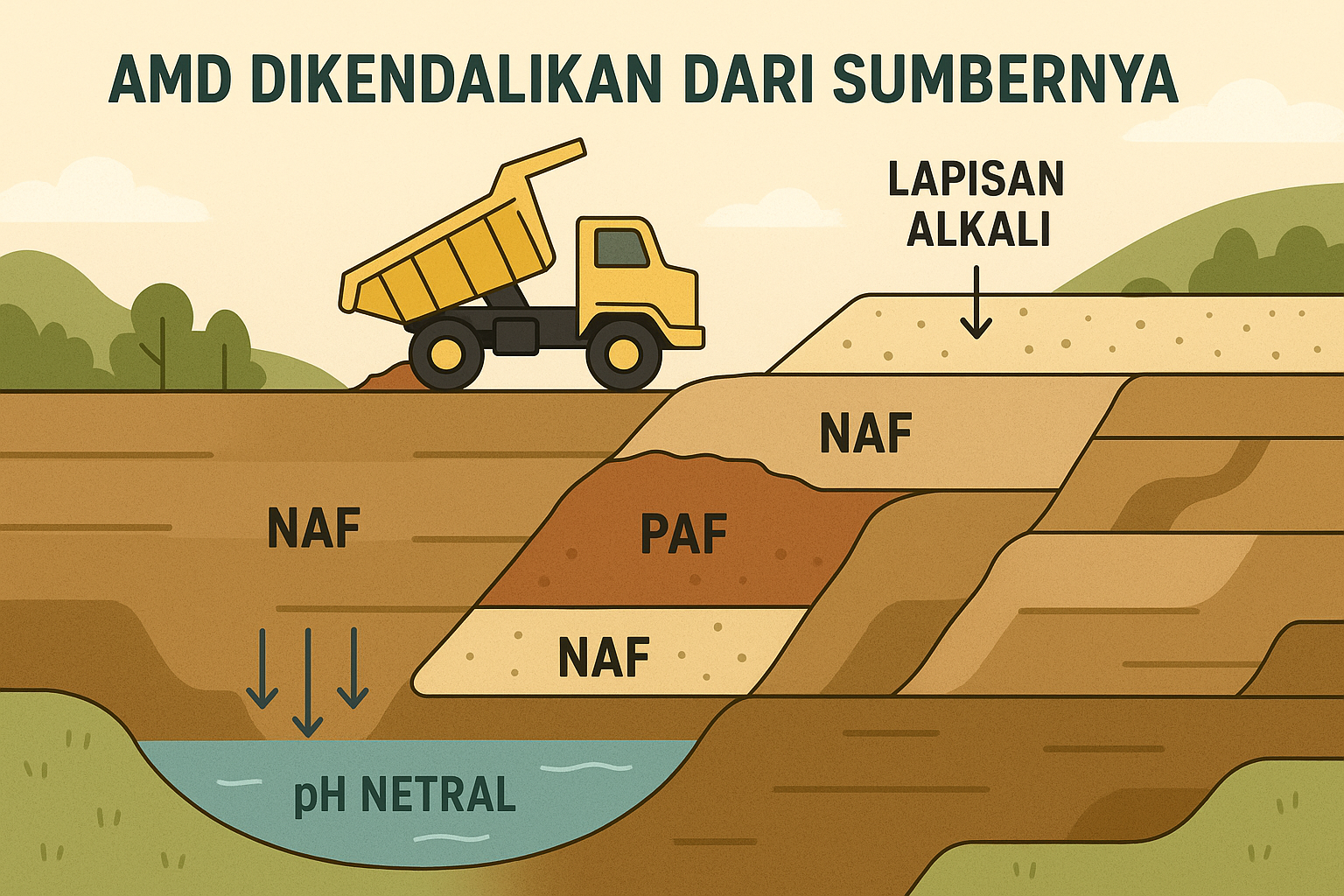
More broadly, any alkaline material can be used to neutralize acid at formation. Crushed limestone is common, but so are industrial by‑products. Authoritative guides note that “if waste materials are expected to generate acid, alkaline materials that have a neutralizing effect can be utilized above or below the acid‑producing waste as part of a waste deposit cover or liner” (mineclosure.gtk.fi). Typical additives are crushed carbonate rock, quicklime (CaO), or high‑pH mine tailings. Fly ash or slag (with elevated CaO/Na₂O) have even been trialed as cost‑saving alternatives. In Indonesia, for example, researchers examined covering coal waste with fly ash (FABA); the high pH of ash buffered infiltration water, raising the pH markedly.
Worldwide experience shows this can work if designed correctly. In a near‑equatorial coal‑mine study, waste rock columns with a fly‑ash cover saw leachate pH rise from ~2 up to ~7 over time (pmc.ncbi.nlm.nih.gov) (levels at which most metals precipitate). Conductivity and metal concentrations fell in parallel. By contrast, simply blending ash into waste gave an immediate pH boost (up to ~3–6) but tended to stabilize around pH 4–5 after secondary acid minerals formed (pmc.ncbi.nlm.nih.gov). In practical terms, this means a dense alkaline cap can gradually “clean up” drainage, whereas poor blending may only partly offset acidity. Field and lab trials at Grasberg showed that blending PAF with limestone can achieve neutral effluent, but only if all size fractions are adequately buffered by excess carbonate (www.ausimm.com).
Chemical treatments of this kind sit squarely in mining chemistry; alkaline materials such as crushed limestone and quicklime are part of chemicals for mining and water applications (chemicals for mining).
Operational dosing and cost comparisons
Alkaline treatment also applies during operations. Many coal mines dose reactive pits and seeps with lime slurry or alkaline ash. For example, a South African study found that high‑ash “waste coal” itself has a significant neutralizing capacity — samples with ~2.3% CaCO₃ content neutralized up to 2,112 L of acid water per tonne of coal (www.scielo.org.za). In one economic comparison, neutralizing 1,750 m³/day of AMD required 1.4 m³ coal per tonne acid; using waste coal instead of purchased lime cut projected operating cost from R24M to R9M (roughly 60% savings) (www.scielo.org.za). This highlights that even coal refuses can be repurposed to passively treat runoff.
Where chemical dosing is undertaken at pits or seeps, accurate chemical dosing is required for consistent pH control (dosing pump).
Design cautions: NP limits and passivation
Studies also warn not to rely solely on thin limestone caps under heavy acid load. MEND (Canada) found that simple crushed‑limestone covers could be overwhelmed by acid infiltration if not refreshed or well‑engineered (mineclosure.gtk.fi). If a high acidity flux punches through the cover’s pore space, it can exhaust the limited NP before neutralizing all acidity. Effective designs may instead blend or layer materials: e.g., mixing carbonate rock uniformly into the waste, or sandwiching PAF waste between multiple alkaline layers or water covers (mineclosure.gtk.fi). The GARD guidelines note that adding too little NP is risky, and that basally placed limestone can “passivate” over years, so one should err on the side of excess NP and include drainage controls (mineclosure.gtk.fi).
Performance outcomes and AMD volumes
In practice, well‑managed source control can dramatically reduce AMD. Grasberg’s optimized dumps produced essentially neutral, low‑metal drainage (www.ausimm.com). The fly‑ash column studies achieved similar alkalinity: under a stable cover the coal effluent reached circumneutral pH (~7) with minimal metal content (pmc.ncbi.nlm.nih.gov). Encapsulation trials (like Pamour) likewise showed nearly full acid neutralization in situ (www.gardguide.com). Large‑scale mine operators report that ignoring PAF segregation often leads to prohibitively expensive acid treatment later. One mining consultancy notes that characterizing and separating PAF units in advance “allows the company to put in place appropriate preventative measures” and has “substantially reduced” long‑term costs (www.srk.com) (www.srk.com).
To quantify: in South African coalfields (for example), ~6 million tonnes/year of waste rock are generated, yielding ~50–60 megalitres/day of AMD (www.scielo.org.za). If conventional treatment (lime) were used, the cost is on the order of tens of millions of Rand annually (www.scielo.org.za). By contrast, simple measures — e.g., burying the same waste under a shale or limestone cap, or mixing in only a few percent alkaline additive — can often raise pH by several units. Indonesian mine trials (e.g., a leach‑cell test of a limestone cover) showed clear gains: the covered waste’s leachate pH rose by 2–3 units versus uncovered waste (www.researchgate.net). Ultimately, each site’s gains depend on its AP/NP balance, climate, and operations, but the global experience is clear: source‑side CRMANAGEMENT cuts AMD risk. Even modest increases in NP/pH at the pile translate to large reductions in cumulative acidity, as shown by columns that neutralize hundreds of litres of AMD per tonne of alkaline waste (www.scielo.org.za).
Bottom line and source notes
In summary, the data strongly favor proactive handling. Strategic segregation and encapsulation of sulfidic wastes “greatly reduce the volume of waste rock that requires special handling” (www.srk.com), while the judicious use of alkaline covers or blends can drive drained pH into the neutral range (pmc.ncbi.nlm.nih.gov) (www.ausimm.com). These measures offer measurable outcomes — neutral pH, minimal trace metals — long before expensive water treatment is needed. Mines planning for AMD can thus treat prevention as a design objective: for example, by earmarking nearby limestone stockpiles for cover, using benign tailings for encapsulation, or even reusing alkaline coal ash. The trend in industry is clear: early AMD control through waste classification and neutralizing layers is far cheaper and more reliable than end‑of‑pipe fixes.
References: Key sources include Thorn and colleagues’ industry reviews (mineclosure.gtk.fi) (mineclosure.gtk.fi), case studies from major mines (Grasberg (www.ausimm.com) (www.ausimm.com)), AMD guides (GARD, MEND (mineclosure.gtk.fi) (www.gardguide.com)), and recent research on alkaline amendments (pmc.ncbi.nlm.nih.gov) (www.scielo.org.za) (www.scielo.org.za). Additional Indonesian context and regulations are discussed in Iskandar et al. (www.researchgate.net), and industrial experience in SRK consulting reports (www.srk.com) (www.srk.com). These collectively show that segregating PAF rock and applying limestone/fly‑ash covers reliably raises pH and cuts metal release by orders of magnitude.