

Industry: Coal_Mining | Process: Extraction
Water trucks still rule the pit. But the physics of evaporation and coal’s natural hydrophobicity (water-repelling behavior) are catching up with a decades-old playbook. Studies find plain water sprays knock down some dust clouds immediately, only for levels to rebound within minutes or hours unless reapplication is constant (link.springer.com).
By contrast, chemical dust suppressants—binders, hygroscopic (moisture-attracting) salts, and polymers—are extending control through shifts and weather cycles. And underground, a quieter revolution has been proven for decades: water infusion into the coal seam, which raises in-situ moisture so less dust is generated when coal is cut at the face.
Water sprays on roads and transfers
Water sprinkling is the traditional baseline for controlling coal dust on haul roads and material transfer points. In practice, water is delivered via bowsers (water trucks) or fixed spray bars to wet road surfaces and conveyor drops. It is “easy to operate,” but effectiveness is limited by rapid evaporation and coal’s hydrophobicity (link.springer.com).
Field results underline the ceiling. One experiment found conventional sprays captured only 23–82% of respirable dust (mean ~45%) and required constant water flow (www.911metallurgist.com). Another reported that combining side (bottom) sprays on a continuous miner (a coal cutting machine) cut cutting-face dust by ~61%, whereas top sprays alone achieved only ~13% on average (www.911metallurgist.com).
Short-lived gains and operating costs
NIOSH found ~20–60% dust reduction on mining faces with optimally placed sprays (www.911metallurgist.com). For haul roads and transfers, water alone often yields a transient decline that rebounds unless trucks continuously drive and re-wet the surface. Without additives, capture efficiency can barely exceed ~50% on a well-covered section.
There’s also the sheer volume of water—and money. Mines may run multiple trucks for hours a day, straining reserves. An Australian case noted “the high expense of running water trucks” and even “potential need to purchase additional trucks” to meet targets (globalroadtechnology.com). Trucks become ineffective if sources run low or roads turn muddy.
Transfer point spray curtains and fogging
At conveyor-crusher drop points, targeted water spray curtains or enclosures capture a portion of rising dust, but performance falls off once droplets evaporate. Some operators now use high-pressure fogging to reach fine dust. One Indonesian mine reports a fogging system that generates ultra-fine mist droplets capable of binding PM2.5 (~0.25 μm) particles, keeping those submicron dust clouds from dispersing (money.kompas.com). PM2.5 and PM10 (particulate matter with aerodynamic diameters ≤2.5 micrometers and ≤10 micrometers) drive health risk because particles are small enough to penetrate deep into the lungs. Fogging can significantly improve capture of very small dust, but requires compressed air and efficient droplet formation, and yields no permanent surface binding.
Chemical dust suppressants on roads and stockpiles
Chemical suppressants enhance control by binding particles or retaining moisture. Common additives include hygroscopic salts (e.g., CaCl₂, MgCl₂), lignosulfonates (paper-industry byproducts), polymers (e.g., polyacrylamide, acrylics), and other tackifiers or surfactants. These agents coat particles (increasing cohesion) and/or draw water from air (hygroscopy) to keep surfaces damp. In haul road practice, chemicals are either mixed into water sprays or applied to a scarified roadbed and allowed to cure into a surface crust. In this category, mines commonly evaluate chemical dust suppressants and dedicated haul road dust suppressants as part of routine control programs.
Moisture retention and longer coverage
Lab work backs up the field lore. A 0.1 wt% solution of guar-gum grafted polyacrylamide (GG-g-PAM) raised a coal-dust sample’s moisture retention by ~13–25% over 8 hours at 25–45 °C versus water alone, and dust generation after application was cut by 32–65% compared to spraying only water (www.researchgate.net). In practical terms, polymer-treated roads can remain effective for days or weeks instead of hours; industry reports claim polymer additives on water trucks extended control 4–5 times longer than plain water (globalroadtechnology.com).
Measured reductions in PM10
Wind-tunnel and field trials show single applications can slash PM₁₀ (particles ≤10 μm) well over 50% on unpaved roads. Treating a desert haul road with a hydrous MgCl₂ (brine) solution kept PM₁₀ orders of magnitude lower than water-only in gusty conditions (www.researchgate.net). Other tests found 63% reduction with a calcium lignosulfonate solution and 53% with tree-resin oil compared to an untreated road (www.researchgate.net). Water-based polyethylene glycol and poloxamer formulas cut PM₁₀ by ~44% and 66% relative to water-sprayed conditions (www.researchgate.net). In sum, many chemical treatments deliver half to two-thirds less airborne dust than water alone—and up to ~90% initial control under ideal application.
Case study and water savings
At a Central Queensland coal site (Hall Creek), an engineered polymer (“Haul-Loc”) cut water use by ~50% while extending suppression duration by 400–500%, compared to plain water (globalroadtechnology.com). Over a year this yielded a +250% increase in treated area and over US$1.2 million saved per haul truck (globalroadtechnology.com).
Environmental and health trade-offs
Hygroscopic salts (CaCl₂, MgCl₂) are very effective (they can even re-absorb ambient moisture), but they corrode steel and can leach into soil or waterways. Lignosulfonates and bio-polymers are generally biodegradable and less damaging, but more expensive. Regulatory agencies (e.g., EPA advisories) note that some synthetic suppressants can contain heavy metals or interfere with soil chemistry. In Indonesia, companies generally choose food-grade or approved substances; RMK Energy in Sumatra reports using a generic “chemical cold dust suppressant” mixed with water on stockpiles (money.kompas.com). Chemical programs are commonly supplied as part of broader chemicals for mining applications.
Water infusion before underground cutting
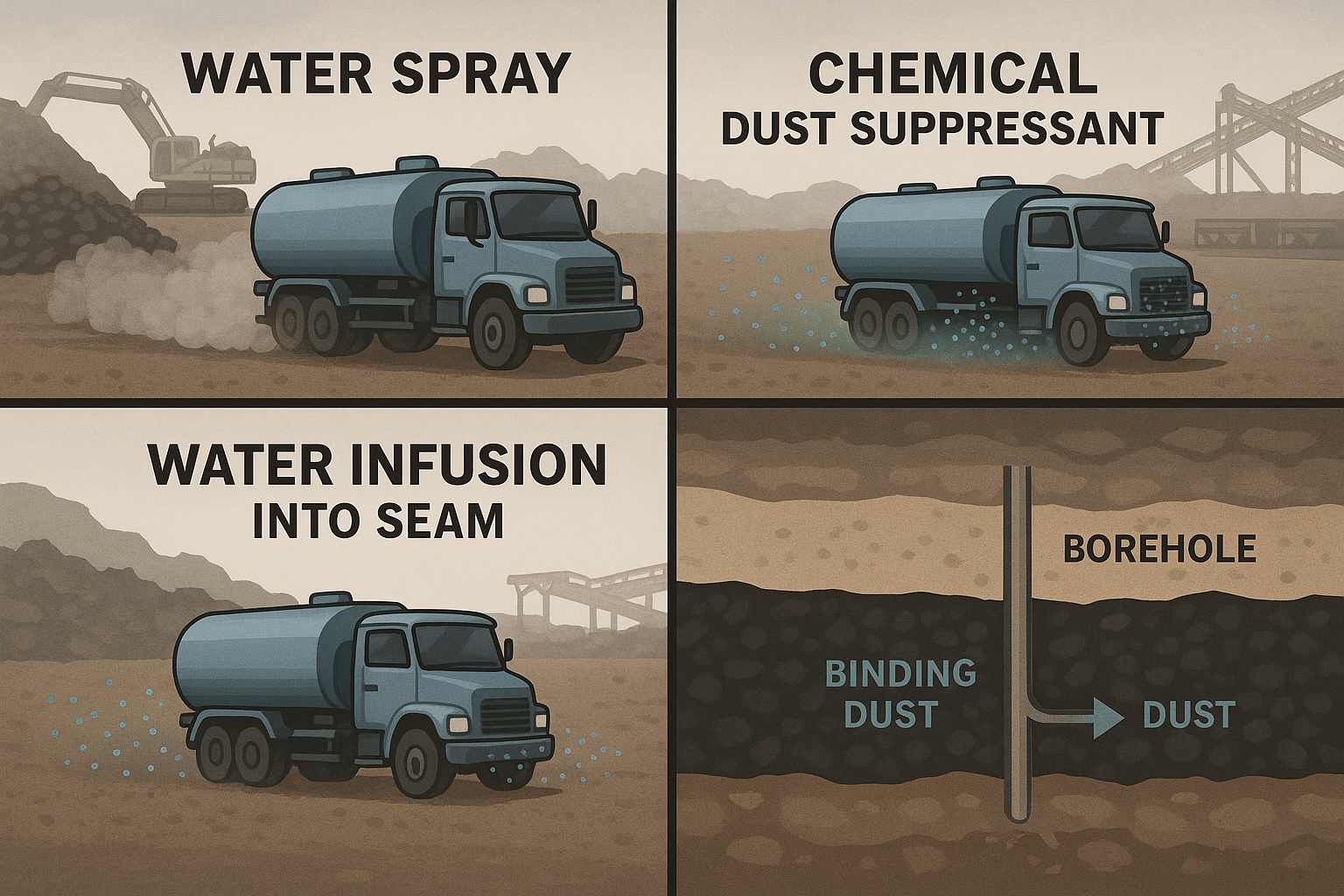
Water infusion (injection of water into the coal seam ahead of excavation) raises the in-situ moisture of coal and suppresses dust generation at the source. Developed in European and Chinese underground mines, injecting tens of liters per cubic meter of coal has proven effective in trials. Specialized boreholes (often the same as methane drainage holes) and high-pressure pumps or seals are used so water permeates the seam; surfactants or wetting agents are often mixed in to spread into coal pores rather than channeling away.
Field practice injecting 9–15 L of water per m³ of coal—raising moisture by ~1%—achieved 40–65% reduction in respirable dust during mining (link.springer.com). In a classic Australian trial (Appin/West Cliff mines, 1980s), seam infusion halved dust exposures by ~30–50% relative to dry conditions (link.springer.com). These reductions are sustained during active cutting, unlike surface sprays.
Infusion limits and current practice
Infusion is only practical in underground mining. It requires drilling and pumping infrastructure and can slow operations if not integrated carefully. Modern coalfaces often have water sprays and ventilation, so some operators view infusion as redundant. Over-wetting a seam can cause roof instability or require extra dewatering. For these reasons, infusion fell out of favor in many Australian mines. It remains common in China and was standard in Europe for decades (ro.uow.edu.au; link.springer.com).
Recent research refines the method: adding surfactants significantly increases coal’s affinity for water, improving moisture uptake; China’s coal institutes have developed “compound wetting agents.” Typical parameters (borehole spacing, water volume, pressure) are being optimized to balance moisture gain against groundwater depth.
Road sprays versus chemical programs
Water sprays on roads provide maybe tens of percent instantaneous reduction—∼20–50% in many trials (www.911metallurgist.com; www.911metallurgist.com)—but lose effect within hours. Chemical treatments deliver much greater reductions (often ≥60% PM₁₀ abatement) and last days; e.g., a lignosulfonate road stabilizer can cut PM₁₀ by ~60% beyond what water achieves (www.researchgate.net). Business implication: water alone requires high operational cost (fuel, trucks, man-hours) and copious supply; chemicals cost more per use but save on water truck runs. In water-scarce settings, supplementing sprays with a hygroscopic polymer can halve water use (globalroadtechnology.com).
Transfer points and fine dust capture
Transfer points rely on targeted sprays or containment. High-pressure fog systems may combine both approaches—atomizing a water-based chemical mixture to capture both coarse and fine dust. Since transfer points often handle wet coal, water sprays can be very effective at cryogenically cooling and wetting; adding a non-foaming surfactant ensures fines adhere. Though no hard figures exist for every scenario, practice shows >80% visible dust control is achievable with a well-designed spray curtain.
Cost, sustainability, and compliance
Water sprays mean low capital but high operating cost and water consumption. Chemical suppressants bring higher product cost but far lower application frequency; polymer adjuvants can cut total water use by ~50% (globalroadtechnology.com). Chemicals can incur environmental handling requirements. Mines must balance added material cost against reduced truck and labor costs—one case doubled the treated area per week and saved over US$1M per truck annually (globalroadtechnology.com). Indonesian mining regulations require minimizing ambient dust; numeric limits mirror international standards (e.g., MSHA’s 2 mg/m³ TLV, or threshold limit value, for coal dust). Indonesian operators often adopt both water and chemical controls; RMK Energy uses a combined water + chemical spray on stockpiles (money.kompas.com).
Emerging methods and the bottom line
Newer “environmentally friendly” suppressants (based on starch, lignin, or bio-polymers) are being tested to avoid toxic residues. Sensor-driven smart spraying and electrostatic applicators are on the horizon. Water infusion research continues in coal geology circles, though it remains niche.
For open-pit mines, a layered approach is clear: use water sprays or cannons at haul roads and crushers for immediate knock-down, then supplement with longer-lived chemical additives on critical surfaces. This combination reduces pumping costs and keeps control in place. If underground mining is considered, water infusion can be evaluated as an additional upstream method with expected ~40–60% dust cuts (link.springer.com). Data from controlled experiments and field trials align: chemical/topically applied suppressants consistently add another large-margin reduction over water alone (www.researchgate.net; www.researchgate.net).
Sources and references
Sources: Peer-reviewed studies and technical reports (link.springer.com) (www.researchgate.net) (www.researchgate.net) (link.springer.com) inform this guide, along with industry cases (globalroadtechnology.com) (money.kompas.com) and regulatory context. The cited figures come from controlled experiments and real-world trials of dust-control technologies in mining and related fields. Each source is cited above by section (【…†L…】).
References: Zhang et al. (2019) Coal Seam Water Infusion for Dust Control: A Technical Review, Environ. Sci. Pollut. Res. 26(5):4537-4554 (ro.uow.edu.au); Zhang et al. (2018) Applications of Water Infusion for Dust Control, Proc. 11th Int. Mine Vent. Cong. (link.springer.com); Zhang et al. (2025) A Review of Water-based Suppressants for Coal Dust (Int. J. Coal Sci. Technol. 12:47) (link.springer.com) (link.springer.com); Kashi et al. (2022) Coal Mine Haul Road Dust Suppression using Guar-Gum Polyacrylamide, J. Mines, Metals & Fuels 70(5):242 (www.researchgate.net); Katra (2019) Comparison of Diverse Dust Control Products…, Applied Sciences 9(23):5204 (www.researchgate.net); Reed & Organiscak (2017) Haul Road Dust Control, NIOSH report (www.researchgate.net); Adams (2021) Dust Suppression in Central Queensland Coal Mining, Global Road Technol. (industry report) (globalroadtechnology.com) (globalroadtechnology.com); Safitri & Sukmana (2024) Cara RMK Energy Turunkan Intensitas Debu (Kompas.com) (money.kompas.com).