
Landfill leachate can carry ammoniacal nitrogen in the hundreds to thousands of mg/L, but Indonesia’s receiving-water limit effectively sits at ≈2 mg/L. Two “polishing” contenders—breakpoint chlorination and ammonia-selective ion exchange—promise compliance, with starkly different cost and risk profiles.
Ammonia in final effluent must typically be driven to a few mg/L. In Indonesia, Government Regulation No.82/2001 effectively limits ammoniacal‑N (ammoniacal nitrogen) to ≈2 mg/L in receiving waters (researchgate.net). Because landfill leachate often starts at hundreds–thousands mg/L NH₄–N (ammonium as nitrogen), “polishing” stages must knock ammonia down by >90% to meet discharge or reuse targets.
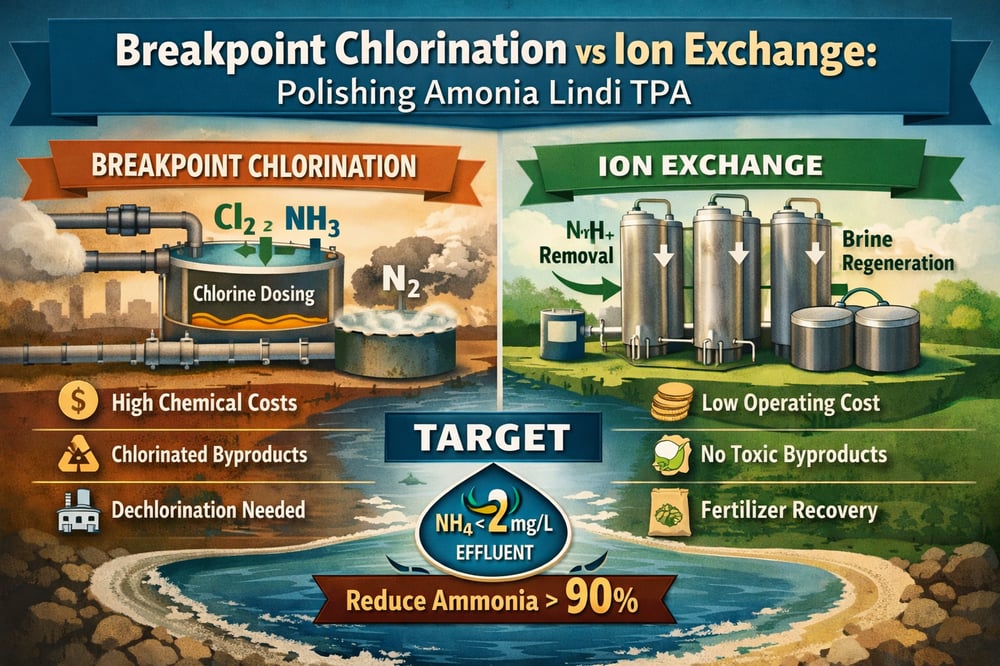
Two technologies dominate late-stage removal: chemical destruction via breakpoint chlorination and physical removal via ion exchange. Both can achieve very low residuals; their economics and environmental side effects diverge.
Breakpoint chlorination: chemistry and dosing
Breakpoint chlorination is a chemical oxidation process that adds chlorine (Cl₂, as gas or hypochlorite) until chloramine intermediates are destroyed and nitrogen gas (N₂) forms. At neutral pH, the sequence is: NH₃ + Cl₂ → NH₂Cl + Cl⁻ + H⁺ (monochloramine), then formation of dichloramine (NHCl₂) and trichloramine (NCl₃); beyond the “breakpoint,” chloramines are oxidized to primarily N₂, with small amounts of nitrate produced (drdarrinlew.us) (pcb.illinois.gov).
Designers typically target a chlorine-to-ammonia‑N mass ratio of ~7–10:1 (stoichiometric ~5:1; in practice ~8–10:1, with ≈9:1 cited in one reference) to ensure the breakpoint is achieved and a free chlorine residual appears, signaling ammonia consumption (pcb.illinois.gov) (pcb.illinois.gov) (pcb.illinois.gov). Accurate chemical feed is therefore central; plants commonly employ dosing pumps for chlorine and caustic (sodium hydroxide) addition.
Performance and footprint (chlorination)
Correctly operated, breakpoint chlorination can remove essentially all ammonia, achieving effluent well below 1–2 mg/L. The end-products are “primarily nitrogen gas, secondarily nitrate” (pcb.illinois.gov). The hardware is compact—often the simplest option to retrofit into existing plants—centering on a chlorine contact basin and feeds; one source calls it “the simplest of the alternatives in terms of operation and equipment” (pcb.illinois.gov).
In one design for a 300 MGD plant (influent 15 mg/L NH₃), a 20‑minute contact tank was sized at ≈9,700 gallons (pcb.illinois.gov). Where clarification precedes or follows, equipment analogous to a clarifier may be in the capital scope, as cited in one engineering estimate.
Chlorination costs and by-products
Chlorine demand is high: for each mg/L of NH₃–N, about 7.6–10 mg/L of Cl₂ is consumed. For example, 40 mg/L NH₃–N requires roughly 300–400 mg/L Cl₂. At typical bulk prices (~$400–$500 per tonne of Cl₂, or ~$0.40–0.50/kg), chlorine alone can cost ~$0.12–0.20 per m³ of effluent (300–400 mg/L × $0.00040–0.00050 per mg) (climate-policy-watcher.org).
One estimate cites chlorine-chemical cost ≈$0.14/m³ for 25–40 mg/L NH₃–N removal (climate-policy-watcher.org). In an EPA design case (15 mg/L NH₃), chlorine (135 mg/L Cl₂) cost ~4.2¢ per 1,000 gallons (≈$0.010/L or $0.013/m³), although that assumed a low chlorine price ($75/ton in 1973) (nepis.epa.gov). Modern commodity costs (≈$400/ton) are ~5× higher. The reaction generates acid, so strong alkalinity (NaOH or lime) is needed; in one design 10,850 lb/day of caustic was required (pcb.illinois.gov).
Residual chlorine must then be removed to avoid toxicity, typically with SO₂ or bisulfite (pcb.illinois.gov) (pcb.illinois.gov); packaged dechlorination agents are typically dosed just ahead of discharge. Capital cost is mainly the feed system, pumps, and contact basin; one engineering analysis estimated about $1.4M capital (feed equipment, tanks, clarifier) for breakpoint chlorination, with annualized cost ~$3.64M/year (pcb.illinois.gov). For context, an EPA study (1973) showed well under $0.10/m³ total for 15 mg/L ammonia (nepis.epa.gov), while contemporary designs report ~$0.30–0.50/m³ or higher for 25–40 mg/L removal (climate-policy-watcher.org).
By-products are the major drawback. Organic matter chlorinated in complex wastewaters forms halogenated compounds (e.g., AOX, THMs) that persist even after dechlorination: “Chlorine as well as chlorinated organic by-products are generally toxic to fish and aquatic biota even at low concentrations” (pcb.illinois.gov). Regulators often discourage chlorinating such streams. Energy and labor are modest (mixing uses minor power) (nepis.epa.gov), but chemical O&M dominates.
Ammonia-selective ion exchange: mechanism and capacity
Ion exchange (IX) uses charged polymer beads (resins) to swap ions in water; strong‑acid cation resins in sodium or hydrogen form preferentially exchange NH₄⁺ (ammonium) at specific sites. Systems use two or more packed columns in parallel: one treats wastewater as another regenerates with brine, then they switch. Specialized resins offer high ammonium capacity (lenntech.com). Typical capacities are on the order of 1–2 equivalents per liter; one commercial strong‑acid cation resin has ~2.0 meq/mL (~28 g NH₄‑N per liter of resin).
IX can achieve very low effluent NH₄⁺, often <1 mg/L when regeneration is timed before breakthrough. It is particularly effective for polishing modest influent loads (<50 mg/L NH₄). As a rule of thumb, ~1 m³ of resin can exchange roughly 28 kg of nitrogen per full cycle (theoretical); in practice, capacity is lower due to kinetics and fouling. For continuous polishing trains, modular ion exchange systems and dedicated ammonia-selective resins are configured to match flow and regeneration intervals.
Ion exchange cost profile and equipment
Resin is the main inventory cost. Standard cation resins range from ~$40–200 per cubic foot (≈$1.40–7.00 per liter), while specialty high‑capacity resins typically run $500–2,000 per cubic foot (samcotech.com) (samcotech.com). Example: treating 1,000 m³/day at 20 mg/L NH₄‑N is a 20 kg N/day load. At ~28 g/L capacity per cycle, ~714 L resin (≈25 ft³) removes the daily load assuming one cycle per day. At ~$1,000/ft³, resin cost is ~25,000; resins are reusable for years (life often 3–5 years or more, depending on water quality).
Regeneration uses a few bed‑volumes of 5–10% NaCl brine; one EPA study found that reusing brine (0.10–0.17 lb NaCl/gal at pH 11.5) cost ~$0.042 per 1,000 gal for 20 mg/L NH₄‑N (~$0.01/m³) (nepis.epa.gov). If outsourcing, regeneration service can add ~$40–100 per ft³ of resin per cycle; eventual spent resin disposal is ~$50–100/ton for non‑hazardous material (samcotech.com) (samcotech.com).
Equipment cost for complete IX installations (tanks, piping, controls) is on the order of $100k–$300k (samcotech.com). One report cites $172,700/year amortized capital for a 10 MGD ammonia IX plant; for example, construction of a 10 MGD IX plant was ~$1.98M (with annual capital recovery ~$172k) (iwaponline.com). Operating costs are dominated by salt and light pumping energy; NaCl is relatively inexpensive (~$200–300/ton). Across cases, per‑cubic‑meter costs (amortized over resin life) span ~$0.01–0.05/m³ for low NH₃ levels, with one analysis showing regeneration chemicals ($7.6/kg salt) contributing only ~$0.000042/gal for 20 mg/L NH₄ (nepis.epa.gov).
Resource recovery is a differentiator: spent regenerant, rich in NH₄Cl, is often treated further or used as fertilizer, and ammonium can be captured (e.g., as struvite) to monetize nutrients (researchgate.net). A large‑plant economic analysis (Smith‑Wu, 2020) put whole‑life IEX nitrogen removal at ~$1.98±0.23 per kg‑N (researchgate.net).
Operational caveats and pretreatment
IX resins can foul when exposed to high organics or heavy metals, reducing effective capacity. Pretreatment—such as fine solids removal using a cartridge filter and adsorptive organics polishing with activated carbon—is often deployed ahead of the columns when leachate is challenging. Spent brine management is required; the ammonium‑loaded rinse is typically treated further or repurposed as liquid fertilizer.
Head‑to‑head: efficiency, OPEX, and environmental footprint
Ammonia removal efficiency is high for both (>90–99%). Breakpoint chlorination can reduce NH₄ to near‑zero in one step, but it requires precise control to reach breakpoint. Ion exchange quantitatively strips ammonia until resin exhaustion, keeping effluent near zero with appropriate regeneration timing.
Footprint and ease diverge. Breakpoint typically needs only a chlorination basin (tens of minutes detention) and dosing system, a straightforward retrofit (pcb.illinois.gov). IX requires multiple packed columns and brine tanks, delivered as modular skids. Chlorination’s ongoing chemical OPEX is substantial—commonly ~$0.10–0.50/m³ for 25–40 mg/L removal, with additional caustic and dechlorination costs (climate-policy-watcher.org) (nepis.epa.gov). IX’s salt‑driven OPEX is comparatively small (~$0.01–0.05/m³), with costs concentrated in resin amortization and routine regeneration (nepis.epa.gov).
Environmental considerations are decisive for many operators. Chlorination of organic‑rich effluents can form toxic halogenated by‑products (AOX, THMs) that persist even after dechlorination (pcb.illinois.gov)—a key reason regulators often discourage this route for complex waste streams. IX avoids generating new toxic compounds; its “waste” is ammonium‑rich brine with potential nutrient value.
Bottom line for landfill polishing (Indonesia context)
Both technologies can achieve Indonesia’s ≈2 mg/L ammoniacal‑N target for final effluent (researchgate.net). But the cost‑benefit calculus favors ion exchange for final polishing: regeneration costs on the order of ~$0.01–0.05/m³, nutrient recovery potential, and no halogenated by‑products (nepis.epa.gov) (researchgate.net). Breakpoint chlorination retains advantages where space is extremely limited and immediate NH₃ destruction is paramount, and it is straightforward to retrofit, but high chemical/O&M costs (often dominated by chlorine, caustic, and dechlorination) and toxic by‑product risks are significant (pcb.illinois.gov) (climate-policy-watcher.org).
Source notes and references
Regulatory context and landfill leachate ammonia: researchgate.net. Breakpoint chlorination chemistry, ratios, contact/operation, costs, and by‑products: drdarrinlew.us; pcb.illinois.gov; pcb.illinois.gov; pcb.illinois.gov; nepis.epa.gov; climate-policy-watcher.org; pcb.illinois.gov; pcb.illinois.gov; pcb.illinois.gov. Ion exchange capacities, costs, and regeneration: lenntech.com; samcotech.com; samcotech.com; nepis.epa.gov; samcotech.com; samcotech.com; samcotech.com; iwaponline.com; researchgate.net; researchgate.net.
