

Industry: Desalination | Process: Pre
Biofouling—the growth of microbes (bacteria, algae, fungi) and their extracellular products on surfaces—remains the industry’s chronic headache. One study found normalized seawater reverse osmosis (SWRO) flux fell ~40% over 7 years despite routine cleaning (researchgate.net). That’s why multilayer pretreatment—coagulation, flocculation, media filtration, ultrafiltration/microfiltration—has become the first line of control.
Coagulation–flocculation can floc out algal cells and dissolved organic polymers so less organic load reaches reverse osmosis (RO). Granular-media pretreatment can remove 48–90% of algal cells, while modern membrane UF/MF prefilters routinely remove >99% (researchgate.net). In heavy-bloom waters, dissolved‑air flotation (DAF) is often added upstream to float and remove algal cells with minimal rupture (waterworld.com).
Coagulant dosing (e.g., ferric chloride or alum) is critical: “coagulation … removes AOM [algal organic matter] more effectively than [filtration] alone,” so less algal-derived matter reaches SWRO (waterworld.com). Measured outcomes confirm this: pre‑DAF or UF plants report >75% algal/biopolymer reduction (researchgate.net), whereas systems lacking coagulation see severe fouling during blooms. In short, robust pretreatment (with adequate coagulant and, for intense blooms, DAF) is the first line of biofouling control.
Layered coagulation–filtration pretreatment
Plants that rely on coagulation–flocculation upstream of filters report more stable RO operation because algal cells and biopolymers are captured before they reach the membranes. In heavy-bloom waters, DAF upstream of media filters minimizes cell rupture and eases downstream loads (waterworld.com).
Ultrafiltration/microfiltration (UF/MF) units routinely remove >99% of algal cells in pretreatment pilots and plants (researchgate.net). Where UF is selected as pretreatment to RO, suppliers provide compact skids for drinking water or surface-water duties; for example, operators deploy ultrafiltration ahead of SWRO to stabilize SDI and biopolymer loads.
Granular-media trains rely on coagulant capture of fine particulates and organics that raw filters or UF alone cannot handle. Plants routinely specify coagulants to improve particle aggregation, and dual-media filters with sand/silica media to remove 5–10 micron particles.
For algal events, many facilities add dissolved air flotation before media filters so intact cells can be floated off, protecting downstream UF and RO from fragile-cell lysis products (waterworld.com).
Chlorine biocide programs: continuous and shock dosing
A continuous or shock-dose chlorine program is the industry standard biocide for seawater pretreatment. In practice, many RO intakes maintain a low residual (e.g., 0.2–0.5 mg/L free Cl₂) continuously, especially when chlorine‑tolerant cellulose triacetate (CTA) membranes are used. CTA membranes are of inherently lower flux than polyamide (PA) membranes but can safely withstand free chlorine (researchgate.net).
Most large SWRO plants in the Middle East (high‑temp, high‑biofouling booms) use CTA elements and continuous chlorination (researchgate.net) (researchgate.net). Yet even under continuous chlorination, CTA RO elements still develop biofilm; chlorine often fails to reach all parts of the membrane module (especially when fibers clog), so some bacteria persist (researchgate.net).
Continuous exposure can select for “disinfection‑resistant” strains; lab and field data document chlorination can enrich certain bacteria, changing community structure (researchgate.net). In one pilot, chlorination increased the membrane fouling potential by shifting microbes to a more robust, thinner‑but‑stickier EPS‑rich biofilm (researchgate.net) (researchgate.net). In summary, continuous chlorination is simple and common, but it will not fully eliminate biofouling.
To mitigate microbial adaptation, many plants apply periodic shock chlorination—high‑dose NaOCl (on the order of 3–5 mg/L as Cl₂) pulsed a few times per week rather than daily (researchgate.net) (researchgate.net). Studies recommend only 1–3×/week on a semi‑random schedule (rather than a fixed daily time) to avoid predictability (researchgate.net). Because microbes readily “learn” a predictable sterilization pattern, a random shock schedule has been found more effective at suppressing regrowth.
Field and lab evidence suggest periodic chlorination pulses can briefly halt fouling, but operators weigh risks: shock doses can lyse cells, releasing intracellular organics that raise assimilable organic carbon (AOC) and fuel downstream biofouling if not promptly removed. One harmful‑algal‑bloom (HAB) guidance notes that avoiding chlorination during a bloom “will help prevent downstream fouling, as fouling AOM will be retained intracellularly … and less assimilable organic carbon is generated” (waterworld.com).
Where automated chemical programs are installed, operators often specify an accurate dosing pump to manage low‑residual continuous chlorination and schedule shock pulses on a semi‑random cadence.
Mandatory dechlorination immediately before RO
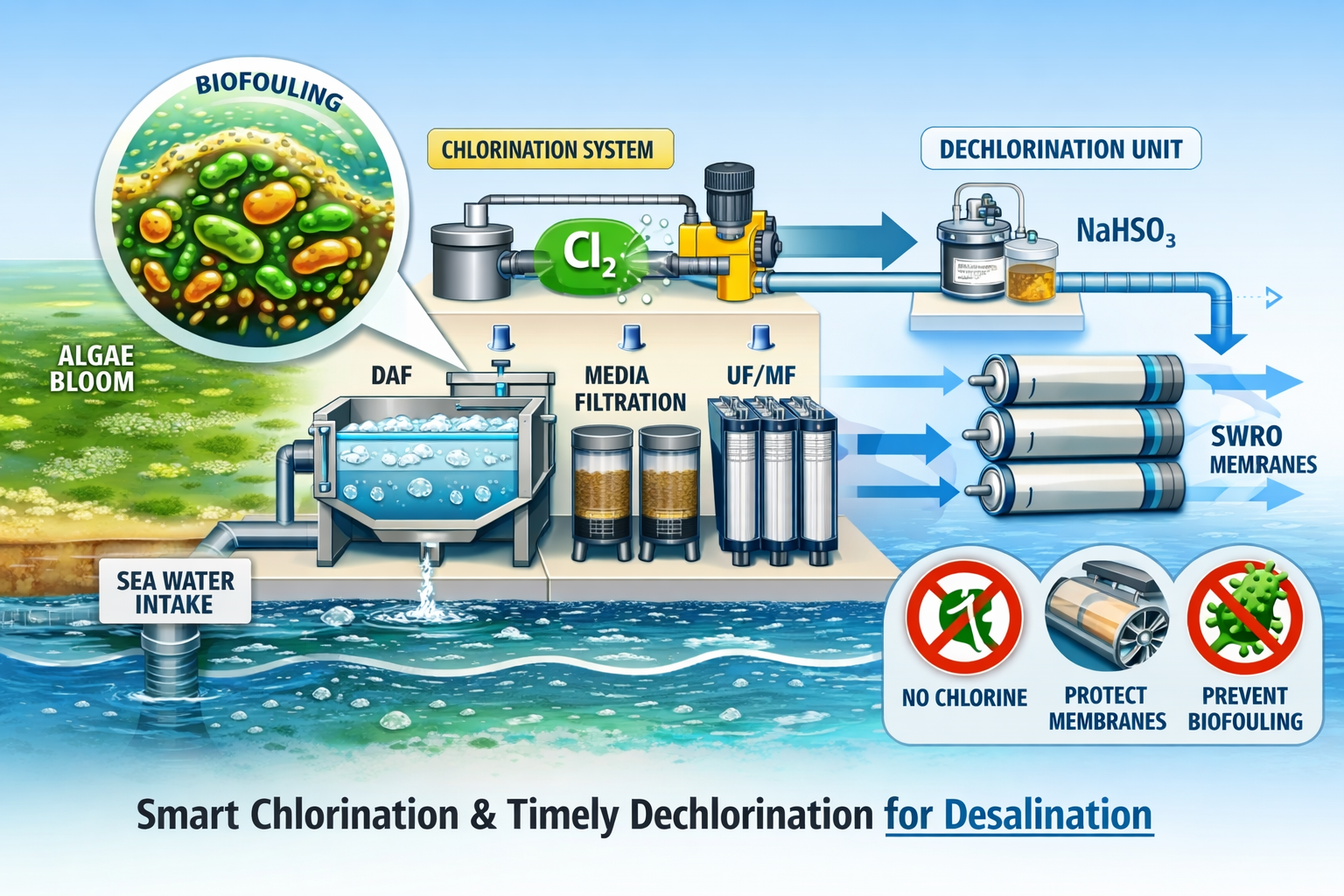
All residual chlorine must be removed before feedwater enters polyamide (PA) RO. Polyamide membranes are chemically incompatible with oxidants; free chlorine irreversibly attacks the amide bonds and degrades the polymer matrix (pubs.acs.org). By contrast, only CTA membranes tolerate chlorine. A guideline explicitly states, “Any [composite polyamide] RO elements may not be exposed to chlorinated water under any circumstances… If there is any doubt, perform chemical testing. Neutralize any chlorine residual with a sodium bisulfite solution” (kh.aquaenergyexpo.com) (mdpi.com).
In practice, a sodium bisulfite (Na₂S₂O₅) or metabisulfite feed is installed immediately upstream of the RO trains. Sodium bisulfite reacts stoichiometrically with bleach: in theory 1.34 mg Na₂S₂O₅ removes 1.00 mg Cl₂, but in practice a safety factor of ~2–3× is used to ensure full removal (researchgate.net). Studies recommend ~2–3 mg bisulfite per 1 mg chlorine (researchgate.net).
Proper mixing time and monitoring are required so that the free‑chlorine residual at the RO inlet is essentially zero; if any chlorine survives, it will “cause permanent damage of the polyamide structure” (researchgate.net). Many operators specify a dedicated dechlorination agent immediately before the RO skids.
For facilities built around seawater RO trains, the dechlorination safeguard is non‑negotiable; vendors of SWRO systems and integrated membrane systems routinely include upstream dechlorination interlocks in their designs.
Pretreatment during seasonal algal blooms
Seasonal algal blooms (HABs) can spike biomass and organic content. In the 2008–09 Cochlodinium bloom in the Arabian/Sea of Oman, conventional pretreatment (single‑stage dual‑media filtration with ferric coagulation) was overwhelmed: plants experienced weeks/months of shutdown, and one reported 100% RO membrane replacement (waterworld.com). Thermal plants (multistage flash) often ran with little issue, underscoring SWRO sensitivity in blooms.
Global experts report HAB impacts are rising with climate change and nutrient inputs; such blooms are becoming more frequent and intense worldwide (waterworld.com). A multi‑barrier response is used:
- Monitoring & early warning: Chlorophyll or algae sensors at the intake and even satellite monitoring of coastal hotspots can provide early warning for preemptive measures.
- Flexible operations: In looming blooms, operators often curtail production or shut down RO to avoid irreversible fouling; continuous monitoring of intake solids and transmembrane pressures helps decision‑making (waterworld.com).
- Enhanced pretreatment: Raise coagulant dose and add DAF upstream, since DAF captures intact algal cells by buoyancy and minimizes cell rupture (waterworld.com). Cartridge or multigrade filters (DMF) should be backwashed more frequently. UF membranes can be run at reduced flux or with more frequent clean‑in‑place cycles; case studies recommend combining DAF+UF in heavy bloom season (e.g., by bypassing one path through DAF) (waterworld.com). Overall, “less AOM in the pretreated water will help to alleviate SWRO fouling” (waterworld.com).
- Chlorination caution: During blooms it may help to avoid adding chlorine at the intake; oxidation can lyse cells and release AOC. Guidance notes that avoiding chlorination during a bloom “will help prevent downstream fouling” (waterworld.com). In practice, if a bloom is present, operators often switch off chlorine dosing and instead add dechlorination immediately, to keep cells intact for mechanical removal in coagulation/DAF.
For filter trains that include cartridges, operators often specify a separate cartridge filter stage so fine particulates are captured ahead of RO during bloom periods.
Even with these steps, intense blooms can force extended outages: the 2008–09 Gulf bloom led to SWRO shutdowns for 4 months in some cases (waterworld.com). Designing for bloom resilience—extra pretreatment capacity, parallel trains, standby ultrafiltration units—has become prudent in algal‑prone locations.
Regulatory context and performance metrics
Any chlorination regimen must respect water‑quality rules. Indonesian drinking‑water standards (Permenkes 492/2010) limit trihalomethanes to 100 µg/L (water.co.id). Although this applies to finished potable water, it underscores the need to minimize excess chlorine in the process. Indonesian projects (e.g., planned Balikpapan seawater desalination, ~120 L/s) will need to comply with Ministry of Health clean‑water criteria and environmental discharge permits; in practice operators track both chlorine residuals and DBP levels in product water and/or discharge.
Data‑driven best practice is to combine physical–chemical pretreatment with tailored chlorination: effective coagulation/filtration, continuous or intermittent high‑dose chlorine to suppress biomass, and immediate sodium‑bisulfite dechlorination before RO. Key performance metrics include maintaining raw‑water fouling indicators such as silt density index, bacterial counts or ATP below target thresholds; monitoring normalized RO flux and triggering cleaning at >10% decline (kh.aquaenergyexpo.com); and ensuring no detectable free chlorine at the RO feed.
As outcomes are quantified—log reductions of algae, flux decline rates, frequency of CIP, and differential‑pressure trends—doses can be adjusted. For instance, if biofilm indicators rise, oxidant pulses or coagulant dose are increased. Plants that invest in pretreatment hardware and spares—including membrane systems upstream and supporting consumables—often standardize on ancillary equipment for monitoring and control.
Sources and supporting studies
Authoritative desalination reviews and industry guides (peer‑reviewed and technical) were used. Studies document algae‑removal efficiencies and chlorination effects (researchgate.net) (researchgate.net) (researchgate.net); desalination case histories report biofouling outages (e.g., 2008 Gulf bloom) (waterworld.com); WHO/health standards (Permenkes 492/2010) provide THM limits (water.co.id); and guidelines explicitly prescribe bisulfite dechlorination before RO (mdpi.com) (researchgate.net). All figures and practices above are drawn from these sources.