

Industry: Semiconductor | Process: Chemical_Mechanical_Planarization_(CMP)
Scratch counts that jump on a wafer even when removal rate barely changes. Pads thrown out with more than half their usable life left. Endpoints missed by seconds that still translate into measurable erosion. In Chemical Mechanical Planarization (CMP)—a polishing step that planarizes layers using slurry abrasives and a rotating pad—small deviations cascade into yield loss.
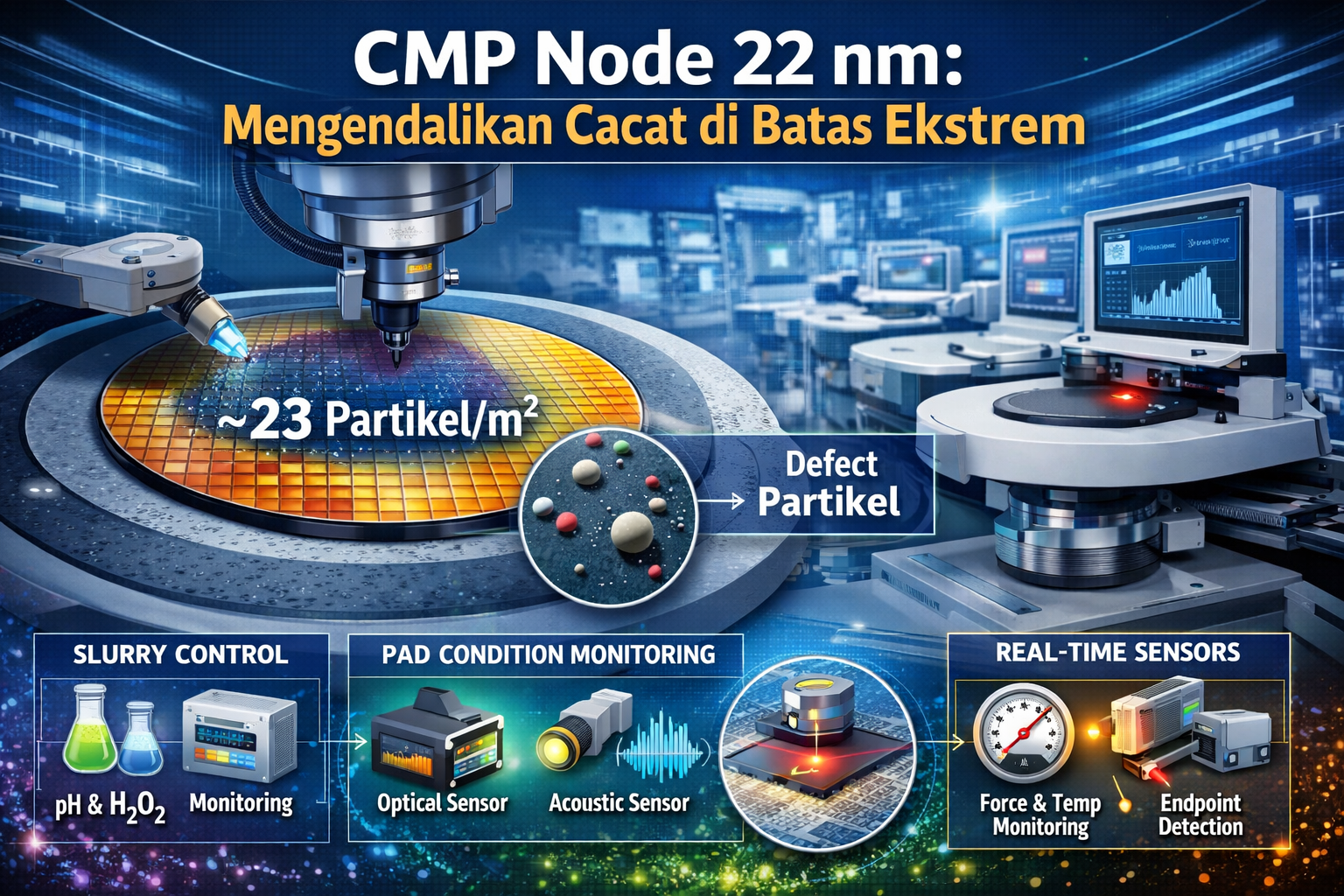
Advanced nodes leave almost no margin. For 22 nm and below it is estimated that only ~23 random particles per m² of wafer can be tolerated (researchgate.net). That is driving fabs toward tight control of slurry chemistry, pad properties, and process parameters—backed by sensors that detect and correct drift in real time.
Slurry chemistry control and particle distribution
In CMP, the slurry—a liquid compound containing abrasives, oxidizers, pH buffers, and additives—sets both removal and defectivity. Small deviations in abrasive behavior or oxidizer concentration shift material removal rate (MRR) and particle interactions dramatically (ci-semi.com) (ci-semi.com).
Particle size matters. Park et al. showed that increasing large colloidal silica agglomerates (0.5–5 μm) sharply raised wafer scratch counts while leaving removal almost unchanged (researchgate.net) (researchgate.net). Abrasive type matters too: irregular fumed silica produced the highest removal but also the most scratches versus rounded colloidal silica, while ceria abrasives showed a higher tendency to scratch oxide despite similar hardness to silica (researchgate.net) (researchgate.net).
The fix starts upstream: narrow abrasive specs and in‑line filtration to remove agglomerates. Park et al. reported that filtering out large particles noticeably reduced scratch density (researchgate.net). Many lines deploy in‑line cartridge filters for exactly this duty. Where chemical compatibility and cleanliness are paramount, 316L housings such as stainless‑steel cartridge housings are commonly selected.
Oxidizer levels (e.g., %H₂O₂ in copper slurries) and pH drift during use, so industry practice is to continuously monitor and control them—tools may titrate or use UV/IR/NIR sensors to keep H₂O₂ at spec (ci-semi.com). Accurate dosing hardware, such as an industrial dosing pump, helps hold oxidizer and additive set‑points.
Additives matter at the interface. Park et al. recommend tuning surfactants or chelants by measuring particle–wafer adhesion to minimize particle attachment and defect “pick‑up” (researchgate.net). To police slurry “health,” fabs instrument line analytics for large‑particle count (LPC), mean particle size, slurry density, solids content, and viscosity in real time (semiconductorinsight.com) (ci-semi.com). Industry reports note that large‑particle control alone commands ~38% of the slurry‑monitoring market, reflecting its outsized impact on defectivity (semiconductorinsight.com).
With virtually no particulate headroom at leading nodes (again, ~23 random particles per m²), modern slurry monitors—often with AI prediction—track oxidizer slumps or impurity spikes and can trigger refresh or tool interventions automatically (ci-semi.com) (semiconductorinsight.com). Tight slurry control has yielded measurable wins: shops report that stabilizing H₂O₂ levels and filtering agglomerates can reduce scratch counts by tens of percent while preserving MRR (researchgate.net) (researchgate.net). Neglecting additive decay or abrasive degradation, by contrast, quickly spikes wafer‑level defects.
Pad properties and conditioning mechanics
Pad hardness, porosity, and wear state set how slurry reaches the wafer and how forces concentrate. Hard pads tend to increase removal—and the risk of scratches—while very soft pads can promote dishing on large features. Pads whose mechanical properties drift with heat or pressure destabilize MRR; Khanna et al. showed that minimizing pad storage‑modulus change (resistance to thermal softening) stabilized removal and planarization efficiency over long polishes (iopscience.iop.org).
Even the pad can scratch. Kim et al. modeled pad‑asperity plowing and found scratches surge when a “scratching index” exceeds ~0.33; low‑hardness metals (Al, Cu) saw far more pad‑induced scratches than hard films (iopscience.iop.org). Matching pad choice to film stack—special nitride pads, softer formulations—reduces pad‑induced damage.
Conditioning keeps the pad open but can become a defect source. In‑situ diamond dressing that is too aggressive sheds large debris; Park et al. flagged dried slurry residues and loose diamond fragments as severe scratch offenders, with debris size increasing under aggressive conditioning (researchgate.net) (researchgate.net).
That has pushed fabs to instrument the pad. In‑situ pad integrity monitors—optical immersion “profilometers”—check roughness and pore occlusion during wafer exchanges. One in‑situ system (Sensofar S mart 2) found pads were often discarded with more than 50% of life unused; monitoring helped use pads to the end of life and avoid early discard (sensofar.com) (sensofar.com). Early glazing detection—using optical or acoustic pad sensors—prevents flat‑topped pads from creating hillocks or non‑uniform pressure distributions.
Mechanical parameters and Preston’s scaling
MRR scales with pressure and speed. A modified Preston relationship gives MRR ∝ P^0.83·V^0.5, so pushing downforce or platen speed increases removal with diminishing returns (sciencedirect.com). Higher downforce (>0.2–0.3 psi) boosts MRR but raises frictional stress and contact area; fragile low‑k layers risk cracks or subsurface damage, and metal leads can see edge guttering. Too low, and dishing or non‑planarity dominates.
Speed settings matter too. Higher rpm increases abrasive engagement but can sling slurry outward, starving the center. Most tools decouple wafer‑carrier and platen rpm and add wafer sweep patterns; mis‑tuning induces periodic scratches (banding, harmonics) or non‑uniform gyration. Engineers co‑optimize pressure and speed to hit removal targets within defect limits; if ex‑situ metrology flags excessive within‑wafer non‑uniformity (WIWNU), recipes are adjusted (e.g., lower pressure or slower platen). Conditioning parameters—downforce on the dresser, angle, and timing—also couple in; inadequate conditioning leaves a glazed pad that prints wheel‑ring scratches onto the next wafer.
Fabs define a “defect window” in pressure/speed/flow space. Non‑contact endpoint detection helps shorten over‑polish time, avoiding prolonged high‑pressure exposure. Modeling or empirical trials set the Preston exponents per film stack; engineers then verify dishing/erosion versus specs the ITRS targeted to <40 nm at sub‑10 nm nodes (iopscience.iop.org). Even a few percent drift—say, a worn carrier pad or slightly low flow—can double defect rates, so tight calibration of force, speed, and slurry flow is mandatory.
In‑situ monitoring and real‑time correction
Slurry sensors: Inline analyzers track oxidizer (H₂O₂) and pH via UV/IR/NIR or automated titration to keep chemistry on target (ci-semi.com). Light‑scattering counters watch LPC in real time; if LPC or solids exceed thresholds, systems divert slurry through fresh filters or swap containers (semiconductorinsight.com). By maintaining slurry “health,” defect rates drop; industry sources call optimal slurry quality “vital” for yield and defect reduction (semiconductorinsight.com).
Mechanical sensors: Force/torque and pad‑temperature probes on the head provide real‑time shear and thermal feedback. Torque spikes can warn of pad glazing or abrasive clogging. Acoustic Emission (AE) sensors detect micro‑events at the interface; Helu et al. showed an AE‑based endpoint detector identified endpoint ~10 seconds earlier than a friction‑based approach, avoiding about 5% over‑polish (researchgate.net). Infrared or resistance sensors track pad temperature to flag lock‑up or heat spikes that can bake slurry or damage films.
Optical endpoint detectors: Laser interferometers or reflectometers scan during polish. A red‑laser (650 nm) scanner tracked polishing profiles and marked barrier/film endpoints via inflection in reflected signals; mapping the wafer also exposes non‑uniformity (mdpi.com) (mdpi.com). Optical methods are non‑contact and sensitive to thin‑film changes, overcoming friction or temperature signals that cannot see interior changes in real time (as noted in the same study).
Pad surface monitors: Immersed optical probes watch roughness and groove fill; if roughness dips below spec, tools trigger quick conditioning; if near‑fresh, they can skip conditioning to improve throughput. Sensofar reports pads are “largely under‑utilized and often discarded with more than half their useful lifetime still remaining,” a gap closed by in‑situ pad metrology (sensofar.com).
Data‑driven control: Anomaly‑detection algorithms now watch friction waveforms, pad temperature, and slurry metrics; tools adjust flow, pause polish, or change conditioning intervals when drift appears. Reports point to a rise in predictive maintenance across CMP fabs (semiconductorinsight.com). Leading CMP slurry‑monitor vendors (e.g., Entegris, Horiba) cite reduced wafer scrap as a payoff from real‑time monitoring.
Outcomes: In‑line slurry monitors tracking LPC and pH have allowed fabs to double slurry usage lifetime before hitting defect thresholds; correlating friction/AE to post‑CMP inspection helps predict scratch events and adjust downforce dynamically. Applying AE endpoints like Helu’s 2014 results saved a 5% over‑polish in one case (researchgate.net). Vendors estimate that thorough in‑situ CMP monitoring can cut defect density by tens of percent and lift yields by several points—critical when the allowable defect budget can be in the tens per square meter (researchgate.net) (semiconductorinsight.com).
Regulatory and environmental constraints (Indonesia)
In Indonesia, CMP slurries and rinse wastewater containing abrasive metals or other chemicals are classified as B3 (hazardous‑toxic) waste under Government Regulation 101/2014; the rule lays out waste listings, manifests, and storage requirements (enviliance.com). Non‑compliance is heavily penalized: producing B3 wastes without proper treatment can draw fines of Rp1–3 billion and up to 3 years’ imprisonment (enviliance.com).
That makes real‑time monitoring a compliance tool as much as a yield lever—flagging abnormal chemistry before discharge. Treatment steps typically include neutralization and filtration prior to release; primary systems for screens, oil removal, and other front‑end steps are available as wastewater physical separation modules.
Bottom line
Defects in CMP arise from a tight interplay between slurry composition, pad state, and mechanical settings. Studies and fab practice converge on the same prescription: hold slurry oxidizer/pH and abrasive distributions within narrow bands, monitor and condition pads to prevent debris and glazing, and keep pressure/speed inside a verified “defect window.” Instrumentation—oxidizer/LPC analytics (ci-semi.com) (semiconductorinsight.com), AE/torque sensing (researchgate.net), optical endpoints (mdpi.com)—turns that prescription into real‑time control.