

Industry: Semiconductor | Process: Fluoride_&_Heavy_Metal_Wastewater_Treatment
Semiconductor wastewater isn’t just dirty—it’s chemically complex. Fabs lean on aggressive chemistries (etchants, plating baths, CMP slurries) that load effluent with fluoride (from hydrofluoric acid, HF) and heavy metals like copper (Cu), nickel (Ni), arsenic (As), antimony (Sb), and tungsten (W). Etch and clean waters often carry arsenic and antimony alongside strong acids and solvents (mdpi.com). HF is especially prevalent—SF-sourced data show waste HF solutions account for >40% of hazardous chemicals generated by the fab (mdpi.com) (mdpi.com).
In practice, fluoride is usually removed by precipitation (forming calcium fluoride, CaF₂), and heavy metals by hydroxide/chemical flocculation; the resulting sludge is a mix of metal hydroxides, CaF₂, and fine silica (from CMP, chemical–mechanical polishing). Studies of semiconductor plant sludges report nano‑aggregates of SiO₂ and CaF₂ (pubmed.ncbi.nlm.nih.gov), which deflocculate into <100 nm particles if released—an acute hazard to water and health (pubmed.ncbi.nlm.nih.gov) (sciencedirect.com). Analyses of semicon‑impacted waters found tungsten at ~400 µg/L (over 4,000× natural background) in treated effluent and ~300 µg/g in downstream sediments (sciencedirect.com)—underscoring the heavy‑metal load that must be captured.
Chemical precipitation and settling
Precipitation and flocculation set the foundation for sludge management in these plants, with pH adjustment and polymers improving solids capture. Coagulant additions are routine in such circuits; many facilities standardize on reagents akin to those in coagulant programs to drive aggregation. For polymer make‑up and feed control, dosing hardware similar to a dosing pump helps maintain stable conditioning without overshoot (no added performance claims beyond this paper).
Once particles form, they are separated and thickened before dewatering. Settling steps can include basins designed along the lines of a clarifier, and compact installations often opt for inclined plates conceptually similar to a lamella settler (equipment references added here without introducing new performance data beyond the sources cited in this paper).
Filter press dewatering (batch)
A filter press (plate & frame or recessed‑plate) is a batch workhorse that produces very dry cakes after chemical conditioning. Typical final cake solids are 35–70% by weight (e.g., 35–50% for alum sludges, 40–70% for lime sludges) (nepis.epa.gov). One 8.5 ft³ press achieved ~25% DS (dry solids) from a 3% feed, driving an 8–10× volume reduction (nepis.epa.gov).
Cost impacts can be dramatic: pressing 100 gal/h of 3% solids (≈12 gal/h cake at 25%) cut annual disposal from ~$200,000 (no dewatering) to ~$39,000—an ~$161,000 (~80%) saving (nepis.epa.gov). At disposal rates of ~$0.43/gal, a 5 ft³ press (~0.15 m³) handling only 45 L/h (12 gal/h) of sludge delivered a 30% after‑tax ROI (return on investment) (nepis.epa.gov). Presses capture >95% of suspended solids and produce a relatively impervious cake, but they run in cycles (fill, press, discharge, cloth clean) and need more operator oversight.
Centrifuge dewatering (continuous)
A decanter/solid‑bowl centrifuge takes continuous feed into a fast‑spinning bowl with a screw conveyor, separating water from solids. With favorable sludge and conditioning, modern decanters can reach cake solids up to ~50% (sludgeprocessing.com); more typically, cakes range 20–35% DS (75–80% moisture). They offer high throughput, low labor (continuous discharge), and smaller footprint than presses, but consume more energy, often require pre‑thickening (they do not tolerate very low‑solids feeds), and may yield a plastic cake needing conveyors. Capture of suspended solids is typically >90%.
Belt filter press dewatering (continuous)
A belt filter press gravity‑thickens and then compresses sludge on moving porous belts. Cakes are usually lower in solids (~15–30% DS) (climate-policy-watcher.org). For instance, typical cakes are ~28% for primary sludge (range 26–32%) and ~15% for waste‑activated sludge (climate-policy-watcher.org). Belts run continuously with lower energy use and simpler mechanics but require polymer and produce looser cakes—meaning more bulk to haul, since 70–85% of the weight can still be water.
Chemical conditioning and aids
Across all systems, chemical conditioning (pH adjustment, polymers) improves solids capture and cake formation. Plants often specify polymer programs comparable to a flocculant package to tighten flocs ahead of pressing or centrifugation (no added claims beyond this paper’s scope). For incremental improvements to cake release and handling, operators may trial additives akin to a sludge treatment aid, especially where silica and calcium fluoride complicate dewatering. Granular or fibrous materials (e.g., silica, CaF₂) can hinder some equipment; pilot runs are advisable. Modern units may include cake washing or acid flushing to recover coagulant or neutralize hazardous constituents, further affecting sludge character.
Performance benchmarks and volume reduction
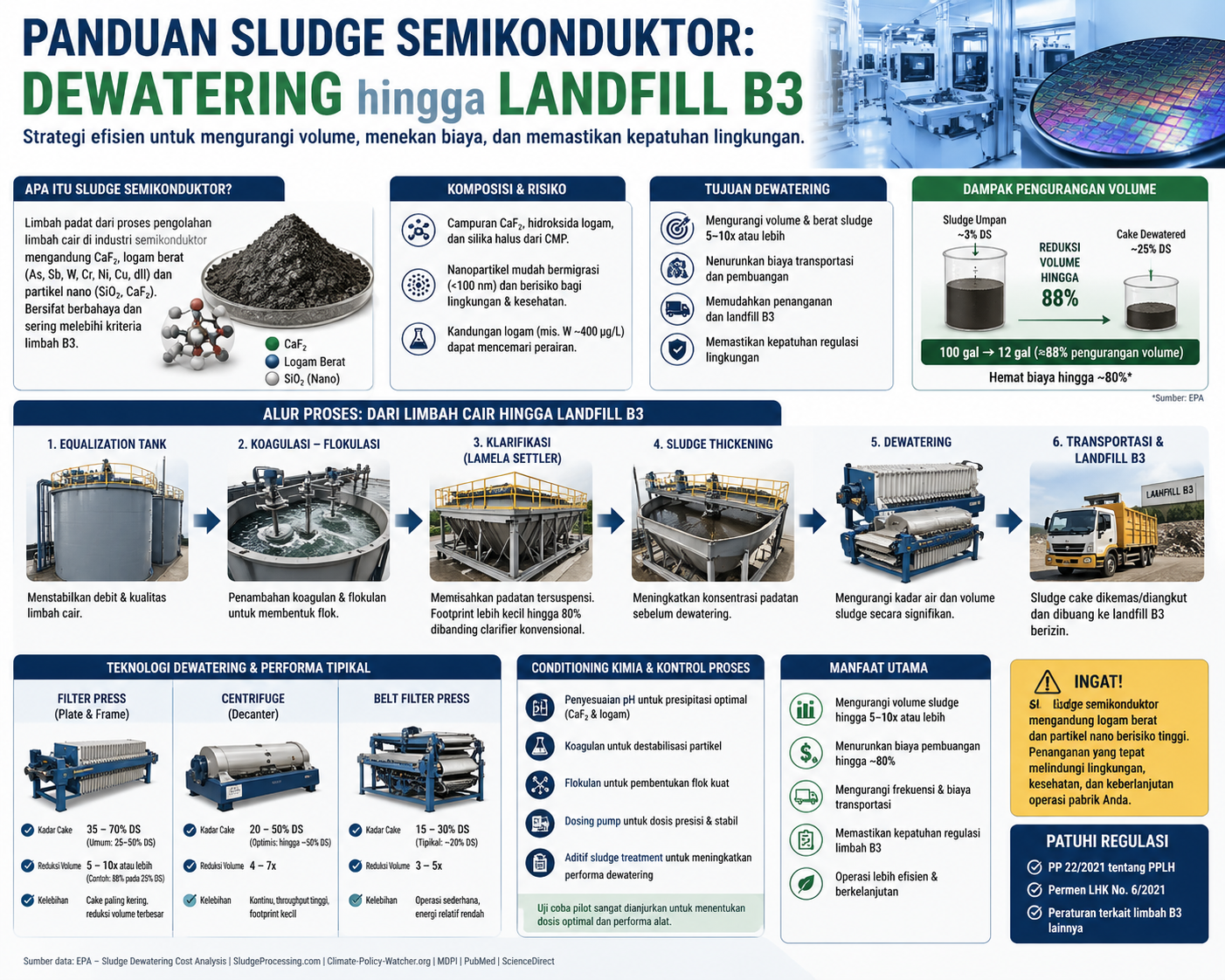
Filter presses deliver the driest cakes and largest volume reduction—e.g., >8× in practice (nepis.epa.gov). Centrifuges can approach similar dryness with automation (up to ~50% DS, sludgeprocessing.com) and fast throughput. Belt presses average ~20% DS (climate-policy-watcher.org), often yielding ~3× volume reduction. As a reference point, pressing 3% sludge to 25% yields ≈88% volume cut (100 → 12 gal) (nepis.epa.gov). In practice, many plants combine methods (e.g., thickening + centrifuge, or press plus pour‑off).
Disposal classification and routing
After dewatering, disposal hinges on sludge chemistry. Heavy metal/bromide sludge usually fails non‑hazardous criteria. In Indonesia, any sludge containing B3 (hazardous) contaminants—such as heavy metals or cyanides—is regulated as B3 waste. Under EPA‑like rules, heavy metals in sludge typically trigger classification (e.g., TCLP—Toxicity Characteristic Leaching Procedure—Cr, Pb, Ni above limits). Treated semiconductor sludge is generally considered hazardous. Untreated semicon sludges are “potentially hazardous” if dumped untreated (pubmed.ncbi.nlm.nih.gov), and their fine particles easily mobilize contaminants.
Residual sludge must go to a secured landfill for hazardous waste (Tempat Pembuangan Akhir B3). Permen LHK 6/2021 mandates that only processed (treated/stabilized) residue may be landfilled, and that landfills must have permits, impermeable liners, and groundwater monitoring (environesia.co.id). In practice, that means hauling dewatered filter‑cake to an approved B3 landfill; open dumping is illegal. (By contrast, truly inert/non‑hazard solids could be landfilled in non‑B3 sites, but heavy‑metal sludges rarely qualify.)
Waste volumes, costs, and ROI
Hazardous sludge disposal is expensive—often hundreds of USD/ton (nepis.epa.gov). Dewatering reduces volumes by 5–10×, cutting hauling and tipping fees dramatically. The earlier example—$200,000 to ~$39,000 per year with a filter press—illustrates the delta (nepis.epa.gov). Small plants also see strong returns: a 0.15 m³ press at 45 L/h yielded >30% ROI (nepis.epa.gov), so any plant paying >$0.20/L for sludge removal will benefit from dewatering (as stated in the source). For chemical cost control during conditioning, plants lean on metering systems analogous to a dosing pump to avoid waste and overdosing.
Recycling and thermal options
Innovative reuse can turn hazardous sludge into a resource. One route is cement incorporation: semiconductor sludge (rich in SiO₂ and CaF₂) can replace 5–20% of Portland cement in concrete (pubmed.ncbi.nlm.nih.gov). A 10% substitution increased 7–90 day mortar strength by 25–35%, with TCLP tests detecting no heavy metals leaching from the cured cement (pubmed.ncbi.nlm.nih.gov). The authors conclude that “semiconductor sludge can be used as a useful resource…avoiding [its] potential hazard” (pubmed.ncbi.nlm.nih.gov).
Thermal treatment (incineration or vitrification) is another option, but heavy metals concentrate in ash, which generally still requires landfill. In Indonesia there are few licensed hazardous‑waste incinerators (e.g., for medical or industrial wastes), so most semiconductor sludges go straight to landfills. If incinerated, off‑gases must be scrubbed and ash stabilized. Some facilities may co‑incinerate sludge as a fuel supplement (e.g., in cement kilns), but this risks fugitive emissions unless tightly controlled.
Compliance anchor and operating reality
Disposal pathways hinge on sludge analysis: stabilize/dryer → secure landfill for hazardous sludges, or reuse/incinerate + final landfill for stabilized residue. All approaches require strict compliance: Indonesia’s current regulations (Permen LHK 6/2021 and PP 101/2014) insist that B3 sludges be treated on‑site as much as possible and only residuals safely disposed (environesia.co.id) (pubmed.ncbi.nlm.nih.gov). Given escalating disposal costs and environmental risks, reducing sludge quantity (via dewatering) and finding beneficial uses (like cement) are the modern strategies supported by the data above.