

Industry: Semiconductor | Process: Chemical_Mechanical_Planarization_(CMP)
The global market for CMP slurry — the abrasive, chemistry-laden fluid that levels wafers — was valued at about $139 million in 2023 (USD), with projections to roughly $243 million by 2030 (CAGR ≈8.3%) (semiconductorinsight.com). Lee and Liu captured the waste side of the equation succinctly: “huge amounts of wastewater and sludge are generated” during CMP (researchgate.net).
Consider copper CMP (Cu–CMP): waste streams often contain 5–35 ppm dissolved copper (Cu²⁺), plus 500–1500 ppm hydrogen peroxide (H₂O₂) and various organics, with typical effluent copper limits around 2 ppm to meet permits (electramet.com). Discharging such wastes without treatment would violate environmental regulations (e.g., Indonesian MOEF B3 waste rules) and incur high disposal fees. The combination — expensive consumables and strict discharge limits — is pushing fabs to recover and reuse slurry.
Physical separation and solids control
The first move in a slurry recycling train is mechanical: pull out particles and debris that scratch wafers and tank yield. Large particle contaminants (LPCs) are especially dangerous — even a few oversize particles can mar a surface (membrane-solutions.com). Industry practice favors multi-stage filtration: coarse filters protect downstream units, then tight, sub‑micron media eliminate LPCs to below 0.01 µm (membrane-solutions.com).
Bag/depth filtration often starts with a cartridge filter to remove 1–100 micron particles, housed in corrosion‑resistant 316L stainless steel housings for cleanroom-grade service. High-retention stages can strip >98% of turbidity before membrane polishing. In one CMP wastewater case, ultrafiltration (UF) pretreatment removed 98.1–99.4% of turbidity (liebertpub.com).
Practical systems also bring in centrifuges or settling tanks — especially if flocculants are added — with clarifiers such as a clarifier to remove suspended solids with 0.5–4 hour detention time. Magnetic separation or gravity separators can recover any magnetic debris (if present). The goal is to produce a well‑mixed slurry/concentrate with most solids removed or recovered for reuse. The discarded filtrate (essentially cleaned water with dissolved contaminants) can then be treated further to recover dissolved chemicals or polish to ultra‑purity.
Membrane-based purification trains
Ultrafiltration (UF, porous membranes that reject colloids) is a workhorse step. Crossflow UF has been shown to remove 42–47% of conductivity (ionic content), 98–99% of turbidity, and up to 24.5% of total organic carbon (TOC) from CMP effluent (liebertpub.com). UF permeate can meet reuse standards after further polishing, and many plants specify a dedicated ultrafiltration unit as pretreatment.
Downstream, reverse osmosis (RO, high‑rejection pressure membranes) or nanofiltration (NF, partial ionic rejection) remove dissolved ions/organics. In trials, UF+RO reduced electrical conductivity to about 6 µS/cm and TOC to around 1.6 mg/L — producing water close to tap/aquarium quality (liebertpub.com). Fabs commonly integrate compact RO, NF, and UF systems for industrial water treatment, while NF stages can be added with nano‑filtration to remove hardness and organics at lower pressure than RO.
Membrane fouling is real on CMP streams; long‑term operation requires periodic backwash, chemical cleanings, and multistage depth filter pretreatment. Recent research has also explored membrane distillation (MD, a thermal membrane process) and novel nanocomposite membranes for CMP streams due to high ionic rejection and tolerance of organics. In one tungsten CMP study, polymeric UF delivered high flux but needed regular cleaning, whereas advanced ceramic/graphene nanofiltration achieved >95% silica/salt rejection at reasonable flux (tens of L/m²‑hr) (researchgate.net). Across studies, membranes can recover >99% of particulate/total suspended solids (TSS) and >90% of dissolved solids in CMP wastewater; remaining contaminants are then removed by downstream steps.
Chemical and electrochemical polishing
After solids removal, dissolved chemistry — heavy metals, oxidants, complexing agents — must be addressed. Precipitation or ion exchange (IX) is one route: pH adjustment or adding precipitants removes metals like Cu²⁺ as hydroxides or sulfides, which are then filtered. However, CMP wastes often contain H₂O₂ and organic chelators that hinder precipitation or IX (electramet.com). Where IX is used for polishing, plants deploy selective ion‑exchange resins for fluoride, nitrate, or trace metals.
Electrowinning/electrodeposition targets metals directly. One demonstration on Cu–CMP waste (5–35 ppm Cu²⁺) reduced copper below a 2.07 ppm permit limit for over a year while recovering a high‑purity copper sheet (electramet.com). Electrocoagulation (EC, in‑situ metal hydroxide floc generation) is another lever: lab studies on Cu–CMP wastewater with high solids and up to 500 mg/L chemical oxygen demand (COD) achieved >99% dissolved Cu removal and 96.5% turbidity reduction within 30 minutes; silica colloid removal can exceed 95% (researchgate.net). After coagulation, the precipitate (metal hydroxides/silica flocs) can be filtered or even reused (e.g., as a cement additive) (researchgate.net).
Hybrid schemes are common. One patent example routes RO retentate (concentrated CMP waste) through ion exchange for heavy metals, enabling reuse of the acid/base solution (patents.google.com). pH and coagulant dosing are controlled via precise dosing pumps to stabilize reactions and protect downstream membranes.
Integrated recovery trains and outputs
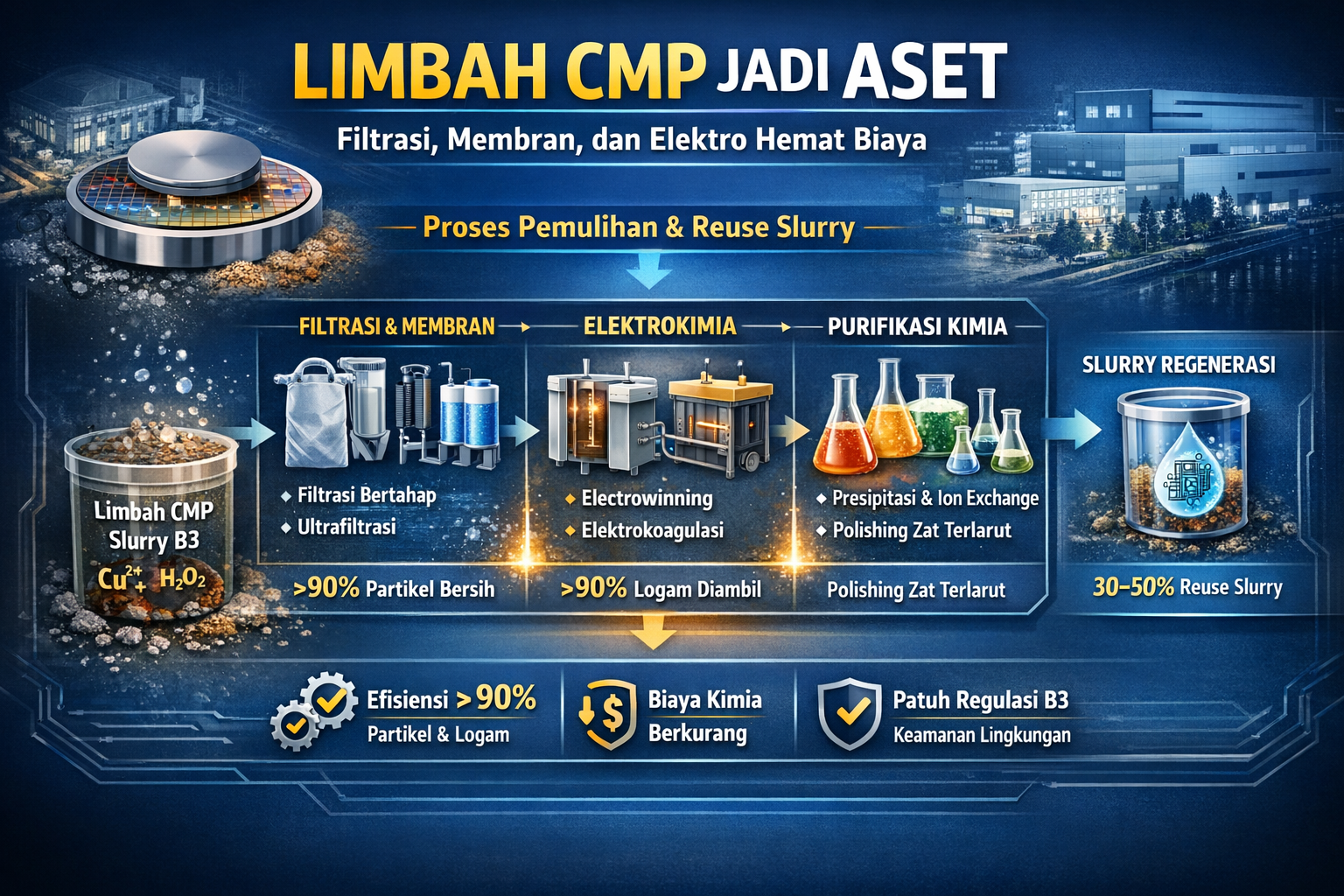
In practice, fabs assemble hybrid trains: settle/centrifuge → UF → RO → EC/IX as needed, with chemical adjustment steps. The final output is two streams: a regenerated slurry (returned abrasive in deionized water with replenished chemicals) and a treated water stream that can be reused in the fab.
“Slurry regeneration” means restoring what polishing consumed. That can include oxidizer, pH adjusters, inhibitors, and, if needed, fresh abrasive to hit spec particle size and concentration. In a tungsten CMP study using silica‑based slurry, UF‑recovered slurry was chemically adjusted (raising oxidizer, inhibitors, or diluting with fresh slurry) and performed within normal removal rate ranges; across 10–20 reuse cycles, careful adjustment kept removal rate and defectivity comparable to fresh slurry (researchgate.net).
Another approach is blending fresh and recovered slurry (global loop recirculation). A patent example reports mixing 35% fresh slurry with 65% recycled concentrate to maintain stable pH/chemistry, extending slurry life multiple‑fold. Properly recycled CMP slurry can replace 30–50% of fresh slurry needs, depending on process tolerances.
Cost and payback dynamics
Slurry is a high‑grade consumable; at $30–$100 per liter for advanced formulations, a 300 mm fab’s monthly usage can translate into millions per year. Reclaiming 30–50% of used slurry cuts that spend roughly in half. Hazardous waste disposal adds up too: specialty waste can run about $100–200 per ton off‑site. On‑site metal removal and reuse not only recovers value (e.g., copper) but also avoids a large fraction of hauling and third‑party treatment fees (electramet.com).
Capital and operating costs center on membranes, vessels, and chemicals: UF/RO modules (tens to hundreds of thousands USD), filter vessels, pumps, plus power, periodic membrane/coagulant replacement, and maintenance downtime. Purpose‑built UF tanks (at under $100k each) may run 24/7 to treat several cubic meters per hour and can pay back in a few years on chemical savings alone. Plants often standardize on modular RO, NF, and UF systems to scale throughput and maintenance. Water savings — from reusing permeate and polishing rinse water — also lower utility bills.
In a real example, one company built a multi‑million‑gallon‑per‑year CMP water recycling plant to reuse essentially all CMP rinse water — justified by reduced water purchase/disposal costs and sustainability targets. The broader trend is visible: TSMC’s new Phoenix plant aims to recycle nearly 100% of fab water (axios.com), though that example focuses on general water, not just CMP.
Outlook and performance benchmarks
Reported recycle efficiencies exceed 90% for particulates and >90% for metals, though full reuse typically supplements fresh chemicals (liebertpub.com; researchgate.net). Across unit operations — filtration, UF/RO/NF, EC, electrowinning, and IX — fabs are building circular loops around their most expensive consumable streams. The direction of travel is clear: systematic filtration/membrane treatment plus targeted decontamination can regenerate CMP slurry streams effectively enough to merit investment, especially in large‑volume fabs facing high slurry costs and strict discharge limits (liebertpub.com; researchgate.net).