

Fabs are slashing ultrapure water use in etch by swapping immersion baths for targeted spray rinses, adding megasonics, and recycling rinse streams back into the ultrapure loop.
Early adopters report millions of gallons saved a year, with 80% reuse already common at leading sites.
Industry: Semiconductor | Process: Etching
Semiconductor fabs are among the world’s thirstiest factories. A typical modern 300 mm facility can draw on the order of 10 million gallons of ultrapure water (UPW, water polished to near‑zero ion/particle levels) per day, equivalent to the daily use of 33,000 US households (weforum.org). Industry leader TSMC reported about 101×10⁶ m³ of water use in 2023, and global fab water demand is projected to double by 2035 as process complexity rises (idtechex.com).
Regulators are tightening the taps. Indonesia’s 2025 revisions to industrial wastewater rules mandate continuous monitoring and tighter effluent limits for chemical‑intensive sectors, including electronics manufacturing (greenlab.co.id) (greenlab.co.id). Layer on local water scarcity and the economics of UPW—which is 10–20× pricier than municipal supply—and fabs have clear incentives to cut consumption without sacrificing cleanliness or yield (sst.semiconductor-digest.com).
Single‑wafer spray rinsing
Instead of soaking cassettes in overflow tanks, modern wet benches are shifting to single‑wafer spray rinses that direct oscillating jets onto a rotating wafer surface (horiba.com) (jstmfg.com). Industry studies report that replacing immersion with sprays “minimizes water usage and total rinse times without sacrificing wafer cleanliness” (sst.semiconductor-digest.com).
By contrast, early 1990s overflow designs wasted flow around cassettes rather than through the wafers (sst.semiconductor-digest.com) (sst.semiconductor-digest.com). With tool redesigns, rinse streams are forced through the wafer stack for much higher hydraulic efficiency. The payoff is shorter rinse cycles: GlobalFoundries cut a post‑etch rinse from 10 minutes to 5 minutes and saved about 10,000 m³ of water per year with no loss of particle‑free quality (idtechex.com).
Megasonic agitation in rinse steps
Megasonic cleaning (ultrasonic agitation at MHz frequencies) enhances particle removal during rinses by generating microscopic cavitation bubbles that produce tiny fluid jets across complex topography (modutek.com). Analyses note that it “dislodges particles…more effectively than chemical methods,” enabling lower chemical strength or fewer process cycles—and, in turn, less water needed for rinsing (modutek.com). Vendors report integrated megasonic tools use fewer process chemicals and generate lower liquid waste, with “less water required” overall (modutek.com).
Rinse flow and tool optimization
Process tweaks are adding up. Because initial portions of continuous rinses add little cleaning as contaminants diffuse slowly, fabs are interleaving zero‑flow pauses and reduced‑flow phases to avoid wasted “drip” water (sst.semiconductor-digest.com). Computational fluid modeling at Sandia showed that small geometry changes—repositioned feed jets and baffles—can direct all incoming water through the wafer stack rather than around it (sst.semiconductor-digest.com) (sst.semiconductor-digest.com).
These iterative changes—plus just‑in‑time control of rinse flow rates and timed drain/refill cycles—are driving steady declines in UPW per wafer in newer fabs.
Rinse water recycling and UPW loop
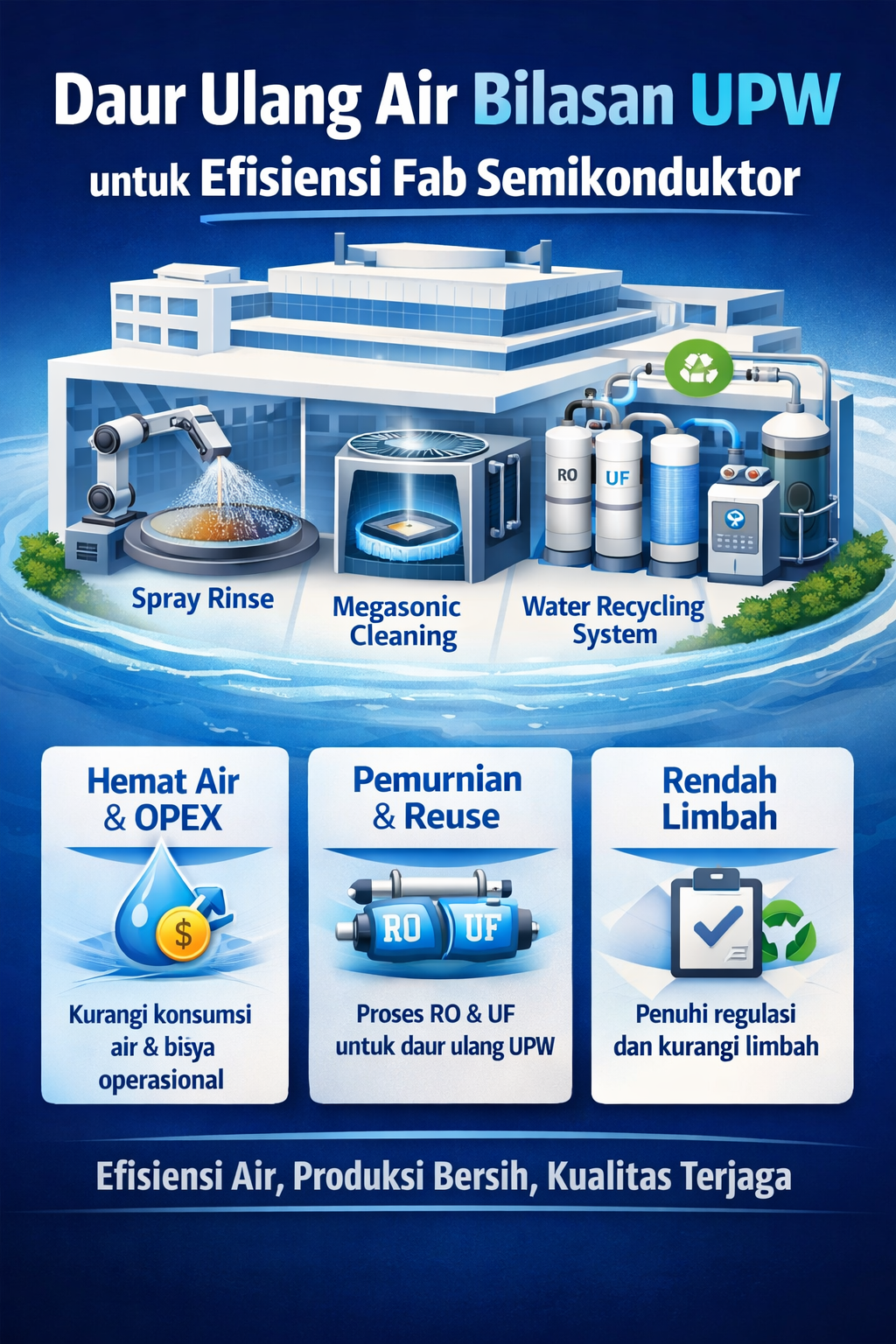
There’s an underappreciated asset hiding in the drain: by most metrics, “spent rinse water…is far superior to that being fed into the front end of the UPW plant,” which makes it an ideal candidate for reuse (sst.semiconductor-digest.com). Because contamination levels are low, recycled rinse water usually needs only mild polishing—such as ultrafiltration—before reuse.
Incorporating rinse streams back into the UPW production loop increases yield per volume of feed and cuts fresh intake, with improved reverse osmosis (RO, a pressure‑driven membrane separation) recoveries above 90% reported in pilots versus 60–75% typical, achieved by blending reclaimed rinse water into the purification train (sst.semiconductor-digest.com) (researchgate.net). RO is a standard polish step in these loops; when referenced in facility plans, reverse osmosis is typically configured for high recovery of low‑TDS process water.
Fab‑scale reclamation plants
At campus scale, closed‑loop recycle is becoming the norm. In Southern Taiwan Science Park, TSMC built a dedicated 20,000 ton/day wastewater treatment plant that delivered 12.61 million tons of reclaimed water in 2023—roughly 30% of that site’s total use—using advanced bio‑oxidation, crystallization, and RO to produce ultrapure‑grade water from lab and process effluent (ctci.com). Such trains are membrane‑heavy; comparable membrane systems combine RO, NF (nanofiltration), and UF (ultrafiltration) modules to hit reuse targets in industrial water treatment.
In Arizona, TSMC is constructing a 15‑acre Industrial Reclamation Water Plant (operational ~2028) designed for near‑zero liquid discharge. It will initially recycle about 85% of fab wastewater, targeting 90%, cutting intake at the first Phoenix fab (4.75 MGD, or million gallons per day) to under 1.2 MGD once online (datacenterdynamics.com) (datacenterdynamics.com). Combined with air‑handler condensate and reclaimed municipal supply, the aim is near self‑sufficiency.
Reuse rates and site outcomes
Across the sector, reuse is rising. SK Hynix increased recycled water volume by 51% from 2020 to 2023 as high‑stress region sites came online (idtechex.com). STMicroelectronics reports roughly 42% of its water is now recycled or reused across all sites, and its Rousset fab cut net fresh‑water use by about 12% since 2016 while raising yield (sustainabilityreports.st.com). Sony’s Nagasaki Technology Centre (front‑end) already reuses about 80% of process water (weforum.org).
Further gains are expected from stream segmentation and point‑of‑use purification, which push reuse rates higher while keeping per‑wafer consumption near constant even as output grows (sustainabilityreports.st.com).
Regulatory and cost alignment
The rinse‑and‑recycle playbook aligns with upcoming discharge standards and online monitoring mandates in Indonesia and other markets (greenlab.co.id) (greenlab.co.id) and reduces liability while lowering operating costs, since UPW is 10–20× more expensive than municipal water (sst.semiconductor-digest.com).
Put together, smarter rinsing technology—spray nozzles, megasonic agitation, optimized flow cycles (horiba.com) (sst.semiconductor-digest.com) (idtechex.com)—plus active water reuse (ctci.com) (datacenterdynamics.com) is delivering high cleanliness with dramatically less water. The metrics—millions of gallons saved per fab and reuse rates reaching 80%—show the approach scales from tool to campus without compromising yields.