
Hydroxide or sulfide to knock metals down; ultrafiltration to clear the field; chelating resins and adsorbents to finish at parts‑per‑billion (ppb). The data show that sequence reliably delivers sub‑ppb in semiconductor wastewater.
Heavy‑metal ions such as Cu, Ni, Zn, and Ag in semiconductor wastewater rarely yield to a single trick. Plants start with chemical precipitation (pH adjustment), then push solids out, and finally polish the trace remainder to ppb levels. The reason is chemistry: metal hydroxides and metal sulfides behave very differently once pH shifts and solubility limits kick in (link.springer.com).
In the baseline flow, precipitation removes the bulk, clarification or membranes capture the floc, and resins or adsorbents trim the last micrograms per liter (μg/L, equivalent to ppb). Final treated water from such tertiary processes is essentially metal‑free, often limited by analytical detection.
Hydroxide vs sulfide precipitation (pH and Ksp)
Hydroxide precipitation adds lime or NaOH to raise pH above 9 (pH is a measure of acidity/alkalinity). That forms metal hydroxides that settle. It is simple and low‑cost but generates bulky sludge and leaves higher residual metal because many metal hydroxides have relatively large solubilities (link.springer.com). Plants typically dose and control pH with equipment such as an accurate dosing pump.
By contrast, sulfide precipitation adds Na₂S or NaHS to produce metal sulfides (e.g., CuS, NiS) with extremely low K_sp (the solubility product, i.e., how little of a compound dissolves), achieving much lower metal concentrations across a broader pH range (link.springer.com). Specialized sulfide precipitants have driven Hg²⁺ from mg/L down to less than 0.05 μg/L in minutes (link.springer.com).
The sludge outcome differs as well: sulfide sludge settles very well and dewaters more easily than hydroxide sludge, and sulfide precipitates are not amphoteric (they do not readily re‑dissolve at high or low pH) (link.springer.com). The caveat is safety: sulfide treatment requires strict pH/Eh (oxidation‑reduction potential) control to avoid toxic H₂S gas release (www.prab.com).
In practice, many plants implement a hybrid: first precipitate with hydroxide (cheap, broad removal), then polish with a mild sulfide dose to capture the last traces.
Clarifiers and ultrafiltration capture
After precipitation, solids come out by clarification or membrane filtration. Conventional clarifiers handle high flow but often leave a few ppm metals behind and large sludge volumes; systems such as a clarifier typically provide the residence time and settled sludge removal noted in primary treatment designs.
Modern lines instead deploy ultrafiltration (UF, a membrane process that removes fine precipitates and colloids). Tubular UF membranes concentrate the slurry to about ~3–5% solids and yield a near‑solid‑free permeate (www.prab.com). That permeate is high‑quality water, often clear enough for reverse osmosis or even direct reuse (www.prab.com), a fit for downstream units such as ultrafiltration modules in reuse loops or RO systems like brackish‑water RO.
The dewatered sludge comes off at roughly tens of g/L solids and can be thickened/filtered for disposal. In short, hydroxide vs. sulfide precipitation differ mainly in residual concentration and sludge handling: sulfide achieves much lower residual metals and smaller sludge volume (link.springer.com) (link.springer.com).
Ion‑exchange polishing to ppb
After bulk removal, trace metals often remain at ppm or sub‑ppm levels (ppm is mg/L). To achieve ppb‑level effluent, specialized polishing units step in. Chelating ion‑exchange resins—such as iminodiacetate‑type or thiol‑functional resins—and strong‑acid cation resins selectively bind residual metal cations and can be regenerated with acid, making them reusable (pmc.ncbi.nlm.nih.gov). Plant designers often deploy complete ion‑exchange systems with chelating beds sized to hit a final target, for example under 10 μg/L.
In practice, ion‑exchange resins often reduce metal levels by more than 99% in a polishing pass, and recent reviews describe ion exchange as “reliable” and highly selective for heavy metals (pmc.ncbi.nlm.nih.gov) (pmc.ncbi.nlm.nih.gov). It is also described as simple and cost‑effective in operation, with regeneration minimizing waste (pmc.ncbi.nlm.nih.gov). For polishing service, a dedicated ion‑exchange resin bed tuned to Cu, Ni, or Zn selectivity is a typical choice.
The main limitation noted is that at extremely low influent concentrations (well below ppm) the capacity of even chelating resins can be challenged (pmc.ncbi.nlm.nih.gov). In polishing service, however, the influent is usually above those levels.
Adsorbents and combined polishing trains
Adsorbent media provide a parallel or series polishing route. Granular materials—activated carbon, specialty polymer beads, metal‑oxide adsorbents—bind residual metals through specific functional groups. Effective adsorbents share high surface area and binding sites such as –COOH, –SH, and –NH₂ (pmc.ncbi.nlm.nih.gov) (pmc.ncbi.nlm.nih.gov). Practical examples include phosphate‑functionalized resins, thiol‑silica, manganese oxides, or zero‑valent elements on supports. Facilities frequently pair a resin bed with a carbon/oxide bed for deep polishing; a media choice such as activated carbon is common for trace organics alongside metals.
This sequence drives heavy metals into the below‑μg/L range. Lab studies show that combining precipitation with a chelating resin can attain sub‑ppb effluent, including less than 0.05 μg/L for Hg (link.springer.com) (pmc.ncbi.nlm.nih.gov). Final treated water from such tertiary processes is essentially metal‑free, often limited by analytical detection.
Quantitative outcomes and selection factors
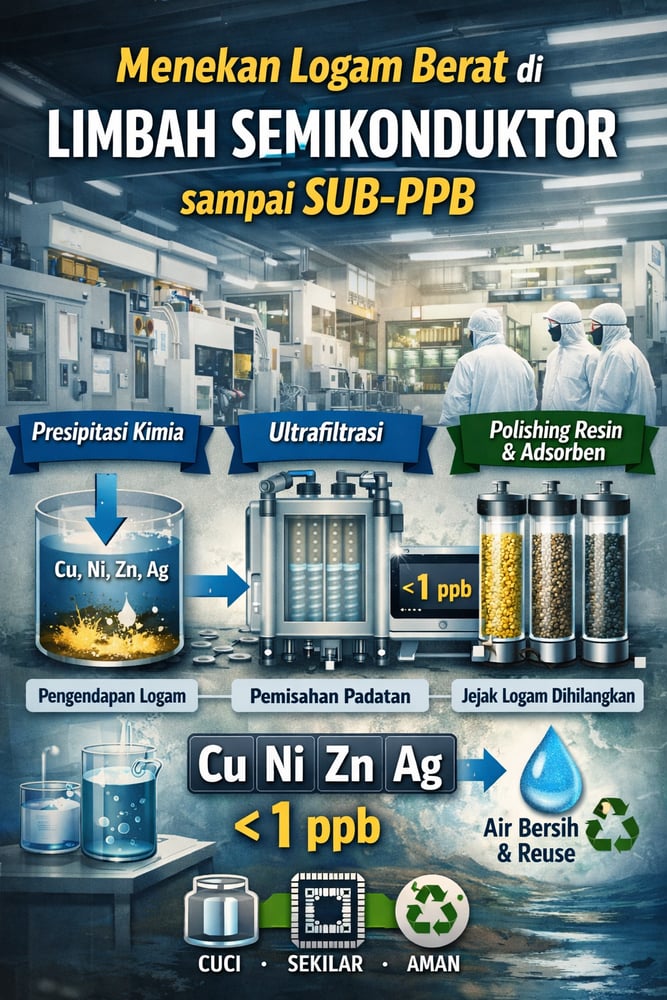
Conventional precipitation usually removes more than 90–99% of metals, frequently reducing mg/L inputs to 0.1–1 mg/L residual; hydroxide vs. sulfide yields higher vs. lower residuals, respectively (link.springer.com) (link.springer.com). An ultrafiltration step removes more than 99% of precipitate solids (www.prab.com), leaving a permeate poised for reuse loops that include membrane systems.
Polishing columns then remove nearly the rest. Pilot tests routinely deliver final Cu, Ni, Zn, and others in the single‑digit μg/L (ppb) range (pmc.ncbi.nlm.nih.gov) (pmc.ncbi.nlm.nih.gov). Selection depends on flow rate, metal loading, and reuse goals, but the data show that combining precipitation + UF + resin/adsorber reliably hits the sub‑ppb heavy‑metal targets needed for semiconductor‑effluent reuse or zero‑liquid‑discharge. (Certain Indonesian standards set discharge limits in mg/L, but typical semiconductor‑treated reuse goals are orders of magnitude lower, hence the need for advanced polishing.)
Sources and operating practice
Peer‑reviewed studies and reviews provide the solubility and removal data (link.springer.com) (link.springer.com), and industry references note the rise of tubular UF plus precipitation as standard practice (www.prab.com). Reviews confirm that ion exchange and tailored adsorbents can achieve μg/L effluent, with high selectivity and regeneration options (pmc.ncbi.nlm.nih.gov) (pmc.ncbi.nlm.nih.gov).
