

Industry: Semiconductor | Process: Wastewater_Treatment
The global chip market hit roughly $543 billion in 2021 as demand rose across sectors, a trend that pushes up both water use and wastewater generation (www.sciencedirect.com). In Korea alone, semiconductor wastewater discharge grew ≈19% between 2010–2019 (www.sciencedirect.com).
That volume is challenging enough. The chemistry is tougher: strong acids/bases, solvents, heavy metals, and fluorides—especially from HF etching—often hit 250–1500 mg/L fluoride in raw streams (www.sciencedirect.com). Regulators commonly cap fluoride around 10–15 mg/L (pubs.acs.org, www.sciencedirect.com) and metals at <0.1 mg/L (Indonesia’s Pb limit is 0.1 mg/L: greenlab.co.id).
This is where the modern fab’s “other fab” comes in: a centralized plant designed for extensive pre‑treatment and advanced polishing, with redundancy and room to tighten specs as rules evolve.
Rising loads, strict discharge
Semiconductor effluent spans strong acids/bases, organics, heavy metals (e.g., Cu, Ni, W), and high fluoride. Meeting multi‑pollutant limits demands a staged approach stitched together by data: equalization, neutralization, precipitation, solid–liquid separation, and polishing via ion exchange (IX), activated carbon (GAC), and membranes (UF/NF/RO).
Ion‑exchange (IX) swaps target ions on resins; granular activated carbon (GAC) adsorbs dissolved organics; ultrafiltration (UF) screens fine colloids; nanofiltration (NF) removes multivalent salts at lower pressure than RO; reverse osmosis (RO) rejects most dissolved inorganics. Multi‑step designs are increasingly paired with modular membrane systems to manage fluctuating loads.
Flow equalization and pH control
An equalization tank (a mixing basin that buffers flow and quality swings) is the first anchor. EPA design manuals note equalization “significantly improve[s] performance” by evening out organics and flows, producing a near‑constant influent to downstream processes (nepis.epa.gov). For fabs with batch etch discharges, several hours of retention commonly smooth acid/base surges (nepis.epa.gov).
Next comes pH neutralization (chemical adjustment to a controlled pH): acidic etch and strip effluents (pH ~1–2) are raised with lime or caustic; alkaline streams (e.g., ammonia etchants) are quenched with acid. HF‑rich effluent (pH 1–3) has been neutralized with KOH/Ca(OH)₂ to set up fluoride precipitation as CaF₂ (bnrc.springeropen.com). Controlled pH is typically ~7–9 to favor metal hydroxide and CaF₂ formation. Dosing is automated with metered chemical feeds; plants frequently standardize on dosing pumps for accuracy and response.
Heavy‑metal precipitation and capture
After pH adjustment, heavy metals are precipitated. Coagulants/precipitants like FeCl₃ or ferrous sulfate, dosed with NaOH, co‑precipitate Cr(VI), Ni, Cu, Zn as hydroxides (iopscience.iop.org). One plating wastewater study using iron‑based co‑precipitation reached stable Cr+Ni+Cu ≈0.1 mg/L effluent (iopscience.iop.org).
Many fabs run multi‑stage precipitation—e.g., dedicated Cr⁶⁺ reduction/precipitation, then Ni/Cu removal—to reliably hit sub‑0.1 mg/L per metal. Coagulant selection and control are central; operators often reference coagulants tailored for turbidity and charge neutralization before settling.
Fluoride precipitation with calcium
Fluoride is especially persistent. Standard practice doses calcium after neutralization—CaCl₂ or Ca(OH)₂—to precipitate CaF₂(s). One semiconductor plant reduced 1,800 mg/L F⁻ to ~10 mg/L (99.5% removal) using a Ca²⁺/pH regime (pubs.acs.org). The optimal ratio n(Ca²⁺)/n(F⁻)≈0.5 at pH≈8.5 yielded 99.49% defluoridation, meeting a 10 mg/L standard (pubs.acs.org).
In a pilot on high‑F industrial effluent (initial pH 1–3), KOH and Ca(OH)₂ delivered ~97.6% F removal (bnrc.springeropen.com, bnrc.springeropen.com). CaF₂ crystals settle well and the resulting sludge can be handled—or even reused, such as in cement (pubs.acs.org, nepis.epa.gov). Mixing and sedimentation are specified explicitly—agitated reactors followed by settling in a clarifier or press—with lamella modules often boosting capture.
Solid–liquid separation and sludge
Following precipitation, high‑rate clarifiers and dissolved air flotation (DAF) remove >90–95% of settled solids. Where fluoride/silica slurries settle sluggishly, lamella settlers increase capture and capacity. Compact designs such as a lamella settler reduce footprint without sacrificing efficiency.
Sludge—CaF₂, metal hydroxides, and Al(OH)₃ where alum coagulants are used—is thickened and dewatered (filter press or centrifuge) for disposal or valorization. Designs typically aim for ≥95% suspended‑solids removal at this stage; UF/microfiltration after chemical dosing can produce ≈0 NTU turbidity effluent (www.sciencedirect.com). Where oils or fines complicate separation, a DAF unit stabilizes capture before membrane polishing.
Ion‑exchange polishing stages
Even after solids removal, trace ions linger. Two‑stage ion exchange commonly follows: a strong‑base anion resin for residual fluoride and nitrate, then a mixed‑bed polish. Strong‑base anion resins have dropped fluoride to single‑digit mg/L or below; historical EPA tests show IX “rinse” stages reaching <3 mg/L F⁻ (nepis.epa.gov). In semiconductor reuse systems, IX/deionization is often pushed to <1 mg/L (samcotech.com).
Regeneration produces brines that require handling, but the polish is decisive for compliance. Plants rely on modular ion‑exchange systems for the main stage and mixed‑bed units when a tighter silica or TDS finish is needed.
Activated carbon for trace organics
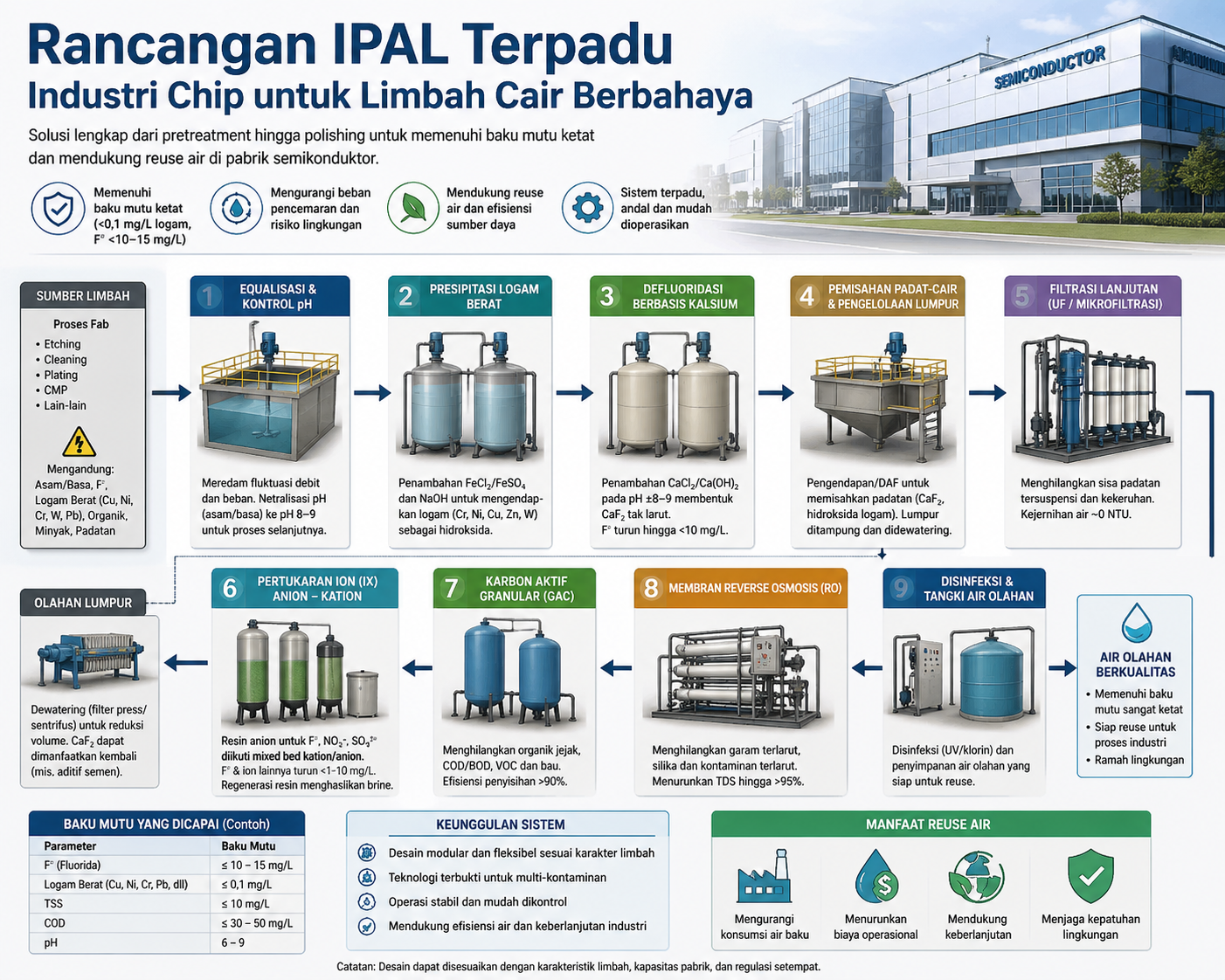
To catch residual organics—photoresist fragments, solvents like isopropanol—granular activated carbon (GAC) adsorption reduces COD/BOD and protects membranes. Typical systems exceed 90% removal of many VOCs. In practice, GAC runs in parallel trains with switchable beds; saturated carbon is regenerated off‑line (steam/air) or replaced. Designs commonly target 20–30 bed volumes between regenerations. Fabs specify media to match target compounds, frequently standardizing on activated carbon columns as a guard stage before RO.
Membrane filtration: UF, NF, RO
UF strips colloidal fines (e.g., CaF₂, silica, metal hydroxides) that pass gravity separators. Studies show that after calcium dosing, UF achieved effluent with 2.09 mg/L F and turbidity 0 NTU (www.sciencedirect.com). For this duty, fabs deploy skid‑mounted ultrafiltration trains to deliver particle‑free feed to high‑pressure membranes.
RO/NF then remove the remaining dissolved inorganics. Lab tests with Ni, Pb, Cu at 50–200 ppm showed 96–98% removal in RO (doaj.org). Properly sized arrays—with staging to reach 75–90% recovery—routinely produce permeate TDS <50 mg/L, far below regulatory thresholds.
If ultra‑low specific‑ion targets are required (e.g., <0.1 mg/L metals), a second‑pass RO or an NF polish is added. The well‑known hybrid—precipitation up front followed by RO—lets membranes handle the remaining ~10–100 mg/L fluoride; experiments show >99% F removal in RO as well. Facilities pair nano‑filtration modules where lower pressure and selective hardness removal help, and brackish‑water RO where maximum salt rejection is the priority.
In sum, UF + RO yields virtually zero suspended solids and 90–99% reduction in remaining dissolved contaminants. One pilot cut TDS by ~80%—from ~2000 to ~400 mg/L—alongside fluoride and salts, producing ultraclear effluent (bnrc.springeropen.com). The RO concentrate (brine) is then reprocessed, often via evaporators or crystallizers in a Zero Liquid Discharge (ZLD) scheme.
Performance outcomes and flexibility
Fluoride: >99% removal to ≤10 mg/L is routine (pubs.acs.org); dual‑barrier setups (precipitation + IX/RO) push to <2–5 mg/L (www.sciencedirect.com, pubs.acs.org). Heavy metals (Cu, Ni, W, etc.) are stripped to ≪0.1 mg/L by sequential precipitation plus membrane polishing (iopscience.iop.org, doaj.org), comfortably below Indonesian limits such as Pb ≤0.1 mg/L (greenlab.co.id).
Pre‑treatment delivers >95% removal of precipitated and suspended solids, while UF/RO finishers deliver >90% removal of dissolved solids (bnrc.springeropen.com, doaj.org). Stagewise results align with the literature: precipitation achieves >95% metal removal; RO provides ∼97–98% metal removal (iopscience.iop.org, doaj.org), and combination systems recover >97% fluoride (pubs.acs.org, bnrc.springeropen.com).
Net effect: discharge‑quality water or stringent reuse, often enabling 50–60% reuse rates (samcotech.com). Plants preserve flexibility by oversizing IX/RO units, including redundancy, and standardizing on ancillary equipment that eases maintenance and future upgrades.
Design building blocks and sources
Designers emphasize the same core building blocks for semiconductor effluent: equalization and pH control; heavy‑metal and fluoride precipitation; solid–liquid separation; and polishing with IX, GAC, and membranes. Each element in this train is backed by specific studies and design manuals: EPA equalization guidance (nepis.epa.gov); fluoride precipitation performance (pubs.acs.org, bnrc.springeropen.com); clarifier/UF turbidity outcomes (www.sciencedirect.com); IX fluoride polishing (nepis.epa.gov, samcotech.com); and RO/NF metal removal and recovery performance (doaj.org).
Sources: Peer‑reviewed studies and industry reports establish these design principles and performances (pubs.acs.org) (www.sciencedirect.com) (iopscience.iop.org) (nepis.epa.gov) (doaj.org) (bnrc.springeropen.com). Indonesian standards such as PermenLH (e.g., Pb ≤0.1 mg/L) are used as benchmarks (greenlab.co.id). The cited data build a data‑backed case that combining equalization, pH control, heavy‑metal and fluoride precipitation, plus IX/carbon/UF‑RO polishing can robustly meet all regulatory and business requirements.