

Industry: Semiconductor | Process: Solvent_&_Acid_Waste_Collection
Semiconductor manufacturing runs on strong acids and organic solvents — etchants, cleans, and strippers — and generates matching hazardous waste streams. Analyses report that waste hydrofluoric acid (HF, a key oxide etchant) alone accounts for over 40% of total hazardous wastes from chip fabs (mdpi.com) (sciencedirect.com).
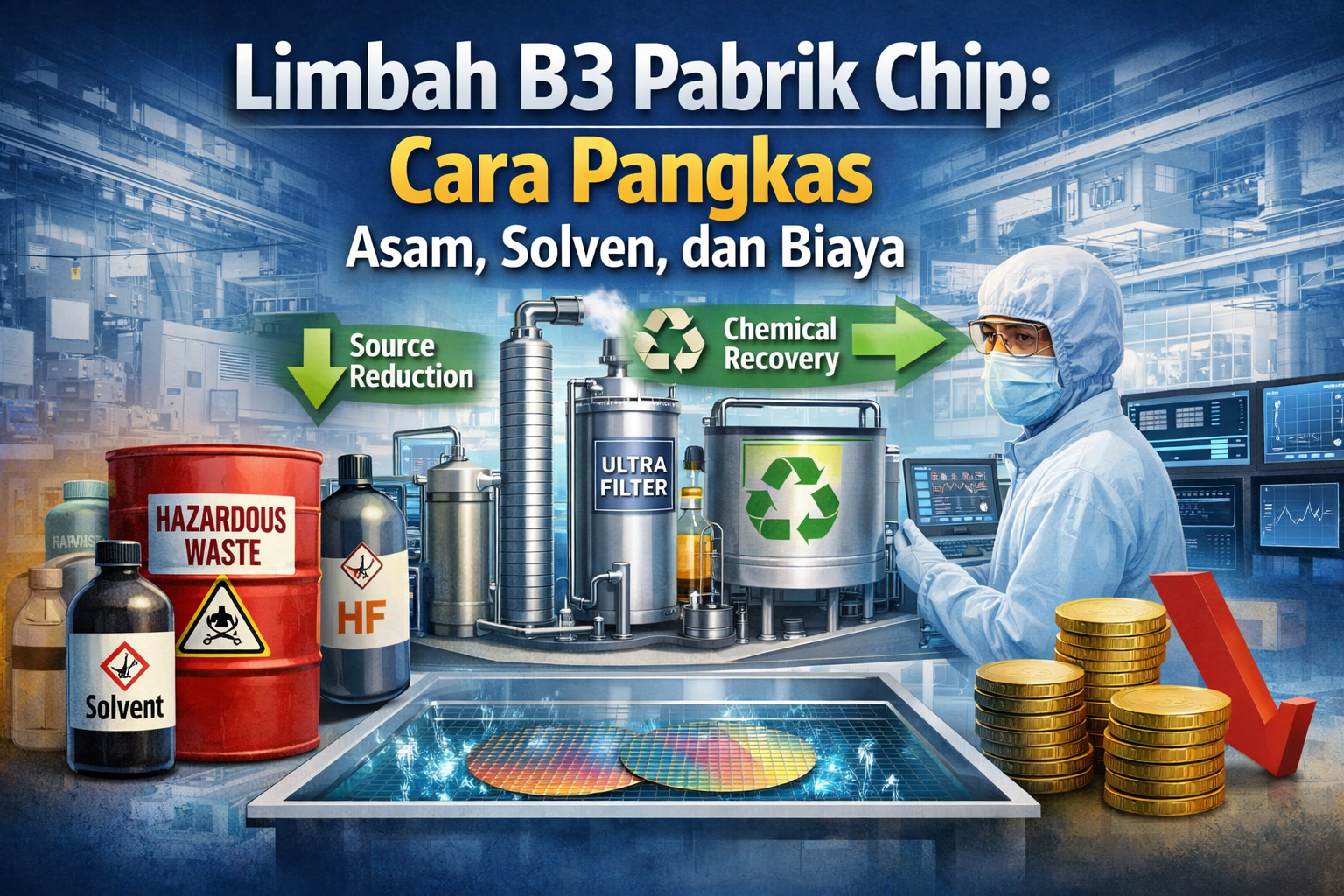
The industry’s response hinges on two parallel strategies: (1) source reduction — optimizing tools and recipes so fewer chemicals are used in the first place — and (2) recycling/recovery of spent chemicals. Both move the needle on emissions and economics. A 2022 analysis found that solvent-waste recovery by distillation, with ~37% renewable energy support, could cut lifecycle carbon emissions by ~89% and lower costs versus incineration disposal (researchgate.net).
This approach also tracks with policy. The US EPA’s waste hierarchy explicitly ranks source reduction and reuse above all other controls, making in‑line efficiency a compliance lever as much as an environmental one (mdpi.com). In practice, leading companies have invested in green technologies: for example, Samsung and Intel have deployed on-site hazardous‑waste treatment and water‑reuse systems, reducing dependency on raw chemicals (mdpi.com).
Wet‑bench recirculation and advanced cleans
Early-stage source reduction is consistently the most effective driver. In wet processing, bath recirculation and filtration extend bath life and cut new chemical additions; one equipment vendor notes that recirculation pumps in wet chemical baths maintain solution quality while reducing consumption (modutek.com). Filtration in recirculated baths is often implemented with industrial cartridge filters such as cartridge filters.
For aggressive cleans like “piranha” (a sulfuric acid + hydrogen peroxide mixture), intermittent “bleed‑and‑feed” cycles keep solutions effective longer; studies report significant reductions in chemical usage and waste with this approach (modutek.com). Precise metering aids these cycles, making an accurate dosing train, including a dosing pump, a practical anchor for control.
Advanced dry‑cleaning alternatives are scaling too. Megasonic wafer cleaning — high‑frequency sound waves that remove particles — can eliminate many solvent rinses altogether, using far less chemical and energy than traditional wet etches (modutek.com). Across these upgrades, fabs are tightening inputs and moving toward circular, zero‑waste reforms; NIST notes broader adoption of closed‑loop recycling and stricter input controls (nist.gov), while SEMI and imec highlight the same shift (semi.org). For continuous-duty filtration hardware, 316L stainless steel housings are standard in clean chemistries; offerings such as stainless steel cartridge housings are designed for pharmaceutical and food grade applications and are widely used in corrosive services.
Solvent recovery by distillation and membranes
When waste is unavoidable, in‑situ recovery reclaims chemicals for reuse and cuts fresh purchases. Distillation and membrane separation are common for photoresist and cleaning solvent streams. Properly designed distillation can recover more than 90% of spent photoresist solvents, at energy costs far below incineration (researchgate.net) (researchgate.net).
Optimized vacuum distillation with heat pumps has significantly reduced energy and utility consumption versus conventional solvent disposal, according to an enhanced design study (researchgate.net). Additional innovations — membrane filters, heat integration, and renewable energy input — continue to push recovery yields to ~90% with major carbon and cost benefits (researchgate.net) (seppure.com).
The economics add up quickly. One industry case found that recycling just 1,500 gallons per month of used isopropanol (IPA) could convert a $45K per year disposal bill into positive value by reclaiming about $1.80 per gallon (altiras.com). In practice, on‑site solvent recyclers have been shown to cut the life‑cycle GHG (greenhouse gas) emissions of solvent usage by roughly 48% (seppure.com). Where membranes are part of the train, integrated solutions such as RO, NF, and UF membrane systems are used in industrial water treatment and solvent‑water separations to complement distillation steps.
Acid recovery with ion‑exchange and RO
Mixed acid waste streams respond well to electrochemical and membrane separation. HF scrubber water typically carries high fluoride and silica; a Singapore fab installed electrodialysis reversal (EDR, a polarity‑switching ion‑exchange membrane process) on scrubber effluent, reclaiming roughly 70% of the flow (returned to the scrubber tank) while removing 80% of dissolved fluoride — diverting a large portion from precipitation treatment (watertechnologies.com). Ion‑exchange membranes can separate and recover strong acids such as HF, HCl (hydrochloric acid), and H₂SO₄ (sulfuric acid) from impurities for recycle. For the ion-exchange platform, fab utilities commonly specify packaged ion-exchange systems when acid recovery is integrated with water reuse.
In a 2012 pilot, Won et al. combined lime coagulation with spiral‑wound reverse osmosis (RO) to enable effective reuse of HF wastewater (x-mol.com). Coagulation steps are often supported with specialty coagulants; options like coagulants are standard components of physico‑chemical treatment trains. For membrane pretreatment in these trains, ultrafiltration (UF) is a frequent choice; systems such as ultrafiltration provide pretreatment to RO and help protect spiral‑wound elements.
For organics, solvent‑resistant membranes or vacuum evaporation can recover acetone, NMP (N‑methyl‑2‑pyrrolidone), and PGMEA (propylene glycol monomethyl ether acetate) at purities often above 90%. These systems generate a small, concentrated residue that is less costly to dispose of — or to process further — than raw waste. Where RO membranes are specified, fabs commonly reference established elements; portfolios like Filmtec RO membranes are widely used in industrial separation duty.
Recovery outcomes and benchmarking data
Cluster analyses of fab data show the upside. Best‑in‑class sites report very high recycle fractions for key chemicals. U.S. fabs have reported recycling 74.2% of spent nitrate solution (a proxy for nitric acid) and releasing 25.8% (mdpi.com). In the same study, one fab managed to recycle 65.4% of its HF waste — the industry’s single largest hazard — while others reached only 0.6% (mdpi.com).
For sulfuric acid waste, South Korean fabs treat nearly all of it on site: 89% of companies “treated 98.7%” of their H₂SO₄ waste, discharging only 1.3% (mdpi.com). Even modest improvements translate to big gains: reclaiming 70–80% of a stream that once went to landfill or flare can cut total hazardous waste volumes by one‑third or more. In precipitation‑based plants, adding capacity with a clarifier is a common way to manage solids when membrane or EDR steps shift loads upstream.
Regulatory and business anchors
Policy and economics are aligned with waste reduction. In Indonesia, B3 regulations classify spent etchants and solvents as hazardous; laws require generators to follow strict management and treatment standards, with non‑compliance risking operational shutdowns (beta.co.id). SEMI and imec’s Circular Semiconductors initiative frames spent chemicals as feedstocks that can cut costs, reduce GHGs, and hedge supply‑chain risks (semi.org).
The disposal math is stark: many fabs face surcharges of $2–3 per gallon of solvent, with annual bills in the tens of thousands or more. By contrast, in‑house distillation or buy‑back programs can shrink that cost by 50–70% (altiras.com). Where closed loops are extended to water utilities, packaged ancillaries such as supporting equipment for water treatment are often deployed to integrate recovery trains with fab infrastructure.
Key takeaways and measurable payoffs
Data from industry analyses show that top‑performing fabs consistently minimize waste at the source and maximize chemistry reuse. Replacing solvent baths with ozone/megasonic cleaning, recirculating wet benches, and precise chemical metering — plus solvent/acid recovery systems such as distillation, RO, and EDR — can reduce hazardous waste by tens of percent. For example, a 70% recovery rate on HF wasteborne scrubber water translates to roughly 70% less acid sent off‑site (watertechnologies.com).
The benefits are tangible: lower raw‑chemical budgets, fewer disposal permits/fees, and markedly lower emissions — often cutting facility carbon output by more than 80% per treated stream (researchgate.net). In short, lean chemical engineering plus circular treatment systems yields the largest reductions in hazardous solvent and acid waste, reflecting both regulatory hierarchies and industry benchmarking.
Source base and references
Authoritative industry and research sources underpin these findings. Shen et al. (2018) analyzed U.S. EPA data on fab chemical waste (mdpi.com) (mdpi.com); Won et al. (2012) evaluated HF wastewater reuse schemes (x-mol.com); and Veolia reported EDR reuse percentages for an HF scrubber stream (watertechnologies.com). Regulatory context (e.g., Indonesian B3 rules) came from government publications (beta.co.id), and trade or vendor reports provided outcome figures and technical descriptions (semi.org) (researchgate.net).
- Shen, C.-W., Tran, P. P., & Ly, P. T. M. (2018). Chemical Waste Management in the U.S. Semiconductor Industry. Sustainability, 10(5), 1545 (mdpi.com) (mdpi.com).
- Won, C.-H., Choi, J., & Chung, J. (2012). Evaluation of optimal reuse system for hydrofluoric acid wastewater. Journal of Hazardous Materials, 239–240, 110–117 (x-mol.com).
- Lee, A., Naquash, A., Chaniago, Y. D., & Lee, M. (2022). Exploitation of distillation for energy‑efficient and cost‑effective environmentally benign process of waste solvents recovery from semiconductor industry. Science of the Total Environment (2022) (researchgate.net).
- National Institute of Standards and Technology (2025). Waste Management in Semiconductor Facilities (NIST CHIPS Program) (nist.gov).
- Famularo, J. (2025). Introducing the Circular Semiconductors Research Network, launched by SEMI and imec. SEMI (Apr 22, 2025) (semi.org).
- Veolia Water Technologies (2016). Semiconductor Fab Reclaims Local Scrubber Wastewater with Electrodialysis Reversal (EDR) (Case Study) (watertechnologies.com).
- Beta Pramesti Asia (2025). Regulation of Liquid Hazardous Waste in Indonesia (blog, Jan 6, 2025) (beta.co.id).
- Altiras Labs (2024). Hidden Opportunities in Used Solvent Disposal for Semiconductors. Altiras (industry blog) (altiras.com).