

Industry: Semiconductor | Process: Fluoride_&_Heavy_Metal_Wastewater_Treatment
Semiconductor fabs discharge a complicated mix of solvents, photoresist by‑products, heavy metals, and fluorides. After primary steps like precipitation and biological oxidation, tertiary polishing targets what’s left: trace organics and ions at very low levels. In head‑to‑head comparisons, granular activated carbon (GAC, a high‑surface‑area adsorbent) has clocked an average 90.0 ± 4.6% removal of trace organics, outperforming UV/H₂O₂ advanced oxidation (AOP, radical‑based oxidation) at 76.4 ± 6.2% in one parallel test (researchgate.net).
The stakes are rising on reuse. Conventional reverse osmosis (RO, a pressure‑driven membrane) recovers ~50% of water, but advanced strategies have pushed ~65% recovery and even ~99% wastewater recovery in multistage counter‑flow designs — essentially approaching zero‑liquid‑discharge in practice (semiengineering.com) (semiengineering.com) (semiengineering.com).
Behind the trend, fabs are stacking multiple barriers — adsorption, oxidation, and membranes — and tuning them with data to hit target removals, recovery goals, and regulatory limits.
Trace‑organic adsorption (GAC performance and limits)
GAC adsorption excels early. In week 1 of a pilot, removal was ~98%, declining to ~81% after ~2,184 bed‑volumes as sites saturated (researchgate.net). In practice, fabs use GAC to polish RO permeate or biological effluent to <0.1–1 mg/L total organic carbon (TOC), soaking up residual solvents like acetone and alcohols (pubs.acs.org) (researchgate.net).
Why it’s popular: GAC is simple, low‑energy (beyond pumping), and produces no toxic by‑products; typical surface area runs ~950–1200 m²/g (researchgate.net). A practical form factor is a packed vessel of granular media, akin to the media offered under activated carbon.
The catch: capacity is finite. Beds need thermal or chemical regeneration or periodic replacement; commercial GAC costs are on the order of a few dollars per kg. Adsorption favors hydrophobic/aromatic organics and struggles with very polar species. Over longer runs, performance can slide — e.g., from 97.6% to 80.7% over ~3 months in one observation (researchgate.net).
Destructive oxidation (AOP options and tradeoffs)
AOPs use highly reactive radicals (·OH from UV/H₂O₂, ozone, or catalysts) to degrade organics and even mineralize them to CO₂/CO₃²⁻. Common variants include UV/H₂O₂, ozonation (O₃), ozone/UV, Fenton’s reagent (iron‑catalyzed peroxide), photocatalysis (TiO₂+UV), and sonolysis. In semiconductor reuse, catalysts added to UV/H₂O₂ after RO have met ultrapure‑water (UPW) standards by oxidizing refractory small molecules like acetonitrile and acetaldehyde (pubs.acs.org).
Performance varies by chemistry. In the above parallel test, AOP alone achieved ~76% removal and can leave partial oxidation products (researchgate.net). Ozone excels at unsaturated organics, while UV/H₂O₂ is strong on simpler molecules but energy‑intensive. Electrical‑energy‑per‑order assessments show ozonation more energy‑efficient than UV/H₂O₂; one study found UV/H₂O₂ had the highest electrical energy cost among the compared options, whereas plain ozonation was lowest‑cost (researchgate.net).
Tradeoffs are clear: AOP destroys contaminants rather than transferring them to a solid phase, and it can hit polar or chlorinated compounds GAC might miss. But it takes capital (UV lamps, ozone generators) and operating power — think kilowatt‑scale UV lamps or ozone blowers. Some variants can form by‑products like bromate (from bromide‑rich waters) or NDMA with certain amines. UV‑based reactors are analogous to ultraviolet units used for low‑chemical disinfection.
Complementary polishing (GAC and AOP together)
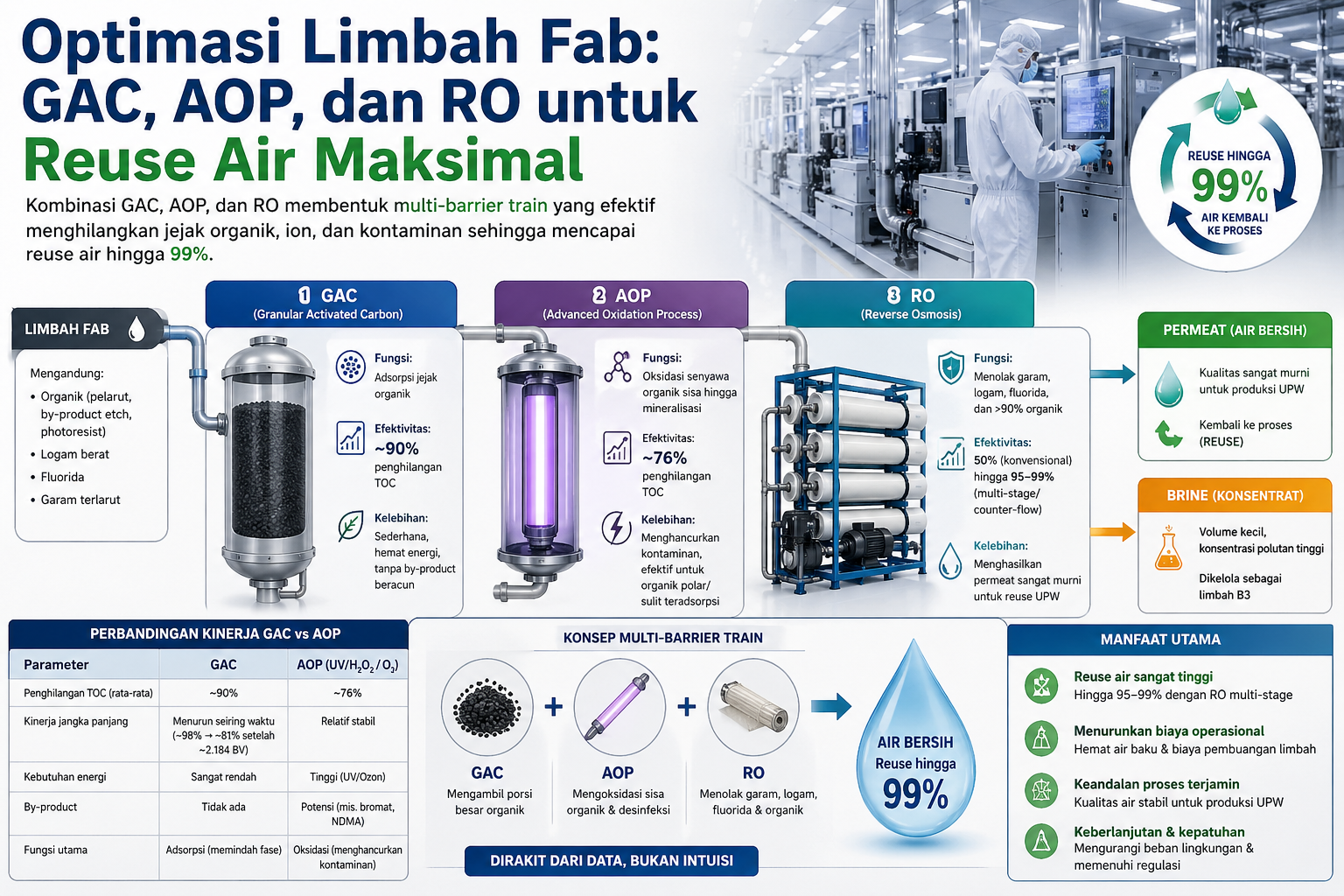
In practice, these steps are complementary. Plants often run GAC first to capture the bulk of organics, then a final AOP stage to oxidize breakthrough — and to disinfect. The average removal gap in one full‑scale comparison (GAC ~90.0 ± 4.6% vs AOP ~76.4 ± 6.2%) underscores the pairing logic (researchgate.net).
Over long runs, GAC efficiency declines as sites fill (from ~98% to ~81% after ~2,184 bed‑volumes), while AOP tends to hold steadier but at higher continuous energy and chemical cost (researchgate.net). GAC towers are simpler and low‑energy (mainly pumping), whereas AOP systems need ongoing power and chemical dosing.
Membrane trains for high reuse (RO and beyond)
When the goal is high‑grade reuse, RO is the workhorse. RO rejects dissolved inorganics (salts, metals, fluoride) and >90% of organics, producing very clean permeate suitable for recycling — often as feed to UPW production (pubs.acs.org). Single‑pass setups typically recover ~50% of influent water from semiconductor wastewater (semiengineering.com), but semi‑batch “flow‑pause” modes with machine‑learning tuning have raised recovery to ~65% (semiengineering.com).
Counter‑flow, multi‑stage RO cascades go further: in a six‑stage arrangement, 95–98% overall recovery is theoretically possible, and fabs in Singapore, Taiwan and the U.S. have reportedly hit ~99% wastewater recovery (semiengineering.com). RO energy costs are moderate (pressures ~30–70 bar), but recoveries >65% require either higher pressure or specialized designs. The tradeoff is concentrate management — high‑recovery RO concentrates pollutants into a small brine that often needs further treatment or evaporation.
In hardware terms, fabs use RO skids tailored to industrial feedwaters, including brackish‑water designs like brackish-water RO. To integrate multiple barriers, suppliers also bundle RO, nanofiltration (NF), and ultrafiltration (UF) within unified platforms, as in membrane systems.
Ultrapure reuse and case indicators
Ultrapure reuse has been demonstrated in pilot trains such as MBR+RO+AOP (MBR, or membrane bioreactor, couples biological treatment with UF membranes), meeting UPW specs in tests (pubs.acs.org). Packaged MBR units such as membrane bioreactors are commonly positioned upstream to stabilize organics before polishing.
Industry momentum is clear: SK Hynix boosted its reused‑water volume by 51% from 2020 to 2023 by adding treatment capacity (idtechex.com). One reported case raised internal reuse from 30% to 65% by optimizing the existing water system — boosting RO recovery and recycle — saving ~$30 million in new plant costs (semiengineering.com).
Fluoride and heavy‑metal polishing steps
GAC and AOP do not remove hazardous ions like fluoride or metals, so fabs pair inorganics polishing steps. Fluoride from etch and CMP (often hundreds of mg/L) is precipitated as CaF₂ or via aluminum salts and then filtered. One study used Ca²⁺ and SiO₂ coagulants plus UF to reduce fluoride from ~250–1500 mg/L down to ~2.09 mg/L — below typical effluent limits (sciencedirect.com). UF modules analogous to ultrafiltration provide the solids separation after precipitation.
For trace metals such as Cu, Fe, Ni, and Zn from plating and CMP, chemical precipitation (hydroxide or sulfide) is standard for bulk removal. Reviews note that membrane separation, ion‑exchange, and adsorption (e.g., chelating resins) can push copper and other metals to ppb‑level concentrations (ncbi.nlm.nih.gov). In polishing service, selective resins akin to those under ion-exchange resins are commonly deployed; additional RO stages can also close the gap.
Data highlights and design takeaway
Highlights from plants and pilots: GAC removes ~90% of trace organics, with supplemental UV/H₂O₂ AOP adding ~10–20% more removal (researchgate.net). Ultrapure effluent has been met in MBR+RO+AOP trials (pubs.acs.org). RO alone typically recovers ~50%, while advanced modes reach ~65% and multistage configurations ~95–98% theoretical, with ~99% reported in practice (semiengineering.com) (semiengineering.com). Industry trends confirm the push, with major fabs reporting >50% recycling gains in recent years (idtechex.com).
Bottom line: a multi‑barrier polish is now standard for high reuse. GAC offers steady, low‑energy adsorption of a broad range of organics (handling >90% initially), while AOP provides destructive oxidation at higher energy for persistent compounds (researchgate.net). RO then secures high‑purity water and enables >90% recycle — up to ~99% in practice — but demands strong pretreatment and a plan for concentrate (semiengineering.com). Across all steps, data‑driven design (target removals, recovery goals, regulatory limits) guides the technically optimal combination.