
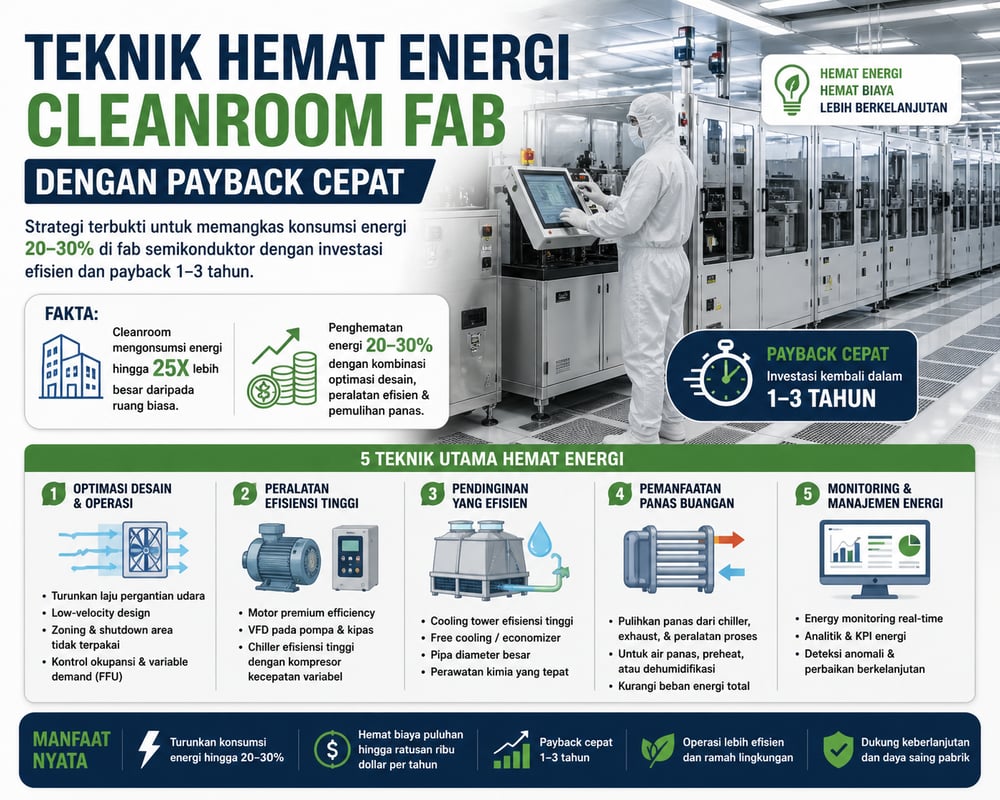
Cleanrooms can gulp roughly 25× the energy of ordinary space, but airflow tuning, high‑efficiency equipment, and waste‑heat capture are delivering six‑figure savings and fast paybacks. Case studies show 20–30% facility‑wide cuts with 1–3 year returns.
Semiconductor manufacturing’s dirtiest secret isn’t dust—it’s energy. Cleanrooms, the controlled spaces that guard yields, can consume about 25× more energy than ordinary building space (Cleanroom Technology). The good news: fabs are finding big, measurable wins by redesigning air systems, upgrading motors and chillers, and reclaiming low‑grade heat—often with paybacks counted in months, not decades.
From fan‑wall retrofits that save $400,000 per year to heat pumps that make boilers redundant, the playbook is getting sharper. One 300 mm fab in Taiwan modeled a 25.2% facility energy reduction with four targeted measures (ResearchGate). And those are not outliers.
Cleanroom airflow and envelope design
Airflow strategy is the lever. Lowering fan face velocity or reducing air‑change rates (ACR) cuts fan power dramatically. A 2004 study found that trimming design ACR by 20% allows about a 50% smaller fan size (Semiconductor Digest). In practice, many fabs now run well below older ISO cleanroom class flow rates without affecting yields (ISO class: classification of allowable particle counts). Using larger filters/coils with slower fans—a low‑velocity design—reduces pressure drops and fan energy.
Cleanroom managers also lean on re‑circulation: mixing a portion of clean return with supply. Recirculating clean return air—e.g., mixing 50% exhaust with supply—can roughly halve conditioning load (ResearchGate). Tight construction (high airtightness classes) avoids costly leakage.
Texas Instruments pushed design details further: a two‑story layout, large straight chiller pipes (fewer elbows), and reflective exterior surfaces reduced friction losses and solar heat gain so much that the fab eliminated a major industrial air conditioner (Semiconductor Digest) (Semiconductor Digest).
Variable-demand ventilation and controls
Right‑sizing airflow to the task is now standard. Fan filter units (FFUs, ceiling‑mounted filtered fans) run at full capacity only during production peaks; they throttle during off‑hours, cutting energy and extending filter life (Semiconductor Digest). Advances in variable‑frequency drives (VFDs, speed control for AC motors) and triac controllers (speed control for single‑phase motors) now let even single‑phase FFU motors vary speed efficiently (Semiconductor Digest).
Fan‑wall ventilation helps at part load: replacing one huge fan with an array of smaller fans increases efficiency across turndown. In one retrofit, swapping two large cleanroom fans for two nine‑fan modules yielded $400,000/year in electricity savings—roughly halving fan energy use (Semiconductor Digest).
Zoning, shutdowns, and setpoints
Zoning cuts idle loads. Segregating healthy/dirty zones and turning down ventilation in unused areas trims HVAC demand. Shifting some airflow from three‑story to two‑story bays at TI cut cooling load significantly (Semiconductor Digest). Automated occupancy controls on exhaust/recirculation dampers and vacuum pumps add savings; one fab saved about NT$317,000/year by duty‑cycling vacuum pumps (ResearchGate).
Higher setpoints are powerful. Raising chilled‑water supply temperature improves chiller COP (coefficient of performance, a ratio of cooling delivered to input power) by more than 1% per °F; a dual‑loop chilled‑water system—one loop at ~55–65°F for most loads, a colder loop only for the hottest tools—can boost overall plant efficiency by about 25% (Semiconductor Digest). Raising room temperature/humidity within spec also helps. A Korean fab study found adiabatic humidification (evaporative, not steam) saved 8–23% of HVAC energy versus conventional steam humidifiers (MDPI).
Taken together, cleanroom optimization adds up. In a 300 mm fab (Taiwan), four measures—regenerative solvent burners, VFD‑controlled cooling towers, demand‑driven vacuum control, and a heat‑recovery coil in the make‑up‑air unit (MAU)—cut modeled facility energy use by about 25.2% (ResearchGate). Lowering air‑change rates and using demand controls typically pay back in 1–2 years: that 20% ACR reduction permitting ~50% smaller fans (Semiconductor Digest) and upgraded FFU controls/fan walls yielding six‑figure annual savings (e.g., $400K/year, Semiconductor Digest).
High‑efficiency equipment and loops
Motors dominate. Continuous‑duty electric motors (driving pumps, fans, compressors) can consume their entire capital cost in electricity in about a month, so premium‑efficiency models, right‑sizing, and adding VFDs almost always pay off—even a few percentage points per motor (Semiconductor Digest).
Chillers matter. A 1,000‑ton chiller at ~70% load saves roughly $20–30K per year by adding a VFD at $0.05/kWh, with an approximately one‑year payback (VFDs remain beneficial below ~95% load) (Semiconductor Digest). Multiple chilled‑water loops at different temperatures—“warm” at ~55–65°F for most loads and low‑temp at ~39–43°F for peak HVA/C needs—boost overall chiller COP by about 25% (Semiconductor Digest). Free/economizer cooling (outside air or cooling‑tower water when weather allows) can slash chiller energy by an order of magnitude—from roughly 0.5 kW/ton down to ~0.05 kW/ton in cold climates (Semiconductor Digest).
Cooling towers and pumps are ripe for upgrades: high‑efficiency towers, large‑diameter piping, and variable‑speed drives reduce consumption and improve condenser‑water approach. Premium towers with VSDs can improve tower efficiency by about 50–90% (approach leaving only 3–5°F to ambient) compared to older designs (Semiconductor Digest). Larger chilled‑water mains, as TI used, allowed much smaller pump horsepower (Semiconductor Digest).
Process cooling is shifting to water/glycol loops instead of air. Water’s thermal carrying capacity is about 3,300× that of air, so process cooling water extracts tool heat far more efficiently—and makes heat recovery easier (Semiconductor Digest).
Lighting is a smaller slice in fabs, but auxiliary systems count. All compressors, chillers, HVAC, ultrapurified water, and chemical‑abatement systems should be selected for efficiency; I/O and metering via smart BMS (building management system) can optimize setpoints and use predictive scheduling to trim wasted runtime. For ultrapurified water (DI/RO), equipment spans reverse osmosis stacks such as integrated RO, NF, and UF systems and deionization technologies like EDI (electrodeionization); pretreatment steps often include ultrafiltration ahead of RO and, where membranes are specified, RO membranes designed for high‑purity duty. Some facilities also deploy ultraviolet disinfection in ultra‑pure loops.
The paybacks add up: ~$20–$30K/year per chiller (Semiconductor Digest), ~$400K/year per fan improvement (Semiconductor Digest), and multi‑ten‑thousand‑dollar gains per retrofitted compressor or tower; upgrading motors and drives alone often pays for itself in months (Semiconductor Digest).
Heat recovery and reuse
Fabs throw off enormous low‑grade heat. Intel and peers use “intensive heat recovery”: capturing reject heat from chillers and compressed‑air aftercoolers and routing it into plant heating. In one fab, chlor‑peak cooling (12,000 refrigeration tons) and large compressors generated so much thermal energy that boilers were no longer needed for most HVAC and ultrapurified‑water (DI/RO) heating loads (ASHRAE). Practically, this is done by running chillers as heat pumps or adding plate heat exchangers on condenser loops. ASHRAE reports a retrofit where re‑piping compressors into the warmer chilled‑water return (instead of cold supply) and other heat‑reuse steps cut the site’s gas and water use and carbon footprint significantly (ASHRAE) (ASHRAE).
Gas handling is another win. Many processes oxidize solvent‑laden or VOC (volatile organic compound) exhaust. Switching from direct‑fired burners to regenerative thermal oxidizers (which recover heat to preheat incoming air) can save large fuel costs; in a Taiwanese 12″ fab, a heat‑recovery oxidizer for organic exothermic processes saved about NT$9.88M (~$300K) per year (ResearchGate).
On the air side, heat exchangers in the make‑up‑air unit (MAU) can recapture exhaust heat. Adding a run‑around coil in the MAU saved NT$1.74M/year (~5×10^5 kWh or ~$55K) in the Taiwan study (ResearchGate). Recovering even a small fraction of exhaust heat (say 50–60%) back into incoming air can cut heating load by the same fraction (MAU/ERV, energy recovery ventilation).
Process heat can be reused too—exothermic tool heat for nearby processes or for pre‑heating rinse water—reducing steam demand. In Europe, one fab reclaims more than 88% of evaporator heat for other purposes, an example of the chip industry’s circular economy (ASML) (Financial Times).
When combined, these steps are dramatic: one analysis showed roughly 25% total energy reduction when heat‑recovery and efficiency measures were applied together (ResearchGate). Each recovered kWh of heating offset is one less kWh burned—often saving tens or hundreds of thousands of dollars per year.
Policy and regulatory context (Indonesia)
Indonesia’s policy environment already points fabs toward this toolkit. The national Green Industry initiative highlights that “green industry gives many benefits, including reducing operating costs via energy and water savings” (Antara News). Government Regulation No.33/2023 (Energy Conservation) mandates efficient technologies and rational energy use across industries (Antara News).
A new ministerial regulation (Permen ESDM No.8/2025) requires structured energy‑management programs (ISO 50001 style) in energy‑intensive facilities (SIP Law Firm). In practice, future fabs would be expected to implement ISO 50001 systems, energy audits, and projects like the “BENEFITS” program to reach 70–80% readiness in energy management (Antara News) (SIP Law Firm).
Bottom‑line outcomes and sources
Across fabs, optimized cleanrooms, high‑efficiency systems, and heat recovery have proven savings potential. Comprehensive retrofits often yield 20–30% cuts in facility energy with 1–3 year paybacks; single actions—like a 1,000‑ton chilled‑water loop upgrade or a fan‑wall retrofit—can save roughly $20K–$400K per year (Semiconductor Digest) (Semiconductor Digest). Facility‑wide, these strategies reduce energy intensity and carbon emissions by similar percentages, strengthening profitability and sustainability (ResearchGate) (Cleanroom Technology).
The data and examples above are drawn from industry studies and case reports: Cleanroom Technology, Semiconductor Digest, ResearchGate, ASHRAE, and Financial Times.
